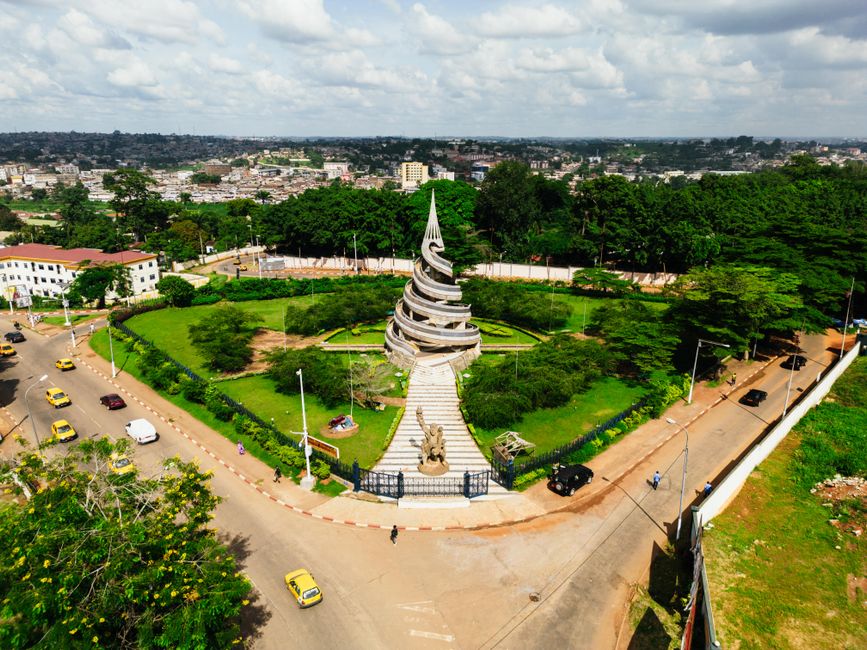
Cameroon calls itself “Africa in miniature,” and it earns the name: in one country you’ll find Atlantic beaches and a waterfall that tumbles straight into the sea, equatorial rainforest with gorillas and forest elephants, the volcanic cone of Mount Cameroon, cool green highlands with royal palaces, savanna and dry Sahelian hills in the north. Most trips start in Douala, the big, busy port city and economic capital, then head to the beaches of Kribi, the botanic garden and black-sand coast of Limbe, the hills and chiefdoms of the West Region around Foumban and Dschang, and the capital, Yaoundé. French and English are both official languages. Almost every visitor needs a visa, applied for online through the official evisacam portal before travel, and a yellow fever certificate. The dry season, roughly December to February in the south, is the best time to go. Give it ten days to two weeks.
Right now in Cameroon
- Sat22–29°C71–84°F2 mm rain
- Sun22–29°C71–84°F1 mm rain
- Mon22–29°C71–83°FMostly clear
Weather, sun and air quality here are for one point near the centre of Cameroon, not the whole country; conditions elsewhere can differ. Readings refresh through the day.
Cameroon: quick answers
- Best time to visit Cameroon
- Cameroon’s climate changes dramatically from south to north. The table uses the official 1991–2020 rainfall averages that Cameroon’s weather service submitted to the World Meteorological Organization; these files don’t include temperature averages, so only rainfall is shown. More
- Places to visit in Cameroon
- Douala, Kribi and the south coast, Limbe and Mount Cameroon, The West Region: Foumban, Dschang and the chiefdoms, Yaoundé, Rainforest and wildlife. More
- Things to do in Cameroon
- Beaches, mountains, wildlife and culture. More
- Entry rules for Cameroon
- Almost every visitor needs a visa, and applications are made only online, through the official consular services portal evisacam.cm, which the Ministry of Tourism and Leisure also points to. There is no visa on arrival without an approved application. According to the portal: Apply and pay online: create an account, fill in the form and pay the fee online by card or mobile payment. The application only becomes effective once the fee is paid; Fees: 153 euros for a normal short-stay visa (1 to 180 days), 229 euros for an express short-stay visa, 153 euros for a transit visa (4 to 30 days) and 305 euros for a long-stay visa. Fees aren’t refunded, even if the application is refused or withdrawn; Processing: a Cameroonian embassy or consulate handles the application, normally within 72 hours of payment, or 24 hours for express. Apply at least 10 days before you travel, and not more than six months ahead. More
- Is Cameroon safe?
- Most visits to the main tourist areas pass without problems. The main issues are practical: health, roads and petty crime in the big cities. More
Cameroon at a glance
Cameroon sits at the hinge of West and Central Africa, at the far end of the Gulf of Guinea. According to the Ministry of Tourism and Leisure, it covers 475,650 square kilometers, a triangle stretching about 1,200 km from the Atlantic to Lake Chad, with 420 km of coastline. It borders Nigeria to the west, Chad and the Central African Republic to the east, and Equatorial Guinea, Gabon and the Republic of the Congo to the south. The ministry describes three broad natural zones: the hot, humid forest south, home to Douala and Yaoundé; the cooler western highlands, mostly above 1,100 m, with volcanic soils, coffee and dense villages; and the Sudano-Sahelian north of savanna and steppe, hot and dry, with the cooler Adamawa plateau in between.
The country has 10 regions and more than 200 ethnic groups and languages, from Bantu peoples in the south to Fulani and many other groups in the north. French and English are the two official languages, and Cameroonian Pidgin English is widely spoken in the west. Cameroon uses the Central African CFA franc (XAF), and keeps UTC+1 all year, with no summer time. It has three UNESCO World Heritage Sites: the Dja Faunal Reserve, the Sangha Trinational forest, shared with the Central African Republic and the Republic of the Congo, and the Diy-Gid-Biy stone sites of the Mandara Mountains in the far north, inscribed in 2025.
A short history
The coast was named by Portuguese sailors in the 15th century, who called the Wouri estuary the “Rio dos Camarões,” the river of prawns, which gave the country its name. Duala traders dealt with Europeans for centuries before Germany made Kamerun a protectorate in 1884. After the First World War, the territory was divided between France and Britain. French Cameroon became independent on 1 January 1960, and the southern part of British Cameroons joined it in 1961, which is why the country is bilingual today. The national day, 20 May, marks the creation of the unitary state in 1972.
The regions for travelers
- Littoral: Douala, the country’s largest city and main port, and the waterfalls and lakes of the hinterland.
- South: the beaches of Kribi, the Lobé Falls, the Campo Ma’an rainforest and the Dja reserve inland.
- Centre: Yaoundé, the capital, set among green hills, with museums, markets and monuments.
- West: the highlands around Bafoussam, Dschang and Foumban, with royal palaces, chiefdoms, crater lakes and markets.
- Southwest: Limbe, its botanic garden and beaches, and Mount Cameroon above Buea.
- East: deep rainforest and the Lobéké and other parks of the Sangha forests, for serious wildlife trips.
- Adamawa, North and Far North: the plateau around Ngaoundéré, savanna parks, and the dramatic volcanic plugs and villages of the Mandara Mountains.
Videos of Cameroon
Hand-picked travel videos from YouTube creators to help you picture the trip. They play from YouTube; the facts in this guide come from our own research.
Where to go: coast, highlands, rainforest and savanna
A classic first trip combines Douala with the beaches of Kribi and the highlands of the West Region, ending in Yaoundé. Roads link the main cities of the south, and a long railway runs from Douala via Yaoundé to Ngaoundéré on the edge of the north.
Douala
Cameroon’s economic capital spreads along the Wouri estuary. It’s a working city more than a showpiece, but it has real character: the old administrative quarter of Bonanjo with the red-and-white Pagode, the 1905 palace of the Bell kings; the Cathedral of Saints Peter and Paul; the Douala Maritime Museum; contemporary art at doual’art and public sculptures across the city; busy markets; and an excellent food and music scene in Akwa and Bonapriso. See our Douala guide for districts, sights and transport.
Kribi and the south coast
About three hours south of Douala, Kribi is Cameroon’s favorite beach town, with a long string of sandy beaches backed by palms and forest, grilled fish and prawns on the shore, and the Lobé Falls, one of the few waterfalls in the world that drop directly into the sea; pirogues take you up the Lobé river to a Bagyeli (Pygmy) settlement for a cultural visit arranged with local guides. Further south, the Campo Ma’an National Park protects coastal rainforest, and the beaches around Grand Batanga and Ébodjé are quieter, with sea turtle nesting projects.
Limbe and Mount Cameroon
On the coast west of Douala, Limbe has black volcanic-sand beaches, a historic botanic garden founded in 1892, and the Limbe Wildlife Centre, which cares for rescued primates. Above it rises Mount Cameroon, an active volcano and, at about 4,040 m, the highest peak in West and Central Africa, climbed in two to three days from the town of Buea. Check current local conditions and road access before you plan this area.
The West Region: Foumban, Dschang and the chiefdoms
The cool, green highlands of the West Region are a world away from the coast. In Foumban, the seat of the Bamoun kingdom, the sultan’s palace and the Museum of the Bamoun Kings display royal regalia, beadwork and the history of King Njoya, who created his own script; the town’s artisans’ street is famous for brass and bronze casting and woodcarving. Around Bafoussam and Dschang, traditional chiefdoms such as Bandjoun have tall, thatched royal halls and museums, and Dschang has a fine museum of civilizations by its lake. The ministry also lists the Manengouba twin crater lakes, on the border between the Littoral and Southwest regions, among the country’s natural sights.
Yaoundé
The capital spreads over seven hills in the forest zone, at about 760 m, a little cooler than Douala. Visit the Reunification Monument, the National Museum in the former presidential palace, the Benedictine monastery’s museum of art on Mont Fébé, the basilica at Mvolyé, and the markets, then use the city as a base for the forests and parks of the south and east. Yaoundé–Nsimalen International Airport has flights to Europe and around Africa.
Rainforest and wildlife
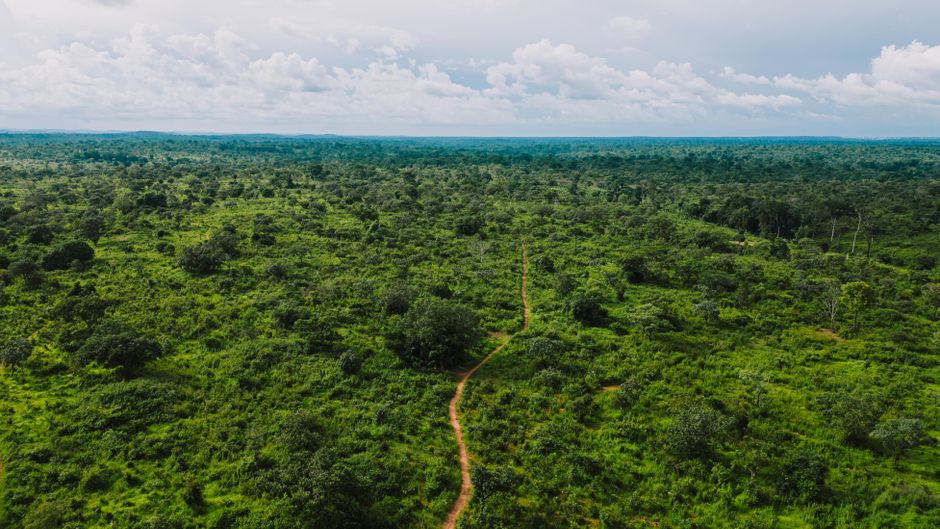
Cameroon’s southern and eastern rainforests are among Africa’s richest. The Dja Faunal Reserve, a UNESCO site, and Lobéké National Park, part of the Sangha Trinational, shelter forest elephants, western lowland gorillas, chimpanzees, bongos and grey parrots; the ministry promotes Lobéké’s forest clearings (“bais”) and their observation platforms, with forest walks led by Baka and Bantu guides. These are remote, multi-day expeditions best organized through a specialist operator.
A few more worth your time
The Ekom-Nkam Falls in the forest of the Littoral hinterland; Edéa and the Sanaga River; the Adamawa plateau and its lakes around Ngaoundéré, the end of the railway; and, far to the north, the savanna parks and the volcanic plugs and terraced villages of the Mandara Mountains around Rhumsiki, with the UNESCO-listed Diy-Gid-Biy stone sites. The north is remote and very hot from March to May; check current local conditions and access before planning a trip there.
Douala Travel Guide
Plan a trip to Douala: the Pagode and the Bonanjo quarter, the Cathedral of Saints Peter and Paul, the Maritime Museum, doual'art and the…
Best time to visit Cameroon
Cameroon’s climate changes dramatically from south to north. The table uses the official 1991–2020 rainfall averages that Cameroon’s weather service submitted to the World Meteorological Organization; these files don’t include temperature averages, so only rainfall is shown. In general, the coast and the southern forests are hot and humid all year, the western highlands and the Adamawa plateau are noticeably cooler, and the north is hot and dry, hottest from March to May.
| Area (weather station) | Rain per year | Wettest months | Driest months | Best months |
|---|---|---|---|---|
| Douala and the coast (Douala) | about 3,610 mm | July–September (689 mm in August) | December–February (23 mm in December) | December–February |
| Yaoundé and the Centre (Yaoundé) | about 1,480 mm | two seasons: March–June and September–November (263 mm in October) | December–February (11 mm in January) | December–February, July–August |
| Adamawa plateau (Ngaoundéré) | about 1,460 mm | April–October | November–February, almost rainless | November–February |
| North (Garoua) | about 1,040 mm | June–September (236 mm in August) | November–March, rainless | November–February |
| Far North (Maroua) | about 730 mm | July–August (236 mm in August) | October–April, almost rainless | November–February |
Douala is very wet, with over 3.6 meters of rain a year, most of it from June to October, when downpours can last for hours and flood roads. From December to February it’s much drier and sunnier, though still hot and humid. Yaoundé has a gentler climate with two rainy seasons and a short, drier spell in July and August. In the north, the single rainy season runs roughly from June to September, and from November the dry harmattan wind brings dust and haze.
Cameroon month by month
| Month | Weather | Highlights | Crowds and prices |
|---|---|---|---|
| January | Dry season across most of the country | Beaches at Kribi; savanna parks; Mount Cameroon climbing season | Busy after the holidays |
| February | Dry and hot; harmattan haze in the north | Youth Day (February 11) | Moderate |
| March | Hot; first storms in the south | Good for the coast; very hot in the north | Moderate |
| April | Rains begin in the south | Easter; green landscapes | Quieter |
| May | Rainy in the south and Centre | National Day (May 20) parades | Moderate |
| June | Heavy rain on the coast | Green highlands | Low season |
| July | Very wet on the coast; drier spell in Yaoundé | Summer holidays | Moderate |
| August | Wettest month in Douala and the north | Assumption (August 15) | Moderate |
| September | Still very wet on the coast | Lush rainforest | Low season |
| October | Rains easing on the coast; wet in Yaoundé | Fewer visitors | Quieter |
| November | Dry season begins | Good time for the West Region and the north | Rising |
| December | Dry, sunny and hot | Festive season; cultural festivals in Douala and the West | Busy; book early |
Festivals and public holidays
According to the Ministry of Tourism and Leisure, civil holidays include New Year’s Day (January 1, also independence day), Youth Day (February 11), Women’s Day (March 8), Labor Day (May 1) and National Day (May 20), alongside Christian holidays (Good Friday, Ascension, Assumption on August 15, Christmas) and Muslim holidays (the end of Ramadan and Tabaski, or Eid al-Adha), whose dates move each year. Traditional festivals are a highlight of a visit: the Ngondo festival of the Sawa peoples of the coast, held on the Wouri in Douala, usually in late November or December, and the Nguon of the Bamoun kingdom in Foumban are among the best known; dates vary, so check locally.
How long to stay: sample itineraries
Douala to Kribi is about three hours by road, Douala to Yaoundé about four hours by road or train, and Douala to Foumban or Dschang about five to six hours.
5 days: Douala and the coast
Two nights in Douala for Bonanjo, the museums, markets and food, then two or three nights in Kribi for the beaches and the Lobé Falls.
10 days: coast, highlands and capital
Two nights in Douala, two or three in Kribi, then up to the West Region for Foumban, Bandjoun and Dschang, ending with two nights in Yaoundé and a flight home from Nsimalen.
2 weeks or more: add the rainforest or the north
Add a specialist-led trip to the Dja or Lobéké forests from Yaoundé, or take the overnight train from Yaoundé to Ngaoundéré for the Adamawa plateau. For a wider trip, combine Cameroon with Nigeria, a short flight away; see our Nigeria guide and our Lagos guide.
Entry, money and costs
Visas and the evisacam portal (last reviewed November 2026)
Almost every visitor needs a visa, and applications are made only online, through the official consular services portal evisacam.cm, which the Ministry of Tourism and Leisure also points to. There is no visa on arrival without an approved application. According to the portal:
- Apply and pay online: create an account, fill in the form and pay the fee online by card or mobile payment. The application only becomes effective once the fee is paid.
- Fees: 153 euros for a normal short-stay visa (1 to 180 days), 229 euros for an express short-stay visa, 153 euros for a transit visa (4 to 30 days) and 305 euros for a long-stay visa. Fees aren’t refunded, even if the application is refused or withdrawn.
- Processing: a Cameroonian embassy or consulate handles the application, normally within 72 hours of payment, or 24 hours for express. Apply at least 10 days before you travel, and not more than six months ahead.
- Documents for a short-stay visa: a passport valid for at least six months, a return ticket, your international vaccination certificate, proof of the purpose of your visit and sufficient funds, a firm hotel booking or a certificate of accommodation from your host endorsed by the local mayor, and proof of your address and profession.
- Collecting the visa: if approved, you receive an online visa authorization with a QR code. Where you live in a city with a Cameroonian embassy or consulate, you complete biometric enrollment there and the visa is stuck in your passport; otherwise you travel with the authorization and have the visa printed on arrival at the airport. Fingerprints are taken for every application.
If you plan to arrive by road or by sea, get your visa from a Cameroonian embassy before you travel. The visa sticker shows how long you can stay and whether it allows one or several entries; you must leave by the day it expires. Make sure your passport is stamped on arrival.
Yellow fever and other health requirements
A yellow fever vaccination certificate is required for all arriving travelers aged 1 year and over, according to the US CDC, and the vaccine is recommended for everyone aged 9 months and over. Carry the original yellow card. Health screening such as temperature checks may be carried out at the Yaoundé and Douala airports.
Customs
According to the ministry, visitors can bring in personal items free of duty, including clothing, a phone, cameras, binoculars and sports gear, plus 3 liters of wine, 1 liter of spirits, and 400 cigarettes, 125 cigars or 500 g of tobacco. Exporting animal products needs permission from the environment authorities, and exporting works of art requires clearance through the Chamber of Commerce, Industry, Mines and Crafts, so keep receipts for carvings and masks.
Money and cards
The currency is the Central African CFA franc (XAF, written FCFA), fixed at 655.957 francs to the euro; on 10 November 2026, the Bank of Central African States (BEAC) indicative rate was about 583–588 francs to the US dollar. The ministry points out that the Central African franc is not the same as the West African franc used in Côte d’Ivoire and Senegal, and that CFA francs can’t be exchanged outside the franc zone, so change money on arrival; euros are the easiest currency to exchange, and exchange commissions are typically 3–5%. ATMs work in the cities, but Cameroon is largely a cash economy: cards are rarely accepted outside international hotels and large stores, so carry cash, in small notes. Mobile money is widely used.
Tipping
Tipping isn’t compulsory. In sit-down restaurants, leave about 5–10% if service isn’t included, round up in bars, and give small tips to guides, drivers and hotel staff who’ve helped you.
What a trip costs
Cameroon’s hotels are relatively expensive for what you get, while local food and transport are cheap. These estimates per person per day are a planning guide as of November 2026:
| Style | Estimated cost per day | What that looks like |
|---|---|---|
| Budget | about 20,000–35,000 FCFA (US$35–60) | Simple hotel, street food and local restaurants, shared taxis and intercity buses |
| Mid-range | about 55,000–100,000 FCFA (US$95–170) | Three- or four-star hotel, restaurant meals, a car and driver for some days, entrance fees |
| High-end | about 170,000 FCFA (US$290) and up | Top hotels in Douala and Yaoundé, private driver-guide, specialist rainforest or wildlife trips |
The figures are our estimates, not official statistics, and don’t include the visa (153 euros, about 100,000 FCFA).
Language and a few useful words
French dominates in most of the country and English in the two western anglophone regions; Pidgin English is widely spoken in the west and in Douala’s markets. Try bonjour (hello), merci (thank you), s’il vous plaît (please), c’est combien? (how much?), and in Pidgin, how na? (how are you?). As the ministry notes, greetings matter everywhere: say hello and shake hands before anything else.
Getting there and getting around
By air
According to the ministry, Cameroon has three international airports, at Douala (DLA), Yaoundé–Nsimalen (NSI) and Garoua, with at least one direct flight a day to Europe, about six hours away. Most visitors arrive in Douala or Yaoundé, often via Paris, Brussels, Istanbul, Casablanca, Addis Ababa or Nairobi. Domestic flights link Douala and Yaoundé with Garoua, Maroua and Ngaoundéré.
Trains
The Transcamerounais railway, operated by Camrail, runs for more than 1,500 km, linking Douala with Yaoundé and continuing to Ngaoundéré, according to the ministry. The Douala–Yaoundé line has daily passenger trains, and an overnight train with sleepers runs between Yaoundé and Ngaoundéré. Book through Camrail’s MyCamrail site or at the stations, and carry your passport.
Buses, taxis and driving
Private bus companies link Douala, Yaoundé, Kribi, Bafoussam, Dschang and other towns, and shared “bush taxis” cover the smaller routes. City taxis are shared, so they pick up other passengers on the way; the ministry gives a minimum city fare of 250 FCFA and about 2,000 FCFA for a private trip in town. For comfort, book a taxi or a car with a driver through your hotel rather than hailing one in the street. If you drive, you need an International Driving Permit with your license; expect police checkpoints, potholes and heavy trucks, and tolls of 500 FCFA per vehicle at road toll posts. Avoid driving after dark.
Culture, food and everyday etiquette
Food and drink
Cameroonian food is varied and generous, drawing on the country’s four great cultural areas. The national dish is ndolé, bitter-leaf greens cooked with peanuts and fish, prawns or meat, served with plantains or miondo (cassava sticks). Try poisson braisé, whole fish grilled with spices; poulet DG, chicken with plantains and vegetables; eru and achu in the west; koki (steamed bean cakes); mbongo tchobi, a black spicy fish stew; and soya, spiced grilled beef skewers sold on street corners in the evening. Local beers, palm wine and fresh fruit juices are everywhere.
Music, crafts and shopping
Cameroon gave the world makossa, born in Douala, and the fast bikutsi rhythms of the Centre; live music fills bars at weekends. Look for bronze and brass castings and carvings in Foumban, beadwork and masks from the Grassfields chiefdoms, woven baskets, and textiles in the markets. Bargaining is normal and, as the ministry puts it, more a conversation than a fight over price: take your time.
Etiquette
Greet everyone and shake hands, including older people and women. In the Muslim north, dress modestly and avoid shorts and short skirts, and take your shoes off before stepping on a prayer mat, entering a mosque or visiting a traditional ruler (lamido). Be patient around prayer times. Ask before photographing people, and never photograph airports, ports, military sites, government buildings or uniformed personnel.
Safety, health and connectivity
Most visits to the main tourist areas pass without problems. The main issues are practical: health, roads and petty crime in the big cities.
- Malaria: present throughout the country, and the US CDC recommends preventive medicine for all travelers. Use repellent, sleep under a net or in air conditioning, and see a doctor quickly if you develop a fever.
- Yellow fever and other vaccines: a yellow fever certificate is required for entry. The CDC also recommends a meningitis vaccine for the northern savanna in the dry season, roughly December to June.
- Road safety: road accidents are the main risk. Travel between towns by day, use reputable bus companies or a trusted driver, and wear a seatbelt.
- City precautions: pickpocketing and bag-snatching happen in crowded markets, bus stations and on public transport. Keep valuables out of sight, avoid walking alone at night, and book taxis through your hotel or restaurant.
- Local laws: carry your passport or a valid ID at all times, as police may ask to see it, and keep copies of your passport and visa separately. Wearing or selling military or camouflage-style clothing is an offence, and same-sex sexual acts are illegal.
- Emergency numbers: police 117, fire 118 and medical assistance 119, according to the Canadian government’s travel service; the UK government lists 112 for an ambulance and 119 for the fire brigade, so try the other number if one doesn’t connect.
Medical facilities are limited, especially outside Douala and Yaoundé, so take insurance that covers treatment and evacuation. Drink bottled or filtered water. Conditions change, so check current local information shortly before you travel.
Connectivity and power
MTN, Orange, Camtel and Nexttel run the mobile networks, with good coverage in the cities and along main roads; SIM cards need your passport to register. Power cuts happen, and telecom services can be disrupted, so carry a power bank and have a backup way to stay in touch. Plugs are the European two-pin type (C and E) at 220 volts; see our travel adapters guide.
Things to do: beaches, mountains, wildlife and culture
- Beaches: Kribi’s sands and the Lobé Falls, and the black-sand coast of Limbe. See our beaches guide.
- Hiking and climbing: Mount Cameroon from Buea, the Manengouba crater lakes and the western highlands. See our hiking guide.
- River and lagoon trips: pirogues on the Lobé river and in the mangroves of the Wouri estuary. See our boat trips guide.
- Wildlife: gorillas, forest elephants and bongos in Lobéké and the Dja, and primates at the Limbe Wildlife Centre.
- Culture: royal palaces and museums in Foumban, Bandjoun and Dschang, and traditional festivals.
- City sightseeing: Douala’s Bonanjo quarter and public art, and Yaoundé’s museums and monuments. See our city sightseeing guide.
What to pack for Cameroon
Pack light, breathable clothes for the coast, a warm layer for the West Region’s cool evenings and for Mount Cameroon, where nights near the summit are cold, a good rain jacket or umbrella from April to October, and hiking shoes for trails and forest walks. Bring insect repellent, sunscreen and a sun hat, modest clothes for the north and for visiting chiefdoms, a power bank and flashlight for power cuts, your yellow fever card, printed copies of your visa authorization and hotel booking, and euros in cash to change.
Cameroon travel FAQ
Do I need a visa for Cameroon?
Almost certainly. Apply online at evisacam.cm before you travel; there is no visa on arrival without an approved application.
How much is the Cameroon visa?
153 euros for a normal short-stay visa (up to 180 days) and 229 euros for express processing, paid online. Fees aren’t refunded if the application is refused.
How long does the Cameroon e-visa take?
Normally 72 hours after payment, or 24 hours for express. Apply at least 10 days before you travel, and no more than six months ahead.
Do I need a yellow fever vaccination for Cameroon?
Yes. A yellow fever certificate is required for all arriving travelers aged 1 year and over; carry the original yellow card.
Is there malaria in Cameroon?
Yes, throughout the country and all year. The US CDC recommends preventive medicine for all travelers.
What is the best time to visit Cameroon?
December to February, the dry season in the south, for beaches, cities and Mount Cameroon; November to February for the north. July to September is very wet on the coast.
What currency is used in Cameroon?
The Central African CFA franc (XAF), fixed at 655.957 francs to the euro. It’s not interchangeable with the West African franc, and cards are rarely accepted outside big hotels.
What languages are spoken in Cameroon?
French and English are both official, and Pidgin English and more than 200 local languages are widely spoken.
What is the capital of Cameroon?
Yaoundé is the capital. Douala is the largest city, the main port and the economic capital.
How far is Kribi from Douala?
About three hours by road to the south.
How many days do I need in Cameroon?
Five days for Douala and Kribi; ten days to two weeks to add the West Region, Yaoundé or a rainforest trip.
What is the emergency number in Cameroon?
Police 117, fire 118 and medical assistance 119, according to the Canadian government’s travel service; the UK government lists 112 for an ambulance.
Plugs and power in Cameroon
Cameroon uses 220 V, 50 Hz and these plugs (left) and wall sockets (right):
European round two-pin sockets; power cuts happen, so a power bank helps.
All plug types and voltages by country → · Check what you need to pack →
Plan your trip
Partner links: TravelerCenter may earn a commission if you book, at no extra cost to you.
🇫🇷 Useful French phrases for Cameroon
All 38 French phrases: restaurant, hotel, emergencies, romance (printable) →
Before you go: guidebooks and travel gear
Affiliate links: we may earn a commission at no extra cost to you. As an Amazon Associate we earn from qualifying purchases. We pick items for the place, not for the commission. How we earn money
Sources · last reviewed 10 November 2026
Researched and last reviewed on 10 November 2026. The visa process, fees, processing times, documents and collection: the official evisacam.cm consular portal; area, coastline, regions, natural zones, languages, airports, railway, customs allowances, money, taxi fares, tolls, public holidays and etiquette: Cameroon’s Ministry of Tourism and Leisure (MINTOUL); yellow fever, malaria and meningitis: the US CDC; exchange rates: the Bank of Central African States (BEAC); rainfall averages: the official 1991–2020 normals submitted to the World Meteorological Organization; no visa on arrival, land and sea arrivals, airport health screening and passport stamps: the UK government’s factual entry pages; cards, driving permits, photography, ID, clothing and other laws, telecoms and emergency numbers: the Canadian government’s travel service, used for practical facts only. History, UNESCO listings, attractions, festivals, food, operators, flights, sockets, distances and typical prices come from general references or are our estimates, and are flagged for checking. Rules and prices change, so check the official sites before you go.
Data: Weather: MET Norway (CC BY 4.0) · Rates: ECB · Wikidata (CC0)