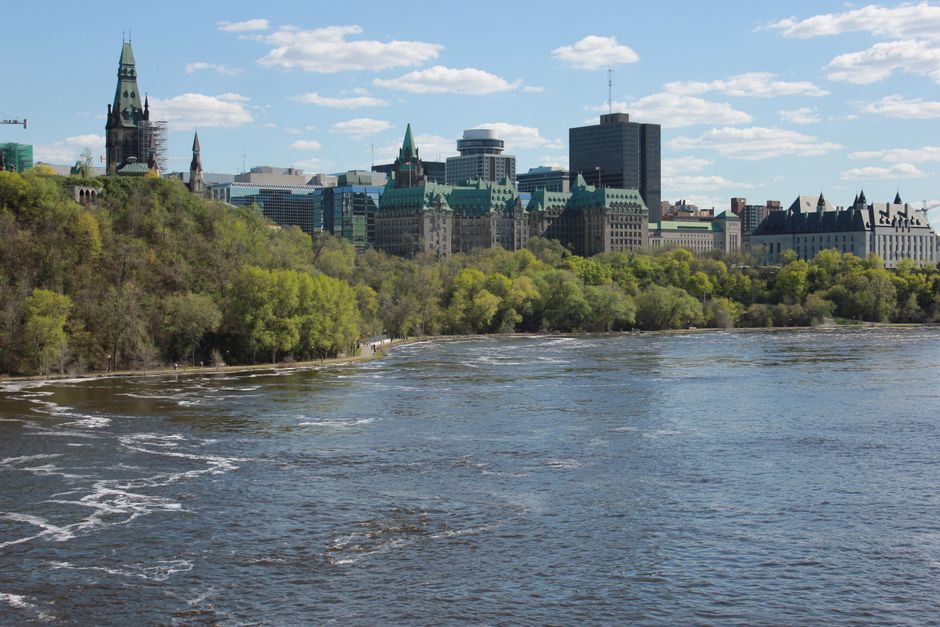
Ottawa, Canada’s capital, sits on a bend of the Ottawa River where it meets the Rideau Canal, facing the city of Gatineau in Quebec on the opposite bank. Just over a million people live in the city, and it feels smaller and greener than Toronto or Montreal: the Gothic-revival Parliament buildings crown a cliff above the river, a 19th-century canal runs through the centre, and wooded parkland and bike paths are never far away. Within walking distance you have half a dozen national museums, the lively ByWard Market and, across the bridges, the Canadian Museum of History and the forests and lakes of Gatineau Park. Ottawa is officially bilingual, and you will hear French as often as English, especially on the Quebec side. In winter, the canal becomes the world’s largest skating rink and the city throws a three-week party called Winterlude.
Right now in Ottawa
- Tue 5–11°C 42–53°F Clear
- Wed 7–18°C 44–64°F 6 mm Showers
- Thu 9–15°C 49–60°F 4 mm Light showers
- Mon 12 Oct Thanksgiving
Weather: MET Norway (CC BY 4.0) · Rates: ECB · Holidays: Nager.Date
Top tours in Ottawa
See all tours for Ottawa →
From local operators, with prices and reviews; you check availability and book on Viator, our partner. We may earn a commission at no extra cost to you. How we earn money
Ottawa at a glance
- Best months: late May to June and September to mid-October for walking, cycling and the canal; February for Winterlude and skating on the Rideau Canal Skateway.
- Time needed: two or three days for Parliament, the canal, the market and two or three museums; add a day for Gatineau Park.
- Getting there: Ottawa Macdonald-Cartier International Airport (YOW) is linked to the city by O-Train Line 4; VIA Rail trains come from Toronto and Montreal.
- Costs (as of October 2026): prices on this page are in Canadian dollars (CA$1 is about US$0.72). Canadian Museum of History admission is $25 for adults and the Canadian War Museum $23, both free on Thursdays from 5 to 7 p.m.; walking along the canal and Parliament Hill is free.
- Before you go: entry rules (including the eTA for visitors who fly in), money and general safety are covered in our Canada travel guide.
Ottawa neighbourhoods and who each one suits
Parliament Hill, downtown and Sparks Street
The Parliamentary Precinct and the government office blocks of downtown (the “Centretown” core) lie west of the canal. Sparks Street, one block south of Parliament, is a pedestrian mall of shops and restaurants, and Wellington Street leads west past the Supreme Court and Library and Archives Canada to LeBreton Flats and the Canadian War Museum. Best for short visits focused on sights; quiet in the evenings outside the summer season.
ByWard Market and Lowertown
East of the canal, the ByWard Market, laid out in 1827 by Lieutenant-Colonel John By, the canal’s builder, is the liveliest area in town, with more than 500 businesses: restaurants, pubs, cafés, boutiques and the market itself. The National Gallery of Canada, Notre-Dame Cathedral Basilica and the Royal Canadian Mint are at its northern edge. Best for food lovers and nightlife; it can be noisy late at night.
The Glebe, Centretown and Little Italy
South of downtown, Centretown has the Canadian Museum of Nature, Bank Street’s shops and the city’s main LGBTQ+ village. Further south, along the canal, the Glebe is a leafy residential area with independent shops on Bank Street and Lansdowne Park, home of the Ottawa Redblacks and a weekend farmers’ market. Preston Street, in Little Italy, is lined with Italian restaurants and runs down to Dow’s Lake. Good for families and for a more local feel.
Sandy Hill, New Edinburgh and Gatineau
Sandy Hill, beside the University of Ottawa, has grand Victorian houses and embassies; New Edinburgh, near Rideau Hall, the Governor General’s residence, is a quiet village of old homes by the Rideau Falls. Across the Ottawa River, Gatineau, in Quebec, has the Canadian Museum of History, French bistros in the old Hull district and access to Gatineau Park; hotels there can be cheaper, but Quebec taxes apply.
Top things to see in Ottawa
Parliament Hill and the tours in 2026
Parliament Hill’s lawns, the Centennial Flame and the views over the Ottawa River are open to everyone. The famous Centre Block, with the Peace Tower, is closed for a long renovation that is expected to last into the 2030s, so you cannot go inside it or up the tower. Instead, the Parliament of Canada currently offers Senate tours (in the Senate of Canada Building, the former railway station opposite the Château Laurier), House of Commons tours (in the West Block, where MPs now sit under a glass-roofed courtyard), East Block tours of the restored 19th-century offices of early prime ministers, and an immersive experience about Parliament. The guided tours are free, but you need a timed ticket, which you can reserve online on the Parliament visitor website (same-day tickets can run out in summer), and you go through airport-style security. Allow an hour per tour and check the schedule, as tours change when Parliament is sitting.
In summer, the Changing of the Guard ceremony takes place on the lawn on most mornings, from late June to late August. Around the Hill, the statues of past prime ministers and the Women Are Persons! monument are worth a stroll, and the riverside path below the cliff links the canal locks with the National Gallery and the War Museum.
The Rideau Canal and its locks
The Rideau Canal, built in the 1830s after the War of 1812 as a military supply route, runs 202 km (126 miles) from Ottawa to Kingston on Lake Ontario through 22 lockstations. It is a UNESCO World Heritage Site and a Parks Canada national historic site, and the only canal of its era in North America still operating on its original route with most of its original structures. In the city, the best spot is the flight of eight Ottawa Locks stepping down to the river between Parliament Hill and the Château Laurier, still worked by hand. In 2026, lockstations operate until Thanksgiving Monday, 12 October: from 8 September, hours are 10 a.m. to 4 p.m. on weekdays and 9 a.m. to 5 p.m. at weekends and on Thanksgiving. The free Canada Strong Pass lockage ended on 7 September; boaters now pay regular fees. Walking and cycling along the canal is free, and in summer you can rent canoes and kayaks at Dow’s Lake or take a canal boat cruise.
The Rideau Canal Skateway
Each winter, the National Capital Commission (NCC) turns 7.8 km (4.8 miles) of the canal into the Rideau Canal Skateway, the world’s largest skating rink. The season typically runs from January to early March, but it depends entirely on the weather, so the opening date for 2027 is announced only when the ice is ready; follow the NCC’s ice-condition updates. When open, the Skateway is free and open 24 hours a day, with change rooms, skate rentals and sharpening, food stalls selling BeaverTails pastries, and a packed-snow walking lane along parts of the route. Mild winters have shortened recent seasons, so do not plan a trip around skating alone.
National museums in Ottawa
Ottawa has more national museums than anywhere else in Canada. All need a timed ticket, and booking online saves 10% at the Canadian Museums of History and War; prices below are before tax.
| Museum | Adult admission | Hours (autumn 2026) | Free entry |
|---|---|---|---|
| Canadian Museum of History (Gatineau) | $25 (senior $23, student $20, child 3–12 $18, family $68) | Daily 9 a.m.–5 p.m., Thursday to 7 p.m. (8 Sep–9 Dec) | Thursdays 5–7 p.m.; 11 November |
| Canadian War Museum | $23 (senior $21, student $18, child 3–12 $16, family $62) | Daily 9 a.m.–5 p.m., Thursday to 7 p.m. (to 9 Dec) | Thursdays 5–7 p.m.; 11 November; veterans and serving military |
| National Gallery of Canada | Check gallery.ca | Check gallery.ca | Check gallery.ca |
| Canadian Museum of Nature | Check nature.ca | Open 9:30 a.m.–4 p.m. on the day we checked | Check nature.ca |
The Canadian Museum of History, in a flowing building by Douglas Cardinal on the Gatineau riverbank directly opposite Parliament, has the Grand Hall of Pacific Coast totem poles, the Canadian History Hall and the Canadian Children’s Museum; the immersive Napoleon show is ticketed separately. The Canadian War Museum, at 1 Vimy Place on LeBreton Flats, is one of the best museums of its kind, from Indigenous warfare to Afghanistan, with tanks, aircraft and a moving Regeneration Hall. The National Gallery of Canada, a glass-and-granite building by Moshe Safdie guarded by Louise Bourgeois’s giant spider sculpture, Maman, holds a superb collection of Canadian and Indigenous art, including the Group of Seven. The Canadian Museum of Nature, in a heritage “castle” at 240 McLeod Street, has dinosaurs, a blue whale skeleton and a gallery on Arctic life. In the suburbs, the Canada Aviation and Space Museum and the Canada Science and Technology Museum are good for families.
ByWard Market
One of Canada’s oldest and largest public markets, the ByWard Market was established in 1827. The indoor Heritage Hall at 55 ByWard Market Square has local food and craft stalls (summer hours 10 a.m. to 6 p.m. Sunday to Wednesday and to 8 p.m. Thursday to Saturday). From May to October, the outdoor market on York Street and the Vendor Village on George Street run Wednesday to Sunday from 11 a.m. to 7 p.m., with farmers, artisans and food stalls. Around them are hundreds of restaurants, pubs and shops; try a BeaverTail, a fried, stretched pastry that has become an Ottawa institution.
More to see
- Château Laurier: the turreted 1912 railway hotel beside the locks; walk through its lobby.
- Notre-Dame Cathedral Basilica: Ottawa’s oldest church, with a starry blue ceiling and carved wooden interior.
- Royal Canadian Mint: guided tours of the workshop where collector coins and gold bullion are made.
- Rideau Hall: the Governor General’s residence, with free grounds and seasonal guided tours.
- Major’s Hill Park and Nepean Point: riverside lawns with views of Parliament, Gatineau and the Alexandra Bridge.
Monuments
- National War Memorial
- Parliament Hill
Other sights
- ByWard Market
- Rideau Canal
Museums
- Canadian Museum of Nature
- Canadian War Museum
- National Gallery of Canada
Activities and best months
- City sightseeingThe Rideau Canal, a UNESCO World Heritage Site, runs 202 km from Ottawa to Kingston with 22 lockstations; Parliament offers Senate, House of Commons and East Block tours. · source
- HikingSepOctGatineau Park, the National Capital Commission's conservation park of over 361 km² across the river, is the region's largest green space and Canada's second most visited park; a free NCC shuttle runs in autumn until 25 October. · source
Other things to do in Ottawa
- Cycle the capital pathways: hundreds of kilometres of paved multi-use paths follow the canal, the Ottawa River and into Gatineau; rent a bike in the ByWard Market or at Dow’s Lake.
- Paddle the canal or river: rent a canoe, kayak or pedal boat at Dow’s Lake in summer, or join a rafting trip on the Ottawa River west of the city.
- Water taxi: in summer, Water Taxi, Eh! shuttles between the Ottawa Locks, Richmond Landing near the War Museum and the Museum of History.
- Festivals: Canada Day on 1 July is the biggest party in the country; the Canadian Tulip Festival colours the city in May; Bluesfest brings big concerts in July.
- Sport: the Ottawa Senators play ice hockey at the Canadian Tire Centre in Kanata, and the Redblacks play Canadian football at Lansdowne Park.
Day trips from Ottawa
Gatineau Park
Just 15 minutes from Parliament across the river in Quebec, Gatineau Park is a 361 km² (139 sq mile) conservation park run by the NCC, the largest green space in the region and one of the most visited parks in Canada. In summer and autumn, you can hike to the Champlain Lookout over the Ottawa Valley, swim at Meech Lake or Philippe Lake, circle the green waters of Pink Lake and visit the Mackenzie King Estate, the country retreat of Canada’s longest-serving prime minister. In winter it has some of the best cross-country skiing in eastern Canada and snowshoe trails. It gets very busy on autumn weekends, when parking fills and roads may close; in 2026 a free NCC shuttle runs on its fall schedule until 25 October, and summer camping ends on 12 October. Visit on a weekday or head to the quieter northern sectors.
Along the Rideau Canal and the St. Lawrence
South of the city, the canal passes small heritage towns such as Merrickville and Smiths Falls, with locks, mills and cafés, about an hour by car. Kingston, at the southern end of the canal, has Fort Henry and the limestone streets of Canada’s first capital and is the base for cruises in the Thousand Islands region; it is about two hours by car or train.
Montreal and Toronto
Montreal is about two hours east by VIA Rail or car, close enough for a long day of old-town streets and bagels, though it deserves a few nights. Toronto is about 4 to 4.5 hours by train (see our Toronto travel guide). For the northeastern US, Boston and New York are a long drive or a short flight away (see our Boston travel guide and New York City travel guide).
Nearby destinations
- Mont-Tremblant115 km
- Montreal165 km
- Muskoka District Municipality286 km
Getting there and getting around
From Ottawa airport: O-Train Line 4
Ottawa Macdonald-Cartier International Airport is about 12 km (7.5 miles) south of downtown, with flights across Canada and to the US, Europe and the Caribbean. O-Train Line 4 runs from Airport station, linked to the terminal, to South Keys, where you change to Line 2 (Trillium Line) and then to Line 1 (Confederation Line) at Bayview for downtown; the whole trip takes roughly 40 to 50 minutes on a regular OC Transpo fare. A taxi or ride-share to downtown takes about 20 to 25 minutes.
OC Transpo buses and the O-Train
OC Transpo runs Ottawa’s buses and the O-Train light-rail lines: Line 1 crosses downtown underground (Parliament, Rideau and Lyon stations are the most useful) and Line 2 runs north–south. Fares let you transfer freely within a time window. You can pay by tapping a PRESTO card or a contactless credit card or phone on the readers, with a mobile app or with exact cash on buses, and a DayPass is sold for unlimited travel. Check current fares on the OC Transpo website before you travel; we could not confirm 2026 prices. Across the river, Gatineau’s buses are run by the Société de transport de l’Outaouais (STO), with separate fares. Central Ottawa is compact and flat, and most sights are within a 20-minute walk of Parliament.
By train, bus and car
VIA Rail’s Corridor trains link Ottawa with Montreal (about 2 hours) and Toronto (about 4 to 4.5 hours) several times a day; Ottawa station is east of downtown at Tremblay, on O-Train Line 1. Long-distance coaches use the same area. Driving, Highway 416 links Ottawa with Highway 401 and the route to Toronto, and Highway 417 runs east to Montreal; downtown parking is metered or in garages, and winter driving needs winter tires and care in snowstorms.
When to go and how long to stay
Ottawa has one of the most extreme climates of any capital: warm, humid summers and long, very cold, snowy winters. Spring arrives with a rush of tulips in May; autumn brings brilliant maple colours in Gatineau Park from late September to mid-October. Winter, from December to March, means deep snow and temperatures that regularly fall below −20 °C (−4 °F), but also the Skateway and Winterlude.
| Season | Average high | Average low | What it’s like |
|---|---|---|---|
| Spring (Mar–May) | 2–19 °C (36–66 °F) | −7 to 8 °C (19–46 °F) | Snowmelt in March, warm days by May; Tulip Festival. |
| Summer (Jun–Aug) | 24–27 °C (75–80 °F) | 13–15 °C (55–60 °F) | Warm and often humid, with thunderstorms; Canada Day and festivals. |
| Autumn (Sep–Nov) | 20 to 5 °C (69–42 °F) | 10 to −2 °C (49–28 °F) | Crisp and colourful in September and October; first snow in November. |
| Winter (Dec–Feb) | −6 to −2 °C (21–28 °F) | −15 to −10 °C (5–14 °F) | Very cold and snowy, with about 2.2 m (88 in) of snow a winter; skating and Winterlude. |
Figures are Environment and Climate Change Canada’s 1981–2010 climate normals for Ottawa Macdonald-Cartier International Airport. The city gets about 940 mm (37 in) of rain and melted snow a year and about 223 cm (88 in) of snow, mostly from December to March.
Winterlude 2027
The 49th edition of Winterlude, the capital’s winter festival organized by the Government of Canada, runs from 29 January to 15 February 2027, over three weekends. Expect ice sculptures, snow slides and family activities in Jacques-Cartier Park in Gatineau (the Snowflake Kingdom), events in downtown Ottawa and, if the ice is ready, skating on the Rideau Canal Skateway. Most outdoor activities have traditionally been free. Hotels fill up on festival weekends, so book early, and dress for temperatures that can fall far below freezing.
How long to stay: 2, 3 and 4 days
- Two days: Parliament Hill and a tour, the Ottawa Locks and Château Laurier, the ByWard Market, the National Gallery and an evening walk along the river.
- Three days: add the Canadian Museum of History across the river and the War Museum or Museum of Nature, and a canal bike ride or skate.
- Four days: add a day of hiking, swimming or skiing in Gatineau Park, or a trip along the canal to Merrickville or Kingston.
Where to stay in Ottawa and the hotel taxes
- Downtown and Parliament: the most central base, with big hotels close to the Hill, the canal and O-Train Line 1.
- ByWard Market: boutique and chain hotels in the middle of the restaurants and nightlife.
- Centretown and the Glebe: quieter, with apartments and bed and breakfasts, close to the canal and the Skateway.
- Gatineau: often cheaper, across the bridges near the Museum of History and Gatineau Park.
Taxes: rates are usually quoted before tax. On the Ontario side, hotel bills add 13% HST, and the City of Ottawa also charges a municipal accommodation tax on hotel and short-term rental stays; ask your hotel for the total. On the Quebec side, Gatineau hotels add 5% GST and 9.975% Quebec sales tax (QST) instead of HST, plus Quebec’s 3.5% lodging tax; shops and restaurants in Gatineau also charge GST and QST. Hotel parking downtown is extra and can be expensive.
Practical tips for Ottawa
- Time zone: Eastern Time on both sides of the river, with daylight saving time.
- Language: Ottawa is bilingual; a “bonjour-hi” greeting is common, and Gatineau is mostly French-speaking, though English is widely understood.
- Cold: in January and February, wind chills can drop below −30 °C (−22 °F); cover your skin, wear layers and limit time outdoors in extreme cold. Skate only on the official Skateway when it is open, never on other frozen water.
- Prices and tipping: sales tax is added at the till; tip about 15–20% in restaurants and bars.
- Safety: Ottawa is generally safe; parts of the ByWard Market and Rideau Street can feel rough late at night, so use normal city sense.
- Emergencies: call 911.
What to pack for Ottawa
In summer, pack light clothes, sunscreen, a hat, insect repellent for Gatineau Park and a light rain jacket. In spring and autumn, bring layers, a warm fleece and a waterproof jacket. For a winter visit, you need serious cold-weather gear: an insulated, windproof coat, thermal layers, a warm hat that covers your ears, a scarf or neck warmer, insulated gloves or mitts and waterproof winter boots with good grip; bring or rent skates for the canal. All year, comfortable walking shoes make the museums and the riverside paths easier.
What to pack
- City walking shoesLisbon and Porto are steep, with polished limestone cobbles that get slippery, so grippy soles matter.
- Day packs and anti-theft bagsA small zipped or anti-theft bag makes crowded trams and viewpoints less stressful.
- Fleeces and warm layersSummits like Pico do Areeiro averaged about 11 °C over 2024, so a fleece is needed even in summer.
- HeadlampsLevada routes such as PR1 and PR9 pass through long, dark, wet tunnels.
- Hiking shoes and bootsMadeira's levadas and the Azores' crater rims are wet, rocky and slippery, so grippy shoes matter more than anywhere else in Portugal.
- Rain jacketsFrom October to April Porto and Lisbon see rain on roughly a third of days.
- Travel adapters and convertersPortugal uses Type C and F sockets at 230 V, so most visitors from outside Europe need an adapter.
- Trekking polesLong stone staircases and steep descents on Madeira's peaks and the Azores' crater rims are easier on the knees with poles.
- Water bottles and hydration packsAlgarve and Alentejo trails are hot and exposed with few refill points.
Ottawa travel FAQ
Can I tour Parliament while Centre Block is closed?
Yes. The Parliament of Canada offers tours of the Senate of Canada Building, the House of Commons in the West Block and the East Block, plus an immersive experience. Tours are free; reserve timed tickets online and allow time for security.
When can you skate on the Rideau Canal?
The Skateway season typically runs from January to early March, but it depends on the weather; the NCC announces the opening when the ice is safe. When open, it is free and open 24 hours a day.
When is Winterlude 2027?
From 29 January to 15 February 2027, in Ottawa and Gatineau. It is the festival’s 49th edition.
How do I get from Ottawa airport to downtown?
Take O-Train Line 4 from Airport station to South Keys, then Line 2 and Line 1 to downtown, roughly 40 to 50 minutes on a regular OC Transpo fare. A taxi takes about 20 to 25 minutes.
How much are Ottawa’s national museums?
Adult admission is $25 at the Canadian Museum of History and $23 at the Canadian War Museum, before tax and 10% less if booked online. Both are free on Thursdays from 5 to 7 p.m.
Is the Canadian Museum of History in Ottawa or Gatineau?
It is in Gatineau, Quebec, directly across the Ottawa River from Parliament Hill, a 20-minute walk over the Alexandra Bridge. Purchases there carry Quebec taxes (GST and QST) rather than Ontario’s HST.
How long is the train from Ottawa to Montreal or Toronto?
VIA Rail takes about 2 hours to Montreal and about 4 to 4.5 hours to Toronto, with several trains a day from Ottawa station on O-Train Line 1.
When are the Rideau Canal locks open?
In 2026, lockstations operate from 15 May to Thanksgiving Monday, 12 October. Watching the Ottawa Locks beside Parliament and walking the canal paths are free all year.
When is the best time to visit Ottawa?
Late May to June and September to mid-October for mild weather, the canal and fall colours; February for Winterlude and skating if you can handle the cold.
Sources
- © OpenStreetMap contributors · ODbL · fetched 4 Oct 2026
- Wikidata · CC0 · fetched 4 Oct 2026
Sources and last review
Researched and last reviewed on 4 October 2026. Rideau Canal hours, fees and history come from Parks Canada; the Skateway and Gatineau Park from the National Capital Commission; the list of Parliament tours from the Parliament of Canada visitor website; Winterlude dates from the Government of Canada; museum prices, hours and free times from the Canadian Museum of History, the Canadian War Museum and the Canadian Museum of Nature; ByWard Market hours from the ByWard Market District; Quebec and Ontario sales taxes from the Canada Revenue Agency; climate from Environment and Climate Change Canada’s 1981–2010 normals for Ottawa Macdonald-Cartier International Airport; population from Wikidata. OC Transpo, the National Gallery of Canada and the City of Ottawa blocked our requests, so transit fares, gallery prices and the city’s accommodation tax rate are not given; tour booking details, Centre Block’s reopening, travel times and some neighbourhood details are general references and flagged for checking. Prices and timetables change, so check the official sites before you go. For entry rules, money and general safety, see our Canada travel guide.
Plan your trip
Partner links: TravelerCenter may earn a commission if you book, at no extra cost to you.