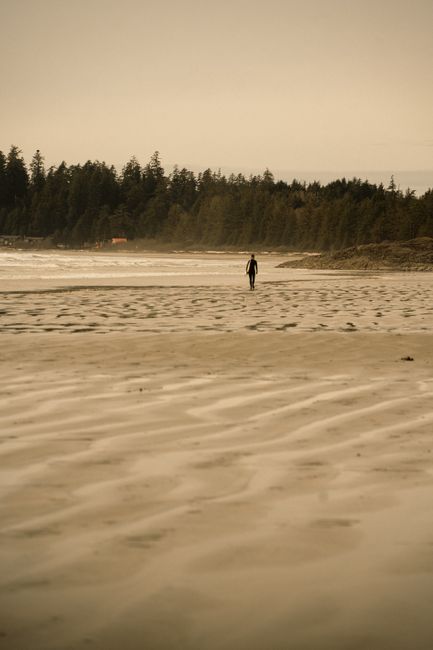
Tofino is a small surf town at the end of the road on the wild west coast of Vancouver Island, where long sandy beaches, giant cedars and the open Pacific meet. The town of about 2,500 people sits at the tip of the Esowista Peninsula, in the traditional territory of the Tla-o-qui-aht First Nation, facing the islands and inlets of Clayoquot Sound, a UNESCO Biosphere Region. Just south, the Long Beach Unit of Pacific Rim National Park Reserve protects some 16 km (10 miles) of surf beaches and old-growth rainforest between Tofino and the fishing town of Ucluelet. People come to learn to surf in any season, to watch grey whales and black bears, to take a boat or floatplane to the natural hot springs, and, in winter, to watch huge Pacific storms roll in from a cosy cabin. Tofino is a long way from anywhere: about three hours’ drive from the Nanaimo ferries on Highway 4, or an hour’s flight from Vancouver. It is busiest from June to September; winter is wet, wild and much cheaper.
Right now in Tofino
- Tue 10–17°C 49–62°F Partly cloudy
- Wed 10–17°C 50–63°F Mostly clear
- Thu 12–16°C 54–60°F 11 mm Partly cloudy
- Mon 12 Oct Thanksgiving
Weather: MET Norway (CC BY 4.0) · Sea temperature: NOAA CoastWatch · Rates: ECB · Holidays: Nager.Date
Top tours in Tofino
See all tours for Tofino →
From local operators, with prices and reviews; you check availability and book on Viator, our partner. We may earn a commission at no extra cost to you. How we earn money
Tofino at a glance
- Best months: July to September for the driest, warmest weather; March and April for migrating grey whales; November to February for storm watching and low prices.
- Time needed: three nights to walk the beaches, take a surf lesson and one boat trip; four or five to add the hot springs, Ucluelet and the rainforest trails.
- Getting there: by car and BC Ferries from Vancouver to Nanaimo, then about three hours on Highway 4; or fly from Vancouver to Tofino-Long Beach Airport (YAZ).
- Costs (as of October 2026): prices are in Canadian dollars; a Pacific Rim daily park pass is $12.25 per adult (about US$8.80) or $24.50 per vehicle group; beach parking in Tofino is $3 an hour or $15 a day; rooms add about 16% in taxes.
- Before you go: entry rules (eTA or visa), money and driving in Canada are in our Canada travel guide.
Tofino’s beaches and areas, and who each one suits
Downtown Tofino and the harbour
The village centre is a few compact streets of galleries, surf shops, bakeries, taco trucks and seafood restaurants above the working harbour on Clayoquot Sound. Whale-watching, bear-watching and hot-springs boats, water taxis and floatplanes all leave from the docks here. Small Tonquin Beach, a 10-minute walk away, is the sunset spot closest to town. Good for visitors without a car, though you will want a bike to reach the surf beaches.
Chesterman Beach, Cox Bay and tinwis Beach
South of town, a string of beaches lined with resorts, cabins and B&Bs is the heart of Tofino’s surf scene. Chesterman Beach is long and gentle, with tide pools around Frank Island at low tide, and is the classic learn-to-surf beach. Cox Bay gets bigger, more consistent waves and hosts surf competitions. tinwis Beach (formerly Mackenzie Beach) is a sheltered cove good for families. Pay parking applies at all District of Tofino beach accesses (see Practical tips).
Long Beach and the national park
Farther south, the highway runs through the Long Beach Unit of Pacific Rim National Park Reserve, with Long Beach itself, Combers, Wickaninnish and Florencia beaches, short boardwalk trails through the rainforest and the Kʷisitis Visitor Centre. A paved multi-use path, ʔapsčiik t̓ašii, runs through the park between Tofino and Ucluelet, perfect for cycling. There are no towns inside the park, only Green Point Campground.
Ucluelet
About 40 km (25 miles) south of Tofino, Ucluelet is a quieter, slightly cheaper fishing town on Barkley Sound, with its own whale-watching boats, aquarium and the spectacular Wild Pacific Trail. It makes a good base if Tofino is full.
Pacific Rim National Park Reserve: passes and fees (as of October 2026)
You need a valid national park pass displayed in your vehicle whenever you stop anywhere in the Long Beach Unit, for example at a beach parking lot or trailhead; driving straight through to Tofino or Ucluelet without stopping does not need one. Regular fees came back on 8 September 2026, after the free summer admission with the Canada Strong Pass ended on 7 September. Youth 17 and under are always free.
| Pass | Adult (18–64) | Senior (65+) | Family/group (up to 7 in one vehicle) |
|---|---|---|---|
| Daily admission | $12.25 | $10.75 | $24.50 |
| Beach Walk pass (4 hours max; Long Beach, Kʷisitis, Incinerator Rock and Wickaninnish lots only) | $7.75 | $6.75 | $15.50 |
| Pacific Rim annual pass | $60.50 | $51.50 | $120.75 |
| Parks Canada Discovery Pass (12 months, 80+ places) | $83.50 | $71.50 | $167.50 |
Buy passes at park pay machines, visitor centres or online. If you visit several national parks within a year, for example Banff or Jasper on the same trip, the Discovery Pass soon pays for itself. Green Point Campground, the only campground in the Long Beach Unit, is open from May to 12 October 2026: $34 a night for an unserviced site, $40 with electricity, $147.50 for an oTENTik (a cabin-tent), plus a reservation fee of $11.50 online. The Kʷisitis Visitor Centre at Wickaninnish Beach is open daily from 9:30 a.m. to 4:30 p.m. until 12 October 2026; the Tofino and Pacific Rim visitor centres, run by the local tourism offices, stay open all year.
Safety on the coast: tides, surf, tsunamis and wildlife
Surf, rip currents, tides and logs
These beaches face the open Pacific. Parks Canada warns of large surf, rip currents and cold water, and there are no lifeguards on most beaches. If a current pulls you out, swim parallel to the shore and signal for help. High tides and big waves can trap walkers against headlands and rocks, and set heavy drift logs rolling at the top of the beach: never sit or climb on logs in the surf zone, and check a tide table before rounding a point or crossing a creek mouth. Storm watchers should stay well back from the water’s edge and off exposed rocks; sneaker waves can run far up the beach.
Earthquakes and tsunamis
The District of Tofino describes the town as a high-risk area for tsunamis because it lies close to the Cascadia Subduction Zone. A tsunami from a nearby earthquake could reach the shore within 15 to 30 minutes, possibly before any official warning. If you feel strong or long shaking, see the sea suddenly draw back or hear a loud roar from the ocean, move immediately to high ground (more than 15 metres, about 50 feet, above the tide line, according to BC Parks) and stay there until officials give the all-clear, since waves can keep coming for hours. Distant tsunamis, from Alaska or Japan for example, take hours to arrive and are announced by sirens, the BC emergency alert system and the Voyent Alert! app. Tsunami route signs mark the way to high ground; note the one nearest your accommodation.
Wolves, bears and cougars
Wolves, black bears and cougars all live here. Since September 2025, Parks Canada has had a wolf warning in force for the Long Beach Unit: wolves have become bolder and have tried to prey on dogs, even large leashed ones, with very close encounters with people. The park asks you to leave dogs at home, keep children close, not hike alone, and carry bear spray. If you meet a wolf, do not run or crouch; pick up small children, keep the group together, back away slowly and make yourself big and loud; if it comes closer, throw sticks or stones and use bear spray. In the park it is illegal to approach or stay within 100 metres of a bear, cougar or wolf unless you are inside a vehicle, and dogs are banned altogether from the coast and trails between Green Point and Willowbrae Trail. Never feed wildlife, keep food locked away, and report sightings to Parks Canada dispatch (1-877-852-3100 or 250-726-3604).
Weather, water and drones
Weather can turn quickly: heavy rain, gale-force winds and dense fog are common, especially from October to April, and power cuts happen during storms. The ocean is cold all year, roughly 10 to 15 °C (50 to 59 °F), so hypothermia is a real risk for anyone in the water without a wetsuit. In summer, Kennedy Lake’s swim beach often has swimmer’s itch, a harmless but uncomfortable rash. Recreational drones are banned in the national park, and wildfire smoke can drift in during hot, dry summers.
Top things to see and do in Tofino
Surfing
Tofino is Canada’s surf capital, and people surf here every month of the year. Many surf schools give group and private lessons on Chesterman Beach and Cox Bay, including wetsuit and board; lessons are by far the safest way to start, and Parks Canada recommends never learning alone in this unpredictable ocean. Because the water is cold, you need a full wetsuit: about 4/3 mm with boots in summer, and a 5/4 mm suit with boots, gloves and a hood in winter. Summer brings the smallest, friendliest waves; autumn and winter swells are bigger and best left to experienced surfers. Respect other surfers and stay away from rips and rocky points.
Whale watching
About 20,000 grey whales migrate along this coast between Mexico and Alaska. The northbound migration passes Tofino in March and April, celebrated by the Pacific Rim Whale Festival in Tofino and Ucluelet (13 to 20 March 2027). A few hundred greys stay to feed off Vancouver Island through the summer, and humpbacks, orcas, sea otters, sea lions and porpoises are also seen. Local operators such as Jamie’s Whaling Station run whale-watching trips from March to October, by covered boat or Zodiac. You can sometimes spot spouts from the beach, the Lighthouse Loop in Ucluelet and the Wild Pacific Trail.
Hot Springs Cove (Nismaakqin Park)
Northwest of Tofino in Clayoquot Sound, the natural hot springs that the Ahousaht call mux̣ʷšiƛa (“steaming from rock”) tumble down a waterfall into six rocky pools by the sea, getting cooler as they mix with ocean swells. The area was renamed Nism̓aakqin Park in 2025 (it was Maquinna Marine Park), and BC Parks manages it with the Ahousaht Nation. There is no road: go by boat (roughly 1.5 hours each way, often with whale watching on the way) or by floatplane (about 20 minutes), with operators that hold a park permit. From the dock, a 2 km (1.2-mile) boardwalk leads through the rainforest to the pools. In winter, high tides flood the pools with cold seawater and floating wood can be dangerous, so check the tides with your operator. No camping or fires near the springs, and no pets beyond the start of the boardwalk. Tours run all year, weather permitting.
Rainforest trails and Meares Island
Inside the national park, the two short Rainforest Trail loops climb boardwalks through moss-draped old-growth western red cedar and hemlock; Shorepine Bog shows stunted trees hundreds of years old; and the Nuu-chah-nulth Trail links Wickaninnish Beach and Florencia Bay. Check Parks Canada’s trail conditions page before you go: the Schooner Cove Trail and its parking lot are closed until further notice, as Parks Canada works with the Tla-o-qui-aht on the area’s future. Across the harbour from town, the Big Tree Trail on Meares Island, a Tla-o-qui-aht Tribal Park reached by water taxi or kayak, leads to some of the largest cedars on the coast.
Storm watching
From about November to February, Pacific storms send big swells crashing onto the headlands and beaches. Many hotels and cabins face the ocean with floor-to-ceiling windows, so you can watch from inside with a fire. Cox Bay, Chesterman Beach, Wickaninnish Beach and Amphitrite Point in Ucluelet are favourite spots. Watch from well above the waterline, never from the rocks or among logs.
Beaches
- Chesterman Beach
- Long Beach
Nature
- Meares Island
Peaks and mountains
- Lone Cone
Protected areas
- Pacific Rim National Park Reserve
- Vargas Island Provincial Park
Nature reserves
- Hot Springs Cove (Maquinna Marine Provincial Park)
Activities and best months
- Beaches and swimmingPacific Rim National Park Reserve's Long Beach Unit, between Tofino and Ucluelet, needs a park pass when you stop (adult $12.25 a day, or a 4-hour Beach Walk pass $7.75); the Kʷisitis Visitor Centre opens daily to 12 October 2026. · source
Other things to do in Tofino
- Bear watching: from about April to October, boats cruise the inlets at low tide to watch black bears turning over rocks on the shore for crabs.
- Kayaking and paddleboarding: paddle the calm waters of Clayoquot Sound with a guide; the harbour currents are strong, so go with a local outfitter.
- Cycling: ride the ʔapsčiik t̓ašii path through the park toward Ucluelet, or cruise between beaches on a rented beach-cruiser bike.
- Food: Dungeness crab, oysters and spot prawns, fish tacos and some excellent restaurants for a small town; book dinner ahead in summer.
- Indigenous art: galleries in town show Nuu-chah-nulth carving and painting; the Kʷisitis Visitor Centre explains the history of the people who have lived here for thousands of years.
- Saunas and spas: wood-fired saunas and spa days are a popular rainy-day plan.
Day trips from Tofino
Ucluelet and the Wild Pacific Trail
Ucluelet’s Wild Pacific Trail is not in Tofino but 40 minutes south: a clifftop path along the rugged outer coast, with viewpoints over surge channels and the open Pacific. Start with the Lighthouse Loop around Amphitrite Point, a 15-minute stroll from the Whale lot to the lighthouse, then continue along the longer Ancient Cedars and Brown’s Beach sections. The trail is free and built by a local society. Stay behind fences and away from the edge in big swells.
Broken Group Islands and the West Coast Trail
The two other units of Pacific Rim National Park Reserve are for more adventurous trips. The Broken Group Islands in Barkley Sound, reached only by boat, are a sea-kayaking paradise of sheltered bays and shell beaches; overnight camping is open from 1 May to 30 September. The 75 km West Coast Trail between Bamfield and Port Renfrew is one of the world’s great backpacking routes, open from 1 May to 30 September with reservations; it is closed from 7 October to 30 April, and the trail fee is $208.50 per person.
On the way: Cathedral Grove and Port Alberni
Highway 4 passes MacMillan Provincial Park’s Cathedral Grove, a stand of giant Douglas firs, some around 800 years old, right beside the road (parking is tight and the highway is busy, so take care), and the town of Port Alberni at the head of a long inlet. Both make good stops on the drive in or out. Back east, see our Victoria and Vancouver guides for the rest of your trip.
Nearby destinations
- Victoria203 km
- Vancouver203 km
- Olympic National Park227 km
- Whistler238 km
Getting there and getting around
By car: ferry to Nanaimo and Highway 4
Most visitors drive. From Vancouver, take BC Ferries from Horseshoe Bay to Nanaimo (Departure Bay) or from Tsawwassen to Duke Point; adults pay $21 and a standard car $89 at the terminal (plus a 5% fuel surcharge), and since October 2025 drivers going from Horseshoe Bay to Nanaimo must book in advance. From Nanaimo, Parks Canada puts the drive to the Long Beach Unit at about three hours, roughly 200 km (125 miles): Highway 19 north, then Highway 4 west past Cathedral Grove and Port Alberni (about 1.5 to 2 hours from Port Alberni to Tofino). West of Port Alberni the road becomes narrow and very winding as it crosses the mountains and runs along Kennedy Lake, with steep drops and few places to pass; there is no mobile coverage on some stretches, and fuel is limited, so fill up in Port Alberni. From Victoria, allow 4.5 to 5 hours.
Road status: Highway 4 was the scene of long closures after the 2023 Cameron Bluffs wildfire, but on 4 October 2026 DriveBC showed no closures, only minor roadwork: tree pruning between Marion Creek and the Kennedy Lake boat launch until 28 October (watch for traffic control between 9 a.m. and 3 p.m.), pruning near Loon Lake with work at night from 7 to 15 October, and storm-sewer work in Tofino in early October. Always check DriveBC before you set off. From 1 October to 30 April, winter tires (or chains carried) are required on signed highways outside the Lower Mainland and southeastern Vancouver Island, which includes this route; rental companies can supply them if you ask.
By air
Tofino-Long Beach Airport (YAZ) is on the Pacific Rim Highway, 11 km (7 miles) south of Tofino and 30 km (19 miles) north of Ucluelet, opposite Long Beach. Pacific Coastal Airlines flies there from Vancouver’s south terminal in about an hour, and charter and seasonal seaplane services (including Harbour Air, which lists Tofino on its network) connect with Vancouver, Victoria and Seattle. You will need a taxi, a shuttle from your hotel or a rental car from the airport.
Getting around
Downtown Tofino is walkable, and a bike is ideal for the beaches and the park path. BC Transit runs a local route between Tofino and Ucluelet that stops along the highway, and some resorts run shuttles. Otherwise a car is the easiest way to get around. Parking in the District of Tofino:
- Beach parking: pay parking is enforced every day of the year from 8 a.m. to 11 p.m. at all District beach accesses, including Tonquin Beach, tinwis Beach, Chesterman Beach and Cox Bay: $3 an hour or $15 a day, at pay stations, with Honk Mobile or with PayByPhone.
- Downtown parking: pay parking from 9 a.m. to 6 p.m. daily between 1 May and 31 October, with free time-limited spots all year.
- National park lots: you need a Parks Canada pass instead (see above).
When to go and how long to stay
Tofino is one of the wettest places in Canada, with about 3,270 mm (129 in) of rain a year, and most of it falls from October to March, when monthly totals of 450–500 mm (18–20 in) are normal. In return, temperatures are very mild all year: snow is rare and short-lived, and summers are cool, sunny and comfortable, with frequent morning fog. July and August are the driest and busiest months, when accommodation books out months ahead. May, June and September are quieter, and September often has the best weather of all. From November to February, storm season brings dramatic seas, empty beaches, cheap rooms and big surf.
| Season | Average high | Average low | What it’s like |
|---|---|---|---|
| Spring (Mar–May) | 10–15 °C (50–58 °F) | 3–6 °C (37–44 °F) | Grey whale migration in March and April; rain easing in May. |
| Summer (Jun–Aug) | 17–19 °C (62–66 °F) | 9–11 °C (48–51 °F) | Driest and busiest; morning fog, sunny afternoons; July gets about 70 mm (2.8 in). |
| Autumn (Sep–Nov) | 18 °C falling to 10 °C (64 to 50 °F) | 9 to 4 °C (48 to 38 °F) | September often fine; storms and heavy rain from mid-October. |
| Winter (Dec–Feb) | 8–9 °C (47–48 °F) | 2 °C (35–36 °F) | Mild, very wet and windy; storm-watching season; quietest and cheapest. |
Figures are Environment and Climate Change Canada’s 1981–2010 climate normals for the Tofino airport station, about 11 km south of town.
Events worth planning around
- Pacific Rim Whale Festival (13–20 March 2027): talks, walks and events in Tofino and Ucluelet during the grey whale migration.
- Surf competitions at Cox Bay, mostly in spring and autumn.
- Summer festivals such as the Tofino Lantern Festival and food and arts events in July and August.
Dates change every year; check the organizers’ websites before you book.
How long to stay: 3, 4 and 5 nights
- Three nights: a surf lesson at Chesterman Beach, a whale-watching or bear-watching trip, and an afternoon on Long Beach and the Rainforest Trail.
- Four nights: add the full-day trip to Hot Springs Cove.
- Five nights: add Ucluelet and the Wild Pacific Trail, kayaking in Clayoquot Sound or Meares Island, with a stop at Cathedral Grove on the way out.
Where to stay in Tofino and the taxes on your bill
- Beachfront resorts and cabins (Chesterman Beach, Cox Bay): the classic Tofino stay, with surf on the doorstep and storm views in winter; the most expensive option.
- Downtown: inns, motels and a hostel, handy for boat trips and restaurants without driving.
- Ucluelet: usually cheaper, with lodges on the Wild Pacific Trail.
- Camping: Green Point in the national park (May to mid-October) and private campgrounds near Tofino; book well ahead for summer.
Taxes: prices are shown before tax. Rooms and other short-term rentals in Tofino pay 8% PST, a 3% Municipal and Regional District Tax (MRDT) collected for the District of Tofino (Ucluelet also charges 3%) and 5% GST, about 16% in total on top of the rate. Most other goods and services carry 5% GST plus 7% PST. In summer many places have two- or three-night minimum stays, and summer rates can be double winter ones.
Practical tips for Tofino
- Time zone: Pacific Time; clocks go back on 1 November 2026.
- Book ahead: rooms, surf lessons and dinner reservations fill up from June to September and on long weekends.
- Services: Tofino has a small hospital, grocery stores and fuel, but prices are higher than in the cities; fill up in Port Alberni.
- Respect the land: this is Tla-o-qui-aht territory, and much of Clayoquot Sound is Tribal Park; camp only in authorized campgrounds, stay on marked trails and pack out all garbage.
- Tipping: 15–20% in restaurants, before tax; tip guides and surf instructors too.
- Emergencies: call 911; in the national park, Parks Canada dispatch is 1-877-852-3100 or 250-726-3604.
What to pack for Tofino
Rain gear is essential in any season: a fully waterproof jacket and, from October to April, waterproof trousers and boots too. Bring warm layers (fleece, wool, a hat), since even summer evenings on the beach are cool. Sturdy, grippy shoes help on wet boardwalks and roots. Surf schools rent wetsuits and boards, but if you surf already, bring a 4/3 mm or 5/4 mm suit with boots. Add a tide table app, a headlamp, binoculars for whales and bears, sunscreen for summer, and bear spray if you plan to hike.
What to pack
- Day packs and anti-theft bagsCarries water, towel and sunscreen down the long stairways to Algarve coves.
- Dry bags and phone pouchesProtects phones and cameras from sand and spray on beaches reached by ferry or steep paths.
- Quick-dry beach towelsA sand-shedding quick-dry towel packs small for beach days and lido visits.
- Reef-friendly sunscreenSummer UV is strong on Portuguese beaches and there is little shade below the cliffs.
- Water shoesRocky coves, lava pools and weever fish in shallow sand make water shoes useful.
- WetsuitsOn the west and north coasts the sea stays around 16–18 °C even in summer, so a thin suit helps for long swims.
Tofino travel FAQ
Do I need a park pass to visit Tofino?
Not for the town itself or the District of Tofino beaches, which have their own pay parking ($3 an hour, $15 a day). You need a Parks Canada pass whenever you stop in the Long Beach Unit of Pacific Rim National Park Reserve: $12.25 per adult or $24.50 per vehicle group per day.
How long is the drive to Tofino?
About three hours from the Nanaimo ferry terminals, 1.5 to 2 hours from Port Alberni, and 4.5 to 5 hours from Victoria. The last part of Highway 4 is narrow and winding; check DriveBC before you go.
Is Highway 4 to Tofino open?
Yes. On 4 October 2026 DriveBC listed no closures, only minor roadwork with single-lane traffic at times. Winter tires are required from 1 October to 30 April.
Can you fly to Tofino?
Yes. Pacific Coastal Airlines flies from Vancouver to Tofino-Long Beach Airport (YAZ), 11 km south of town, in about an hour. Seaplane and charter flights also serve Tofino.
When can you see grey whales in Tofino?
The migration passes in March and April, during the Pacific Rim Whale Festival (13–20 March 2027). Some greys feed here all summer, and whale-watching boats run from March to October.
Is the water warm enough to surf without a wetsuit?
No. The water stays around 10 to 15 °C all year, so you need a full wetsuit: 4/3 mm in summer and 5/4 mm with boots, gloves and a hood in winter. Surf schools include them with lessons.
How do you get to Hot Springs Cove?
By boat (about 1.5 hours each way) or floatplane from Tofino with a permitted operator, then a 2 km boardwalk to the pools. The park, now called Nism̓aakqin Park, has no road access.
When is storm-watching season in Tofino?
Roughly November to February, when Pacific storms bring the biggest waves. Watch from a safe spot well above the water, never from rocks or among drift logs.
Is it safe to walk on Tofino beaches with wolves and bears around?
Yes, with care. Parks Canada has a wolf warning for the Long Beach Unit: leave dogs at home, keep children close, do not hike alone and carry bear spray. Stay at least 100 metres from bears, wolves and cougars.
What taxes are added to hotel bills in Tofino?
8% PST, 3% MRDT and 5% GST, about 16% in total.
Sources and last review
Researched and last reviewed on 4 October 2026. Park fees, passes, campground dates, visitor-centre hours, the wolf warning, the 100-metre wildlife rule, the dog ban, the Schooner Cove Trail closure, water safety and drive time from Nanaimo come from Pacific Rim National Park Reserve (Parks Canada); tsunami guidance and parking rules from the District of Tofino; Hot Springs Cove details and its new name from BC Parks; Highway 4 roadwork from DriveBC; winter tire rules and accommodation taxes from the Government of British Columbia and its MRDT map; ferry fares from BC Ferries’ fare guide effective 16 June 2026; airport details from Tofino-Long Beach Airport and Pacific Coastal Airlines; whale-watching seasons from Jamie’s Whaling Station; the 2027 whale festival dates from the Pacific Rim Whale Festival; the Lighthouse Loop from the Wild Pacific Trail Society; climate from Environment and Climate Change Canada’s 1981–2010 normals for the Tofino airport station. Population, beach length, distances and drive times beyond Nanaimo, water temperatures and wetsuit advice, whale numbers, storm and bear seasons, boat and flight times to the hot springs and some local details are flagged for checking. Prices and timetables change, so check the official sites before you go. For entry rules, money and general safety, see our Canada travel guide.
Plan your trip
Partner links: TravelerCenter may earn a commission if you book, at no extra cost to you.