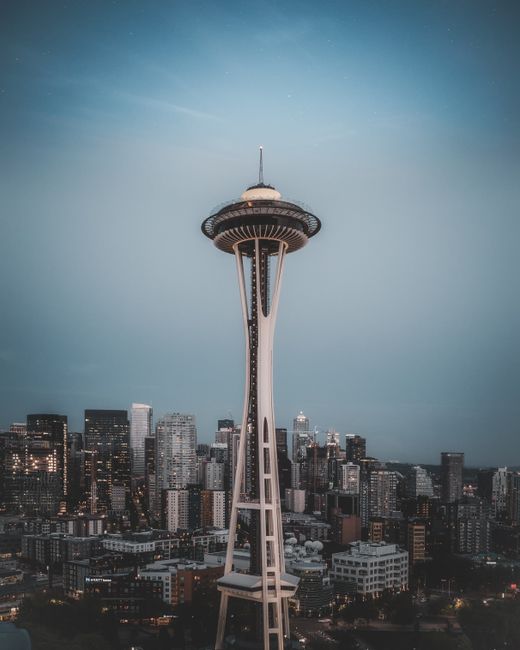
Seattle is the biggest city in the Pacific Northwest: a hilly, green port city between the saltwater of Puget Sound and Lake Washington, with the snowy dome of Mount Rainier on the skyline on clear days. Visitors come for Pike Place Market and the rebuilt waterfront, the Space Needle and the glass art of Seattle Center, ferries across the Sound, coffee, seafood and music, and as the starting point for Alaska cruises and for the national parks of Washington State. Summers are dry and mild; from October to April the city is cool, gray and often damp.
Right now in Seattle
- Tue 13–16°C 55–61°F Partly cloudy
- Wed 12–17°C 54–63°F Partly cloudy
- Thu 11–19°C 52–66°F Partly cloudy
- Mon 12 Oct Columbus Day
Weather: MET Norway (CC BY 4.0) · Sea temperature: NOAA CoastWatch · Holidays: Nager.Date
Top tours in Seattle
See all tours for Seattle →
From local operators, with prices and reviews; you check availability and book on Viator, our partner. We may earn a commission at no extra cost to you. How we earn money
Seattle at a glance
- Best for: markets and seafood, waterfront walks, ferry rides, museums, coffee and music, and day trips to mountains, rain forest and islands.
- How long: 3 days for the city highlights; 5–7 days to add a ferry island, Mount Rainier or the Olympic Peninsula. Add a night or two before or after an Alaska cruise.
- Best time: July to September, when highs reach about 77 °F (25 °C) and it rarely rains. October is cooler, around 60 °F (16 °C), with rain returning; November to January are the wettest months.
- Getting there: Seattle-Tacoma International Airport (SEA), about 38 minutes from downtown by Link light rail; Amtrak trains from Portland and Vancouver.
- Costs (as of October 2026): light rail $3 a ride; Bainbridge Island ferry $11.35 for a foot passenger; Space Needle from $35; hotel bills carry about 15.7% in taxes, plus a 2.3% tourism assessment at larger downtown hotels.
- Before you go: entry rules and ESTA, money, tipping and driving are in our United States travel guide.
Seattle neighborhoods: where things are
Seattle is long and narrow, squeezed between Elliott Bay on Puget Sound to the west and Lake Washington to the east, with Lake Union and the Ship Canal cutting across the middle. Downtown and the waterfront are compact and walkable, but steep: several streets climb sharply up from the water.
Downtown, Pike Place Market and the waterfront
The heart of a first visit: the market on its bluff above the bay, the new waterfront park below it, the Seattle Art Museum, the aquarium, the shopping streets around Westlake Center and the Bell Street cruise terminal at Pier 66. It is the easiest base without a car, with the light rail to the airport underneath.
Pioneer Square and the Chinatown-International District
Pioneer Square is where the city began, with red-brick and stone buildings from the years after the Great Fire of 1889, art galleries and the Underground Tour. Just east, the Chinatown-International District has Asian restaurants, groceries and the Wing Luke Museum, and the two stadiums, Lumen Field and T-Mobile Park, sit just to the south.
Belltown, Seattle Center and South Lake Union
Belltown, north of the market, is full of restaurants and bars. Beyond it, Seattle Center is the former 1962 World’s Fair grounds, home of the Space Needle, Chihuly Garden and Glass, the Museum of Pop Culture and Climate Pledge Arena, linked to downtown by the monorail. South Lake Union, around the southern tip of Lake Union, is the modern tech district, with seaplanes and kayak rentals on the lake.
Capitol Hill, Fremont and Ballard
Capitol Hill, a short light rail ride from downtown, is the city’s liveliest nightlife and LGBTQ neighborhood, with Volunteer Park and its conservatory at the top. North of the Ship Canal, Fremont is quirky and artsy (look for the Fremont Troll under the Aurora Bridge), and Ballard, the old Scandinavian fishing district, has breweries, seafood restaurants, a Sunday farmers’ market and the Ballard Locks.
Top things to see in Seattle
Prices and hours below were checked on the official sites in October 2026, unless we say otherwise; check again before you go.
Pike Place Market
Established in 1907, Pike Place Market is one of the oldest continuously operating public markets in the United States, a warren of arcades and lower levels with around 500 small businesses: farmers, fishmongers who toss salmon across the counter, bakeries, flower sellers, craftspeople and buskers. The market is open every day except Thanksgiving and Christmas Day; most of it is busiest from 10 a.m. to 5 p.m., while some restaurants stay open late. Come early in the morning to see stalls being set up and to beat the crowds, especially on summer weekends and cruise days. Since a pilot program began, vehicle access to Pike Place street itself is limited from 10 a.m., so walk in or use the market’s parking garage. The original coffee shop of a famous chain is on Pike Place, and the line outside it can be long; the gum wall in Post Alley is a few steps away.
The new waterfront: Waterfront Park and the Overlook Walk
For decades the Alaskan Way Viaduct, an elevated highway, cut the city off from Elliott Bay. It has been demolished and replaced by Waterfront Park: a wide promenade along a rebuilt seawall, a new surface street, rebuilt Piers 58 and 62 with a floating dock, and the Overlook Walk, an elevated walkway with steps, planting and viewpoints that links Pike Place Market directly down to the water and the Seattle Aquarium. According to the waterfront program, the park is open daily from 7 a.m. to 10 p.m.; a few projects still have construction around them. Along the piers you will find the Seattle Great Wheel, seafood restaurants, harbor cruises and the downtown ferry terminal at Colman Dock. The Seattle Aquarium, open daily 9:30 a.m.–6 p.m., has added the Ocean Pavilion, a large tropical reef exhibit, beside its original pier building.
The Space Needle
Built for the 1962 World’s Fair, the Space Needle is the city’s symbol, with indoor and outdoor viewing decks, glass benches tilting over the edge and a rotating glass floor on the level below. Tickets are timed and priced by date and time: as of October 2026 general admission costs $35–$55, with discounts for youth (5–12) and seniors (65+). A combination ticket with Chihuly Garden and Glass (and an IMAX film at the nearby science center) costs $74, and Seattle CityPASS, which includes both, costs $119–$139. Opening hours vary by day: in October 2026 roughly 10:30 a.m.–7:30 p.m. Monday to Thursday and 9 or 9:30 a.m. until 8:30–9:30 p.m. Friday to Sunday. Allow about 30 minutes from the entrance to the top, through security and an exhibit on the tower’s history. Large bags are not allowed (small backpacks are fine). Clear days show Mount Rainier, the Olympic Mountains and the Cascades; sunset slots sell out first.
Chihuly Garden and Glass and the Museum of Pop Culture
At the foot of the Needle, Chihuly Garden and Glass shows the work of Washington-born glass artist Dale Chihuly in galleries, a tall glasshouse with a huge hanging sculpture and an outdoor garden where glass mingles with plants. As of October 2026 general admission costs $40–$45, seniors and youth (5–12) $35–$40, and children under 4 are free; it opens 10 a.m.–6:30 p.m. on Sunday, 10:30 a.m.–5:30 p.m. Monday to Thursday and 10 a.m.–7:30 p.m. on Friday and Saturday. Visit at dusk, when the glass glows. Next door, the Museum of Pop Culture (MoPOP), in a crumpled, colorful Frank Gehry building, covers music (Seattle’s own Jimi Hendrix and Nirvana), science fiction, fantasy and video games; it was open 10 a.m.–5 p.m. when we checked, with same-day re-entry. Check its site for ticket prices. The rest of Seattle Center, including the International Fountain and the lawns, is free.
Pioneer Square and the Underground Tour
After the Great Fire of 1889, Seattle rebuilt Pioneer Square on top of itself, raising the streets one or two stories and leaving the old sidewalks and storefronts below. The Underground Tour is a 75-minute guided, humorous walk through those buried passages, starting at 614 First Avenue. Tours start on the hour, every day of the year, from 10 a.m. to 6 p.m., with extra half-hourly tours from June to September; it is closed on Thanksgiving and Christmas Day. Buy tickets in advance online or by phone, or at the ticket counter. Above ground, the square has the Klondike Gold Rush National Historical Park’s free museum, which tells how Seattle outfitted the 1897–1898 gold rush to Alaska and the Yukon.
The Ballard Locks
The Hiram M. Chittenden Locks, known simply as the Ballard Locks, lift boats between Puget Sound and the freshwater lakes. Watching fishing boats, yachts and kayaks pass through is free, and the grounds include a botanical garden and a fish ladder with underwater viewing windows, where salmon climb past in summer, at their peak from about July to September. The locks are run by the US Army Corps of Engineers; check its site for visitor center hours. Combine them with Ballard’s restaurants or a walk to Golden Gardens beach.
The Museum of Flight
South of downtown at Boeing Field, the Museum of Flight is one of the largest air and space museums in the world, with a hall of suspended aircraft, a Concorde, an early Air Force One, a space shuttle trainer and a collection on the Boeing story. As of October 2026 it is open daily 10 a.m.–5 p.m. and admission costs $29 for adults, $25 for seniors (65+) and $21 for youth (5–17). It closes on Thanksgiving Day (26 November 2026) and Christmas Day. Allow at least half a day; it is about 20 minutes by car from downtown or reachable by King County Metro bus.
Ferry to Bainbridge Island
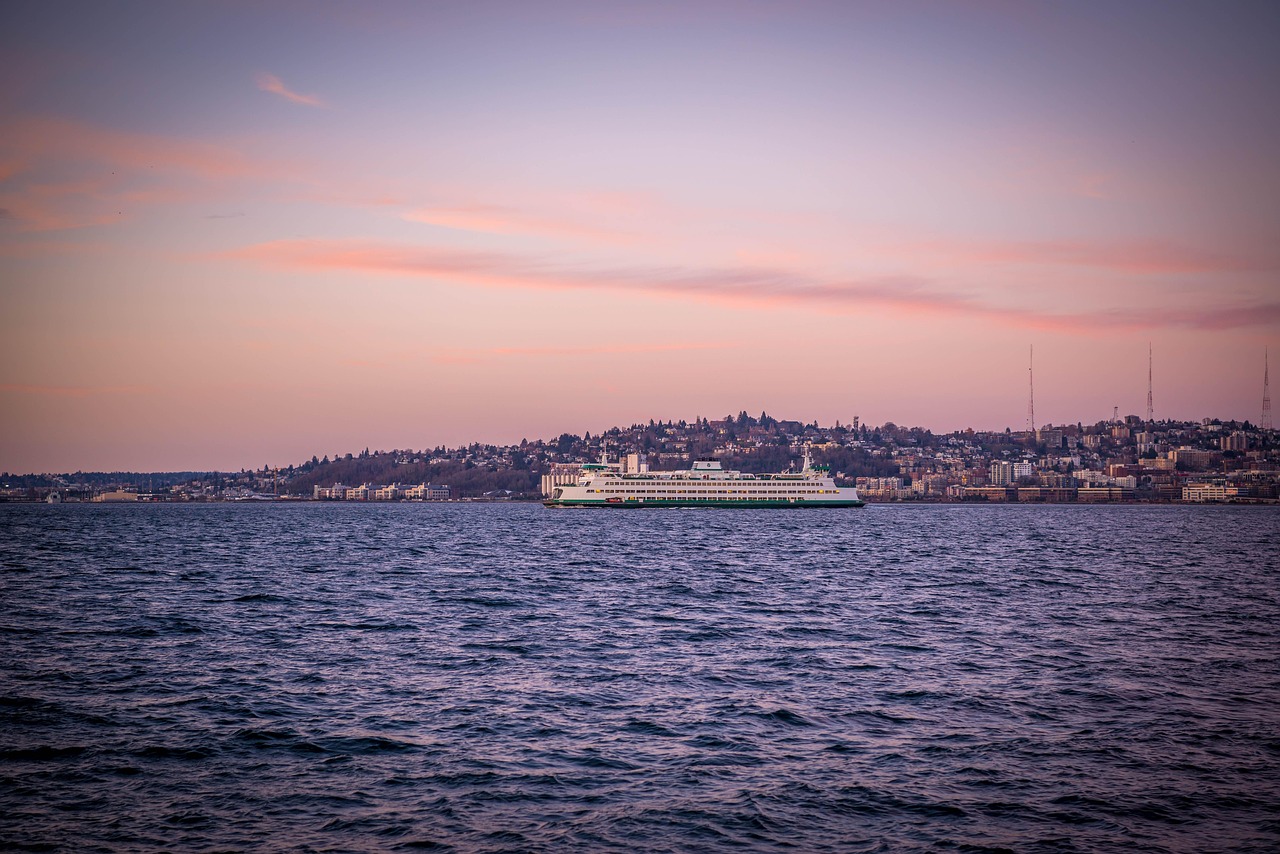
The cheapest sightseeing cruise in town is a Washington State Ferries crossing from Colman Dock on the waterfront to Bainbridge Island, about 35 minutes each way, with views back to the skyline and, on clear days, Mount Rainier and the Olympics. As of October 2026 the adult passenger fare is $11.35, seniors (65+) pay $5.65, and riders 18 and under travel free. Passenger fares are collected only in Seattle, so the return trip is included. A standard car under 22 feet (6.7 m) with its driver costs $20.25, collected in Seattle. From the Bainbridge terminal you can walk into Winslow, the island’s small town, with cafés, wineries’ tasting rooms and a museum of art. The ferry is also the gateway to Olympic National Park and the Kitsap Peninsula. See our boat trips guide for other ideas.
Seattle as an Alaska cruise port
Seattle is one of the main home ports for cruises to Alaska. According to the Port of Seattle, the 2026 season ran from 17 April to 11 October 2026, with 15 cruise lines, 26 ships, about 330 port calls and more than 2 million cruise passengers expected. Ships use two terminals:
- Bell Street Cruise Terminal at Pier 66: one berth on the downtown waterfront, within walking distance of Pike Place Market and the new Overlook Walk, with taxis, airport shuttles, rideshare and drop-off at the entrance.
- Smith Cove Cruise Terminal at Pier 91: two berths at the north end of the waterfront, about 10 minutes by car from downtown, with taxis, shuttles and a dedicated rideshare lot.
All cruise berths have shore power. The Port’s Port Valet service, for passengers of participating lines, carries your luggage from the ship straight to your flight, so you can explore on disembarkation day without bags. The Port reports that 82% of cruise passengers arrive by air and about half stay overnight, so book a hotel early for the night before sailing. Round-trip Alaska cruises from Seattle usually call at Victoria, British Columbia, so bring your passport. Ports in Alaska, such as Juneau, Ketchikan and Skagway, have their own guides in this series as they are published. The 2027 season had not been published in detail when we checked; most lines sail from late April or May to late September or early October.
Other things to do in Seattle
Parks, viewpoints and the water
Kerry Park on Queen Anne Hill is the classic postcard view of the Space Needle with downtown and, on clear days, Mount Rainier behind it. Discovery Park, a former army fort on a headland, has forest trails, bluffs and a lighthouse beach. The Olympic Sculpture Park, run by the Seattle Art Museum, is free and zigzags down to the bay. On Lake Union you can rent a kayak or paddleboard and float past houseboats, or take a short seaplane flight over the city. Gas Works Park, on the north shore of the lake, has rusting industrial towers and a skyline view. See our hiking and cycling guides; the Burke-Gilman Trail is a long, flat bike path along the Ship Canal and lakes.
Museums
Beyond the big names, the Seattle Art Museum downtown has strong Northwest Coast Native art, the Burke Museum at the University of Washington covers natural history and Indigenous cultures, the Museum of History and Industry (MOHAI) on Lake Union tells the city’s story, and the Wing Luke Museum covers Asian Pacific American history. Many museums have reduced or free admission on certain days; check each one’s site.
Food, coffee and drink
Seattle’s specialties come from the water and the region’s farms: wild salmon, Dungeness crab, oysters from Puget Sound and Hood Canal, and teriyaki, pho and dim sum shaped by the city’s Asian communities. Coffee is a serious business here, with independent roasters in every neighborhood. Ballard and Fremont have dozens of craft breweries, and Woodinville, about 30 minutes northeast, has many tasting rooms of Washington wineries; see our wine tasting guide. See our city sightseeing guide for walking ideas.
Sports and events
Seattle hosted matches of the 2026 FIFA World Cup at Lumen Field in June and July 2026. Regular seasons continue: Mariners baseball at T-Mobile Park in spring and summer, Seahawks football at Lumen Field and Sounders soccer, plus Kraken ice hockey and concerts at Climate Pledge Arena at Seattle Center.
Getting there and getting around
From Seattle-Tacoma International Airport (SEA)
SEA is about 13 miles (21 km) south of downtown. The easiest way into the city is Link light rail from SeaTac/Airport Station: from baggage claim, go up to the skybridge level, cross to the parking garage and follow the signs; a free electric cart runs between the skybridge and the station from 5 a.m. to midnight. According to Sound Transit and the Port of Seattle, the ride to downtown takes 38 minutes, trains run about every 8–10 minutes for most of the day, and service runs from about 5 a.m. to midnight. A night bus covers the airport–downtown route about every 30 minutes after the last train. Taxis and rideshare are in the parking garage; expect 25–45 minutes to downtown depending on traffic.
Light rail, buses and fares
Sound Transit’s Link light rail now has two lines. The 1 Line runs from Lynnwood in the north through the University of Washington, Capitol Hill, downtown, the stadiums and the airport to Federal Way (the Federal Way extension opened on 6 December 2025). The 2 Line runs from Lynnwood through downtown and, since the Crosslake Connection opened on 28 March 2026, across Lake Washington on the I-90 floating bridge, via Judkins Park and Mercer Island, to Bellevue and downtown Redmond. It is the first light rail line in the world to run on a floating bridge. A new station, Pinehurst in North Seattle, opened on 30 September 2026.
As of October 2026 a one-way adult Link fare is $3.00, whatever the distance; seniors (65+) and riders with disabilities pay $1 with a reduced-fare permit, and everyone 18 and under rides free on Sound Transit. Pay before boarding by tapping a contactless bank card or phone, an ORCA card, or with the Transit GO Ticket app. An ORCA regional day pass costs $6 and covers trips up to $3 on participating buses and trains. The Seattle Center Monorail between Westlake Center and Seattle Center costs $4 one way or $8 round trip for adults ($2 for youth and reduced fares) and runs from 7:30 a.m. to 11 p.m., later after arena events; buy tickets from its machines or tap an ORCA card (its readers do not accept bank cards). King County Metro buses and the streetcars cover the rest of the city.
Trains and driving
Amtrak’s Cascades trains link King Street Station with Portland and Vancouver, British Columbia, and the Coast Starlight runs to Portland, Sacramento and Los Angeles. A car is not needed in the city, where parking is expensive and hills and one-way streets make driving slow, but it is the simplest way to reach Mount Rainier and the Olympic Peninsula. Interstate 5 is congested at rush hour. Driving tips are in our United States travel guide.
| Route | Distance | How and how long |
|---|---|---|
| SEA airport to downtown | about 13 miles (21 km) | Link light rail, 38 minutes, $3; taxi or rideshare 25–45 minutes |
| Downtown to Bainbridge Island | across Elliott Bay | Washington State Ferries, about 35 minutes; $11.35 for adults on foot |
| Seattle to Mount Rainier (Paradise) | about 100 miles (160 km) | Car, about 2.5–3 hours via the Nisqually Entrance |
| Seattle to Port Angeles (Olympic) | about 80 miles (130 km) | Ferry to Bainbridge Island or Kingston, then drive; about 2.5–3 hours |
| Seattle to Portland | about 175 miles (280 km) | Car or Amtrak, about 3–3.5 hours |
| Seattle to Vancouver, Canada | about 140 miles (225 km) | Car or Amtrak Cascades, about 3–4 hours plus the border |
Day trips from Seattle
- Mount Rainier National Park: the 14,410-foot (4,392 m) volcano is about 2.5 hours away; Paradise has wildflower meadows in summer and deep snow in winter. As of October 2026 the entrance fee is $30 per car for 7 days, no timed entry reservation was required in 2026, and the Sunrise Road stayed closed to cars after the 2026 wildfires. Our Mount Rainier guide covers the details.
- Olympic National Park: rain forest, wild beaches and Hurricane Ridge; take the ferry and drive to Port Angeles. The park’s entrance fee is also $30 per car. Better as an overnight trip; see our Olympic guide.
- Snoqualmie Falls: a 268-foot (82 m) waterfall about 30 miles (48 km) east, with a viewing platform and a short trail.
- The San Juan Islands: ferries from Anacortes, about 1.5 hours north by car, to Friday Harbor and Orcas Island; orca and whale-watching tours run mainly in summer.
- Leavenworth: a Bavarian-style village in the Cascades, about 2.5 hours east, busy in fall and at Christmas.
- Portland, Oregon: about 3 hours south by car or train; our Portland guide covers the city.
Nearby destinations
- Mount Rainier National Park95 km
- Olympic National Park107 km
- Victoria119 km
- Vancouver193 km
- Portland (Oregon)234 km
- Whistler283 km
When to go and how long to stay
Weather for your datesSunrise and sunset
Seattle’s reputation for rain is about frequency rather than quantity: it gets about 39 inches (999 mm) a year, less than many East Coast cities, but spread over roughly 93 days with at least 0.1 inch (2.5 mm), mostly as light rain and drizzle from October to April. Summers are dry and sunny. The table uses NOAA’s 1991–2020 climate normals for the Seattle-Tacoma International Airport weather station.
| Season | Average high / low | Wet days per month | What it’s like | Good for |
|---|---|---|---|---|
| Winter (Dec–Feb) | 47–50 °F (8–10 °C) / 37–38 °F (3 °C) | 9–13 | Cool, gray and damp; short days; occasional snow | Museums, food, coffee, lower hotel prices |
| Spring (Mar–May) | 54–66 °F (12–19 °C) / 40–49 °F (4–9 °C) | 6–11 | Showers and sunny spells; blossoms in March and April | Gardens, city walks, the first cruises |
| Summer (Jun–Aug) | 71–78 °F (22–26 °C) / 53–57 °F (12–14 °C) | 2–4 | Dry, sunny, long evenings; occasional heat waves and wildfire smoke | Ferries, mountains, cruise season, outdoor dining |
| Fall (Sep–Nov) | 72 °F falling to 52 °F (22–11 °C) / 54 °F falling to 41 °F (12–5 °C) | 4–13 | September often fine; rain returns in October | Salmon at the locks, fall color, fewer crowds |
In October the average high is about 60 °F (16 °C) and the low 47 °F (8 °C), with about 8 wet days. Daylight saving time ends on Sunday 1 November 2026, and by December it is dark before 4:30 p.m. In late summer, smoke from wildfires in the Cascades can drift into the city for a few days; check the air quality if you plan to hike.
3 days in Seattle
Day one: Pike Place Market in the morning, down the Overlook Walk to the waterfront and the aquarium, then a round trip on the Bainbridge ferry for the sunset. Day two: the monorail to Seattle Center for the Space Needle, Chihuly Garden and Glass and MoPOP, then dinner in Belltown or Capitol Hill. Day three: Pioneer Square and the Underground Tour, then the Ballard Locks and an evening in Ballard or Fremont.
5 to 7 days in Seattle
Add the Museum of Flight, Discovery Park and a kayak on Lake Union. Then spend a full day at Mount Rainier (Paradise and a short meadow trail), or two to three days on a loop around the Olympic Peninsula via the ferry. With a week, add the San Juan Islands or Woodinville’s wineries, or continue south to Portland by train.
Where to stay in Seattle and the hotel taxes
- Downtown and the waterfront: the most convenient, near the market, the ferries, Pier 66 and the light rail to the airport.
- Belltown and Lower Queen Anne: near Seattle Center and Pier 91, with lots of restaurants.
- South Lake Union: newer hotels, on the streetcar.
- Capitol Hill and the University District: livelier and often cheaper, on the light rail.
- Near the airport (SeaTac): handy for early flights; on the light rail, with lower taxes than the city.
Room rates are usually quoted before tax. According to the Washington State Department of Revenue’s lodging rate table for October to December 2026, the total lodging tax rate in the City of Seattle is 15.7%, which includes the 7% convention and trade center tax that applies to lodging in Seattle. On top of that, about 70 hotels with 60 or more rooms in the downtown neighborhoods collect a 2.3% Seattle Tourism Improvement Area assessment per room night, set by the city in 2023 and used for tourism marketing. A downtown hotel bill can therefore carry roughly 18% in taxes and assessments, as of October 2026. Many hotels add a nightly “destination” or “urban” fee, and parking often costs $40 or more a night, so compare the total price. Hotels are fullest, and most expensive, from June to September, especially on cruise weekends.
Practical tips for Seattle
- Sales tax: prices in shops and on menus exclude sales tax; according to the state Department of Revenue, the combined rate in Seattle is 10.55% as of October 2026.
- Tipping: 18–22% is usual at sit-down restaurants; more in our United States travel guide.
- Book ahead: Space Needle sunset slots, the Underground Tour on summer weekends and hotels around cruise departures.
- Ferries: walk on rather than drive on summer weekends, when car lines can be long; foot passengers pay only in Seattle.
- Safety: downtown is busy and generally fine for visitors; as in any big city, keep an eye on your belongings, stay aware around Third Avenue and some transit stations late at night, and never leave valuables in a parked car.
- Cold water: Puget Sound stays cold all year, around 50 °F (10 °C), so swim only where it is designated and wear a life jacket when paddling.
- Emergencies: call 911.
What to pack for Seattle
Locals rarely carry umbrellas; they wear a light waterproof jacket with a hood and layers underneath, and that is the best plan for visitors too, in every season. Bring comfortable walking shoes with good grip for the steep, often wet streets, a warm layer for ferry decks and evenings (even in summer they drop to the mid-50s °F, about 13 °C), and sunglasses for bright summer days on the water. For Mount Rainier or the Olympic Peninsula add hiking shoes, a fleece and rain pants. Bring your passport if your cruise calls at Victoria or you plan to visit Vancouver.
Seattle travel FAQ
How do I get from Seattle airport to downtown?
Take Link light rail from SeaTac/Airport Station, reached through the parking garage: about 38 minutes to downtown for $3, with trains every 8–10 minutes for most of the day, as of October 2026.
How much does the Seattle light rail cost?
A flat $3 one way for adults on both the 1 Line and the 2 Line, $1 for seniors with a reduced-fare permit, and free for anyone 18 and under. Tap a contactless card or phone before boarding.
Does the light rail go across Lake Washington to Bellevue?
Yes. Since 28 March 2026 the 2 Line runs from Lynnwood through downtown Seattle and across the I-90 floating bridge to Bellevue and Redmond.
How much is the Space Needle?
General admission costs $35–$55 as of October 2026, depending on the date and time slot. A combination ticket with Chihuly Garden and Glass costs $74.
How much is the ferry from Seattle to Bainbridge Island?
$11.35 for an adult foot passenger, $5.65 for seniors and free for riders 18 and under, as of October 2026, paid only in Seattle, so the return is included. The crossing takes about 35 minutes.
When is the Alaska cruise season in Seattle?
In 2026 it ran from 17 April to 11 October, from Pier 66 (Bell Street) downtown and Pier 91 (Smith Cove). Most sailings are from May to September.
Can I visit Mount Rainier as a day trip from Seattle?
Yes, by car: Paradise is about 2.5–3 hours each way. The entrance fee is $30 per car, and no timed entry reservation was needed in 2026. Roads to the high areas close in stages from late October.
Does it rain all the time in Seattle?
No. It rains often but lightly from October to April, with about 9–13 wet days a month in winter, while July and August have only about 2 wet days each.
What taxes are added to Seattle hotel bills?
A total lodging tax of 15.7% in the City of Seattle, per the state Department of Revenue, plus a 2.3% tourism assessment at downtown hotels with 60 or more rooms, as of October 2026.
Plan your trip
Partner links: TravelerCenter may earn a commission if you book, at no extra cost to you.
Sources · last reviewed 4 October 2026
Researched and last reviewed on 4 October 2026. Market hours: Pike Place Market; Space Needle and Chihuly Garden and Glass prices and hours: the operators’ sites; MoPOP, the Museum of Flight, the Seattle Aquarium, the Underground Tour and the Seattle Center Monorail: their own sites; the waterfront: the City of Seattle’s Waterfront Seattle program; light rail fares, lines and openings: Sound Transit; airport connections: the Port of Seattle and Sound Transit; ferry fares: Washington State Ferries (WSDOT); cruise season and terminals: the Port of Seattle; sales and lodging taxes: the Washington State Department of Revenue; the tourism assessment: the City of Seattle; Mount Rainier and Olympic fees: the National Park Service; climate: NOAA’s 1991–2020 normals for Seattle-Tacoma International Airport. The Ballard Locks details, ferry and driving times, the aquarium’s exhibits and day-trip distances come from general or secondary sources and are flagged for checking. Check the official sites before you go. For entry rules, ESTA, tipping and driving, see our United States travel guide.
Place data: Wikidata (CC0)