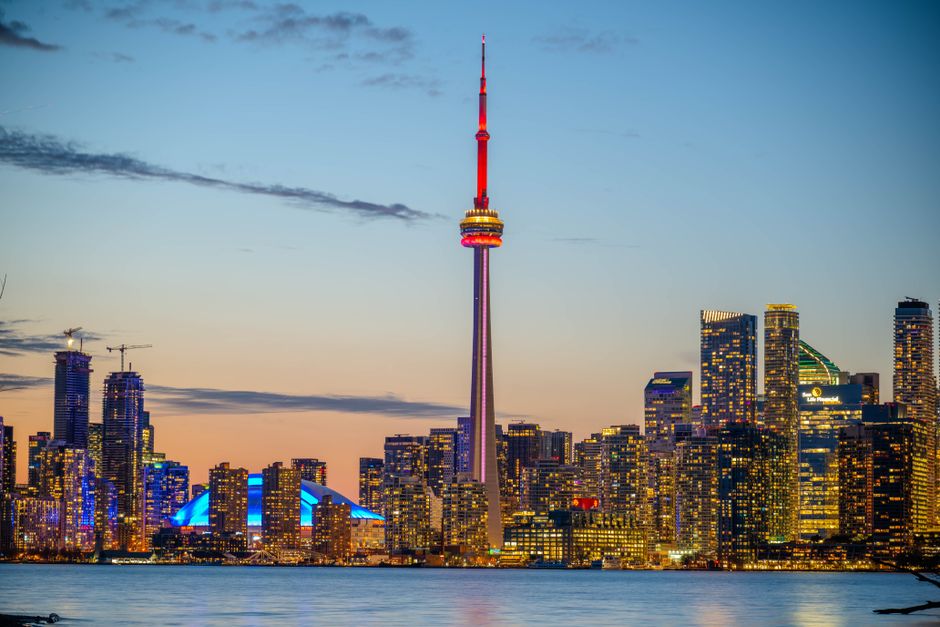
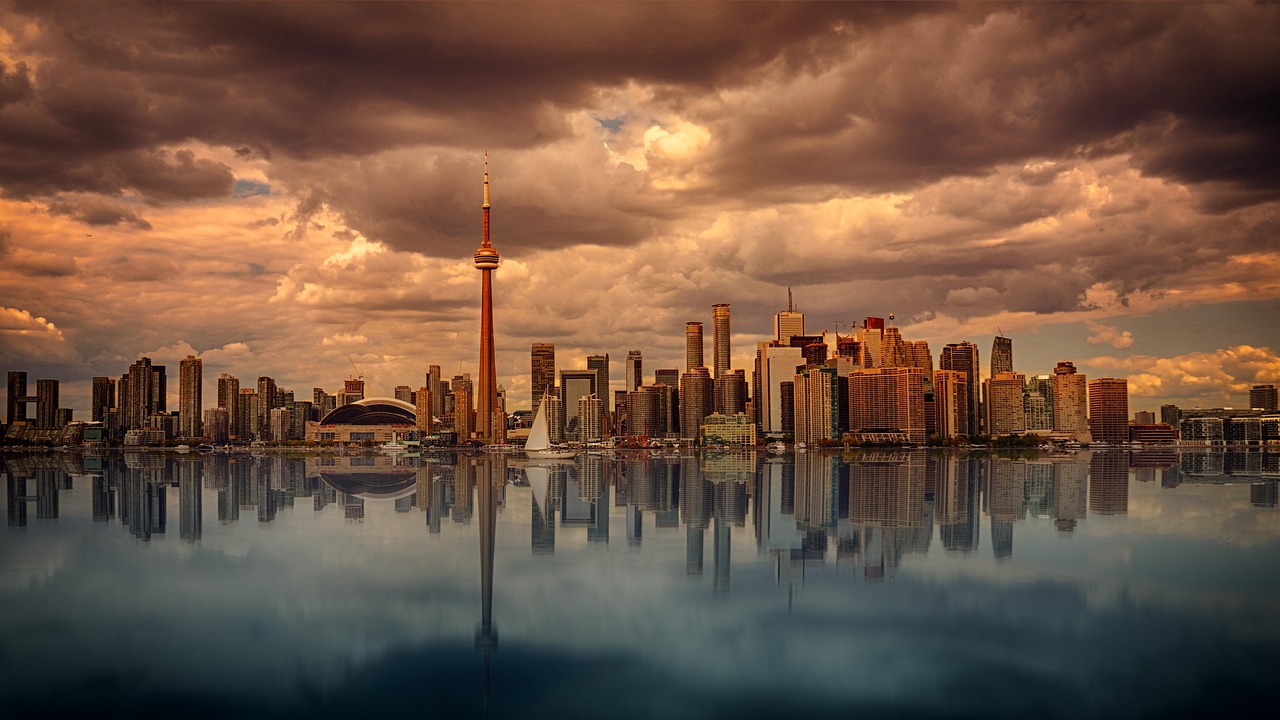
Toronto, Canada’s biggest city and the capital of Ontario, spreads along the north shore of Lake Ontario under the needle of the CN Tower. Some 2.8 million people live in the city itself, and about half of them were born outside Canada, which shows in everything from the food to the dozens of languages you hear on a single streetcar ride. It is a city of neighbourhoods rather than grand monuments: Victorian warehouses turned into galleries, a 19th-century market hall, leafy streets of brick houses, a chain of islands a short ferry ride offshore and some of the best museums in the country. A fast train links the main airport with downtown in under half an hour, and from Union Station you can reach Niagara Falls, Ottawa and Montreal by rail.
Right now in Toronto
- Tue 5–14°C 41–58°F Mostly clear
- Wed 12–20°C 54–69°F 4 mm Partly cloudy
- Thu 10–17°C 50–63°F Mostly clear
- Mon 12 Oct Thanksgiving
Weather: MET Norway (CC BY 4.0) · Rates: ECB · Holidays: Nager.Date
Top tours in Toronto
See all tours for Toronto →
From local operators, with prices and reviews; you check availability and book on Viator, our partner. We may earn a commission at no extra cost to you. How we earn money
Toronto at a glance
- Best months: late May to June and September to mid-October, for warm days, patios and festivals without the humid peak of July; winter is cold and grey but full of indoor culture.
- Time needed: three days for the waterfront, the main museums and a few neighbourhoods; add a day each for Niagara Falls or the Toronto Islands at a slow pace.
- Getting there: Toronto Pearson International Airport (YYZ) is linked to Union Station by the UP Express train in 28 minutes; Billy Bishop Toronto City Airport (YTZ) sits on the Toronto Islands, minutes from downtown.
- Costs (as of October 2026): prices on this page are in Canadian dollars (CA$1 is about US$0.72). A TTC ride is $3.30 when you tap a card; the UP Express is $12.35 one way ($9.25 tapping PRESTO or a bank card); CN Tower general admission is $47 for adults.
- Before you go: entry rules (including the eTA for visitors who fly in), money and general safety are covered in our Canada travel guide.
Toronto neighbourhoods and who each one suits
Downtown, the Financial District and the waterfront
The towers of the Financial District rise around Union Station, the city’s grand 1920s railway hub, with the CN Tower, Rogers Centre (home of the Toronto Blue Jays) and Ripley’s Aquarium just to the southwest. An underground walkway network, the PATH, links many office towers, malls and hotels, which is handy in January. South of the Gardiner Expressway, Harbourfront has a lakeside promenade, the Harbourfront Centre arts complex and the Jack Layton Ferry Terminal for the islands. It is the most convenient base for first-time visitors and anyone arriving by the UP Express.
Old Town, St. Lawrence and the Distillery District
East of Yonge Street, the Old Town is where the town of York was laid out in 1793. Today it has the St. Lawrence Market, the triangular Gooderham (“Flatiron”) Building, St. James Cathedral, Victorian storefronts and theatres such as the St. Lawrence Centre. A 15-minute walk further east, the Distillery District is a pedestrian village of red-brick 19th-century whisky distillery buildings with galleries, cafés, restaurants and theatre. Both suit food lovers and visitors who like to walk.
Queen West, Chinatown and Kensington Market
Queen Street West is the city’s long-running creative strip of independent shops, bars and music venues, with Trinity Bellwoods Park as its back garden and the Graffiti Alley murals running parallel to it. Spadina Avenue’s Chinatown is busy and inexpensive, and just behind it, Kensington Market is a scruffy, cheerful tangle of vintage shops, cheap eats, coffee bars and fruit stalls in narrow Victorian houses. Best for younger travellers, foodies and anyone who likes street life.
Yorkville, the Annex and the University of Toronto
Around Bloor Street, Yorkville is the polished end of town, with designer boutiques, galleries and expensive restaurants, right next to the Royal Ontario Museum. West of it, the University of Toronto’s Gothic-revival campus and the Annex’s big brick houses, bookshops and pubs feel almost like a college town. Good for museum-goers and those who want a quieter, leafier base on the subway.
Leslieville, the Beaches and the Danforth
In the east end, Leslieville has brunch spots and small shops along Queen Street East; further out, the Beaches neighbourhood has a boardwalk along a sandy Lake Ontario beach. North of the Don Valley, the Danforth (Greektown) is lined with Greek tavernas and bakeries. These are residential areas with a relaxed, local feel, reached by streetcar or subway.
Top things to see in Toronto
CN Tower
At 553.33 metres (1,815 ft), the CN Tower, opened in 1976, is the tallest freestanding structure in the Western Hemisphere and the symbol of the city. Lifts with glass panels whisk you to the Main Observation Level at 346 metres (114 storeys), and one floor down, at 342 metres, you can walk on the glass floor and step out onto an open-air terrace. The Top, 33 storeys higher, is the highest observation platform in the Western Hemisphere, and on windy days you can feel the tower sway. The observation levels are open from 9:30 a.m. to 11 p.m. (last entry 9 p.m.). Tickets are timed and can be bought up to 30 days ahead; in October 2026, Timed General Admission costs $47 for adults (14–64), $34 for seniors and youths (6–13) and $18 for children aged 3–5, and The Top plus general admission costs $59 for adults. Tax is added to these prices, and children aged 2 and under go free.
For thrill-seekers, EdgeWalk is a hands-free, harnessed walk around the outside of the main pod, 116 storeys above the ground, from $199; it runs in the warmer months. The 360 Restaurant revolves once every 72 minutes or so and takes reservations up to two months ahead. On a clear evening, go up about an hour before sunset to see the city in daylight and lights.
Royal Ontario Museum (ROM)
Canada’s largest museum of world culture and natural history fills a 1914 heritage building and the jagged glass-and-aluminium Michael Lee-Chin Crystal on Bloor Street. Highlights include the dinosaur galleries, the gems and minerals, ancient Egypt, Chinese temple art and the First Peoples gallery. In October 2026 the museum is open from 10 a.m. to 5:30 p.m. and closed on most Mondays (it opens on Thanksgiving Monday, 12 October). General admission is free on the third Tuesday evening of each month, when the museum stays open until 8:30 p.m., and part of the main floor is free to enter. Buy timed tickets on the museum’s website. Museum station on subway Line 1 is right outside, decorated with columns copied from the collection.
Art Gallery of Ontario (AGO)
The AGO, on Dundas Street West, has a superb collection of Canadian art, including the Group of Seven’s paintings of the northern Ontario wilderness, works by Indigenous artists, the Thomson Collection of European art and the largest public collection of Henry Moore sculpture. Architect Frank Gehry, who grew up nearby, redesigned the building with a curving wooden staircase and a long glass gallery. It is closed on Mondays; open 10:30 a.m. to 5 p.m. Tuesday and Thursday, to 9 p.m. on Wednesday and Friday, and to 5:30 p.m. at weekends. A single-day ticket costs $30 for adults (18+) and $15 for youths aged 10–17; children 9 and under and Indigenous visitors enter free, and Ontario residents under 25 can get a free annual pass. Admission is free on the first Wednesday evening of each month from 6 to 9 p.m. (book a free timed ticket online).
St. Lawrence Market
Toronto’s historic market, at Front and Jarvis streets, has been feeding the city since 1803. The South Market hall is packed with butchers, fishmongers, cheese counters, bakeries and lunch stalls; try the famous peameal bacon sandwich. It is open Tuesday to Friday 9 a.m. to 7 p.m., Saturday 7 a.m. to 5 p.m. and Sunday 10 a.m. to 5 p.m.; it is closed on Mondays. On Saturdays a farmers’ market runs from 5 a.m. to 3 p.m., and antiques and vintage markets are held on Sundays. Upstairs, the Market Gallery shows exhibitions on the city’s history.
The Distillery District
The former Gooderham and Worts distillery, founded in 1832, is one of the best-preserved collections of Victorian industrial buildings in North America. Its cobbled lanes are closed to cars and lined with more than 40 boutiques, galleries, cafés, bakeries, restaurants and the Young Centre for the Performing Arts, home of the Soulpepper theatre company. The district is open 364 days a year; entry is free, but the cobblestones are uneven, so wear flat shoes. It is at its busiest during the Christmas market season from mid-November, when entry at peak times may need a timed ticket; check the district’s website for current details. Paid Green P parking is on site, and the 504 King streetcar stops nearby.
Toronto Islands
A 10- to 15-minute ferry ride from downtown, the Toronto Islands are a car-free chain of parkland, beaches, lagoons and a small residential community, with the best skyline views in the city. City-run ferries leave from the Jack Layton Ferry Terminal at 9 Queens Quay West (at Bay Street, behind the Westin Harbour Castle). From mid-April to mid-October boats go to Centre Island, Hanlan’s Point and Ward’s Island; in 2026 the fall timetable runs to 13 October, and from 14 October to mid-April 2027 the winter schedule serves Ward’s Island only. A round-trip ticket costs $9.57 for adults (20–64), $6.15 for seniors and youths (15–19), $4.51 for children aged 2–14, and is free for infants. Tickets bought online can be used on any day until the end of that calendar year and let you use an express line; on summer weekends, waits can exceed 30 to 60 minutes, so go early or choose the quieter Ward’s Island route.
On the islands, you can walk or cycle the paths between Ward’s Island and Hanlan’s Point, swim at the supervised beaches in summer, rent a canoe or kayak, and visit the Gibraltar Point Lighthouse, built in 1808. In summer, Centreville is a small old-fashioned amusement park for young children. Hanlan’s Point Beach has a clothing-optional section. Bike Share bikes cannot be taken on the ferry, but there are docking stations on the islands. Private water taxis also run across the harbour.
More to see
- Casa Loma: a 1914 mock-Gothic castle on a hill in midtown, with towers, secret passages and gardens.
- Ripley’s Aquarium of Canada: next to the CN Tower, with a moving walkway through a shark tunnel; a combination ticket with the tower is sold.
- Hockey Hall of Fame: the Stanley Cup and a century of ice hockey history, in an old bank building at Front and Yonge.
- Bata Shoe Museum and the Aga Khan Museum: two specialist museums, one on footwear from around the world, the other on Islamic arts, in a striking building in the northern suburbs.
- Nathan Phillips Square and City Hall: the curved 1965 towers of City Hall, the “Toronto” sign and, in winter, a free outdoor skating rink.
If you plan to see several big sights, Toronto CityPASS covers the CN Tower and Ripley’s Aquarium plus three of the ROM, Casa Loma, the AGO, the Toronto Zoo and a harbour cruise (seasonal), over nine days, for $134.96 plus tax for adults and $99.96 plus tax for children aged 4–12.
Museums
- Art Gallery of Ontario
- Casa Loma
- Royal Ontario Museum
Other sights
- St. Lawrence Market
Viewpoints
- CN Tower
Historic centres
- Distillery District
Beaches
- Toronto Islands
Activities and best months
- Boat tripsCity of Toronto ferries leave the Jack Layton Ferry Terminal at 9 Queens Quay West for the Toronto Islands (round trip adult $9.57). · source
- City sightseeingThe Distillery District, dating from 1832, is open 364 days a year with more than 40 boutiques and the Soulpepper theatre on cobbled lanes. · source
Other things to do in Toronto
- Eat your way around the world: dim sum in Chinatown, Portuguese bakeries in Little Portugal, Greek food on the Danforth, Korean barbecue on Bloor Street West, and Caribbean, Indian and Ethiopian cooking all over the city.
- Sport: the Maple Leafs (ice hockey) and the Raptors (basketball) play at Scotiabank Arena, the Blue Jays (baseball) at Rogers Centre, and Toronto FC (soccer) and the Argonauts (Canadian football) at BMO Field.
- Theatre and music: the Entertainment District around King Street West has big touring musicals, Massey Hall and Roy Thomson Hall host concerts, and small clubs on Queen Street West and in Kensington have live music most nights.
- Walk and cycle the waterfront: the Martin Goodman Trail runs along the lakeshore; Bike Share Toronto has stations across downtown. In winter, skate at Nathan Phillips Square or the Harbourfront Centre rink when they are open.
- Festivals: the Toronto International Film Festival (September), Caribana, the Toronto Caribbean Carnival (summer), Pride (June) and Nuit Blanche (autumn) fill the streets; the Toronto Biennial of Art runs at venues including the CN Tower until 20 December 2026.
- City sightseeing: explore the PATH, Graffiti Alley and the ravines of the Don Valley on foot, or take a harbour cruise from Queens Quay in the warmer months.
Day trips from Toronto
Niagara Falls
The Horseshoe Falls are about 130 km (80 miles) southwest of Toronto around the end of Lake Ontario, roughly 1.5 to 2 hours by car depending on traffic on the Queen Elizabeth Way. GO Transit runs trains from Union Station to Niagara Falls all year (on the Lakeshore West line; when there is no direct train, take the train to Burlington and GO bus route 12), and GO sells combo tickets that bundle the return trip with a WEGO visitor bus pass in Niagara. Boat trips into the mist, the tunnels behind the falls and the Winter Festival of Lights are all covered in our Niagara Falls travel guide.
Niagara-on-the-Lake and wine country
Twenty minutes downriver from the falls, Niagara-on-the-Lake is a pretty 19th-century town of inns and gardens, home of the Shaw Festival theatre and surrounded by wineries famous for icewine. Combine it with the falls in a long day, or stay overnight. From spring to October, a WEGO shuttle links the town with Niagara Falls, so you can make the trip car-free from Toronto with GO Transit.
Muskoka and Algonquin Park
Muskoka, Ontario’s classic cottage country of granite shores and deep lakes, starts about two hours north by car at Gravenhurst; Ontario Northland buses from the Union Station Bus Terminal and Yorkdale also serve Gravenhurst, Bracebridge and Huntsville. Algonquin Provincial Park is another hour or so beyond. Both are at their best for the fall colours from late September to mid-October, and both are more rewarding as an overnight trip than a day trip (see our Muskoka travel guide).
Ottawa, Montreal and farther afield
VIA Rail’s Corridor trains leave Union Station several times a day for Ottawa (about 4 to 4.5 hours) and Montreal (about 5 hours), passing through Kingston and the Thousand Islands region; see our Ottawa travel guide. South of the border, New York City is about an hour’s flight from Pearson or Billy Bishop, or a long day on the Maple Leaf train via Niagara Falls (see our New York City travel guide), and Chicago is about 1.5 hours by air (see our Chicago travel guide).
Nearby destinations
- Niagara Falls67 km
- Muskoka District Municipality166 km
Getting there and getting around
From Toronto Pearson: the UP Express
Pearson is Canada’s busiest airport, about 25 km (15 miles) northwest of downtown, with Terminals 1 and 3 linked by a free Terminal Link train. The UP Express station is in Terminal 1. Trains run every 15 minutes and take 28 minutes to Union Station, stopping at Weston, Mount Dennis and Bloor (for the subway). The first train leaves Pearson at 5:27 a.m. on weekdays and 6:24 a.m. at weekends and holidays, and the last at 12:54 a.m.
| UP Express fare (Pearson–Union) | Price | Notes |
|---|---|---|
| Adult ticket, one way | $12.35 | Ages 13–64; round trip $24.70 (e-tickets valid for a year) |
| Adult, tapping PRESTO or a credit/debit card | $9.25 | One way; tap on and off with the same card or phone |
| Senior (65+) | $6.20 ticket / $5.80 PRESTO | Senior PRESTO fare needs a PRESTO card set to senior |
| Group Pass (online only) | $25 for 3, $32.50 for 4, $40 for 5 | One way, travelling together |
| Family (ticket machines only) | $25.70 | One way |
| Children 12 and under | Free |
Planned construction occasionally replaces trains with GO buses at weekends, as on 3 and 4 October 2026; check UP Express service alerts. Taxis and ride-shares to downtown take 30 to 60 minutes depending on traffic, and the TTC’s 900 Airport Express bus links Terminals 1 and 3 with Kipling subway station for a regular TTC fare.
Billy Bishop Toronto City Airport
This small airport at the foot of Bathurst Street, on the western end of the Toronto Islands, has flights to more than 20 cities in Canada and the US, mainly with Porter Airlines. It is open from 5 a.m. to 11 p.m., and US preclearance has now opened, so you clear US customs before you fly. A pedestrian tunnel (and a very short ferry) connects it with the mainland, from where it is a short taxi, streetcar or walk to downtown hotels.
TTC subway, streetcars and buses
The Toronto Transit Commission (TTC) runs the subway, streetcars and buses, including the new Line 5 Eglinton and Line 6 Finch West light-rail lines. Most visitors simply tap a credit card, Interac debit card or phone wallet on the reader; you can also use a PRESTO card or pay exact cash.
| TTC fare (adult) | Price | Notes |
|---|---|---|
| Tap credit or debit card / phone wallet | $3.30 | Includes a two-hour transfer; counts towards fare capping |
| PRESTO card | $3.30 | Same transfer and capping rules; seniors $2.25, youths 13–19 $2.35 |
| Cash or PRESTO one-ride ticket | $3.35 | Cash: exact fare, paper transfer only, no two-hour transfer |
| PRESTO day pass | $13.50 | Unlimited TTC travel for the day |
| Children 12 and under | Free |
Tap the same card or phone every time you enter a station or board a vehicle; with PRESTO or a bank card, any rides within two hours of your first tap are free, and since 31 August 2026 monthly fare capping makes all TTC trips free after 47 paid fares in a calendar month. Keep your card handy as proof of payment. With “One Fare”, you also pay only once when connecting between the TTC and GO Transit or neighbouring city transit systems. Downtown, the 504 King and 501 Queen streetcars are a cheap way to see the city.
Trains, buses and driving
Union Station is the hub for VIA Rail’s intercity trains to Ottawa, Montreal, Kingston and Windsor, Amtrak’s Maple Leaf to New York via Niagara Falls, GO Transit’s regional trains and the UP Express. Intercity coaches, including GO and Ontario Northland, use the Union Station Bus Terminal across the street. You do not need a car downtown; parking is expensive and traffic on the Gardiner Expressway and Highway 401, one of the busiest highways in North America, is heavy at rush hour. Rent a car only for trips to cottage country.
When to go and how long to stay
Toronto has four distinct seasons, softened a little by Lake Ontario. Summers are warm to hot and often humid, with thunderstorms; spring arrives late and changeable; autumn is crisp and colourful, the best season for walking. Winters are cold and often grey, with snow on and off from December to March and cold wind off the lake, but the PATH, the museums and the theatres keep the city busy.
| Season | Average high | Average low | What it’s like |
|---|---|---|---|
| Spring (Mar–May) | 5–18 °C (40–65 °F) | −2 to 10 °C (29–50 °F) | Slow to warm up; sunny days and cold snaps; parks green up in May. |
| Summer (Jun–Aug) | 24–27 °C (75–80 °F) | 15–18 °C (59–64 °F) | Warm and humid, with heat waves and thunderstorms; festival season and island beaches. |
| Autumn (Sep–Nov) | 21 to 8 °C (70–46 °F) | 13 to 2 °C (56–36 °F) | Warm September, crisp October with fall colours, grey and damp November. |
| Winter (Dec–Feb) | −1 to 2 °C (31–36 °F) | −7 to −3 °C (20–26 °F) | Cold and often cloudy; about 1.2 m (48 in) of snow a winter; wind chill by the lake. |
Figures are Environment and Climate Change Canada’s 1981–2010 climate normals for the Toronto (downtown) station. The city gets about 830 mm (33 in) of rain and melted snow a year, spread fairly evenly through the months, and about 122 cm (48 in) of snow, mostly from December to March.
How long to stay: 2, 3 and 4 days
- Two days: the CN Tower and the waterfront; St. Lawrence Market and the Distillery District; the ROM or the AGO; an evening in Kensington Market and on Queen West.
- Three days: add the ferry to the Toronto Islands (or a lakeside walk in the Beaches in winter), Casa Loma and a game or a show.
- Four days: add a full day at Niagara Falls and Niagara-on-the-Lake, or continue by train to Ottawa and Montreal.
Where to stay in Toronto and the hotel taxes
- Union Station, the Financial District and the Entertainment District: the most central base, with the UP Express, the CN Tower and the theatres on the doorstep; prices rise on game and concert nights.
- Harbourfront: lake views and the island ferry, a short walk from Union Station.
- Old Town and St. Lawrence: historic streets, the market and good restaurants, within walking distance of the Distillery District.
- Yorkville and the Annex: upscale or leafy, on the subway, next to the ROM.
- Near Pearson airport: handy for early flights, but far from the sights.
Taxes: room rates in Canada are usually quoted before tax. Ontario adds 13% HST (harmonized sales tax) to hotel bills, as to most purchases. The City of Toronto also charges a Municipal Accommodation Tax (MAT) of 6% on hotel and short-term rental stays; a temporary increase to 8.5% ended on 1 August 2026, so stays from that date pay 6%. Some hotels add a destination marketing fee or resort fee, and downtown parking can cost $40 or more a night, so check the total price before you book.
Practical tips for Toronto
- Time zone: Toronto is on Eastern Time (the same as New York) and uses daylight saving time.
- Prices and tipping: shop and restaurant prices exclude the 13% HST, which is added at the till. Tip about 15–20% in restaurants and bars, and a little for taxis and hotel staff.
- Weather: wind off the lake can make winter feel much colder than the thermometer suggests; in summer, heat warnings are issued on humid days, so carry water.
- Safety: Toronto is generally safe; use normal city sense on transit late at night and around a few busy downtown intersections, and do not leave valuables visible in parked cars. Swim only at supervised beaches and check the city’s beach water quality reports in summer.
- Language: English is the everyday language; signs at federal sites are bilingual in English and French.
- Emergencies: call 911.
What to pack for Toronto
In summer, bring light clothes, sunscreen, a hat, a swimsuit for the island beaches and a light rain jacket for thunderstorms. In spring and autumn, pack layers, a warm jumper or fleece and a waterproof jacket; evenings by the lake and on the ferry are cool. From December to March, you need a proper winter coat, a hat, gloves, a scarf and waterproof boots with grip for icy pavements. All year, comfortable walking shoes matter: the cobblestones of the Distillery District and long walks between neighbourhoods are hard on feet.
What to pack
- City walking shoesLisbon and Porto are steep, with polished limestone cobbles that get slippery, so grippy soles matter.
- Day packs and anti-theft bagsA small zipped or anti-theft bag makes crowded trams and viewpoints less stressful.
- Dry bags and phone pouchesSpray soaks phones and cameras on open boats to the Algarve caves and on whale-watching trips.
- Fleeces and warm layersIt is cooler at sea than on land, especially on morning whale-watching trips.
- Rain jacketsA windproof, waterproof shell keeps you warm on open boats, where wind and spray cool you quickly.
- Reef-friendly sunscreenSun reflects off the water on cruises and cave tours.
- Travel adapters and convertersPortugal uses Type C and F sockets at 230 V, so most visitors from outside Europe need an adapter.
- Water shoesKayak and small-boat trips to the Algarve grottoes land on rock and wet sand.
Toronto travel FAQ
How do I get from Toronto Pearson airport to downtown?
Take the UP Express from Terminal 1 to Union Station: 28 minutes, every 15 minutes, for $12.35 one way with a ticket or $9.25 if you tap a PRESTO card, credit or debit card. Children 12 and under ride free.
How much is a TTC subway or streetcar ride?
An adult fare is $3.30 when you tap a credit or debit card, phone or PRESTO card, with free transfers for two hours; cash is $3.35 with no two-hour transfer. A PRESTO day pass costs $13.50, and children 12 and under ride free.
How much does it cost to go up the CN Tower?
Timed General Admission is $47 for adults, $34 for seniors and youths aged 6–13 and $18 for children aged 3–5, plus tax; adding The Top costs $12 more. The observation levels are open from 9:30 a.m. to 11 p.m., with last entry at 9 p.m.
How do I get to the Toronto Islands, and how much is the ferry?
City ferries leave from the Jack Layton Ferry Terminal at Bay Street and Queens Quay. A round trip costs $9.57 for adults, $6.15 for seniors and youths and $4.51 for children aged 2–14. From 14 October 2026 to mid-April 2027, only the Ward’s Island route runs.
When are Toronto’s museums free?
The Art Gallery of Ontario is free on the first Wednesday evening of each month from 6 to 9 p.m., and the Royal Ontario Museum on the third Tuesday evening of each month until 8:30 p.m. Book free timed tickets online in advance.
What taxes are added to Toronto hotel bills?
Ontario’s 13% HST plus the City of Toronto’s 6% Municipal Accommodation Tax, which went back down from 8.5% on 1 August 2026. Some hotels also add their own fees, and parking is extra.
Can I do Niagara Falls as a day trip from Toronto?
Yes. The falls are about 130 km (80 miles) away, 1.5 to 2 hours by car; GO Transit trains run from Union Station all year, and GO sells combo tickets with a WEGO bus pass in Niagara. Stay overnight to see the falls lit up at night.
How long is the train from Toronto to Ottawa or Montreal?
VIA Rail Corridor trains from Union Station take about 4 to 4.5 hours to Ottawa and about 5 hours to Montreal, with several departures a day. Book ahead for the cheapest fares.
When is the best time to visit Toronto?
Late May to June and September to mid-October bring warm days, patios and festivals without the summer humidity. July and August are best for the islands and beaches; winter suits museum, theatre and hockey fans who dress warmly.
Sources
- © OpenStreetMap contributors · ODbL · fetched 4 Oct 2026
- Wikidata · CC0 · fetched 4 Oct 2026
Sources and last review
Researched and last reviewed on 4 October 2026. UP Express fares, times and service alerts come from UP Express (Metrolinx); TTC fares, transfers and fare capping from the Toronto Transit Commission; ferry fares and schedules and the Municipal Accommodation Tax from the City of Toronto; market hours from St. Lawrence Market; prices and hours from the CN Tower, the Royal Ontario Museum and the Art Gallery of Ontario; airport hours from Billy Bishop Toronto City Airport; GO Transit services to Niagara from GO Transit; Ontario Northland stops from Ontario Northland; climate from Environment and Climate Change Canada’s 1981–2010 normals for the Toronto station; population from Wikidata. VIA Rail journey times, the TTC airport bus, distances, EdgeWalk’s season, festival months and some neighbourhood details are general references and flagged for checking. Prices and timetables change, so check the official sites before you go. For entry rules, money and general safety, see our Canada travel guide.
Plan your trip
Partner links: TravelerCenter may earn a commission if you book, at no extra cost to you.