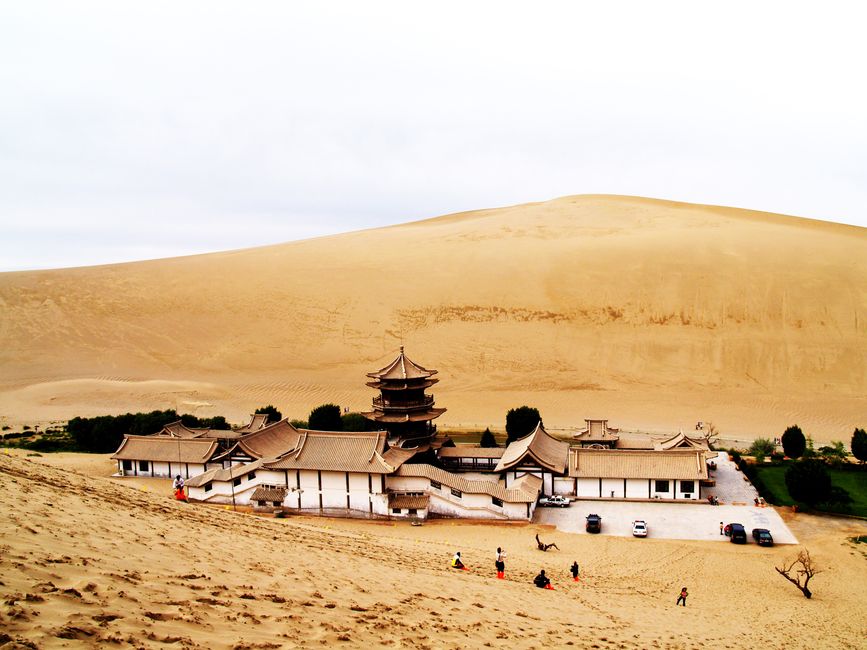
Dunhuang, an oasis town on the edge of the Gobi and the Kumtag Desert at the far western end of Gansu province in northwest China, was for a thousand years a gateway of the Silk Road, where caravans heading west chose the northern or southern route around the Taklamakan Desert. Its wealth and faith left one of the world’s greatest treasuries of Buddhist art: the Mogao Caves, a UNESCO World Heritage Site of hundreds of cave temples cut into a cliff above a dry riverbed between the 4th and 14th centuries, their walls covered with murals of paradises, flying apsaras, donors and daily life, and filled with painted clay Buddhas. Visits are carefully managed to protect the fragile paintings, with real-name booking, timed entry and daily caps. Just south of town rise the Mingsha Shan, the Singing Sand Dunes, sheltering the small Crescent Lake, where visitors ride camels and slide down the sand at sunset. Further out lie the Yumen Pass and Yangguan, ancient frontier gates of the Han empire, and the wind-carved rock formations of the Yardang Geopark. Dunhuang is a small, friendly city of about 190,000, with a lively night market. It is best from April to October, outside the hottest days of July and August.
Right now in Dunhuang
- Wed 14–22°C 57–72°F Cloudy
- Thu 11–19°C 52–66°F Partly cloudy
- Fri 9–22°C 47–71°F Mostly clear
Weather: MET Norway (CC BY 4.0)
Top tours in Dunhuang
See all tours for Dunhuang →
From local operators, with prices and reviews; you check availability and book on Viator, our partner. We may earn a commission at no extra cost to you. How we earn money
Dunhuang at a glance
- Best for: the Mogao Caves, Buddhist art, Silk Road history, sand dunes and desert landscapes, camel rides and sunsets.
- How long: 2–3 days.
- Best time: April to June and September to October; July and August are hot and busy; winters are cold but quiet, with cheaper Mogao tickets.
- Getting there: by air to Dunhuang (DNH), by train to Dunhuang Station, or by high-speed train to Liuyuan South on the Lanzhou–Urumqi line, then about 2 hours by road.
- Getting around: by taxi, DiDi, bus and tour minibus; the center is walkable.
- Good to know: book the Mogao Caves well ahead on the official WeChat account with your passport; the 240-hour visa-free transit does not cover Gansu.
- Before you go: visa-free entry, the arrival card, payments and general safety are in our China travel guide.
Dunhuang’s areas and where to stay
Dunhuang is compact. The Mogao Digital Exhibition Center is about 15 km (9 miles) east of the center, the caves about 25 km (16 miles) southeast, and the Mingsha dunes about 5 km (3 miles) south.
The town center and the night market
The center, around the Shazhou night market, the Dunhuang Museum and the main avenues, has most mid-range hotels, restaurants and tour offices, and is walkable in the evenings.
Mingshan Road and the dunes
Along Mingshan Road, leading south toward the Mingsha Shan, resort hotels, courtyard guesthouses and desert “glamping” camps line the road, some with dune views and rooftop terraces for sunsets.
Near the Mogao Caves and the airport
East of town, a few large hotels near the Digital Exhibition Center and the airport suit early cave visits but are far from restaurants.
Where to stay in Dunhuang
- Town center: convenient for food, the night market and transport.
- Mingshan Road: dune views, quieter resort-style hotels and guesthouses.
- Desert camps: tents and cabins near the dunes for stargazing.
Rooms fill and prices rise in July, August and the National Day holiday in early October.
The Mogao Caves
The Mogao Caves, about 25 km (16 miles) southeast of the town, were carved into the eastern face of the Mingsha hills above the Daquan River from about AD 366. Over the next millennium, through the Northern Wei, Sui, Tang, Song, Western Xia and Yuan dynasties, monks, merchants and officials funded hundreds of caves; some 735 survive, with about 45,000 m² (484,000 sq ft) of murals and more than 2,000 painted sculptures. Highlights include the giant seated Buddhas of the Nine-Story Pagoda (Cave 96), the reclining Buddha of Cave 148, and the Library Cave (Cave 17), sealed around 1000 and rediscovered in 1900, which held tens of thousands of manuscripts, now scattered among museums around the world. The caves are managed by the Dunhuang Academy, which researches and conserves them.
How visits work in 2026
According to the Dunhuang Academy’s 2026 opening notice, the Mogao Caves operate a real-name, timed booking system with daily caps:
- Regular visit (A ticket): up to 6,000 tickets a day. You start at the Mogao Digital Exhibition Center, where you watch two digital films in Exhibition Hall 1, then take a shuttle bus to the caves for a guided tour of 8 caves.
- Emergency visit (B ticket): up to 12,000 tickets a day, opened during the busy season when regular tickets are sold out, with a guided tour of 4 caves and no films. Check in at Exhibition Hall 2.
- Special caves: some of the finest caves open in limited numbers as a paid add-on, arranged at the special cave office in the cave area after your regular or emergency visit.
Book only through the official channels: the “Mogao Ku Canguan Yuyue Wang” (Mogao Caves visit booking) WeChat service account or its mini program. Holders of foreign passports and of Hong Kong, Macau and Taiwan travel permits use the “Ticket Booking” option in the WeChat service account’s booking menu. The academy has not authorized any third-party ticket sellers. Arrive at the Digital Exhibition Center at least 30 minutes before your time slot, with your passport; regular ticket holders exchange their booking for a paper “ticket information sheet” at the windows or self-service machines. There is no ticket office or parking at the caves themselves.
In the peak season (1 April to 30 November), the caves are open from 8:00 to 18:00, with the last check-in at 16:10; in the off-season (1 December to 31 March), from 9:00 to 17:00, with the last check-in at 15:10. Peak-season A tickets cost about 238 yuan and B tickets about 100 yuan, while off-season tickets are cheaper, at about 140 yuan. In the summer peak, A tickets often sell out within minutes of release, so book as early as the system allows. The caves close in heavy rain or sandstorms, with full refunds for unused tickets; this happened on 24 June and 29 July 2026.
Inside the caves, photography, touching the walls and leaning on screens are forbidden, and suitcases, large bags, pets and drones cannot be taken into the cave area. The official information line is 4008-333-715 (8:30–16:30), for questions only, not bookings.
Top things to see in Dunhuang
Mingsha Shan and Crescent Lake
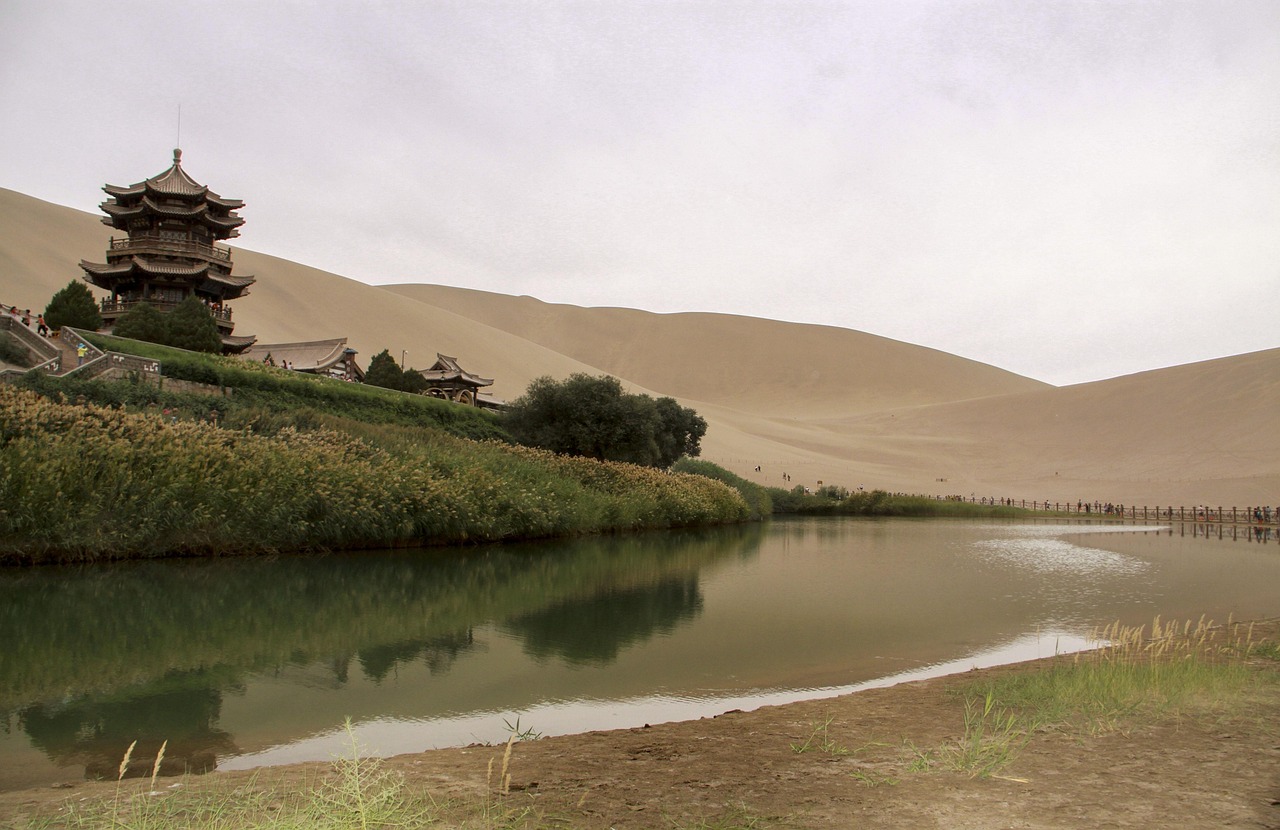
The Mingsha Shan (Singing Sand Mountains), a range of golden dunes up to about 100 m (330 ft) high, rumble when the sand slides, giving them their name. In a hollow among them lies Crescent Lake, a spring-fed pool with a rebuilt pavilion, which has survived centuries of shifting sand. Climb the dunes on wooden ladders, ride a camel along the ridges, try sandboarding or a buggy, and stay for sunset. Orange shoe covers are rented at the entrance to keep sand out of your shoes.
Yumen Pass and Yangguan
The Yumen Pass (Jade Gate Pass), about 90 km (56 miles) northwest, was the Han dynasty’s gateway for jade and goods from the west; a square earthen fort survives in the desert, with remains of the Han Great Wall and beacon towers nearby. Yangguan, about 70 km (43 miles) southwest, guarded the southern route, with a museum and a beacon tower on a ridge. Both are part of the Silk Roads UNESCO listing.
Yardang Geopark
The Dunhuang Yardang National Geopark, beyond the Yumen Pass, is a field of huge wind-eroded clay formations shaped like ships, castles and animals, visited by park bus; it is spectacular at sunset.
Dunhuang Museum
The Dunhuang Museum presents the history of the oasis and the Silk Road, with manuscripts, Han wooden slips and models of the frontier. Entry is free.
Western Thousand Buddha Caves
The Western Thousand Buddha Caves, about 35 km (22 miles) southwest, are a smaller group of cave temples on a cliff above a river, managed by the Dunhuang Academy and much quieter than Mogao.
More classic sights
- Yulin Caves: cave temples with superb Western Xia murals in Guazhou county, about 170 km (106 miles) east.
- Shazhou night market: food stalls, crafts and Silk Road souvenirs in the evenings.
- White Horse Pagoda: a small pagoda linked to the monk Kumarajiva’s journey to China.
- Dunhuang shows: staged music and dance productions inspired by the Mogao murals.
Other things to do in Dunhuang
Desert experiences
Beyond the camel rides at the dunes, you can join overnight desert treks with camping, ride in off-road vehicles, or simply lie on the sand under a sky full of stars far from city lights. See our hiking guide.
Silk Road journeys
Dunhuang sits on one of the classic overland routes of Asia. Travelers continue west through Turpan and Urumqi in Xinjiang toward Kazakhstan and Almaty, or east along the Hexi Corridor through Jiayuguan, with its Ming fort at the western end of the Great Wall, Zhangye’s rainbow-colored Danxia hills and Lanzhou, to Xi’an, the old capital at the eastern end of the road. See our city sightseeing guide.
Food and drink
Dunhuang’s cooking blends northwest Chinese and Hui Muslim traditions. Try donkey meat with yellow noodles (lürou huangmian), the local specialty; Lanzhou-style beef noodles; lamb skewers and hand-pulled noodles; niangpi (cold noodles); and the sweet apricot skin water (xingpi shui), a refreshing drink made from dried apricots. Melons, grapes and apricots from the oasis are excellent in summer and autumn, and the night market has dozens of stalls.
Day trips from Dunhuang
- Yumen Pass, the Han Great Wall and the Yardang Geopark: a classic full-day loop to the northwest, usually by tour minibus or private car.
- Yangguan: the southern Han pass and museum, often combined with the Western Thousand Buddha Caves.
- Yulin Caves: a half-day or full-day trip east to Guazhou.
- Jiayuguan: the Ming fort at the western end of the Great Wall, about 4–5 hours by road or train.
- Zhangye Danxia: striped red, yellow and orange hills, about 6–7 hours by road or a few hours by high-speed train from Liuyuan South; best on an overnight trip.
Getting there and getting around
By air
Dunhuang Mogao International Airport (DNH), about 13 km (8 miles) east of town, has flights from cities such as Lanzhou, Xi’an, Beijing, Shanghai and Chengdu, with more routes in summer. Taxis to the center take about 20 minutes.
By train
Dunhuang Station, east of town, has trains to Lanzhou, Jiayuguan and Xi’an, including overnight sleepers. Liuyuan South, about 130 km (81 miles) north, is on the Lanzhou–Urumqi high-speed line, with fast trains to Jiayuguan, Zhangye, Lanzhou, Turpan and Urumqi; buses and taxis link it with Dunhuang in about 2 hours. Book on the 12306 website or app with your passport.
Visa-free transit
Gansu has no port in the 240-hour visa-free transit, and Dunhuang is outside the permitted areas, so you need a visa or visa-free entry to China to visit.
Around town
The town center is small and walkable. Taxis and DiDi are cheap; bus 3 runs to the Mingsha dunes, and shuttle buses run from town to the Mogao Digital Exhibition Center. For the Yumen Pass, Yardang and Yangguan, join a minibus tour or hire a car and driver.
When to go and how long to stay
Dunhuang has an extremely dry desert climate, with fewer than 80 mm (3 in) of rain a year, strong sunshine and large daily temperature swings. Spring (April–May) is warm by day and cool at night, with occasional sandstorms. Summer (June–August) is hot, often above 30 °C (86 °F) in the afternoons, with the strongest sun and the most visitors; the rare heavy rains of summer can close the caves. Autumn (September–October) is clear, warm and calm, the best time. Winter (November–March) is cold and dry, with nights well below freezing, but the caves are quiet and the light is beautiful. Dunhuang has no station in the WMO 1991–2020 series, so the table uses the 1991–2020 climate normals for the Yumenzhen station of the China Meteorological Administration (CMA), about 200 km (124 miles) to the east at about 1,530 m (5,020 ft), as submitted to the World Meteorological Organization (WMO): average daily highs and lows, total precipitation, and days with at least 1 mm of rain. Dunhuang, lower at about 1,140 m (3,740 ft), is a few degrees warmer in summer.
| Month | Average high / low | Rain (days with 1 mm or more) | What to expect |
|---|---|---|---|
| January | −3 °C (27 °F) / −15 °C (4 °F) | 2 mm (0.1 in), 1 day | Cold, dry and sunny |
| February | 3 °C (37 °F) / −11 °C (12 °F) | 2 mm (0.1 in), under 1 day | Cold; Chinese New Year |
| March | 10 °C (51 °F) / −4 °C (24 °F) | 5 mm (0.2 in), 1 day | Cool and windy; spring dust |
| April | 18 °C (65 °F) / 3 °C (37 °F) | 4 mm (0.2 in), 1 day | Mild days, cool nights; Mogao peak season begins |
| May | 24 °C (75 °F) / 8 °C (47 °F) | 9 mm (0.3 in), 2 days | Warm; occasional sandstorms |
| June | 28 °C (82 °F) / 13 °C (55 °F) | 15 mm (0.6 in), 2 days | Hot and dry |
| July | 30 °C (86 °F) / 15 °C (59 °F) | 13 mm (0.5 in), 3 days | Hot; peak season; rare storms |
| August | 29 °C (84 °F) / 13 °C (56 °F) | 12 mm (0.5 in), 3 days | Hot and busy |
| September | 24 °C (74 °F) / 8 °C (46 °F) | 8 mm (0.3 in), 1 day | Warm and clear; ideal |
| October | 16 °C (61 °F) / 1 °C (34 °F) | 2 mm (0.1 in), 1 day | Mild days and crisp nights; Golden Week crowds |
| November | 7 °C (44 °F) / −6 °C (21 °F) | 2 mm (0.1 in), 1 day | Cold nights; quiet |
| December | −1 °C (29 °F) / −13 °C (9 °F) | 3 mm (0.1 in), 1 day | Cold; off-season Mogao prices |
Yumenzhen receives about 76 mm (3 in) of rain a year, mostly from May to September.
Two days in Dunhuang
Day one: the Mogao Caves in the morning (booked ahead), the Dunhuang Museum in the afternoon, and the night market for dinner. Day two: the Yumen Pass, the Han Great Wall and the Yardang Geopark, returning for sunset on the Mingsha dunes and Crescent Lake.
Three to four days
Add Yangguan and the Western Thousand Buddha Caves, the Yulin Caves, a desert camp night or a special-cave visit at Mogao; then continue along the Silk Road to Jiayuguan, Zhangye and Lanzhou, or west to Turpan and Urumqi.
What a trip to Dunhuang costs
Prices are approximate, for October 2026, converted at about 6.74 yuan to the US dollar.
| Item | Typical cost |
|---|---|
| Mogao Caves, A ticket (regular visit), peak season | about 238 CNY (about US$35) |
| Mogao Caves, B ticket (emergency visit), peak season | about 100 CNY (about US$15) |
| Mogao Caves, off-season ticket | about 140 CNY (about US$21) |
| Mingsha Shan and Crescent Lake | about 110 CNY (about US$16) |
| Camel ride at the dunes | about 100–150 CNY (about US$15–22) |
| Yumen Pass and Yardang day tour | about 200–350 CNY (about US$30–52), plus tickets |
| Donkey meat with yellow noodles | 30–60 CNY (about US$4.50–9) |
| Mid-range hotel double, per night | 250–600 CNY (about US$37–89), more in July and August |
Practical tips for Dunhuang
- Book Mogao first: reserve your cave slot on the official WeChat account before you fix the rest of your plans; A tickets sell out fast in summer.
- Allow half a day for Mogao: the films, shuttle and cave tour take about 3–4 hours.
- Go to the dunes late: the light and temperature are best in the two hours before sunset.
- Hire a driver for the passes: the Yumen Pass, Yardang and Yangguan are far apart in the desert.
- Protect cameras from sand: keep gear in sealed bags on the dunes.
- Carry your passport: for Mogao, trains, hotels and checks.
Safety
Dunhuang is a safe, small town; the main risks come from the desert climate. In summer, afternoon temperatures can climb well above 30 °C (86 °F) on the dunes and at the remote sites, where there is no shade, and the air is extremely dry, so dehydration and heatstroke are real risks: drink plenty of water, wear a wide-brimmed hat, sunglasses and sunscreen, and plan desert outings for the morning and late afternoon. Nights are cool even in summer and cold in spring and autumn. Sandstorms in spring can reduce visibility and close sites; follow official notices. The rare heavy rains of summer can cause flash floods and close the Mogao Caves. On the dunes, follow the marked routes and listen to camel handlers; sandboarding and buggies cause injuries. Do not wander into the desert alone: distances are large and phone signal is patchy. In an emergency, call 110 for police, 120 for an ambulance and 119 for fire.
What to pack for Dunhuang
Light, long-sleeved clothing and a wide-brimmed hat, sunglasses, high-factor sunscreen, lip balm and moisturizer for the dry air, a scarf or buff against sand, a warm layer for cool nights, and closed shoes for the dunes. China uses 220 V, with flat two-pin, round two-pin and angled three-pin sockets. See our hiking shoes and travel adapters guides.
Dunhuang travel FAQ
How do I book the Mogao Caves?
Book a real-name time slot on the official “Mogao Ku Canguan Yuyue Wang” WeChat service account or mini program; foreign passport holders use the “Ticket Booking” option. The academy has not authorized third-party sellers.
What is the difference between Mogao A and B tickets?
The A ticket (regular visit, up to 6,000 a day) includes two digital films and a guided tour of 8 caves; the B ticket (emergency visit, up to 12,000 a day, opened in the busy season) includes 4 caves without the films.
How much are Mogao Caves tickets?
About 238 yuan for the A ticket and about 100 yuan for the B ticket in peak season, and about 140 yuan in the off-season.
What are the Mogao Caves opening hours?
8:00 to 18:00 from 1 April to 30 November (last check-in 16:10) and 9:00 to 17:00 from 1 December to 31 March (last check-in 15:10).
Can I take photos inside the Mogao Caves?
No. Photography is forbidden inside the caves to protect the murals.
How many days do I need in Dunhuang?
Two to three days for Mogao, the dunes and the western passes.
What is the best time to visit Dunhuang?
April to June and September to October; summer is hot and crowded.
How do I get to Dunhuang?
Fly to Dunhuang, take a train to Dunhuang Station, or take a high-speed train to Liuyuan South and continue about 2 hours by road.
Can I use the 240-hour visa-free transit to visit Dunhuang?
No. Gansu is not in the permitted areas; you need a visa or visa-free entry.
Is Dunhuang hot?
Summer afternoons are hot and very dry, often above 30 °C (86 °F), while nights are cool and winters cold.
Sources and last review
Researched and last reviewed on 5 October 2026. The Mogao Caves’ 2026 opening seasons and hours, real-name timed booking, daily limits of 6,000 regular and 12,000 emergency tickets, what each visit includes, special caves, the official WeChat booking channels and the “Ticket Booking” option for foreign passports, the lack of authorized third-party sellers, arrival times, the ticket information sheet, the rules in the cave area and refunds when the caves close: the Dunhuang Academy’s “2026 Mogao Caves opening notice” of 30 March 2026; closures and reopenings on 24–25 June and 29–30 July 2026: the Mogao Caves Opening Management Committee’s notices on the Dunhuang Academy website; visa-free transit and the permitted areas: the National Immigration Administration; train booking with a passport: China Railway’s official 12306 site; climate normals: the China Meteorological Administration via the World Meteorological Organization’s 1991–2020 normals (Yumenzhen station, the nearest in the series); the exchange rate: the CFETS central parity rate; the Mogao and Silk Roads inscriptions: the UNESCO World Heritage List. Mogao ticket prices (not stated in the 2026 notice), cave numbers and dates, the dunes’ ticket, distances, flights, train links and typical prices are general references or estimates, flagged for checking. Prices and rules change, so check locally before you go. For entry rules, money and general safety, see our China travel guide.
Plan your trip
Partner links: TravelerCenter may earn a commission if you book, at no extra cost to you.
🇨🇳 Useful Mandarin Chinese phrases for Dunhuang
All 38 Mandarin Chinese phrases: restaurant, hotel, emergencies, romance (printable) →