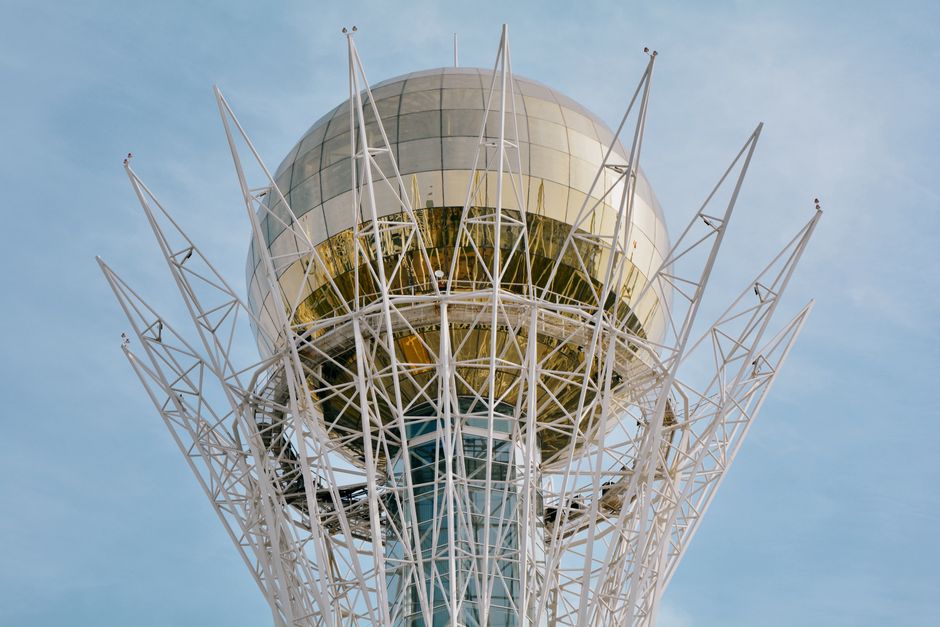
Kazakhstan is the world’s largest landlocked country, a land of endless steppe, snow-capped mountains, canyons, deserts and futuristic cities stretching from the Caspian Sea to the Altai and the borders of China. Most visits start in Almaty, a leafy city of apple orchards and Soviet boulevards at the foot of the Tian Shan, where you can reach the Medeu skating rink, the Shymbulak ski resort and the turquoise Big Almaty Lake in less than an hour. From there, road trips lead to the red walls of Charyn Canyon, the Kolsai Lakes and the sunken forest of Kaindy, and to the dunes of Altyn-Emel. The capital, Astana, rises from the northern steppe with bold modern architecture by world-famous designers. Farther afield lie the turquoise-domed mausoleum of Turkistan, the lakes and pine forests of Burabay, the otherworldly cliffs of Mangystau by the Caspian, and the Baikonur Cosmodrome. Travel is easy for many visitors: citizens of dozens of countries can stay 30 days without a visa, flights and overnight trains link the cities, and Almaty is one of Central Asia’s most cosmopolitan cities. A few things need planning: distances are enormous, winters in the north are among the coldest of any capital, mountain weather changes fast, and a local SIM card needs extra steps to keep working.
Right now in Kazakhstan
- Wed 2–12°C 36–54°F 2 mm Partly cloudy
- Thu 6–14°C 43–57°F 10 mm Mostly clear
- Fri 4–11°C 39–51°F Clear
Weather: MET Norway (CC BY 4.0)
Multi-day tours of Kazakhstan
Multi-day tours from local operators. You check dates and book on Viator, our partner; we may earn a commission at no extra cost to you. How we earn money
Kazakhstan at a glance
The Republic of Kazakhstan covers about 2.72 million km² (1.05 million sq miles), the ninth-largest country in the world and about the size of Western Europe, but it has only about 20 million people, one of the lowest population densities on Earth. It borders Russia, China, Kyrgyzstan, Uzbekistan and Turkmenistan, with a long coast on the landlocked Caspian Sea. The country is divided into 17 regions and three cities of national significance: the capital, Astana; the largest city, Almaty; and Shymkent. Kazakh is the state language and Russian an official language, spoken by almost everyone in the cities; English is common among young people and in tourism. Most Kazakhs are Sunni Muslims, and there is a large Orthodox Christian population of Russian heritage; the country is secular and diverse, home to more than a hundred ethnic groups.
Since March 1, 2024, the whole of Kazakhstan has used a single time zone, UTC+5, with no daylight saving time. Electricity is 220 V, with round two-pin sockets (types C and F). The currency is the tenge (KZT).
A short history
The steppes of Kazakhstan were home to some of the world’s first horse-riding nomads, to the Scythian Saka, whose “Golden Man” warrior was found in a burial mound near Almaty, and to the Turkic peoples who moved across them for centuries. Silk Road cities flourished in the south, around Turkistan and Taraz, until the Mongol conquest of the 13th century. The Kazakh Khanate was founded in the 1460s, and its three tribal groups, the hordes or zhuz, came gradually under Russian control from the 18th century. In the Soviet era, the forced settlement of the nomads and the famine of the early 1930s killed more than a million Kazakhs; the steppe became home to labor camps, the Virgin Lands farming campaign, the Baikonur Cosmodrome and the Semipalatinsk nuclear test site. Kazakhstan was the last Soviet republic to declare independence, in December 1991. The capital moved from Almaty to Astana in 1997.
Kazakhstan’s regions
- The southeast (Almaty and the Tian Shan): Almaty, the Ile-Alatau mountains, Big Almaty Lake, Charyn Canyon, the Kolsai Lakes and Kaindy, Altyn-Emel National Park and Lake Balkhash.
- The south (the Silk Road): Shymkent, Turkistan and its mausoleum, the ancient city of Otrar, Taraz and the Aksu-Zhabagly nature reserve.
- The north and center (the steppe): Astana, the lakes and forests of Burabay, Karaganda and the Saryarka steppe and lakes.
- The west (the Caspian): Aktau, the cliffs and underground mosques of Mangystau, and the oil city of Atyrau.
- The east (the Altai): Ust-Kamenogorsk, the Katon-Karagay National Park, Lake Markakol and the Belukha massif.
Where to go: mountains, canyons, steppe and cities
Most first trips focus on Almaty and its mountains, often with a road trip east to the canyons and lakes, a flight or overnight train to Astana, and perhaps a few days in the south around Turkistan. See our guides to the two main cities:
- Almaty: the green former capital, with the Zenkov Cathedral, the Green Bazaar, Kok-Tobe, the Medeu skating rink, Shymbulak and Big Almaty Lake.
- Astana: the futuristic capital on the steppe, with the Bayterek tower, the Khan Shatyr, the Palace of Peace and Reconciliation, the National Museum and the EXPO sphere.
The southeast is Kazakhstan’s outdoor playground. Charyn Canyon, about 200 km (125 miles) east of Almaty, has a “Valley of Castles” of red sandstone towers along a river; the three Kolsai Lakes, set in spruce forests, and Kaindy Lake, where the trunks of drowned trees rise from turquoise water, lie in the mountains beyond. Altyn-Emel National Park, about 250 km (155 miles) northeast of Almaty, has the “Singing Dune,” the colorful Aktau mountains and herds of wild kulan.
In the south, Turkistan is home to the 14th-century Mausoleum of Khoja Ahmed Yasawi, built by Timur, Kazakhstan’s greatest monument and a major pilgrimage site; it has its own airport and a new tourist old town. In the north, Burabay, about three hours from Astana, is a resort area of granite peaks, pine forests and lakes. In the west, Mangystau is a desert region of white chalk cliffs, canyons such as Bozzhyra, and ancient underground mosques, reached from Aktau on the Caspian. The Baikonur Cosmodrome, leased to Russia, can be visited only on organized tours to watch launches, with special permits.
In the far east, the Altai region around Ust-Kamenogorsk and the Katon-Karagay National Park offers alpine meadows, horse treks, Old Believer villages and the glaciers of Mount Belukha, which Kazakhstan shares with Russia; border-zone permits are needed for some areas, so travel with a local operator. On the Caspian, Aktau is a Soviet-planned city of numbered districts with sandy beaches, and the deserts of Mangystau beyond are best explored on a three- or four-day 4×4 trip with camping under the stars, taking in the Bozzhyra canyon, the Torysh “valley of balls” with its spherical stone concretions, and the underground mosques of Beket-Ata and Shakpak-Ata.
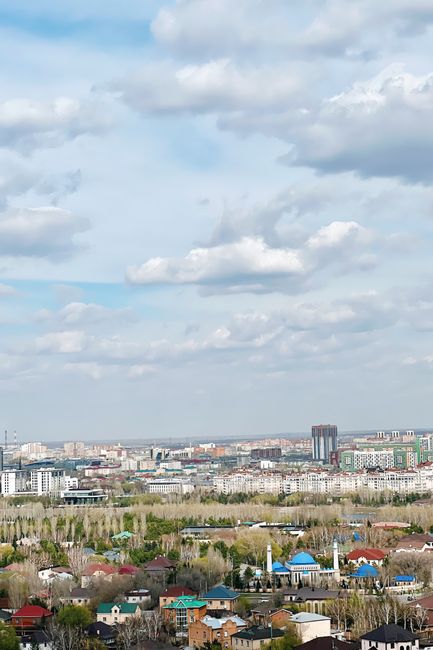
Almaty Travel Guide
Plan a trip to Almaty: neighborhoods and where to stay, Panfilov Park and the Zenkov Cathedral, the Green Bazaar, Kok-Tobe, museums and the metro,…
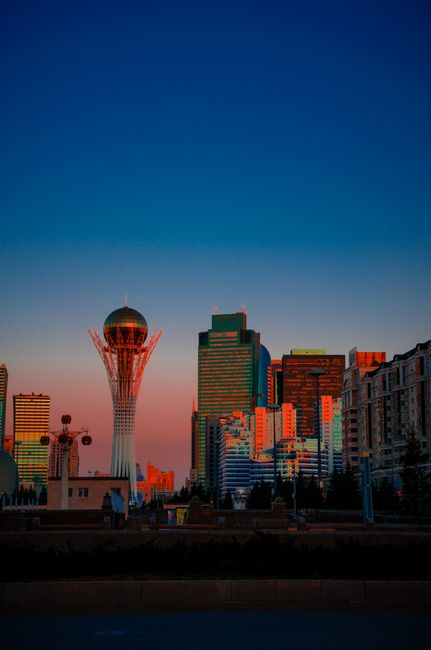
Astana Travel Guide
Plan a trip to Astana: the Left Bank and Right Bank and where to stay, the Bayterek tower, Khan Shatyr, the Palace of Peace…
Best time to visit Kazakhstan
Kazakhstan has an extreme continental climate, with hot summers, very cold winters and big differences between regions. Late spring, from May to June, and early autumn, from September to early October, are the best times for most of the country: warm days, green or golden landscapes and clear mountain views. Summer, from July to August, is the season for hiking in the Tian Shan and the Altai, with warm days in Almaty around 30 °C (86 °F) and heat in the deserts and the south; it is also when Kazakhs take their holidays. Winter, from November to March, is long and cold: Almaty is relatively mild, with skiing at Shymbulak from about December to April, while Astana, on the open steppe, has average January lows around −19 °C (−1 °F), and bitter winds can push the wind chill below −40 °C (−40 °F).
In practice, choose May, June and September for a combined city and nature trip, July and August for high mountain treks, and December to March for skiing near Almaty.
Spring on the steppe is short but spectacular: in April and early May, wild tulips, the ancestors of the garden tulip, bloom across the southern steppe and the foothills, especially in the Aksu-Zhabagly reserve and around Almaty, followed by poppies in May. In autumn, aspens and birches turn the mountain valleys gold in late September, and the first snows dust the peaks above Almaty in October.
The table shows rounded averages from the 1991–2020 climate normals of Kazhydromet, Kazakhstan’s national hydrometeorological service, as submitted to the World Meteorological Organization (WMO), for one station in each main region.
| Area (station) | January high / low | July high / low | Precipitation a year | Wettest months |
|---|---|---|---|---|
| Southeast: Almaty | 0 °C (33 °F) / −8 °C (17 °F) | 30 °C (87 °F) / 19 °C (65 °F) | about 670 mm (27 in) | April and May |
| North: Astana | −10 °C (13 °F) / −19 °C (−1 °F) | 27 °C (80 °F) / 15 °C (59 °F) | about 340 mm (13 in) | June and July |
| South: Shymkent | 5 °C (41 °F) / −5 °C (23 °F) | 34 °C (93 °F) / 19 °C (65 °F) | about 610 mm (24 in) | January to March |
| West: Aktau | 3 °C (38 °F) / −3 °C (26 °F) | 32 °C (90 °F) / 21 °C (70 °F) | about 170 mm (7 in) | November to January |
Kazakhstan month by month
| Month | Weather | Highlights | Crowds and prices |
|---|---|---|---|
| January | Very cold in the north; snowy in Almaty | Skiing at Shymbulak; ice skating at Medeu | Moderate in the mountains |
| February | Cold | Skiing; winter festivals | Moderate |
| March | Cold north, thawing south | Nauryz (March 21–23), the spring new year | Low |
| April | Mild south; snowmelt in the mountains | Tulips in bloom on the steppe; apricot blossom | Low |
| May | Warm and green | Excellent for Almaty, Charyn and Turkistan | Moderate |
| June | Warm to hot | Mountain lakes accessible; long days | Moderate to high |
| July | Hot in the south and deserts; warm in the north | High treks; Capital Day in Astana (July 6) | High |
| August | Hot | Mountain treks; apples and melons | High |
| September | Warm days, cool nights | Golden aspens; harvest season | Moderate |
| October | Cool; first snow in the mountains | Autumn colors in the Tian Shan | Low |
| November | Cold | Quiet season | Low |
| December | Very cold in the north | Independence Day (December 16); ski season opens | Rising |
Festivals and holidays
- Nauryz: the spring new year, a public holiday from March 21 to 23, with yurts in city squares, horse games, music and the seven-ingredient soup nauryz kozhe.
- Unity of the People of Kazakhstan Day: May 1, followed by Defender of the Fatherland Day (May 7) and Victory Day (May 9).
- Capital Day: July 6, with concerts and fireworks in Astana.
- Kurban Ait: Eid al-Adha, a public holiday whose date moves about 11 days earlier each year.
- Republic Day and Independence Day: October 25 and December 16.
- World Nomad Games: held in Astana in 2024 with horseback games, eagle hunting and wrestling; check whether events are scheduled during your visit.
Extreme cold, heat and mountain weather
Winters on the northern steppe are severe: in Astana, temperatures can fall below −30 °C (−22 °F), with blizzards (buran) that close roads and disrupt flights; dress in proper winter clothing, cover exposed skin and follow road-closure alerts. In summer, the southern deserts and Mangystau exceed 35 °C (95 °F). In the mountains, weather changes very quickly, snow is possible even in summer at altitude, and avalanches, mudslides and rockfalls are real risks in spring.
How long to stay: sample itineraries
- 5 days: Almaty (3 nights), with Medeu, Shymbulak and Big Almaty Lake, and a long day trip to Charyn Canyon.
- 7–8 days: add a two-day road trip to Charyn, the Kolsai Lakes and Kaindy, and two days in Astana by flight or overnight train.
- 10–14 days: add Turkistan and Shymkent in the south, or Burabay near Astana, or a few days in Mangystau.
- Two to three weeks: combine Kazakhstan with Kyrgyzstan, whose capital, Bishkek, is about four hours by road from Almaty, and Uzbekistan, reached from Shymkent.
Entry, money and costs
Visas (last reviewed October 2026)
According to Kazakhstan’s e-government portal (egov.kz) and the UK government, citizens of more than 50 countries, including the United States, the United Kingdom, Canada, Australia, New Zealand, Japan, Singapore, Malaysia, the larger European Union countries, Switzerland and Norway, can visit without a visa for up to 30 days per entry, for tourism or business, with a maximum of 90 days in any 180-day period. Citizens of most former Soviet republics, Mongolia and a few other countries can stay longer, usually 90 days; citizens of China, South Korea, Turkey, the United Arab Emirates, Brazil and Argentina can stay up to 30 days under bilateral agreements; and citizens of India, Iran, Hong Kong and Macao can visit visa-free for up to 14 days. Visa-free visitors may not work. According to the UK government, your passport must be valid for at least 30 days after arrival, with a blank page.
Citizens of countries that need a visa can apply online for an e-visa through Kazakhstan’s government visa and migration portal, for tourism or business, or at an embassy; according to the UK government, visa applicants aged 17 and over give fingerprints. Check the current list and rules on the official portals before you book.
Registration, QazETA and SIM cards
Your hotel or host must register your arrival with the authorities within three working days, according to the UK government; hotels do this automatically. If you buy a local SIM card, you must verify your phone’s IMEI on the imei.kz portal, which needs a border-crossing certificate from the official QazETA mobile app and a Kazakh individual identification number (IIN); otherwise, the SIM is blocked after 30 days. For short stays, a local SIM works for the first 30 days, and an international eSIM avoids the procedure.
Customs and rules to know
You must declare cash worth more than US$10,000 on arrival. According to the UK government, selling, importing or distributing e-cigarettes and vapes is illegal in Kazakhstan, smoking is banned in most public places, and shops may not sell alcohol between 11 p.m. and 8 a.m. Drinking in the street can lead to a fine or detention. Carry your original passport, as police may ask for it and copies are not accepted. Drug offenses carry long prison sentences. Flying a drone requires a license from the Civil Aviation Committee. A few areas, including the town of Baikonur, are closed to foreigners without prior permission. According to the UK government, a law adopted in December 2025 prohibits the “promotion” of non-traditional sexual orientations; same-sex relations are not illegal, but public attitudes are conservative outside the big cities.
Money and cards
The currency is the tenge (KZT). On October 5, 2026, the National Bank of Kazakhstan’s official rate was about 448 tenge to the US dollar. Kazakhstan is highly cashless: cards and phone payments are accepted almost everywhere in cities, including taxis, cafés and markets, and ATMs are common. Carry some cash for rural guesthouses, bazaars and national park fees. Change money only at banks and licensed exchange offices, which require your passport and reject damaged or old US banknotes.
Tipping
Many restaurants add a 10–15% service charge; where they don’t, leaving about 10% is common in cities. Tip guides and drivers on tours.
What a trip costs
Prices are approximate, for October 2026, converted at about 448 tenge to the US dollar.
| Item | Typical cost |
|---|---|
| Beshbarmak or plov in a café | 2,500–4,500 KZT (about US$5.60–10) |
| Dinner in a mid-range restaurant | 7,000–15,000 KZT (about US$16–33) per person |
| Cappuccino | 1,200–2,000 KZT (about US$2.70–4.50) |
| Ride-hailing taxi across Almaty | 1,500–3,500 KZT (about US$3.30–7.80) |
| Overnight train, Almaty to Astana, sleeper | 15,000–40,000 KZT (about US$33–90) |
| Charyn Canyon or national park entry | 1,000–3,000 KZT (about US$2.20–6.70) |
| Mid-range hotel double, per night | 30,000–60,000 KZT (about US$67–134) |
A comfortable mid-range trip costs roughly 45,000–75,000 KZT (about US$100–167) per person per day, sharing a double room; backpackers using hostels, cafeterias and public transport can manage on 18,000–28,000 KZT (about US$40–63).
Getting there and getting around
Airports
The main international airports are Almaty (ALA) and Astana (NQZ), with flights from Istanbul, Dubai, Frankfurt, Seoul, Tokyo, Delhi, Beijing, Tashkent, Bishkek and many other cities; see our Istanbul, South Korea and Japan guides. Air Astana and the low-cost FlyArystan, SCAT and others fly between Almaty, Astana, Shymkent, Turkistan, Aktau and other cities; with distances this large, domestic flights save days.
Trains
The national railway, Kazakhstan Temir Zholy (KTZ), runs trains across the country, from fast Talgo trains to slow sleepers. The overnight Almaty–Astana service takes about 12–13 hours on the fastest trains, a comfortable alternative to flying, with sleeping compartments. Other routes link Almaty with Shymkent and Turkistan, and Astana with Burabay (Shchuchinsk). Buy tickets on the railway’s official site or app, or at stations, with your passport.
Buses, shared taxis and tours
Buses and minibuses link cities and towns, and shared taxis wait at bus stations. For the canyons and mountain lakes east of Almaty, public transport is limited, so most visitors join a tour or hire a car with a driver.
Driving
Kazakhs drive on the right. You need an international driving permit with your license. Main highways are improving, but many roads are poorly maintained, roadworks are often unmarked, livestock wander onto rural roads, and service stations are far apart; in winter, snow, ice and blizzards make driving hazardous, and roads are closed during storms. Alerts in English are published on the QazAvtoZhol website.
Planning around the distances
It is easy to underestimate Kazakhstan’s size: Almaty to Astana is about 1,200 km (750 miles) by road, and Almaty to Aktau about 3,000 km (1,900 miles), farther than London to Moscow. Build your trip around one or two regions, use domestic flights for the long jumps, and keep road trips to the Almaty region, where the canyons and lakes are within a day’s drive. On road trips east of Almaty, fill up with fuel whenever you can, carry water and snacks, and download offline maps, as mobile coverage disappears in the canyons and mountains. Overnight trains are a good way to cover distance without losing a day, and the Almaty–Shymkent–Turkistan route links neatly with Uzbekistan.
Land borders
Kazakhstan has busy road crossings with Kyrgyzstan (Korday, near Bishkek), Uzbekistan (Zhibek Zholy, near Tashkent) and Russia, and trains and buses to China. See our Kyrgyzstan, Uzbekistan and Russia guides. Crossings can close at short notice.
National parks and World Heritage Sites
Kazakhstan’s UNESCO World Heritage Sites include:
- Mausoleum of Khoja Ahmed Yasawi: the great Timurid shrine in Turkistan, inscribed in 2003.
- Petroglyphs of Tamgaly: thousands of Bronze Age rock carvings northwest of Almaty, inscribed in 2004.
- Saryarka – Steppe and Lakes of Northern Kazakhstan: wetlands visited by flamingos and migrating birds, inscribed in 2008.
- Silk Roads: the Routes Network of Chang’an–Tianshan Corridor: ancient cities on the Silk Road, inscribed in 2014.
- Western Tien-Shan: mountain forests and meadows shared with Kyrgyzstan and Uzbekistan, including the Aksu-Zhabagly reserve.
- Cold Winter Deserts of Turan: desert ecosystems inscribed in 2023.
National parks such as Ile-Alatau above Almaty, Kolsai Lakes, Charyn, Altyn-Emel, Burabay and Katon-Karagay charge small entry fees, and some require online registration for overnight stays or certain trails. See our hiking guide.
Culture, food and everyday etiquette
Food
Kazakh cuisine is the food of nomads, built around meat, dairy and bread. The national dish is beshbarmak, boiled horse meat or mutton on wide noodles with onion broth, eaten “with five fingers”; try also kazy, horse-meat sausage; baursak, puffy fried dough served with tea; kurt, dried salty cheese balls; plov; manti; lagman; and shashlik. Tea with milk is drunk constantly, and fermented mare’s milk, kumis, and camel’s milk, shubat, are summer specialties. Almaty is famous for its apples, the ancestors of the domestic apple grew wild in the surrounding mountains. The cities have excellent Korean, Uyghur, Georgian, Russian and international restaurants.
Hospitality
Hospitality (konakzhaylylyk) is central to Kazakh culture. If you are invited to a home, take a small gift, remove your shoes, and expect a table laden with food; the guest of honor may be offered the sheep’s head to share out. Accept tea when offered, and don’t refuse food outright.
Nomad traditions
Nomadic culture is still alive in Kazakhstan. Yurts (kiyiz uy) are set up for festivals and in summer pastures, and you can stay in yurt camps near the Kolsai Lakes, in Altyn-Emel and on the steppe. Horse games such as kokpar, a rough team sport played with a goat carcass, and kyz kuu, a chase in which a young man pursues a woman on horseback, are staged at festivals. In the mountains and the south, a few families still practice berkutchi, hunting with golden eagles, and some offer demonstrations to visitors. The two-stringed dombra is the national instrument, heard at every celebration.
Remembering the Soviet past
Several museums tell the darker story of the Soviet era. Near Astana, the ALZHIR memorial museum stands on the site of a Gulag camp for the wives of “traitors to the motherland.” In Dolinka, near Karaganda, the KarLag museum occupies the former headquarters of one of the largest Soviet labor camp systems. In the northeast, Semey (formerly Semipalatinsk) has memorials to the victims of the more than 450 nuclear tests carried out at the nearby test site between 1949 and 1989, which Kazakhstan closed in 1991. The tests and the shrinking of the Aral Sea in the southwest are part of the country’s modern identity.
A few words of Kazakh
Russian is understood almost everywhere, and English in hotels and many restaurants in the big cities. Kazakhs appreciate a few words of Kazakh: sälemetsiz be (hello), rakhmet (thank you), sau bolyňyz (goodbye), iä (yes), zhok (no) and kansha? (how much?).
Responsible travel
Stay on marked trails in the national parks, take your trash with you, and respect fire bans in forests and on the steppe. Don’t buy products from protected wildlife, and choose operators who keep horses and eagles well. Support community tourism in villages such as Saty near the Kolsai Lakes.
Etiquette
Greet people with a handshake (men) and a smile; wait for women to offer their hand. Dress modestly at mosques, covering legs and shoulders, and women should cover their hair. Respect national symbols: it is an offense to post content that disrespects the flag, religion or culture. Don’t point your feet at people or step over food laid out on a cloth.
Safety, health and connectivity
Kazakhstan is generally safe for visitors. These are the main things to know:
- Petty crime: pickpocketing is common in markets and on public transport, and there have been robberies near nightclubs in big cities at night; use pre-booked or app taxis and avoid walking alone late.
- Roads: driving standards are erratic, many cars lack rear seat belts, and winter driving is dangerous; avoid long drives at night.
- Mountains: weather changes quickly, with risks of avalanches, rockfalls and altitude sickness; trek with a reputable agency and tell someone your route. Almaty’s mountain rescue service has bases at Shymbulak and near Big Almaty Lake; the emergency numbers are 112 and 109 in Almaty.
- Extreme cold: in Astana and the north, winter temperatures can fall below −30 °C (−22 °F); dress for the conditions and limit time outdoors in blizzards.
- Photography: don’t photograph military sites, border areas, airports and some official buildings; some supermarkets ban photography.
- Earthquakes: Almaty lies in an active seismic zone.
- Health: tick-borne encephalitis is present in mountain forests in spring and summer; use repellent and check for ticks. Tap water is generally safe in big cities but bottled water is advisable elsewhere.
- Emergencies: call 112; or 101 for fire, 102 for police and 103 for an ambulance.
Mobile coverage is good in cities and along main roads but patchy in the mountains and steppe. Prepaid SIM cards from Beeline, Kcell, Tele2 and Activ are sold with your passport (see the IMEI rule above); Wi-Fi is standard in hotels and cafés.
Things to do: mountains, canyons, steppe and space
Ski or hike at Shymbulak, skate at Medeu, walk up to Big Almaty Lake, camp near the Kolsai Lakes, drive the Valley of Castles in Charyn Canyon, hear the Singing Dune in Altyn-Emel, visit the Yasawi Mausoleum in Turkistan, admire Astana’s architecture, sleep in a yurt on the steppe, explore the chalk cliffs of Mangystau, and watch a rocket launch from Baikonur on an organized tour. See our hiking, cycling and city sightseeing guides. Kazakhstan combines naturally with Kyrgyzstan, Uzbekistan and Mongolia, and many visitors connect through Turkey, Georgia or Azerbaijan.
Kazakhstan travel FAQ
Do I need a visa to visit Kazakhstan?
Citizens of more than 50 countries, including the United States, the UK, Canada, Australia and most of the EU, can visit visa-free for up to 30 days per entry, up to 90 days in 180 days. Others can apply for an e-visa or a visa at an embassy.
How long can I stay in Kazakhstan without a visa?
Usually 30 days per visit, with a maximum of 90 days in any 180-day period; some former Soviet republics and a few others get 90 days, and India, Iran, Hong Kong and Macao 14 days.
Do I need to register in Kazakhstan?
Yes, but your hotel or host does it for you within three working days of arrival.
Will my local SIM card work in Kazakhstan?
For 30 days. To keep it working longer, you must verify your phone’s IMEI through imei.kz, using the QazETA app and an individual identification number; otherwise, use an international eSIM.
What is the best time to visit Kazakhstan?
May to June and September for cities and nature; July and August for high mountain treks; December to March for skiing near Almaty.
How cold is Astana in winter?
Very cold: average January lows are around −19 °C (−1 °F), with colder spells below −30 °C (−22 °F) and strong winds.
How do I travel from Almaty to Astana?
By flight in about 1.5–2 hours, or by overnight train in about 12–13 hours on the fastest services.
Can I drive to Big Almaty Lake?
No. Since 2026, private cars, motorcycles, e-scooters and e-bikes have been banned on the final stretch of the road, according to the park administration; visitors walk from the barrier or join organized tours.
What currency is used in Kazakhstan?
The tenge, about 448 to the US dollar in October 2026. Cards and phone payments are accepted almost everywhere in the cities.
Is Kazakhstan safe for tourists?
Yes, generally. The main risks are petty theft, erratic driving, mountain hazards and severe winter weather in the north.
Are vapes legal in Kazakhstan?
Selling, importing and distributing e-cigarettes and vaping liquids is illegal and can lead to fines or prison, so don’t bring them.
How many days do I need in Kazakhstan?
Five days covers Almaty and its mountains; a week to ten days adds Charyn, the Kolsai Lakes and Astana; two weeks lets you add Turkistan or Mangystau.
Can I visit Baikonur?
Only on organized tours with special permits arranged well in advance, usually to watch a launch; the town is closed to independent visitors.
Sources and last review
Researched and last reviewed on 4 October 2026. Visa-free stays and the 90-in-180 rule: Kazakhstan’s e-government portal (egov.kz), the Ministry of Foreign Affairs, and the UK government’s factual entry page; registration within three working days, the QazETA app and IMEI rule, cash declarations, the vape, alcohol-sale and smoking rules, ID, drones, closed areas, mountain rescue and emergency numbers, road conditions and earthquakes are from the UK government’s factual entry and safety pages; the exchange rate: the National Bank of Kazakhstan; climate normals: Kazhydromet via the World Meteorological Organization’s 1991–2020 normals. The 2026 Big Almaty Lake vehicle ban is from local press reporting the Ile-Alatau National Park administration. The single time zone, the bilateral visa lengths for specific countries, the e-visa details, population, area, history, UNESCO inscriptions, holidays, train journey times and typical prices are general references or estimates, flagged for checking. Rules and prices change, so check the official sites before you go.
Plan your trip
Partner links: TravelerCenter may earn a commission if you book, at no extra cost to you.
🇷🇺 Useful Russian phrases for Kazakhstan
All 38 Russian phrases: restaurant, hotel, emergencies, romance (printable) →