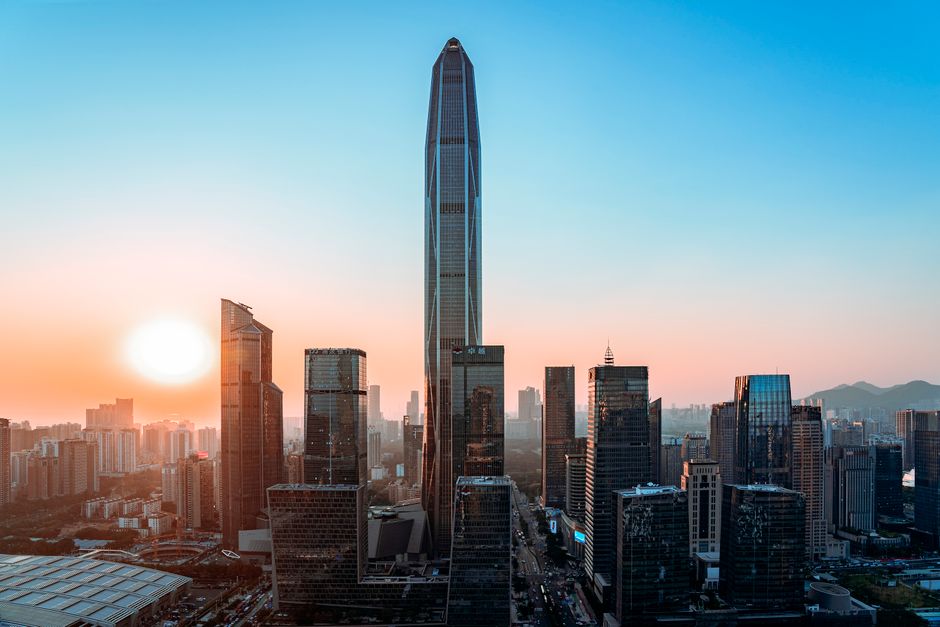
Shenzhen is China’s boldest modern city: a cluster of fishing villages on the border with Hong Kong that became the country’s first Special Economic Zone in 1980 and grew, in a single generation, into a metropolis of about 18 million people, home to tech giants, electronics markets and a skyline topped by the 599-meter (1,965-foot) Ping An Finance Centre. It has few ancient monuments, but it is green, clean, easy to get around and full of things to do: walk or cycle the long waterfront of Shenzhen Bay Park, browse the electronics stalls of Huaqiangbei, see the miniature world landmarks of Window of the World and the creative district of OCT-LOFT, buy a painting in Dafen Oil Painting Village, eat Cantonese and Chaozhou food and seafood in Shekou, and escape to the beaches and hills of Dapeng and Wutong Mountain in the east. Many visitors come for a day or two from Hong Kong, crossing at Luohu, Futian or Shenzhen Bay, or by high-speed train from West Kowloon; others fly into Shenzhen’s airport and continue across southern China. The best months are October to December; summers are hot and wet, with typhoons possible.
Right now in Shenzhen
- Wed 20–29°C 67–84°F Partly cloudy
- Thu 22–30°C 71–85°F Partly cloudy
- Fri 23–30°C 74–87°F Clear
Weather: MET Norway (CC BY 4.0) · Sea temperature: NOAA CoastWatch
Top tours in Shenzhen
See all tours for Shenzhen →
From local operators, with prices and reviews; you check availability and book on Viator, our partner. We may earn a commission at no extra cost to you. How we earn money
Shenzhen at a glance
- Best for: modern architecture, technology and electronics, theme parks, parks and coastline, shopping and food.
- How long: 2–3 days, or a day trip from Hong Kong.
- Best time: October to December, when it is dry and sunny; January to March is mild, and May to September hot, humid and rainy.
- Getting there: across the land border from Hong Kong, by high-speed train from Hong Kong, Guangzhou and the rest of China, by ferry, or by air to Shenzhen Bao’an (SZX).
- Getting around: by metro, which reaches all the border crossings and most sights, and by taxi or DiDi.
- Good to know: mainland China’s entry rules apply when you cross from Hong Kong; Hong Kong dollars and apps don’t work here.
- Before you go: visa-free entry, the 240-hour transit, the arrival card, payments and general safety are in our China travel guide.
Shenzhen’s areas and where to stay
Shenzhen runs for about 80 km (50 miles) from west to east along the border with Hong Kong. Most visitors stay in the central districts of Futian and Luohu, or in Nanshan to the west.
Futian
The modern civic center, with the Civic Center, Lianhuashan Park, the Ping An Finance Centre, the Futian high-speed station for Hong Kong and the Futian border crossing, international hotels and malls. It is the most central and convenient base.
Luohu
The original center of the boom, next to the Luohu border crossing and railway station, with older hotels, the busy Dongmen pedestrian shopping area, and malls; convenient for short visits from Hong Kong.
Nanshan and Shekou
West of the center, Nanshan is the tech district, home to big tech campuses, universities, Shenzhen Bay Park and the theme parks of Overseas Chinese Town (OCT). At its southern tip, Shekou has a relaxed expat feel, with seafood restaurants, bars, the Sea World waterfront and the ferry port to Hong Kong and Macau.
Dapeng and the east coast
In the far east, the Dapeng Peninsula has the city’s best beaches, at Xichong, Dameisha and Xiaomeisha, with resort hotels and guesthouses, about 1–1.5 hours from the center.
Where to stay in Shenzhen
- Futian: international hotels, the high-speed station to Hong Kong and the Civic Center.
- Luohu: mid-range hotels next to the Luohu crossing.
- Nanshan and OCT: modern hotels near the theme parks and Shenzhen Bay.
- Shekou: waterfront hotels, restaurants and the ferry port.
- Dapeng: beach resorts and guesthouses.
Business hotels fill during big trade fairs, tech events and conferences.
Top things to see in Shenzhen
Shenzhen Bay Park
Running for about 15 km (9 miles) along the shore of Shenzhen Bay, facing Hong Kong’s New Territories, Shenzhen Bay Park is the city’s favorite outdoor space: a waterfront promenade with cycle paths, mangroves, birdwatching in winter and sunsets over the Shenzhen Bay Bridge. Rent a shared bike and ride from the Talent Park, with its views of the “Spring Bamboo” tower of the China Resources Headquarters, to the mangrove reserve.
Ping An Finance Centre and the Civic Center
The Ping An Finance Centre, completed in 2017, is the city’s tallest building; its Free Sky observation deck on the 116th floor looks over Futian and on clear days to Hong Kong. To the north, the curving roof of the Civic Center contains the Shenzhen Museum; behind it, Lianhuashan Park climbs to a statue of Deng Xiaoping, the leader who launched the Special Economic Zone, with a view along the central axis. The Civic Center area is lit up with light shows on many evenings.
Huaqiangbei
The Huaqiangbei electronics district is the world’s largest electronics market: multi-story malls of stalls selling phones, drones, components, gadgets and accessories, the supply chain behind the city’s hardware industry. It is fascinating to browse even if you buy nothing; prices are negotiable.
Window of the World and OCT
In Nanshan, Window of the World reproduces about 130 world landmarks in miniature, including a one-third-scale Eiffel Tower; next door, Splendid China Folk Village has miniatures of Chinese landmarks and minority villages; and Happy Valley is a roller-coaster theme park. OCT-LOFT, a former factory district, has galleries, design shops, cafés and the OCT Art and Design Gallery, and OCT Harbour is a waterfront shopping and dining area.
Dafen Oil Painting Village
In the northeast, Dafen was once the world’s center of reproduction oil painting, with thousands of painters copying masterpieces; today its lanes are filled with studios selling copies and original works, and you can watch artists at work or commission a portrait.
Shekou, Sea World and Nantou
Sea World in Shekou is a waterfront plaza around the Minghua, a retired French cruise liner, surrounded by restaurants and bars; the Design Society and its V&A-curated gallery stand nearby. Inland, Nantou Ancient Town, a walled town of the Ming dynasty, has been revived with cafés and exhibitions in old lanes.
More classic sights
- Shenzhen Museum and the Shenzhen Reform and Opening-up Exhibition: the story of the city’s transformation from fishing villages to megacity.
- Dapeng Fortress: a walled Ming-dynasty coastal fort with old houses and temples.
- Wutong Mountain: the city’s highest peak, 943 m (3,094 ft), with forest trails and views over Shenzhen and Hong Kong.
- Fairy Lake Botanical Garden: gardens, a fossil forest and the Hongfa Buddhist Temple in the hills.
- Shenzhen Talent Park: a lakeside park with a light show on the surrounding towers.
Other things to do in Shenzhen
Food and drink
As a city of migrants, Shenzhen has food from every province, but the local base is Cantonese: dim sum breakfasts, roast goose, char siu, wonton noodles and claypot rice. Hakka cuisine from the hills of eastern Guangdong (salt-baked chicken, stuffed tofu) and Chaozhou cooking (beef hotpot with hand-beaten meatballs, braised goose, oyster omelets and kung fu tea) are local favorites. Seafood is excellent at the markets of Shekou and Nan’ao, where you choose live seafood and have it cooked at a restaurant nearby. The city also has a thriving coffee and craft beer scene.
Beaches and hiking
The Dapeng Peninsula has Shenzhen’s best beaches: Xichong, a long surf beach facing the open sea, the busy resort beaches of Dameisha and Xiaomeisha, and the coastal trail from Xichong to Dongchong, one of the city’s most popular hikes. Wutong Mountain and Maluan Mountain have forested trails. See our hiking and cycling guides.
Shopping and tech
Besides Huaqiangbei, browse the flagship stores of Chinese phone and drone brands in the malls, the Dongmen pedestrian street, the art and design shops of OCT-LOFT, and the Coastal City and MixC malls. See our city sightseeing guide.
Day trips from Shenzhen
- Hong Kong: just across the border by MTR, bus or high-speed train; a separate jurisdiction with its own entry rules.
- Guangzhou: dim sum, Shamian Island and the Canton Tower, about 30–40 minutes by high-speed train.
- Macau: about an hour by ferry from Shekou, or by bus over the Hong Kong–Zhuhai–Macao Bridge.
- Dongguan and Huizhou: neighboring cities; Huizhou’s West Lake and Luofu Mountain are about 1–1.5 hours away.
- Chaozhou: an old town famous for food, temples and tea, about 2–2.5 hours by high-speed train; best overnight.
Nearby destinations
- Guangzhou104 km
Getting there and getting around
From Hong Kong: the border crossings
Shenzhen and Hong Kong are linked by several land crossings, all reached by metro on the Shenzhen side. You clear Hong Kong departure control, then mainland Chinese entry, so you need a passport valid for mainland China and must meet China’s visa or visa-free rules. According to the Hong Kong Immigration Department, the main passenger crossings and their hours are:
- Lo Wu–Luohu: the busiest crossing, at the end of the MTR East Rail Line; open 6:30 to midnight; Luohu metro and railway station are next to the exit.
- Lok Ma Chau Spur Line–Futian: also on the East Rail Line; open 6:30 to 22:30; connected to Futian Checkpoint metro station.
- Lok Ma Chau–Huanggang: open 24 hours, for cross-border coaches, shuttle buses and cars.
- Shenzhen Bay: a joint checkpoint in Nanshan for buses from Hong Kong and cars; open 6:30 to midnight.
- Heung Yuen Wai–Liantang: the newest crossing, for passengers and vehicles, in the northeast; open 7:00 to 22:00.
- West Kowloon high-speed rail: trains from Hong Kong West Kowloon to Futian take about 15–20 minutes and to Shenzhen North about 20–25 minutes; you clear both immigration controls at West Kowloon, open 6:30 to 23:30.
Queues are long at weekends and on holidays, when hundreds of thousands of people cross. If you are using the 240-hour visa-free transit, note that only designated ports count for entry: in Shenzhen, Bao’an airport and Shekou port, plus the West Kowloon rail port and the Hong Kong–Zhuhai–Macao Bridge port; you can leave through any open port in Guangdong. Citizens of countries on China’s 30-day visa-free list can use any crossing.
By air
Shenzhen Bao’an International Airport (SZX), about 35 km (22 miles) northwest of Futian, has flights across China and to Asia, Europe and Australia, and is a designated 240-hour transit port. Metro Line 11 runs to Futian in about 40 minutes. Ferries link the airport’s Fuyong ferry terminal with Hong Kong and Macau.
By train and ferry
Shenzhen North is the main high-speed station, for Guangzhou South (about 30 minutes), Xiamen, Changsha, Beijing and Shanghai; Futian station, underground in the city center, has trains to Hong Kong and Guangzhou. Book on the 12306 website or app with your passport. Ferries from Shekou run to Hong Kong, Hong Kong International Airport and Macau.
Around town
The metro has more than 15 lines, English signs and low fares; pay with Alipay or WeChat Pay QR codes or a Shenzhen Tong card. Taxis, almost all electric, and DiDi are cheap and plentiful. Shared bikes are ideal for Shenzhen Bay Park.
When to go and how long to stay
Shenzhen has a humid subtropical climate, warm all year. October to December is the best time: sunny, dry and warm, with highs of 21–29 °C (70–84 °F). January to March is mild, sometimes cool and damp, and spring becomes humid and foggy. The rainy season runs from April to September, with heavy downpours and thunderstorms, peaking in June; summer highs are around 31 °C (88 °F), and the humidity makes it feel much hotter. Typhoons can strike from July to October. There is no CMA station for Shenzhen in the WMO normals, so the table uses the 1991–2020 normals for Shanwei, a coastal station of the China Meteorological Administration (CMA) about 130 km (80 miles) east on the same coast, as submitted to the World Meteorological Organization (WMO): average daily highs and lows, total precipitation, and days with at least 1 mm of rain. Shenzhen’s own figures are similar.
| Month | Average high / low | Rain (days with 1 mm or more) | What to expect |
|---|---|---|---|
| January | 20 °C (67 °F) / 12 °C (54 °F) | 33 mm (1.3 in), 3 days | Mild and dry; cool spells |
| February | 20 °C (68 °F) / 14 °C (56 °F) | 39 mm (1.5 in), 5 days | Mild; Chinese New Year |
| March | 22 °C (72 °F) / 16 °C (61 °F) | 71 mm (2.8 in), 6 days | Warmer; humid and foggy |
| April | 25 °C (78 °F) / 20 °C (68 °F) | 143 mm (5.6 in), 9 days | Warm; rains begin |
| May | 28 °C (83 °F) / 23 °C (74 °F) | 264 mm (10.4 in), 10 days | Hot and humid; heavy rain |
| June | 30 °C (86 °F) / 26 °C (78 °F) | 443 mm (17.5 in), 14 days | The wettest month |
| July | 31 °C (88 °F) / 26 °C (79 °F) | 300 mm (11.8 in), 14 days | Hot; storms; typhoon risk |
| August | 31 °C (88 °F) / 26 °C (79 °F) | 343 mm (13.5 in), 12 days | Hot and humid; typhoon risk |
| September | 31 °C (88 °F) / 25 °C (77 °F) | 199 mm (7.8 in), 8 days | Hot; drier; typhoon risk |
| October | 29 °C (84 °F) / 22 °C (72 °F) | 43 mm (1.7 in), 3 days | Warm and sunny; excellent |
| November | 26 °C (78 °F) / 18 °C (65 °F) | 28 mm (1.1 in), 2 days | Sunny and pleasant; ideal |
| December | 21 °C (71 °F) / 14 °C (57 °F) | 24 mm (0.9 in), 3 days | Mild and dry; very good |
This coast receives about 1,900 mm (76 in) of rain a year, most of it from April to September.
Two days in Shenzhen
Day one, the Civic Center, Lianhuashan Park and the Ping An Finance Centre’s view, Huaqiangbei in the afternoon, and dinner and the light show at Talent Park. Day two, Shenzhen Bay Park by bike, OCT-LOFT and Window of the World, and seafood and sunset in Shekou.
Three to four days
Add a day on the Dapeng Peninsula for Xichong beach and the coastal trail, Dafen Oil Painting Village and Wutong Mountain, or continue to Guangzhou and Guilin by high-speed train.
What a trip to Shenzhen costs
Prices are approximate, for October 2026, converted at about 6.74 yuan to the US dollar.
| Item | Typical cost |
|---|---|
| Metro ride | 2–10 CNY (about US$0.30–1.50) |
| High-speed train Futian–Hong Kong West Kowloon | about 70–90 CNY (about US$10–13) |
| High-speed train to Guangzhou South | about 75–100 CNY (about US$11–15) |
| Free Sky observation deck | about 180–200 CNY (about US$27–30) |
| Window of the World ticket | about 200–250 CNY (about US$30–37) |
| Dim sum or noodle meal | 30–80 CNY (about US$4.50–12) per person |
| Seafood dinner in Shekou | 150–300 CNY (about US$22–45) per person |
| Mid-range hotel double, per night | 450–900 CNY (about US$67–134) |
Practical tips for Shenzhen
- Set up payments before crossing: Hong Kong’s Octopus card and dollars don’t work in Shenzhen; use Alipay, WeChat Pay or yuan.
- Check your entry status: mainland China’s visa or visa-free rules apply, separate from Hong Kong’s.
- Avoid peak crossing times: Friday evenings, weekends and holidays bring long queues at Luohu and Futian.
- Book big attractions: theme parks and observation decks sell timed tickets online.
- Plan for heat and rain: carry water and an umbrella from May to September.
- Bargain at markets: prices at Huaqiangbei and Dafen are open to negotiation.
Safety
Shenzhen is a safe, orderly city with a strong police presence and little violent crime. Watch for pickpockets and phone snatchers at the border crossings, Luohu station, Dongmen and Huaqiangbei, and be wary of touts selling “cheap” electronics, counterfeit goods or tours. Use official taxis or DiDi. Traffic is fast, and electric scooters and delivery riders are everywhere, including on sidewalks; look carefully before you cross. In summer, the heat and humidity are intense, and heavy rain can flood streets; typhoons, mainly from July to October, can close beaches and stop flights, trains and ferries, so follow official alerts. At the beaches, swim only in patrolled areas, as currents can be strong at Xichong. Carry your passport, as police may ask to see it. In an emergency, call 110 for police, 120 for an ambulance and 119 for fire.
What to pack for Shenzhen
Light, breathable clothes, sandals or quick-drying shoes, an umbrella or light rain jacket from April to September, swimwear and sunscreen for the beaches, walking shoes for the coastal trails, a light jacket for air-conditioned malls and for the winter months, and a power bank. China uses 220 V, with flat two-pin, round two-pin and angled three-pin sockets; Hong Kong uses different three-pin plugs. See our rain jackets and travel adapters guides.
Shenzhen travel FAQ
How do I get from Hong Kong to Shenzhen?
Take the MTR East Rail Line to Lo Wu or Lok Ma Chau and walk across to Luohu or Futian, take a cross-border bus to Shenzhen Bay or Huanggang, or ride the high-speed train from West Kowloon to Futian in about 15–20 minutes.
Do I need a visa to visit Shenzhen from Hong Kong?
Shenzhen is in mainland China, so China’s rules apply: citizens of countries on the 30-day visa-free list can enter without a visa; others need a Chinese visa or must qualify for the 240-hour transit through a designated port.
Can I use the 240-hour visa-free transit to enter Shenzhen?
Only through designated ports: Bao’an airport, Shekou port, the West Kowloon high-speed rail port or the Hong Kong–Zhuhai–Macao Bridge, not the Luohu or Futian land crossings. You can then travel anywhere in Guangdong.
What are the opening hours of the Luohu crossing?
According to the Hong Kong Immigration Department, Lo Wu–Luohu is open from 6:30 to midnight; Lok Ma Chau–Huanggang is open 24 hours.
Is Shenzhen worth visiting?
Yes, for modern architecture, technology, Huaqiangbei, theme parks, the Shenzhen Bay waterfront, beaches and food; it works well as a day or two from Hong Kong.
Can I use Hong Kong dollars or Octopus in Shenzhen?
Generally no. Pay with Alipay or WeChat Pay linked to a foreign card, or with yuan in cash.
What is the best time to visit Shenzhen?
October to December, when it is dry and sunny. Summers are hot, humid and wet, with typhoons possible.
How do I get from Shenzhen to Guangzhou?
By high-speed train from Shenzhen North or Futian to Guangzhou South in about 30 minutes, or from Shenzhen station to Guangzhou East.
Where are the best beaches in Shenzhen?
On the Dapeng Peninsula: Xichong for open-sea surf and the coastal trail, and Dameisha and Xiaomeisha for resort beaches.
Where should I stay in Shenzhen?
In Futian for the center and the train to Hong Kong, Luohu for the border, Nanshan or Shekou for the bay, theme parks and nightlife, or Dapeng for beaches.
Sources and last review
Researched and last reviewed on 4 October 2026. Border crossings and their hours: the Hong Kong Immigration Department’s control point pages; visa-free transit ports, the Guangdong permitted area and exits: the National Immigration Administration; the 30-day visa-free list: the National Immigration Administration and Chinese embassies; train booking with a passport: China Railway’s official 12306 site; climate normals: the China Meteorological Administration via the World Meteorological Organization’s 1991–2020 normals (Shanwei station, used as the nearest coastal station); the exchange rate: the CFETS central parity rate. Population, building heights, train and ferry times, the airport metro, attraction details, opening hours and typical prices are general references or estimates, flagged for checking. Prices and rules change, so check locally before you go. For entry rules, money and general safety, see our China travel guide.
Plan your trip
Partner links: TravelerCenter may earn a commission if you book, at no extra cost to you.
🇨🇳 Useful Mandarin Chinese phrases for Shenzhen
All 38 Mandarin Chinese phrases: restaurant, hotel, emergencies, romance (printable) →