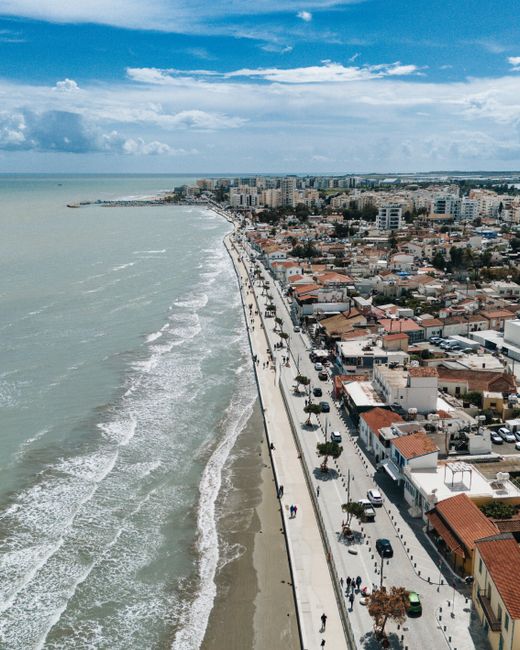
Larnaca (Larnaka) is where most visitors to Cyprus first touch down, and many never realise how pleasant the town is just five minutes from the runway. It is a relaxed, walkable seaside town built on the site of ancient Kition, with a palm-lined promenade called Finikoudes, a sandy town beach, a small Ottoman-era fort, and the honey-coloured church of St Lazarus, where the friend Jesus raised from the dead is said to be buried. Just outside town, a salt lake turns pink with flamingos in winter, with the Ottoman shrine of Hala Sultan Tekke on its shore. Offshore lies the Zenobia, one of the world’s great wreck dives, and inland are the lace village of Lefkara, the Neolithic settlement of Choirokoitia and the hilltop monastery of Stavrovouni. Larnaca is also the most central base on the island, with Nicosia, Limassol and Ayia Napa all within an hour. Come from March to June or late September to November; two or three days covers the town, four or five lets you explore the district.
Right now in Larnaca
- Wed 18–25°C 64–77°F Mostly clear
- Thu 19–27°C 66–81°F Clear
- Fri 21–28°C 69–83°F Clear
Weather: MET Norway (CC BY 4.0) · Sea temperature: NOAA CoastWatch
Top tours in Larnaca
See all tours for Larnaca →
From local operators, with prices and reviews; you check availability and book on Viator, our partner. We may earn a commission at no extra cost to you. How we earn money
Larnaca at a glance
- Best months: March–June and late September–November. Average afternoon highs run from about 23 °C in April to 33 °C in August (Cyprus Department of Meteorology, Larnaca airport, 1991–2020 normals). Winters are mild, with most rain from November to February.
- Days needed: 1–2 for the town, St Lazarus and the salt lake; 3–5 with the Zenobia, Lefkara, Choirokoitia, Nicosia or Ayia Napa.
- Getting there: Larnaca airport (LCA), the island’s main airport, is about 5 km south-west of the centre; city buses and taxis take 10–20 minutes.
- Getting around: on foot in the centre and along the seafront; Cyprus Public Transport buses to the beaches and villages; Intercity Buses to the other towns.
- Budget level: good value, cheaper than Limassol or Ayia Napa in summer. See our Cyprus guide for entry rules, money and driving on the left.
Larnaca’s areas and who each one suits
- Finikoudes and the centre: the seafront promenade, the town beach, St Lazarus and the old streets behind, with cafés, bars and restaurants. Best for a short stay without a car.
- The old Turkish quarter (Skala): south of the fort, with the Büyük Mosque, potters’ workshops and quiet lanes leading to the Piale Pasha seafront and the fishing shelter.
- Mackenzie: the beach strip near the airport, with beach bars, fish restaurants and planes passing low overhead; lively in summer.
- Dhekelia Road (Larnaca Bay): the line of beach hotels east of town along the bay towards Oroklini; good for families and beach holidays, but you need a bus or car to reach the centre.
- The villages: Lefkara, Kiti, Kalavasos or Tochni for agrotourism stays in restored stone houses.
Top things to see in Larnaca
Prices and hours below are as of October 2026 and come from the Deputy Ministry of Tourism’s official Visit Cyprus pages and the Department of Antiquities’ opening-hours list. Summer hours run from 16 April to 15 September, winter hours from 16 September to 15 April. One-, three- and seven-day Department of Antiquities passes (€8.50, €17 and €25) cover the district’s sites and museums.
The church of St Lazarus
According to Orthodox tradition, Lazarus, raised from the dead by Jesus, fled to Cyprus, became the first bishop of Kition and was buried here after his second death. The church above his tomb was built in the late 9th century and rebuilt in the 17th century, with a tall bell tower and a gilded carved iconostasis inside. Go down to the crypt to see the empty stone sarcophagus. Entry to the church is free; there is a small fee for the Byzantine museum in the courtyard. Dress modestly, covering shoulders and knees, and keep quiet during services.
Finikoudes and Larnaca castle
The palm-lined Finikoudes promenade, with its town beach, cafés and sea-view restaurants, is the heart of Larnaca from morning to late at night. At its southern end, the small Larnaca castle, built in its present form by the Ottomans in the 17th century on medieval foundations, houses the Medieval District Museum; climb up to the battlements for the view along the coast. Entry is €2.50; it opens 08:00–19:30 on weekdays in summer, with shorter hours in winter and at weekends.
The salt lake and Hala Sultan Tekke
The Larnaca salt lake, a cluster of four lakes just west of town by the airport, fills with water in winter and dries to a white salt crust in summer. From about November to March, thousands of greater flamingos and other water birds feed here; a walking and cycling path runs along the shore, with bird hides. On the western shore, among palm and cypress trees, stands Hala Sultan Tekke, one of the most important Muslim shrines in the region, built around the tomb of Umm Haram, a relative of the Prophet Muhammad, who died here in the 7th century. The present mosque dates from the early 19th century. It is open daily (08:30–19:30 in summer, to 17:00 in winter, according to the Department of Antiquities). Dress modestly; women may be given a scarf to cover their hair.
Kition and the town museums
Larnaca stands on ancient Kition, one of the island’s city-kingdoms and a Phoenician stronghold. The excavated area north of the centre shows the remains of temples and Bronze Age city walls (open on weekdays only). The Archaeological Museum of the Larnaca District (Tuesday to Sunday) and the private Pierides Museum, with one of the finest collections of ancient Cypriot art, fill in the story.
The Kamares aqueduct
On the western edge of town, the arches of the Kamares aqueduct, built in the mid-18th century by the Ottoman governor Bekir Pasha to bring water to Larnaca, are lit up at night and make a good stop on the way to the salt lake.
Diving the Zenobia and other things to do in the water
The Zenobia, a 172 m Swedish roll-on, roll-off ferry, sank on her maiden voyage in June 1980, about 1.5 km off Larnaca, with her cargo of more than a hundred lorries still on board. She lies on her side at about 16–42 m and is often rated one of the top ten wreck dives in the world. The shallowest parts suit newly qualified divers on guided dives; the interior is for experienced, trained wreck divers only. Dive centres in Larnaca run daily trips. See our diving guide.
- Snorkelling: rocky stretches near the fishing shelter and the coast towards Cape Kiti. See our snorkelling guide.
- Boat trips: short cruises along Larnaca Bay and trips to swim near the Zenobia site. See our boat trips guide.
- Water sports: kitesurfing and windsurfing at Mackenzie and along the bay when the afternoon breeze picks up.
Beaches and swimming
Larnaca’s beaches are mostly of grey-brown sand, with shallow water that suits children. Finikoudes, the town beach, has lifeguards and showers in summer and is right by the cafés; Mackenzie, near the airport, is livelier, with beach bars and restaurants. The long beaches of Larnaca Bay along the Dhekelia Road are organised in front of the hotels. Quieter spots are Faros beach at Pervolia, by the Cape Kiti lighthouse, and the coves towards Zygi. Four Larnaca municipal beaches received Blue Flags in 2026, according to the press. For the island’s best sand, Ayia Napa and Protaras are about 40 minutes east. See our beaches guide.
Day trips from Larnaca
- Lefkara: a hill village of stone houses, about 40 minutes west, famous for its lefkaritika lace, on the UNESCO intangible heritage list, and its silver filigree. Buy from the makers and avoid machine-made imports.
- Choirokoitia: a Neolithic village of round stone houses from about 7000 BC, on a UNESCO-listed hillside off the motorway, with several houses rebuilt as they were. There is no shade; go early. Open daily, with longer hours in summer.
- Stavrovouni Monastery: perched on a peak of almost 700 m, said to hold a fragment of the True Cross brought by St Helena. Only men may enter the monastery; everyone can enjoy the views.
- Kiti and Angeloktisti church: a church with a rare 6th-century mosaic of the Virgin and Child, 10 km south-west.
- Nicosia: about 45 minutes by motorway or bus, for the Cyprus Museum, the old town inside the Venetian walls and the pedestrian crossing at Ledra Street.
- Ayia Napa and Cape Greco: about 40 minutes east, for sandy beaches and sea caves.
Getting there and getting around
Flights
Larnaca airport (LCA), run by Hermes Airports, is the island’s main gateway, with flights from all over Europe, the Middle East and beyond, year-round. Cyprus is outside the Schengen area, so expect passport or ID checks on arrival even from EU countries; Cyprus does not use the EU’s Entry/Exit System, and your passport is stamped instead. City buses run from the airport to the centre and Finikoudes, and airport shuttle buses go direct to Nicosia, Limassol, Paphos and Ayia Napa. Taxis wait outside arrivals.
Buses and taxis
Cyprus Public Transport runs Larnaca’s city and district buses. As of October 2026, its fare page lists a single urban fare of €2.70 in cash or €2.00 with a Motion travel card, €4.70 (€3.50 by card) for night buses between 21:00 and 04:00, and an all-island day ticket for city buses in every district at €20. Intercity Buses link Larnaca with Nicosia, Limassol, Paphos and Ayia Napa several times a day. Check routes on the official cyprusbybus.com planner. Taxis are metered; agree the fare for longer trips.
Driving
Cyprus drives on the left. The A3 motorway runs east to Ayia Napa and the A1 and A2 west to Limassol and Nicosia. A car is the easiest way to reach Lefkara, Choirokoitia and Stavrovouni, but you don’t need one in town. The road to Ayia Napa passes through the UK’s Dhekelia base area without checks; obey signs and don’t photograph military installations.
When to go and how long to stay
Larnaca has a hot, dry climate with very little rain from May to October and mild winters. July and August are hot, with afternoon highs around 33 °C and warm, humid nights; spring and autumn are ideal, and the sea stays warm into November. Winter is the season for flamingos on the salt lake, and for sunny sightseeing days between showers. At Pentecost, the town’s seafront fills with stalls, concerts and water games for Kataklysmos, the Festival of the Flood, centred on Monday 21 June in 2027.
| Season | Average high | Average low | Rain a month | What it’s like |
|---|---|---|---|---|
| Spring (Mar–May) | 20–27 °C | 9–16 °C | 30 mm falling to 12 mm | Warm and green; perfect for sightseeing; sea warm enough from May. |
| Summer (Jun–Aug) | 31–33 °C | 20–23 °C | almost none | Hot, humid and dry; peak season; warm sea. |
| Autumn (Sep–Nov) | 31 °C falling to 23 °C | 21 °C falling to 13 °C | 5 mm rising to 42 mm | Warm sea and pleasant days; flamingos return in November. |
| Winter (Dec–Feb) | 17–19 °C | 8–10 °C | 47–95 mm | Mild, with showers; flamingos on the salt lake. |
Figures are the World Meteorological Organization’s 1991–2020 climate normals for the Larnaca airport station, reported by the Cyprus Department of Meteorology. Larnaca gets about 350 mm of rain a year and about 3,350 hours of sunshine, among the highest totals in Europe.
1–2 days in Larnaca
Day 1: St Lazarus and its crypt, the old Turkish quarter, the castle and lunch on Finikoudes; in the afternoon, the salt lake path to Hala Sultan Tekke and the Kamares aqueduct, with dinner by the fishing shelter. Day 2: a dive or snorkel trip, or a beach day at Mackenzie, with the Pierides Museum in the cooler late afternoon.
3–5 days in Larnaca
Add Lefkara and Choirokoitia, Stavrovouni and Kiti, a day in Nicosia, and a beach day at Ayia Napa or Cape Greco.
Where to stay in Larnaca
- Short stay, no car: the centre near Finikoudes and St Lazarus.
- Beach lovers: Mackenzie, for beach bars and restaurants, or the Larnaca Bay hotels for a classic beach holiday.
- Early flight: anywhere near Mackenzie, 5 minutes from the terminal.
- Village charm: restored houses in Lefkara, Tochni or Kalavasos.
As of October 2026, Cyprus has no national per-night tourist tax; check your booking for any local charges.
Practical tips for Larnaca
- Arriving: check that your passport is stamped on entry; Cyprus is outside Schengen and does not use EES.
- Flamingos: visit the salt lake from November to March, ideally early morning or late afternoon.
- Churches and mosques: cover shoulders and knees; at Hala Sultan Tekke, women may be asked to cover their hair.
- Diving: only dive the Zenobia interior with training and a guide.
- Heat: visit Choirokoitia and Kition early; there is little shade.
- Emergencies: call 112.
What to pack for Larnaca
For summer, pack light, breathable clothes, a sun hat, sunglasses, high-factor sunscreen and a refillable water bottle. Bring a swimsuit and a quick-dry towel, and water shoes for rocky stretches. A scarf or light shirt is useful for churches and the mosque, comfortable shoes for the salt lake path and the villages, and binoculars for the flamingos in winter, when you will also want a light jacket and an umbrella. Cyprus uses British-style three-pin plugs at 240 V.
Larnaca travel FAQ
How far is Larnaca airport from the town centre?
About 5 km, 10–20 minutes by city bus or taxi. Shuttle buses also run from the airport straight to Nicosia, Limassol, Paphos and Ayia Napa.
How many days do you need in Larnaca?
One or two days for the town, St Lazarus and the salt lake; three to five with the Zenobia, Lefkara, Choirokoitia, Nicosia and Ayia Napa.
When can you see flamingos in Larnaca?
From about November to March, when the salt lake has water. They are best seen early in the morning or late in the afternoon from the shore path.
Can you visit Hala Sultan Tekke?
Yes. It is open daily, from 08:30 to 19:30 in summer and to 17:00 in winter, according to the Department of Antiquities. Dress modestly.
How deep is the Zenobia wreck?
She lies on her side at about 16–42 m, about 1.5 km off Larnaca. Shallow parts suit newly qualified divers with a guide; the interior is for trained wreck divers.
Is Larnaca good for beaches?
The town beaches are sandy, shallow and convenient, and four Larnaca municipal beaches had Blue Flags in 2026. For the island’s best sand, Ayia Napa and Protaras are about 40 minutes east.
How much is the bus in Larnaca?
As of October 2026, a single city fare is €2.70 in cash or €2.00 with a Motion card, according to Cyprus Public Transport. Night buses cost more.
Can I go from Larnaca to Nicosia for the day?
Yes. Intercity buses and airport shuttles take about 45 minutes, and the drive is about the same. In Nicosia you can cross on foot to the northern part of the city at Ledra Street with your passport.
Do I need a passport to fly from another EU country to Larnaca?
You need a passport or, for EU citizens, a national ID card. Cyprus is not in the Schengen area, so there are border checks on all arrivals.
Is there a tourist tax in Larnaca?
There is no national per-night tourist tax in Cyprus as of October 2026. Check your booking for any local charges.
Sources and last review
Researched and last reviewed on 4 October 2026. Site prices and opening hours come from the Deputy Ministry of Tourism’s official Visit Cyprus pages and the Department of Antiquities; bus fares from Cyprus Public Transport; climate from the Cyprus Department of Meteorology’s 1991–2020 normals for Larnaca airport, published by the World Meteorological Organization; entry rules from the European Commission and the UK government. The 2026 Blue Flag count for Larnaca’s beaches comes from press reports and is flagged for checking. Prices, timetables and rules change, so check the official sites before you travel.
Plan your trip
Partner links: TravelerCenter may earn a commission if you book, at no extra cost to you.
🇬🇷 Useful Greek phrases for Larnaca
All 38 Greek phrases: restaurant, hotel, emergencies, romance (printable) →