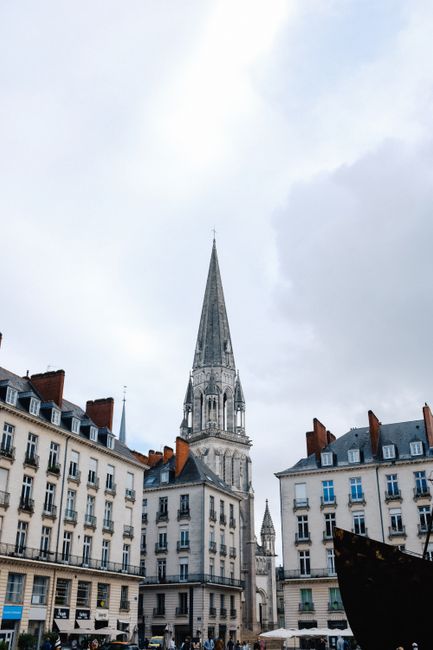
Nantes is the creative, laid-back city of the lower Loire, where a 12-metre mechanical elephant walks the old shipyards carrying passengers, a green line painted on the pavements leads you to art installations all over town, and the castle of the Dukes of Brittany stands with free ramparts to walk. Once France’s great Atlantic port and Jules Verne’s birthplace, it mixes medieval lanes, 18th-century merchants’ mansions and a reinvented riverside island. It is about two hours from Paris by TGV, close to the Muscadet vineyards and the Atlantic coast, and its trams and buses are free at weekends. Give Nantes two days, and three or four with the estuary, Clisson or the coast.

Right now in Nantes
- Wed 14–20°C 58–68°F 2 mm Light showers
- Thu 11–17°C 51–62°F Partly cloudy
- Fri 9–17°C 48–62°F Cloudy
Weather: MET Norway (CC BY 4.0) · Air quality: OpenAQ · Rates: ECB
Top tours in Nantes
See all tours for Nantes →
From local operators, with prices and reviews; you check availability and book on Viator, our partner. We may earn a commission at no extra cost to you. How we earn money
Nantes at a glance
- Best for: quirky art and design, families, the castle and city history, summer festivals, food and Muscadet, and a base for the Loire estuary and the Atlantic.
- How long: 2 days for the city, 3–4 with Saint-Nazaire and the Estuaire art route, Clisson or the Muscadet vineyards.
- Best time: May to September; July and August for the Voyage à Nantes summer art trail.
- Getting in: TGV from Paris Montparnasse in about 2 hours; Nantes Atlantique airport is 20 minutes by shuttle bus.
- Getting around: walk the centre and use Naolib’s trams, busway and river shuttles, free for everyone on Saturdays and Sundays.
- Before you go: entry rules, money, trains and general safety are on our France travel guide; Nantes was the historic capital of Brittany, covered in our Brittany travel guide, and sits at the western end of the Loire Valley.
Nantes’s neighbourhoods and who each one suits
Nantes spreads along the north bank of the Loire, with the Île de Nantes in the middle of the river. The main station is a short walk east of the castle and the cathedral; the shopping streets and old merchant quarter lie to the west.
Bouffay and the castle quarter
The medieval heart, with half-timbered houses, narrow lanes full of crêperies and bars, the Château des ducs de Bretagne and the cathedral. Lively day and night; the best area for a short first stay, close to the station.
Graslin and Commerce
The elegant 18th-century city of the shipowners, with the Graslin theatre, Place Royale, the Passage Pommeraye, the shopping streets around Place du Commerce and the Île Feydeau’s leaning mansions with carved masks. Central, smart and well served by trams.
Île de Nantes
The former shipyards island, transformed into a district of art, design and riverside walks, with the Machines de l’Île, the Hangar à Bananes bars and the Anneaux (Rings) by Daniel Buren along the Quai des Antilles. Great for families and for evenings by the water.
Trentemoult
A colourful former fishing village on the south bank, reached by Navibus river shuttle, with painted houses, narrow alleys and waterside restaurants. A peaceful place for lunch or a quiet stay.
Top things to see in Nantes
Prices and hours below come from the official websites, as of October 2026. The Pass Nantes covers most of them.
Les Machines de l’Île
In the vast former shipyard halls, artists and engineers build giant mechanical creatures inspired by Jules Verne and Leonardo da Vinci. You can ride the Grand Éléphant, 12 m tall, as it walks around the island spraying water, watch the workshops at work in the Galerie des Machines, and ride the Carrousel des Mondes Marins, a three-level carousel of sea creatures by the river. The next big project, the Heron Tree, has a prototype branch you can visit. How to visit: each of the three attractions costs €12 for adults, €10 for ages 13–17 and students and €8 for ages 4–12; under-4s go free. Tickets for the elephant are sold on site for the same day and sell out on busy days, so arrive early. Opening days and hours change by season, from about 10:00 or 14:00 to 18:00 or 19:00, and the site closes for maintenance part of the winter; check the calendar on lesmachines-nantes.fr.
Château des ducs de Bretagne and the Nantes History Museum
The white-stone castle of the last Dukes of Brittany, where Duchess Anne was born in 1477, combines a medieval fortress with a Renaissance palace inside its moat. Walk the ramparts and courtyard for free, then visit the Nantes History Museum in 32 rooms, from the dukes to the port, the slave trade and the city’s industry. How to visit: the courtyard and ramparts are open daily, 8:30–19:00 (until 20:00 in July and August). The museum opens 10:00–18:00, closed on Mondays except in July and August, and costs €9, or €5 reduced; under-18s go free, and entry is free for everyone on the first Sunday of the month except in July and August.
Cathedral of Saint-Pierre-et-Saint-Paul
A soaring Gothic cathedral built over 457 years, with a nave of pale tufa stone and the Renaissance tomb of Duke Francis II and his wife Marguerite de Foix, which was taken away for restoration after the fire; ask whether it is back in place. An arson fire in July 2020 destroyed the great organ and windows. After five years of work, the cathedral reopened to the public on 27 September 2025; restoration of the west front and other parts continues, with the end of the works planned for 2028, so some areas may be screened off.
Passage Pommeraye
An ornate covered shopping arcade of 1843, with three levels of galleries linked by a grand staircase, statues, gas-style lamps and boutiques. It is free and one of the most photographed interiors in Nantes.
Jardin des Plantes
A free botanical garden opposite the main station, with old trees, glasshouses, ponds and playful giant benches and figures by the illustrator Claude Ponti. A perfect first or last stop before a train.
Le Voyage à Nantes and the green line
A green line painted on the ground runs all year for about 20 km around the city, linking the main sights, viewpoints and permanent artworks; follow it with the tourist office’s free map. Each summer, the Voyage à Nantes festival adds new installations, exhibitions and events along it. The 2026 edition ran from 4 July to 6 September 2026, opening with the festive Nuit du VAN. As of October 2026 the 2027 dates had not been announced; expect early July to early September.
The Pass Nantes
The official Pass Nantes, sold by Le Voyage à Nantes, costs €30 for 24 hours, €40 for 48 hours, €49 for 72 hours and €75 for 7 days (as of October 2026). It gives free entry to the city’s museums and their exhibitions, the Machines de l’Île, unlimited public transport, river cruises and guided visits. If you will only see the castle museum, the €15 annual Pass Musées also covers the Musée d’arts and the Jules Verne museum.
Food and drink in Nantes
Nantes invented beurre blanc, a butter, shallot and Muscadet sauce served with Loire fish such as pike or zander. The famous LU biscuits were born here in 1846; the tower of the old factory is now an arts centre, Le Lieu Unique, with a bar and restaurant. Try gâteau nantais, a rum and almond cake, the boiled sweets called berlingots, Curé Nantais cheese and fresh oysters with a cold glass of Muscadet. The Talensac covered market is the best place for local food, and Bouffay and the Île de Nantes are full of restaurants and bars.
Other things to do in Nantes
Ride the Navibus and visit Trentemoult
Naolib’s river shuttle crosses the Loire from Gare Maritime to Trentemoult in a few minutes, on a normal transport ticket and free at weekends. Have lunch on the quayside and walk the alleys of painted houses.
The Jules Verne Museum
A small museum in a 19th-century house above the river, with books, posters, models and objects linked to the writer, who was born in Nantes in 1828. It is included in the Pass Nantes and the Pass Musées.
Walk or cycle by the river
Nantes lies on the Loire à Vélo route, which ends at Saint-Brevin-les-Pins on the Atlantic; paths along the Loire and the Erdre river are flat and good for a bike ride, with Bicloo public bikes for short trips. Boat trips run on the Erdre, lined with châteaux and gardens.
Day trips from Nantes
The Estuaire art route and Saint-Nazaire
Along the 60 km of the Loire estuary between Nantes and Saint-Nazaire, about thirty permanent artworks stand on the banks, from Buren’s rings in Nantes to the giant Serpent d’Océan skeleton at Saint-Brevin-les-Pins. Follow them by car or bike, or on a summer boat trip down the estuary. Saint-Nazaire, about 40 minutes by train, has a huge Second World War submarine base, shipyards where cruise liners are built, and beaches.
Muscadet vineyards and Clisson
The Muscadet vineyards begin a few kilometres south-east of Nantes, between the Sèvre and Maine rivers, with many growers offering tastings; see our wine-tasting guide. Their capital, Clisson, about 30 minutes by train, looks Italian, with red-tiled roofs, a ruined castle above the river and a Tuscan-style villa and garden, La Garenne Lemot.
The Atlantic coast
Pornic, La Baule’s long sandy beach, the salt marshes and medieval walls of Guérande, and the Brittany coast are all within about an hour; see our Brittany travel guide. Inland, the châteaux of the Loire Valley begin around Angers and Saumur, about an hour by train.
Nearby destinations
- Île de Ré114 km
- La Rochelle122 km
- Loire Valley122 km
- Brittany139 km
- Mont-Saint-Michel158 km
- Saint-Malo163 km
- Normandy227 km
- Bordeaux275 km
Getting there and getting around
By train
TGV INOUI and OUIGO trains link Paris Montparnasse with Nantes in about 2 hours (see our Paris travel guide for the stations), and direct TGVs run from Charles de Gaulle airport, Lille, Lyon, Strasbourg and Marseille. Regional trains go to Rennes, Angers, Saint-Nazaire, La Baule and Clisson. Nantes station has a north exit for the city centre and the Jardin des Plantes and a south exit for the coach station.
By air
Nantes Atlantique airport, about 10 km south-west, has flights across France and Europe. The Naolib airport shuttle runs to the station via the Cité des Congrès and Hôtel-Dieu in about 20 minutes, every 20 minutes from April to October and every 30 minutes in winter; a ticket costs €10 (as of October 2026) and is also valid for an hour on the rest of the network. Since 30 March 2026 the shuttle stops at the coach station (quai A) by the station’s south exit.
Trams, buses and Navibus
Naolib runs three tram lines, a busway, buses, Navibus river shuttles and TER trains within the metropolitan area. As of October 2026 a 1-hour ticket costs €1.80, a 24-hour ticket €6.80 and ten 1-hour tickets €17.80, from machines at tram stops, the Naolib app or Relais Naolib shops. Public transport is free for everyone from Saturday 00:00 to Sunday 23:59 (the airport shuttle still needs a ticket), and under-6s travel free all week with an adult. The Pass Nantes includes travel.
Driving and parking
Park and ride: Naolib’s park-and-ride car parks are free at weekends, and central car parks are busy. Since 1 January 2025 the area inside the Nantes ring road (périphérique) is a low-emission zone (ZFE): every vehicle driving in it needs a Crit’Air sticker, and unclassified vehicles (cars registered before 1997) may not drive there on weekday rush hours, 7:00–9:00 and 16:00–19:00, except public holidays. The ring road itself is outside the zone.
When to go and how long to stay
Nantes has a mild, oceanic climate: soft, wet winters with little frost, pleasant springs, and warm, fairly dry summers. The table uses Météo-France’s official 1991–2020 normals for Nantes-Bouguenais, the airport station just south-west of the city: average daily highs and lows, and days with at least 1 mm of rain.
| Season | Average high / low | Rainy days per month | What it’s like | Good for |
|---|---|---|---|---|
| Winter (Dec–Feb) | 9–10 °C / 3–4 °C | 11–13 | Mild, wet and windy; frost is rare | Museums, the castle, food and markets |
| Spring (Mar–May) | 13–20 °C / 5–10 °C | 9–10 | Fresh and changeable, gardens in flower | Sightseeing, the Machines, river walks |
| Summer (Jun–Aug) | 23–25 °C / 13–14 °C | about 7–8 | Warm and fairly dry; occasional heatwaves | The Voyage à Nantes, the estuary, the coast |
| Autumn (Sep–Nov) | 22 °C falling to 13 °C / 12 °C falling to 6 °C | 8–13 | Warm September, wet and windy by November | Muscadet harvest, city breaks |
Nantes-Bouguenais gets about 820 mm of rain a year on about 120 days, most in autumn and winter, and around 1,870 hours of sunshine. August is the warmest month, with an average high of about 25 °C.
How long to stay: 2-, 3- and 4-day plans
2 days: Day 1, the Château des ducs and its museum, the cathedral, Bouffay and the Passage Pommeraye, then dinner on the Île Feydeau or in Bouffay. Day 2, the Machines de l’Île and a ride on the elephant, the Quai des Antilles and the Hangar à Bananes, then the Navibus to Trentemoult.
3 days: add the Jardin des Plantes, the Jules Verne museum and the green line, or a day in Clisson and the Muscadet vineyards. 4 days: add Saint-Nazaire and the Estuaire art route, or a beach day at Pornic or La Baule.
Where to stay in Nantes
- Bouffay and the castle: central and lively, close to the station; light sleepers should ask for a quiet room.
- Graslin and Commerce: elegant, central hotels on the tram lines, near shops and restaurants.
- Near the station and the Jardin des Plantes: practical for early trains and day trips.
- Île de Nantes: modern hotels and apartments near the Machines and the riverside bars.
- Trentemoult and the vineyards: quiet guesthouses for a slower stay.
Nantes’s tourist tax (taxe de séjour), set by Nantes Métropole, is charged per person per night. According to the official government database of rates, in 2026 it is €0.88 in 1-star hotels, B&Bs and hostels, €1.10 in 2-star, €1.87 in 3-star, €2.86 in 4-star, €3.96 in 5-star hotels and €5.39 in palaces; unclassified rentals pay 5.5% of the price per person per night, within a legal cap. These totals include the Loire-Atlantique department’s 10% surcharge. Under-18s are exempt.
Practical tips for Nantes
- Use free weekends: trams, buses, Navibus and park-and-ride car parks are free on Saturdays and Sundays, except the airport shuttle.
- Get to the elephant early: rides are sold on site for the same day and sell out in holidays and summer.
- Mondays: the castle museum and several other museums close outside July and August, but the courtyard and ramparts are open daily.
- First Sundays: the castle museum is free outside July and August.
- Rain: carry a light waterproof whatever the season.
- Emergencies: call 112. Keep an eye on bags in busy trams and around Bouffay at night.
What to pack for Nantes
Bring comfortable shoes for cobbles and long walks along the green line, a light rain jacket or umbrella in every season, and layers, since Atlantic weather changes quickly. In summer add sunglasses, a hat and a swimsuit for the coast; in winter a warm, waterproof coat. A small daypack is handy for days on the estuary or in the vineyards.
Nantes travel FAQ
How many days do you need in Nantes?
Two days covers the castle, the cathedral, Bouffay, the Machines de l’Île and Trentemoult. Three or four days lets you add Clisson and the Muscadet vineyards, Saint-Nazaire and the Estuaire art route, or a day at the beach.
How much does the Nantes elephant ride cost?
As of October 2026, a ride on the Grand Éléphant costs €12 for adults, €10 for ages 13–17 and students and €8 for ages 4–12; under-4s go free. Tickets are sold on site for the same day only, so arrive early.
Is the Château des ducs de Bretagne free?
The courtyard, ramparts and moat gardens are free and open daily. The Nantes History Museum inside costs €9, or €5 reduced, as of October 2026; under-18s go free, and it is free for all on the first Sunday of the month outside July and August.
Is public transport free in Nantes at weekends?
Yes. Naolib’s trams, buses and Navibus are free for everyone from Saturday 00:00 to Sunday 23:59, as of October 2026. The airport shuttle still needs a €10 ticket.
How much is a tram ticket in Nantes?
As of October 2026, a 1-hour ticket costs €1.80 and a 24-hour ticket €6.80, valid on trams, buses, Navibus and local TER trains. Buy them from machines, the Naolib app or Relais Naolib shops.
When is the Voyage à Nantes in 2027?
The 2027 dates had not been announced as of October 2026. The summer festival usually runs from early July to early September; the 2026 edition ran from 4 July to 6 September. The green line can be followed all year.
Is Nantes Cathedral open after the fire?
Yes. The cathedral reopened on 27 September 2025, five years after the 2020 fire. Restoration continues until about 2028, so some parts, including the west front, may be under scaffolding.
Is the Pass Nantes worth it?
It costs €30 for 24 hours, €40 for 48 hours, €49 for 72 hours or €75 for 7 days (as of October 2026), including museums, the Machines de l’Île, transport and river cruises. It pays off if you ride the elephant and visit two or three museums on weekdays.
How do I get from Nantes airport to the city centre?
Take the Naolib airport shuttle to the station and city centre, about 20 minutes, every 20 minutes from April to October and every 30 minutes in winter. A ticket costs €10 as of October 2026.
How long is the train from Paris to Nantes?
About 2 hours by TGV from Paris Montparnasse, as of October 2026. Direct TGVs also run from Charles de Gaulle airport, Lille and Lyon.
Do I need a Crit’Air sticker to drive in Nantes?
Yes, to drive inside the ring road, which has been a low-emission zone since 1 January 2025. Only unclassified vehicles registered before 1997 are banned, and only on weekday rush hours.
How much is the tourist tax in Nantes?
In 2026 it ranges from €0.88 per person per night in 1-star hotels, B&Bs and hostels to €2.86 in 4-star and €3.96 in 5-star hotels, including the department’s surcharge. Unclassified rentals pay 5.5% of the price, and under-18s pay nothing.
Sources and last review
Researched and last reviewed on 4 October 2026. Prices and hours come from the official websites of Les Machines de l’Île, the Château des ducs de Bretagne, Le Voyage à Nantes, Naolib (fares, free weekends and the airport shuttle) and Nantes Métropole (low-emission zone). Tourist-tax rates come from the French tax authority’s open data on local rates; climate figures are Météo-France’s 1991–2020 normals for Nantes-Bouguenais. Train times are approximate. Prices, timetables and opening hours change, so check the official sites before you travel. For entry rules, money and general safety, see our France travel guide.
Plan your trip
Partner links: TravelerCenter may earn a commission if you book, at no extra cost to you.
🇫🇷 Useful French phrases for Nantes
All 38 French phrases: restaurant, hotel, emergencies, romance (printable) →