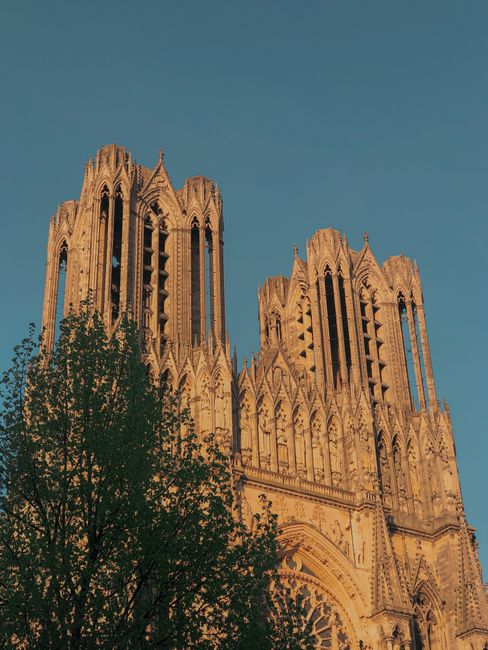
Reims is the capital of champagne and the city where the kings of France were crowned. Its Gothic cathedral of Notre-Dame, with the famous Smiling Angel and Chagall windows, is one of the great churches of Europe, and beneath the city’s chalky hills run miles of cellars where the big champagne houses age their bottles and welcome visitors for tours and tastings. Reims is only about 45 minutes by TGV from Paris, which makes it a classic day trip, but it rewards a night or two: add the Basilica of Saint-Remi, the room where the Second World War ended in Europe, and the vineyards of the Montagne de Reims and Épernay. Give Reims one full day, and two or three to enjoy the wine country.
Right now in Reims
- Wed 10–20°C 50–68°F 11 mm Heavy rain
- Thu 11–15°C 51–59°F 6 mm Mostly clear
- Fri 7–13°C 45–56°F Cloudy
Weather: MET Norway (CC BY 4.0) · Rates: ECB
Top tours in Reims
See all tours for Reims →
From local operators, with prices and reviews; you check availability and book on Viator, our partner. We may earn a commission at no extra cost to you. How we earn money
Reims at a glance
- Best for: champagne cellar tours and tastings, Gothic architecture, history from the coronations to 1945, and vineyard drives.
- How long: 1 day for the cathedral and one or two champagne houses, 2–3 days with Épernay, the Montagne de Reims and a relaxed tasting pace.
- Best time: May to October for vineyard views, with the grape harvest in late August and September; December for the Christmas market.
- Getting in: TGV from Paris Gare de l’Est to Reims station, by the city centre, in about 45 minutes; other TGVs stop at Champagne-Ardenne TGV station just outside the city.
- Getting around: the centre and the cathedral are walkable; two tram lines and buses run by Grand Reims Mobilités link the station, the centre, the TGV station and the champagne houses on the Saint-Nicaise hill.
- Before you go: entry rules, money, trains and general safety are on our France travel guide, and the train from the capital is covered in our Paris travel guide.
Reims’s neighbourhoods and who each one suits
Reims is a compact city of broad Art Deco streets, rebuilt after heavy bombing in the First World War. The station, the cathedral and the champagne hill of Saint-Nicaise form a line from north-west to south-east, about 3 km end to end.
The cathedral quarter
The streets around Notre-Dame and the Palais du Tau, with the tourist office, the Christmas market and many restaurants. The obvious base for a first visit.
Place Drouet-d’Erlon
A long pedestrian square between the station and the cathedral, lined with cafés, brasseries and bars, and busy until late. Lively, central and handy for trains, though noisy at weekends.
Saint-Remi and Saint-Nicaise
The quieter south-east of the city, home to the Basilica of Saint-Remi and the hill of Saint-Nicaise, where Pommery, Taittinger, Veuve Clicquot and Ruinart have their cellars. Good for a calm stay near the tastings, a tram or 30-minute walk from the cathedral.
Boulevard Lundy and the north
Grand 19th-century champagne mansions and houses such as Mumm and the Musée de la Reddition, close to the station and the city centre.
Top things to see in Reims
Prices and hours below come from the official websites, as of October 2026. Two major museums are closed for renovation: the Palais du Tau and the Musée des Beaux-Arts both plan to reopen in 2027.
Reims Cathedral (Notre-Dame de Reims)
Begun in 1211, the cathedral is a masterpiece of High Gothic, with a west front covered in some 2,300 statues, including the Smiling Angel, and a vast nave lit by stained glass, among it windows by Marc Chagall. For centuries the kings of France were crowned here, including Charles VII with Joan of Arc at his side in 1429. Badly damaged by shelling in 1914, it was restored with help from around the world. With the Palais du Tau and the Basilica of Saint-Remi, it forms a UNESCO World Heritage Site. How to visit: the cathedral is free to enter and open daily, except during services.
The cathedral towers
Guided tours of the towers, run by the Centre des monuments nationaux, climb about 250 steps to walk among the gargoyles and roof timbers with views over the city and the vineyards. How to visit: tickets cost €9 (as of October 2026), free for under-18s, and online booking is required. Tours run Tuesday to Saturday at 10:00, 11:00, 14:00, 15:00 and 16:00, and on Sundays at 14:00, 15:00 and 16:00, from 9 September to 15 November; the towers close from 16 November to 14 February, and summer has an extra 17:00 tour.
Palais du Tau
The former archbishops’ palace beside the cathedral, where kings stayed and feasted on coronation day, holds the cathedral treasure and original statues from the façade. It is closed for a major renovation and is due to reopen in 2027 as a renewed museum of the coronations; only a small temporary shop is open. Until then, the cathedral towers are the way in to the site.
Basilica of Saint-Remi
A huge Romanesque and early Gothic abbey church, in parts older than the cathedral, built over the tomb of Saint Remi, the bishop who baptised Clovis, king of the Franks, around 500. It is free to visit and much quieter than the cathedral. Next door, the Musée Saint-Remi in the old abbey covers Reims from the Gallo-Romans to the Middle Ages; it is open Tuesday to Sunday, 10:00–18:00, and its cloister garden is closed for works.
Musée de la Reddition
In this school building, used as General Eisenhower’s headquarters, Germany signed its surrender in the early hours of 7 May 1945. The map room has been kept as it was, and the museum reopened with a new display. How to visit: open daily except Tuesdays, 10:00–18:00; city museums are free for under-18s and on the first Sunday of the month.
Champagne houses and cellar tours
Visiting a champagne house is the reason most people come to Reims. The big houses have kilometres of cellars, many cut into Gallo-Roman chalk quarries (crayères) 20–30 m underground, where it is about 10–12 °C all year. Tours last 1–2 hours and end with a tasting; most need booking online, often weeks ahead for weekends and summer. Prices below come from the houses’ official websites, as of October 2026.
- Mumm: on Rue du Champ de Mars, near the centre. The Cordon Rouge Experience, a cellar tour with one glass, costs €30 (1 h 30); tours with two tastings cost €42 or €60.
- Veuve Clicquot: on the Saint-Nicaise hill. The basic cellars tour costs €36 (1 hour), with longer tasting tours from €60 to €80 and beyond. Open Tuesday to Sunday until 1 November 2026, then Wednesday to Sunday until early January.
- Pommery: an Elizabethan-style estate with a 116-step staircase down to 18 km of galleries in about 60 chalk pits, decorated with bas-reliefs and contemporary art. Self-guided cellar visits start from about €27 and guided tours cost more; check the Vranken-Pommery booking site.
- Taittinger: cellars 18 m below the ruins of the Saint-Nicaise abbey, with four tasting tours; book on the house’s online ticket office.
- Ruinart: the oldest champagne house, founded in 1729, with spectacular listed chalk pits; visits are premium and limited, so book well in advance.
Many smaller houses and growers in Reims and the villages also welcome visitors, often more personally and for less. See our wine-tasting guide for how tastings work. Under-18s cannot be served alcohol, and drivers should spit or choose a non-alcoholic option.
Champagne Hillsides, Houses and Cellars
In 2015 UNESCO listed the “Champagne Hillsides, Houses and Cellars” as a World Heritage Site, recognising where and how sparkling champagne was developed. It has three parts: the historic vineyards of Hautvillers, Aÿ and Mareuil-sur-Aÿ; the Saint-Nicaise hill in Reims, with its champagne houses and chalk pits; and the Avenue de Champagne and Fort Chabrol in Épernay.
Food and drink in Reims
Beyond champagne, Reims is known for its pink biscuits (biscuits roses), made since the 17th century to dip in a glass of bubbly; the Fossier biscuit house has a shop in town. Look for jambon de Reims, a herb-crusted ham, Chaource cheese, and the still red wines of Bouzy. Place Drouet-d’Erlon is the busiest place for a brasserie meal, the streets near the cathedral and the Halles du Boulingrin, a 1920s concrete market hall with stalls and lunch counters, are better for local food. Champagne bars pour by the glass, a good way to compare houses and growers.
Other things to do in Reims
Fort de la Pompelle
A First World War fort on the front line just south-east of the city, never captured, with a museum of uniforms, weapons and German helmets. It is open Tuesday to Sunday, 10:00–18:00, and costs €5.50 (as of October 2026), free for under-18s and on the first Sunday of the month. You need a car or taxi.
The Christmas market
Every winter about 150 chalets set up around the cathedral, selling crafts, food and mulled wine and champagne by the glass. It usually runs from late November to late December; as of October 2026 the 2026 dates had not been confirmed by the organisers, so check the Reims tourist office website.
Day trips from Reims
The vineyards start at the edge of the city. A car, a bike or a guided tour is easiest for the villages; Épernay is on the railway.
Épernay and the Avenue de Champagne
Épernay, about 30 minutes by regional train or car, is the other champagne capital. The Avenue de Champagne is lined with the mansions of famous houses, including Moët & Chandon, with many kilometres of cellars beneath. Many offer tours and tastings; book ahead. Nearby Hautvillers, where the monk Dom Pérignon worked, is a pretty hilltop village with vineyard views.
The Montagne de Reims and the Verzenay lighthouse
The wooded hill between Reims and Épernay is a regional nature park, ringed by grand cru villages such as Verzenay, Verzy and Bouzy. At Verzenay a lighthouse built in 1909 stands among the vines, with a vineyard museum and a view from the top. Nearby, the Faux de Verzy are rare dwarf beeches with twisted branches, on a free forest trail.
Strasbourg and Alsace
High-speed trains link Reims and the Champagne-Ardenne TGV station with Strasbourg in about 1 h 30–2 h; see our Strasbourg travel guide for the Alsace wine route and Christmas markets.
Nearby destinations
- Paris130 km
- Luxembourg City157 km
- Lille167 km
- Brussels177 km
- Ghent200 km
- Maastricht214 km
- Antwerp219 km
- Bruges224 km
Getting there and getting around
By train
TGV INOUI and some regional trains run from Paris Gare de l’Est to Reims station, by Place Drouet-d’Erlon, in about 45 minutes. Other high-speed trains, from Charles de Gaulle airport, Lille, Strasbourg, Brittany and the Atlantic coast, stop at Champagne-Ardenne TGV, about 5 km south-west in Bezannes; tram line B links it with the city centre. Check which station is on your ticket. Regional trains go to Épernay and Châlons-en-Champagne.
By air
Paris Charles de Gaulle is the nearest major airport; direct TGVs reach Champagne-Ardenne TGV station in about 30–40 minutes. See our Paris guide for the airport.
Trams and buses
Reims has two tram lines, A and B, and a bus network run by Grand Reims Mobilités (formerly Citura), with tickets valid for an hour and day tickets. Buy them from tram-stop machines, the app or the driver, and validate on every boarding; check current fares on grandreims-mobilites.fr. The trams link Reims station, the city centre and Champagne-Ardenne TGV station; buses serve Saint-Remi and the champagne houses of the Saint-Nicaise hill.
Driving and parking
Reims has a low-emission zone (ZFE) inside its inner ring of boulevards. As of October 2026, according to secondary sources, Crit’Air 4, Crit’Air 5 and unclassified vehicles may not drive in it, and Crit’Air 3 vehicles are expected to be banned later. Any car, including foreign cars, needs a Crit’Air sticker to enter; check grandreims.fr before you drive. For the vineyards a car is useful, but agree on a non-drinking driver: France’s limit is 0.5 g of alcohol per litre of blood, and lower for new drivers.
When to go and how long to stay
Reims has a cool, temperate climate: cold, grey winters, mild springs and warm summers that rarely get very hot. Reims-Prunay airport station has no complete 1991–2020 record, so the table uses Météo-France’s official 1991–2020 normals for Mailly-Champagne, a station on the Montagne de Reims about 12 km south of the city, at 182 m: average daily highs and lows, and days with at least 1 mm of rain.
| Season | Average high / low | Rainy days per month | What it’s like | Good for |
|---|---|---|---|---|
| Winter (Dec–Feb) | 6–7 °C / 1–2 °C | 10–13 | Cold, grey and damp; frost and the odd snowfall | Cellar tours (always 10–12 °C), the Christmas market |
| Spring (Mar–May) | 11–19 °C / 4–10 °C | 9–10 | Fresh, with buds and flowers in the vineyards | Sightseeing, vineyard drives |
| Summer (Jun–Aug) | 22–25 °C / 12–14 °C | 8–10 | Warm and pleasant, with thunderstorms | Vineyard walks and cycling, terraces |
| Autumn (Sep–Nov) | 20 °C falling to 10 °C / 11 °C falling to 5 °C | 8–11 | Harvest in September, then misty and cooler | The grape harvest, tastings |
Mailly-Champagne gets about 755 mm of rain a year on about 120 days. July is the warmest month, with an average high of about 25 °C.
How long to stay: 1-, 2- and 3-day plans
1 day: the cathedral in the morning (with a towers tour if open), lunch near Place Drouet-d’Erlon or the Halles du Boulingrin, then one champagne house in the afternoon.
2 days: add the Basilica of Saint-Remi, the Musée de la Reddition and a second champagne house. 3 days: add Épernay and the Avenue de Champagne, or a drive round the Montagne de Reims to Verzenay, Hautvillers and grower tastings.
Where to stay in Reims
- Around the cathedral: the classic base, with the sights and the Christmas market on your doorstep.
- Place Drouet-d’Erlon and the station: practical for trains and nightlife; choose a quiet room.
- Saint-Remi and Saint-Nicaise: calmer, near the champagne houses, with some luxury hotels in mansions and parks.
- Vineyard villages: guesthouses and grower B&Bs on the Montagne de Reims or near Épernay, for a car-based stay.
Reims charges a tourist tax (taxe de séjour), set by the Grand Reims urban community, per person per night. According to the official government database of rates (in force since 2024), it is €0.88 in 1-star hotels, B&Bs and hostels, €1.10 in 2-star, €1.76 in 3-star, €2.75 in 4-star, €3.63 in 5-star hotels and €5.06 in palaces; unclassified rentals pay 5.5% of the price per person per night, within a legal cap. These totals include the Marne department’s 10% surcharge. Under-18s are exempt. Check your booking, as rates can change.
Practical tips for Reims
- Book champagne tours early: weekend and summer slots at the big houses sell out; small growers may need a phone call or email.
- Bring a layer to the cellars: they stay at 10–12 °C even in summer, and some have more than 100 steps.
- Pace the tastings: two houses a day is plenty; eat between them and drink water.
- Check closures: the Palais du Tau and the Musée des Beaux-Arts are closed until 2027, the cathedral towers close from mid-November to mid-February, and city museums close on Mondays (the Musée de la Reddition on Tuesdays).
- Shipping wine: bottles are heavy and many houses can ship; check your home country’s allowance.
- Emergencies: call 112.
What to pack for Reims
Bring comfortable shoes with grip for cellar steps and cobbles, a warm layer or light jacket for the cool cellars in every season, and a waterproof, as rain falls on about a third of days. In winter pack a proper coat, hat and gloves. If you plan to buy champagne, a padded bottle bag or wine luggage protects it on the train or plane.
Reims travel FAQ
How many days do you need in Reims?
One full day covers the cathedral and one or two champagne houses. Two or three days lets you add the Basilica of Saint-Remi, the Musée de la Reddition, Épernay and the vineyard villages of the Montagne de Reims.
How long is the train from Paris to Reims?
About 45 minutes by TGV from Paris Gare de l’Est to Reims station in the city centre. Some trains use Champagne-Ardenne TGV station, linked to the centre by tram.
Is Reims Cathedral free?
Yes. Entry to the cathedral is free, and it is open daily except during services. Guided tours of the towers cost €9 as of October 2026 and must be booked online; they do not run from 16 November to 14 February.
Is the Palais du Tau open?
No. As of October 2026 the Palais du Tau is closed for renovation and is due to reopen in 2027. The cathedral towers, run by the same national monuments body, remain open for guided visits.
How much does a champagne tour in Reims cost?
As of October 2026, a basic cellar tour with one glass costs €30 at Mumm and €36 at Veuve Clicquot, and Pommery’s self-guided visits start from about €27. Longer tours with several tastings cost €40 to over €100. Book online in advance.
Do I need to book champagne house visits?
Yes, almost always. The big houses sell timed tours online, and summer and weekend slots fill up weeks ahead. Smaller growers usually ask you to call or email first.
What is the best champagne house to visit in Reims?
It depends on taste: Pommery for its dramatic chalk pits and art, Taittinger for its medieval abbey cellars, Mumm for a central, classic tour, Veuve Clicquot for its history, and Ruinart for a premium, small-group visit.
Can you visit Épernay from Reims?
Yes. Épernay is about 30 minutes by regional train or car. Walk the Avenue de Champagne, tour a house such as Moët & Chandon, and add the village of Hautvillers if you have a car.
Where was the German surrender signed in Reims?
In the Musée de la Reddition, Eisenhower’s former headquarters, on 7 May 1945. It is open daily except Tuesdays, 10:00–18:00, as of October 2026.
Do I need a Crit’Air sticker to drive in Reims?
Yes, to drive inside the ring of inner boulevards, which is a low-emission zone. Older Crit’Air 4, 5 and unclassified vehicles may not enter; check grandreims.fr for the current rules.
How much is the tourist tax in Reims?
The official rates range from €0.88 per person per night in 1-star hotels, B&Bs and hostels to €2.75 in 4-star and €3.63 in 5-star hotels, including the Marne department’s surcharge. Unclassified rentals pay 5.5% of the price. Under-18s pay nothing.
When is the Reims Christmas market?
It usually runs from late November to late December around the cathedral, with about 150 chalets. As of October 2026 the exact 2026 dates had not been confirmed, so check the Reims tourist office website.
Sources and last review
Researched and last reviewed on 4 October 2026. Prices and hours come from the official websites of the Centre des monuments nationaux (cathedral towers and Palais du Tau), the Reims city museums, and the Mumm, Veuve Clicquot, Taittinger and Vranken-Pommery champagne houses. Low-emission-zone rules are from secondary sources and should be checked on the Grand Reims website. Tourist-tax rates come from the French tax authority’s open data on local rates; climate figures are Météo-France’s 1991–2020 normals for Mailly-Champagne. Train times are approximate. Prices, timetables and opening hours change, so check the official sites before you travel. For entry rules, money and general safety, see our France travel guide.
Plan your trip
Partner links: TravelerCenter may earn a commission if you book, at no extra cost to you.
🇫🇷 Useful French phrases for Reims
All 38 French phrases: restaurant, hotel, emergencies, romance (printable) →