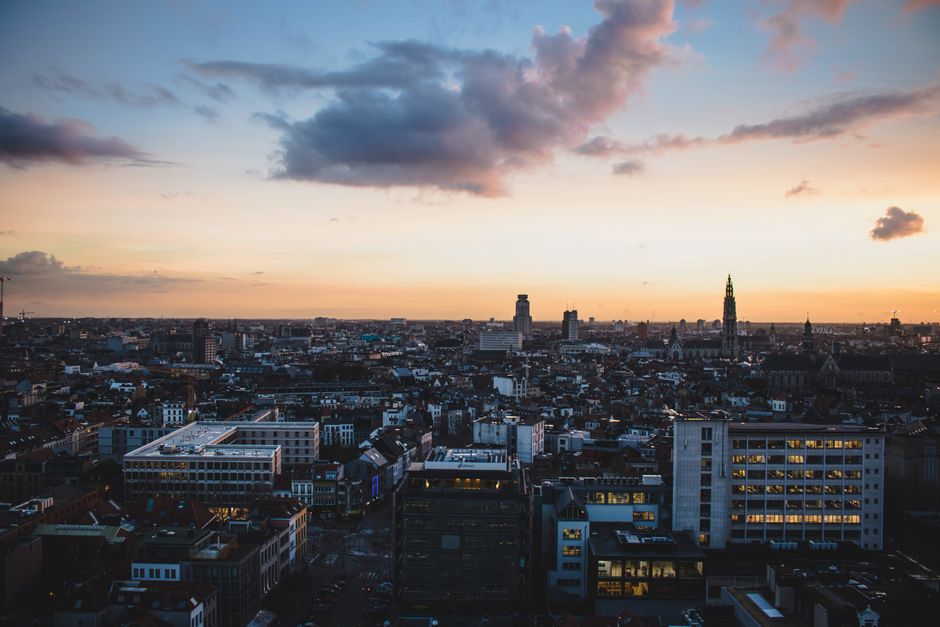
Antwerp is Belgium’s port city and its most stylish: a place of Rubens altarpieces and a soaring Gothic cathedral, a railway station built like a palace, the diamond quarter, avant-garde fashion boutiques and one of the biggest ports in Europe. The old town clusters around the Grote Markt by the Scheldt river, while the 19th-century boulevards, the revived docks of the Eilandje and the cafés of the Zuid spread out from it. You come for art, for shopping, for food and beer, and for a city that feels busy, grown-up and very Flemish. Give it two days; three to add the port and the museums properly.
Right now in Antwerp
- Wed 12–21°C 53–70°F 7 mm Cloudy
- Thu 12–15°C 53–59°F 6 mm Showers
- Fri 10–15°C 49–59°F 6 mm Light rain
Weather: MET Norway (CC BY 4.0) · Air quality: OpenAQ · Rates: ECB
Top tours in Antwerp
See all tours for Antwerp →
From local operators, with prices and reviews; you check availability and book on Viator, our partner. We may earn a commission at no extra cost to you. How we earn money
Antwerp at a glance
- Best for: Rubens and Flemish art, the Cathedral of Our Lady, Antwerp Central Station, fashion and design shopping, the port and the docks, food, beer and nightlife.
- How long: 2 days for the old town, the cathedral, the MAS, the KMSKA and the station; 3 days to add the port, the Red Star Line Museum and the Zuid.
- Best time: May, June and September for mild weather; December for the winter market; any time for the museums.
- Getting in: trains from Brussels take about 35–50 minutes, from Ghent about 50 minutes, from Rotterdam 35 minutes to an hour, and from Amsterdam about 1 hour 15 minutes by Eurostar.
- Getting around: walk the centre and use De Lijn’s trams and premetro. As of October 2026, the Antwerp City Pass costs €45 for 24 hours and includes museums, churches and public transport.
- Note for 2026: Rubens’ house itself is closed for restoration until at least 2030, and the Museum Plantin-Moretus is closed until 5 December 2026.
Antwerp, area by area
The historic centre lies on the right bank of the Scheldt, inside a ring of 19th-century boulevards (the Leien) and the R1 ring road. Central Station is about 20 minutes’ walk east of the Grote Markt along the Meir shopping street; the docks of the Eilandje are to the north and the Zuid to the south.
The old town (Grote Markt and the cathedral)
The Grote Markt, with its Renaissance town hall, guildhouses and the Brabo fountain, the cathedral, the Vlaeykensgang alleys, the Vrijdagmarkt with the Plantin-Moretus printing house and the riverside castle of Het Steen. Best for: first visits and atmosphere.
Meir, the Fashion District and the station
The Meir is the main shopping street; south of it, the Fashion District around the Nationalestraat and Kammenstraat has the MoMu fashion museum and boutiques of the Antwerp designers. East, past the Rubens House, Central Station, the zoo next door and the diamond quarter. Best for: shopping and train travellers.
Het Zuid
The “South” grew up around 19th-century docks that were filled in; today its wide squares have the KMSKA fine arts museum, the FOMU photo museum, the M HKA contemporary art museum, galleries and some of the city’s best restaurants. Best for: art, dining and a local feel.
Eilandje
The old docks north of the centre have been turned into a waterfront district of warehouses, marinas and new apartments, with the MAS museum, the Red Star Line Museum and, a little further, Zaha Hadid’s Port House. Best for: museums, views and waterside bars.
Top things to see in Antwerp
Prices and hours below were checked on the official sites in October 2026. They change, so check before you go. Under-18s enter most of Antwerp’s museums free, and several museums ask everyone to book a time slot online.
Cathedral of Our Lady
Built between the 14th and 16th centuries, the Cathedral of Our Lady is the largest Gothic church in the Low Countries, and its 123-metre spire rules the skyline. Inside are four works by Rubens, including two great triptychs painted after his return from Italy: The Raising of the Cross and The Descent from the Cross, plus The Resurrection and The Assumption above the high altar. As of October 2026, entry costs €12 (€10 for students, over-60s and visitors with disabilities; free for under-18s). It opens Monday to Friday 10:00–17:00, Saturday 10:00–15:00 and Sunday and public holidays 13:00–17:00; services can close parts of the church.
The Rubens House (Rubenshuis)
Peter Paul Rubens lived and worked in this Italian-style palazzo from 1610 until his death in 1640. The house itself is closed for a major restoration and will not reopen before 2030, later than first planned. What you can visit is the new entrance building on the Hopland, with the Rubens Experience, an interactive introduction to the painter’s life and studio, the restored baroque garden and the library. As of October 2026, a ticket for the Rubens Experience and garden costs €12 (€8 for ages 18 to 25) and the garden alone €8; under-18s are free. It opens 10:00–17:00 on weekdays and 10:00–18:00 at weekends, and is closed on Wednesdays. Visits to the Rubens Experience have fixed start times, so book ahead. To see Rubens’ paintings, go to the cathedral, the KMSKA and St James’ Church, where he is buried.
KMSKA (Royal Museum of Fine Arts)
Reopened in 2022 after an 11-year renovation, the KMSKA has a world-class collection of Flemish masters, from Jan van Eyck and Jean Fouquet’s Madonna to Rubens, Van Dyck and Jordaens, plus the largest collection of James Ensor in the world and works by Magritte. A dramatic white “vertical museum” hidden inside the old building holds the modern art. As of October 2026, tickets cost €20 (€10 for under-26s, free for under-18s, with a time slot). It opens 10:00–17:00 on weekdays and 10:00–18:00 at weekends and on public holidays, with late opening until 22:00 most Thursdays.
MAS (Museum aan de Stroom)
The red sandstone tower of the MAS, stacked like crates on the Eilandje, tells the story of Antwerp, its port and its links with the world. Even without a ticket, ride the escalators up the glass “boulevard” to the free rooftop panorama for the best view of the city, the river and the port; the boulevard stays open into the evening. As of October 2026, the museum floors cost €12 (€8 for ages 18 to 25; free for under-18s), and are open Tuesday to Sunday 10:00–17:00. Everyone, including free visitors, must book a time slot online for the museum floors.
Antwerp Central Station
Opened in 1905, Antwerpen-Centraal is often called one of the most beautiful stations in the world: a stone “railway cathedral” with a great dome, marble halls and a vast iron-and-glass train shed, now with tracks on three levels. It is free to walk in. Next door is the historic Antwerp Zoo, one of the oldest in the world, and around the corner the diamond district.
Museum Plantin-Moretus
The home and printing works of the Plantin and Moretus families, who printed books here for three centuries, is the only museum on the UNESCO World Heritage list. It has the two oldest surviving printing presses in the world, a library of antique books and rooms hung with family portraits by Rubens. It is closed for renovation until 5 December 2026, when it reopens with a new permanent display, a new route and a visitor app. Normally it opens Tuesday to Sunday 10:00–17:00; as of October 2026, tickets cost €12 (€8 for ages 18 to 25; free for under-18s).
Red Star Line Museum
Between 1873 and 1934, the Red Star Line carried some two million emigrants from Antwerp to New York and Philadelphia. In the shipping line’s restored warehouses on the Eilandje, the museum follows their journeys through personal stories, and the tower gives a view over the docks. As of October 2026, entry costs €10 (€12 when a temporary exhibition is on; reduced €6 or €8). It is open Tuesday to Sunday 10:00–17:00.
Het Steen and the Scheldt quays
Het Steen, a riverside castle that is the oldest building in Antwerp, now houses one of the city’s visitor centres. Outside, the Scheldt quays have been redesigned as a long promenade with terraces, play areas and views of the river; follow it north to the Eilandje. To cross the river, walk through the Sint-Annatunnel, a 1930s pedestrian tunnel with original wooden escalators, to the left bank, the Linkeroever, for the classic view back to the skyline.
Monuments
- Cathedral of Our Lady, Antwerp
Castles and forts
- Het Steen
Museums
- MAS (Museum aan de Stroom)
- Plantin-Moretus Museum
- Red Star Line Museum
- Royal Museum of Fine Arts Antwerp (KMSKA)
Other sights
- Antwerp Central Station
The port, diamonds and fashion
The Port of Antwerp
Antwerp’s port, merged with Zeebrugge’s as the Port of Antwerp-Bruges, is one of the largest in Europe, stretching for kilometres north of the city. The best way to see it is on a harbour cruise: Flandria runs Port of Antwerp cruises of 2 or 3 hours from the Steenplein, from €23 per person as of October 2026, past container terminals, locks and huge ships. The Port House, Zaha Hadid’s glass “diamond” perched on an old fire station, is worth seeing from outside on the way to or from the MAS. More ideas are in our boat trips guide.
The diamond district
For centuries Antwerp has been a world centre of diamond trading and cutting. The diamond quarter, a few heavily guarded streets beside Central Station, is mostly a working business district of dealers’ offices and jewellers. To learn the story, visit DIVA, the city’s museum of diamonds, jewellery and silver near the Grote Markt. If you shop for diamonds, buy from established jewellers and ask for a certificate.
Fashion and shopping
Since the “Antwerp Six” graduated from the city’s Royal Academy of Fine Arts in the 1980s, Antwerp has been a fashion capital. MoMu, the fashion museum on the Nationalestraat, has changing exhibitions, and the streets around it are full of designer and concept stores, vintage shops and Belgian labels. For antiques and design, try the Kloosterstraat in the Zuid.
Food and drink
Order a bolleke, the round glass of De Koninck amber ale, the city’s own beer; try Antwerpse handjes, hand-shaped biscuits and chocolates named after the legend of Brabo, who cut off a giant’s hand and threw it into the river; and eat mussels and fries, stews and Belgian waffles.
Activities and best months
- Boat tripsFlandria sails 2- or 3-hour cruises through the Port of Antwerp from Asiadok-Zuidkaai on the Eilandje, past container terminals and ships hundreds of metres long, from EUR 23; sailing dates are on its schedule. · source
- City sightseeingThe Cathedral of Our Lady on the Handschoenmarkt holds four works by Rubens, including the Raising of the Cross, plus a carved 1713 pulpit and 19th-century oak choir stalls. It is open Monday to Friday 10:00-17:00, Saturday 10:00-15:00 and Sunday 13:00-17:00; tickets are EUR 12 and under-18s go free. · source
- CultureThe KMSKA (Royal Museum of Fine Arts) needs a booked time slot and about two hours; it is open 10:00-17:00 on weekdays (to 22:00 on Thursdays) and 10:00-18:00 at weekends, with tickets at EUR 20, EUR 10 under 26 and free under 18. · source
Day trips from Antwerp
- Ghent: the Ghent Altarpiece, a castle and canal-side quays, about 50 minutes by train.
- Bruges: about 1 hour 30 minutes by direct train; go early.
- Brussels: the Grand-Place and the museums, about 35–50 minutes by train.
- Mechelen and Lier: two small historic towns, each about 15–20 minutes by train; Mechelen has St Rumbold’s tower and the Kazerne Dossin memorial.
- Into the Netherlands: Rotterdam is 35 minutes to an hour by train, and the beaches and Delta Works of Zeeland are an hour or so by car.
Nearby destinations
Getting to Antwerp
By train. Antwerpen-Centraal is on the high-speed line between Brussels and the Netherlands. Eurostar trains (the former Thalys) run to Rotterdam and Amsterdam (about 1 hour 15 minutes) and south to Brussels and Paris; slower Eurocity Direct and IC trains also link Antwerp with Rotterdam, Breda and Amsterdam, and SNCB trains run to Brussels, Brussels Airport (about 30 minutes direct), Ghent and Bruges. From London, take the Eurostar to Brussels-Midi and change. Some trains also stop at Antwerpen-Berchem, south of the centre. Train times are approximate; check the operators before you go.
By air. Brussels Airport is the main gateway. Antwerp’s own small airport, in Deurne, has only a few flights.
By car. Antwerp is on the E19 (Brussels–Breda), E34 and E313, and traffic on the R1 ring road is often heavy; works for the Oosterweel link add to delays. The city centre and the left bank, inside the ring, form a low-emission zone (LEZ). As of October 2026, the Flemish government has kept the current rules: diesel cars need Euro 5 or newer, and most petrol cars from the late 1990s on are allowed. Cars with foreign number plates, except Dutch ones, must be registered online, free of charge, no later than the day after you enter; a registration made in Antwerp is also accepted in Ghent, but not in Brussels. Use the park-and-ride sites on the edge of the city and take the tram in.
Getting around Antwerp and the Antwerp City Pass
Walk in the old town and along the river. De Lijn runs trams, buses and the premetro (trams running underground through the centre); as of October 2026 a single ticket costs €3 for 60 minutes (in the app, by text or by tapping a contactless bank card on board), a day ticket €9, a 3-day ticket €18 and a 10-journey card €22; children under 6 travel free with a paying adult. Velo, the city’s shared bikes, have stations all over town.
The Antwerp City Pass gives one free visit to 16 museums (including the KMSKA, the MAS, MoMu, FOMU and the Rubens House), four historic churches (including the cathedral) and three attractions, with temporary exhibitions, plus free public transport and a discount on bike hire. As of October 2026 it costs €45 for 24 hours, €55 for 48 hours and €65 for 72 hours, online or at the visitor centres at Het Steen (Steenplein 1) and Central Station. With the cathedral, the KMSKA and the MAS it pays for itself in a day; for under-26s, whose museum tickets are already cheap, it is rarely worth it.
When to go and how long to stay
Antwerp has a mild, damp maritime climate: cool summers, mild winters and rain in every month. The table uses the Royal Meteorological Institute of Belgium’s (KMI/IRM) 1991–2020 climate statistics for the municipality of Antwerp.
| Season | Average temperature | Average high | Rain per month | Sunshine per month | What it’s like |
|---|---|---|---|---|---|
| Winter (Dec–Feb) | 4.0–4.6 °C | 6.8–7.7 °C | 63–91 mm | 51–78 hours | Grey and damp, occasional frost; winter market and museums |
| Spring (Mar–May) | 7.1 °C rising to 14.0 °C | 11.2–18.9 °C | 43–60 mm | 136–221 hours | The driest season; terraces reopen on the Groenplaats |
| Summer (Jun–Aug) | 16.9–18.9 °C | 21.6–23.6 °C | 77–84 mm | 212–225 hours | Pleasantly warm with some showers; quayside bars and harbour cruises |
| Autumn (Sep–Nov) | 15.5 °C falling to 7.4 °C | 20.1–10.5 °C | 73–81 mm | 164 falling to 66 hours | Mild in September, wetter later; good museum weather |
Antwerp gets about 850 mm of rain a year and about 1,740 hours of sunshine, with an average temperature of 11.1 °C, slightly warmer than the rest of Flanders. Carry an umbrella in every season.
Antwerp in 2 days
Day 1: the Grote Markt and the cathedral’s Rubens paintings in the morning, Het Steen and the Scheldt quays, then the MAS and its free rooftop, the Red Star Line Museum and dinner on the Eilandje. Day 2: Central Station, the Rubens Experience and garden, the Meir and the Fashion District, and the KMSKA in the Zuid in the afternoon (or on a Thursday evening).
Antwerp in 3 days
Add a harbour cruise and a walk through the Sint-Annatunnel to the left bank, or a day trip to Ghent or Mechelen. From 5 December 2026, add the reopened Museum Plantin-Moretus.
Weather month by month
Averages from RMI normals 1991–2020, Antwerpen-Deurne · Last reviewed 4 Oct 2026
Where to stay in Antwerp
- Old town: boutique hotels near the Grote Markt and the cathedral; central and atmospheric.
- Around Central Station: chain hotels and good value, ideal for train travellers; the streets right by the station are busy at night.
- Het Zuid: design hotels and B&Bs near the KMSKA and the best restaurants.
- Eilandje: waterside hotels and apartments near the MAS, quieter in the evening.
A city tax per room per night is added to hotel bills. Book early for big trade fairs and December weekends.
Practical tips for Antwerp
- Book time slots: the MAS, the KMSKA and the Rubens Experience all work with timed tickets; book online, even with a pass.
- Check closing days: the MAS, the Red Star Line Museum and Plantin-Moretus close on Mondays, and the Rubens House on Wednesdays; the KMSKA and the cathedral stay open.
- Go cash-free: many museums, including the Rubens House, take cards only.
- Leave the car: register foreign cars for the LEZ before you go, and avoid the ring road at rush hour.
What to pack for Antwerp
A light waterproof or umbrella in every season, comfortable shoes for cobbles and long museum days, layers for changeable weather and a warm coat, hat and gloves from November to March. Antwerp is a well-dressed city, so smart-casual clothes fit in well for dinners in the Zuid. Bring a windproof layer for harbour cruises.
What to pack
- City walking shoesLisbon and Porto are steep, with polished limestone cobbles that get slippery, so grippy soles matter.
- Day packs and anti-theft bagsA small zipped or anti-theft bag makes crowded trams and viewpoints less stressful.
- Dry bags and phone pouchesSpray soaks phones and cameras on open boats to the Algarve caves and on whale-watching trips.
- Fleeces and warm layersIt is cooler at sea than on land, especially on morning whale-watching trips.
- Rain jacketsA windproof, waterproof shell keeps you warm on open boats, where wind and spray cool you quickly.
- Reef-friendly sunscreenSun reflects off the water on cruises and cave tours.
- Travel adapters and convertersPortugal uses Type C and F sockets at 230 V, so most visitors from outside Europe need an adapter.
- Water shoesKayak and small-boat trips to the Algarve grottoes land on rock and wet sand.
Antwerp travel FAQ
Is the Rubens House open?
Only partly. Rubens’ house is closed for restoration and will not reopen before 2030, but the Rubens Experience, the garden and the library are open. As of October 2026, the Rubens Experience and garden cost €12; the site is closed on Wednesdays.
Where can I see Rubens’ paintings in Antwerp?
In the Cathedral of Our Lady (four works, including The Raising of the Cross and The Descent from the Cross), the KMSKA, St James’ Church, where he is buried, and St Paul’s Church.
How much does the Antwerp cathedral cost?
As of October 2026, €12 for adults, €10 reduced and free for under-18s. It is included in the Antwerp City Pass.
Is the Antwerp City Pass worth it?
For adults visiting three or more museums or churches in a day, yes. As of October 2026 it costs €45 for 24 hours, €55 for 48 hours and €65 for 72 hours, and includes public transport.
Is the MAS rooftop free?
Yes. The escalator boulevard and the rooftop panorama are free and open into the evening. The museum floors cost €12 as of October 2026 and need a timed booking.
Is the Museum Plantin-Moretus open?
It is closed for renovation until 5 December 2026, when it reopens with a new display. The reading room stays open for researchers.
Can I drive into Antwerp with a foreign car?
Yes, if it meets the low-emission zone rules (diesel Euro 5 or newer as of October 2026), but cars with foreign plates, except Dutch ones, must be registered online first, free of charge, by the day after you enter.
How do I get from Antwerp to Amsterdam?
By Eurostar in about 1 hour 15 minutes, or more cheaply by Eurocity Direct or slower trains via Rotterdam. See our Amsterdam guide.
How many days do you need in Antwerp?
Two days for the cathedral, the station, the MAS, the KMSKA and the Rubens Experience; three to add a harbour cruise, the Red Star Line Museum and a day trip.
Antwerp or Ghent?
Antwerp is bigger, more cosmopolitan and better for shopping, fashion and museums; Ghent is smaller and more medieval, with the Ghent Altarpiece and its castle. They are 50 minutes apart by train, so it is easy to see both.
Sources
- © OpenStreetMap contributors · ODbL · fetched 4 Oct 2026
- Wikidata · CC0 · fetched 4 Oct 2026
Sources and last review
Researched and last reviewed on 4 October 2026. Cathedral hours and prices: Musea & Kerken Antwerpen; Rubens House status, prices and hours: Rubenshuis; KMSKA, MAS, Museum Plantin-Moretus and Red Star Line Museum: the museums’ own websites; Antwerp City Pass: antwerpcitypass.be; harbour cruises: Flandria; tram and bus fares: De Lijn; low-emission zone: the Flemish rules as published by the City of Ghent and the City of Antwerp’s Slim naar Antwerpen service; climate: KMI/IRM 1991–2020 climate statistics for the municipality of Antwerp. Train times and some LEZ details come partly from secondary sources and are flagged for checking. Prices, timetables and rules change, so check the official links before you go. For the Dutch side of the border, see our Rotterdam guide and Netherlands travel guide.
Plan your trip
Partner links: TravelerCenter may earn a commission if you book, at no extra cost to you.
🇳🇱 Useful Dutch phrases for Antwerp
All 38 Dutch phrases: restaurant, hotel, emergencies, romance (printable) →