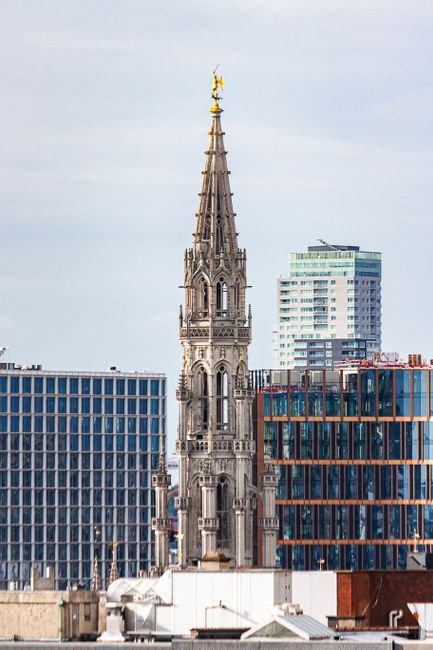
Brussels is a city of surprises: a medieval market square ringed with gilded guildhalls, a tiny bronze boy who has more than a thousand costumes, Art Nouveau houses with swirling iron balconies, the glass towers of the European Union, and a giant silver molecule on the northern edge of town. It is the capital of Belgium and the unofficial capital of Europe, a bilingual French- and Dutch-speaking city with a famously relaxed attitude, a love of comic strips and some of the best beer, chocolate, waffles and chips you will find anywhere. You come to stand on the Grand-Place at dusk, see Magritte and Bruegel in the Royal Museums of Fine Arts, ride up the Atomium, explore the EU quarter for free and eat moules-frites in a wood-panelled brasserie. It is also the best hub in the country: Bruges, Ghent and Antwerp are all an hour or less by train. Give it two days for the city, three or four to add day trips.
Right now in Brussels
- Wed 11–22°C 51–72°F 7 mm Cloudy
- Thu 11–14°C 52–58°F 6 mm Showers
- Fri 9–14°C 47–57°F 4 mm Cloudy
Weather: MET Norway (CC BY 4.0) · Rates: ECB
Top tours in Brussels
See all tours for Brussels →
From local operators, with prices and reviews; you check availability and book on Viator, our partner. We may earn a commission at no extra cost to you. How we earn money
Brussels at a glance
- Best for: the Grand-Place, art museums (Magritte, Bruegel, Rubens), Art Nouveau architecture, comic strips, the European institutions, beer, chocolate and food, and day trips to Bruges, Ghent and Antwerp.
- How long: 2 days for the Grand-Place, the Upper Town museums, the Atomium and the EU quarter; 3–4 days to add Art Nouveau, the Sablon and Marolles, and a day trip or two.
- Best time: May, June and September for mild weather; mid-August in even years for the Flower Carpet; late November to early January for Winter Wonders.
- Getting in: Eurostar and other high-speed trains arrive at Brussels-Midi from Paris, London, Amsterdam and Cologne; trains from Brussels Airport reach the centre in about 17 minutes.
- Getting around: walk the centre; use the metro, trams and buses for the rest. As of October 2026, a STIB journey costs €2.40 by contactless card, capped at €8.50 a day.
- Before you go: Belgium uses the euro and is in the Schengen area; non-EU visitors are registered in the EU’s Entry/Exit System at the border. ETIAS is not yet running as of October 2026.
Brussels, area by area
The historic centre sits inside a ring of boulevards called the Pentagon, after its shape. Within it, the Lower Town spreads around the Grand-Place, and the Upper Town climbs a hill to the Royal Palace and the museums. The European quarter lies just to the east, the Art Nouveau districts of Ixelles and Saint-Gilles to the south, and the Atomium about 7 km north at Heysel. Street signs and metro stations are in French and Dutch: Grand-Place is also Grote Markt, and Brussels-Midi is also Brussel-Zuid.
The Lower Town: Grand-Place, Îlot Sacré and Saint-Géry
The cobbled heart of the city: the Grand-Place, the covered Galeries Royales Saint-Hubert arcades, the restaurant lanes of the Îlot Sacré, Manneken Pis, the former stock exchange (the Bourse) and the cafés of Saint-Géry and the fashion boutiques of Rue Antoine Dansaert. Best for: first visits, nightlife and being in the middle of everything.
The Upper Town: Mont des Arts, Royal Quarter and Sablon
Up the hill from Brussels-Central station, the Mont des Arts gardens lead to the Royal Museums of Fine Arts, the Musical Instruments Museum in an Art Nouveau department store, Place Royale and the Royal Palace facing the Parc de Bruxelles. Nearby are the Sablon squares, with antique dealers and chocolatiers, and, below the huge Palais de Justice, the old working-class Marolles with its daily flea market on Place du Jeu de Balle. Best for: museums, elegant streets and calmer hotels.
The European quarter and Cinquantenaire
Around Schuman and Place Luxembourg are the European Parliament, the Commission’s Berlaymont building and the Council. Free museums tell the story of Europe, and further east the triumphal arch of the Parc du Cinquantenaire is surrounded by the Art & History Museum, Autoworld and the Royal Military Museum. Best for: politics and history buffs, and business trips.
Ixelles and Saint-Gilles
South of the centre, these lively residential districts have the best Art Nouveau streets, including the Horta Museum, as well as the African district of Matongé, the ponds of Ixelles, and squares lined with bars and restaurants such as Place Flagey and Parvis de Saint-Gilles. Best for: eating out, architecture and a local feel.
Top things to see in Brussels
Prices and hours below were checked on the official sites in October 2026. They change, so check before you go.
The Grand-Place
One of the most beautiful squares in Europe and a UNESCO World Heritage Site since 1998. The Gothic Town Hall, with its 96-metre spire, faces the King’s House (home of the Brussels City Museum), and the other sides are lined with ornate baroque guildhalls rebuilt in stone after French bombardment flattened the square in 1695. It is free and always open. Come twice: early in the morning, and again after dark, when the façades are lit.
Manneken Pis and his wardrobe
Five minutes’ walk from the Grand-Place, the little bronze statue of a boy relieving himself is smaller than most people expect, about 55 cm tall, and the original from the 17th century is kept in the City Museum, with a copy on the corner. What makes him special is his wardrobe: on many days of the year he is dressed in one of more than 1,000 costumes donated from around the world, often with a brass band in attendance. Many of the outfits are on show at the GardeRobe MannekenPis museum on Rue du Chêne, a few steps away. Seeing the statue is free.
Royal Museums of Fine Arts and the Magritte Museum
On Place Royale, Belgium’s national art collection covers six centuries. The Old Masters Museum has Flemish primitives, Rubens and the finest Bruegels outside Vienna, including The Census at Bethlehem and the Fall of the Rebel Angels. The Magritte Museum, recently renovated, holds the world’s largest collection of the surrealist’s work, from bowler hats to clouds. As of October 2026, each museum costs €13 for adults, €10 for those 65 and over and €5 for ages 18 to 25, and under-18s go free; a combined ticket costs €20. Both open Tuesday to Friday 10:00–17:00 and at weekends 11:00–18:00, and are closed on Mondays. Entry is free on the first Wednesday of the month from 13:00. Book Magritte tickets online.
The Atomium
Built for the 1958 World’s Fair, the Atomium is a 102-metre model of an iron crystal magnified 165 billion times: nine steel spheres joined by tubes with escalators. Inside are exhibitions on the 1950s, the building’s history and design, and a panoramic restaurant and viewing sphere at the top. As of October 2026, tickets cost €17 for adults, €15 for those 65 and over and €9 for students and children over 115 cm; smaller children go free. It opens every day from 10:00 to 18:00 (last entry 17:30), is busiest from 11:00 to 15:00, and closes for maintenance from 18 January to 5 February 2027. Take metro line 6 to Heysel; Mini-Europe is next door.
Parlamentarium and the House of European History
Two of the best free museums in Brussels sit in the European quarter. The Parlamentarium, the European Parliament’s visitor centre, explains how the EU works with interactive displays in all 24 official languages. The House of European History, in a former dental clinic in Parc Léopold, tells the story of the continent from myths to the present. Both are free and open on Monday 13:00–18:00, Tuesday to Friday 9:00–18:00 and at weekends 10:00–18:00 (closed on 1 January, 1 May, 1 November and 24, 25 and 31 December). Book a free slot for the Parlamentarium online, as entry without one depends on space.
The Royal Palace
The King’s official palace, facing the Parc de Bruxelles, opens to the public only in summer. In 2026, after three years of renovation, it opened from 3 July to 16 August, with a €10 ticket for visitors aged 13 and over and compulsory online booking (free for under-13s). The 2027 dates had not been announced in October 2026; watch the palace’s website from late spring.
The Belgian Comic Strip Center
Belgium gave the world Tintin, the Smurfs and Lucky Luke, and this museum, in a glass-roofed Art Nouveau textile warehouse designed by Victor Horta, celebrates them. As of October 2026, it costs €12 for adults, €9 for ages 12 to 25 and over 65, €5 for children aged 6 to 11 and €32 for a family of four, and opens Tuesday to Sunday 10:00–18:00 (last entry 17:00). Afterwards, look for the comic-strip murals painted on walls around the centre.
Art Nouveau and the Horta Museum
Brussels was a birthplace of Art Nouveau in the 1890s, and four of Victor Horta’s town houses are a UNESCO World Heritage Site. His own house and studio in Saint-Gilles, now the Horta Museum, is the one you can visit inside; it is small, so book a time slot ahead. Then walk the streets around it to spot curving façades and stained glass.
Monuments
- Grand-Place
Other sights
- Atomium
- Manneken Pis
Museums
- Belgian Comic Strip Center
- Horta Museum
- Royal Museums of Fine Arts of Belgium
Palaces
- Royal Palace of Brussels
Eating and drinking in Brussels
- Moules-frites: a pot of mussels with chips, best from September to spring. Skip the touts in Rue des Bouchers.
- Frites: Belgian chips, fried twice and served in a paper cone with mayonnaise; and waffles from street stands.
- Chocolate: pralines were invented in the Galeries Royales Saint-Hubert; the Sablon has many of the top chocolatiers side by side.
- Beer: try a Trappist beer in an old café such as À la Mort Subite, or lambic and gueuze at the Cantillon brewery.
Festivals and events in Brussels
Winter Wonders 2026
Winter Wonders (Plaisirs d’Hiver / Winterpret), Brussels’ Christmas festival, runs from Friday 27 November 2026 to 3 January 2027, daily from 12:00 to 22:00 (until 18:00 on 24 and 31 December and 3 January). Stalls, rides and a big wheel stretch from the Bourse to Sainte-Catherine, and the Grand-Place has a Christmas tree and a sound-and-light show.
The Flower Carpet
Every two years, in mid-August, volunteers lay a carpet of flowers across the Grand-Place. The 2026 edition, with a Japanese theme, used more than 750,000 dahlias and took place from 13 to 16 August 2026; the next is expected in August 2028. The best view is from the Town Hall balcony, usually open for a small fee.
The Ommegang and other events
The Ommegang, a costumed Renaissance procession recognised by UNESCO, fills the streets and the Grand-Place in the first week of July; in 2026 it was held on 1 and 3 July, with grandstand seats on the Grand-Place costing about €59 to €89 and free viewing along the route and on the Sablon. The 2027 dates had not been confirmed in October 2026. Belgian National Day on 21 July brings a parade and fireworks.
Activities and best months
- City sightseeingvisit.brussels puts the Grand-Place first among the city's must-sees: the Gothic town hall, the Maison du Roi with the City Museum and the late-17th-century guild houses, a UNESCO World Heritage Site since 1998. Close by are the Bourse with Belgian Beer World, the Royal Galleries (one of Europe's oldest covered arcades) and Manneken Pis; further out, the Atomium from the 1958 World's Fair, the Royal Quarter, the Mont des Arts and the Cinquantenaire. · source
- CultureThe Royal Museums of Fine Arts (the Old Masters and the Magritte Museum) are the most visited museums in Brussels; tickets are EUR 13 each or EUR 20 combined, under-18s go free, and all the museums are free from 13:00 on the first Wednesday of the month. visit.brussels also lists the Comic Strip Trail of more than 80 murals, the Horta House (Art Nouveau) and the dinosaur gallery of the Institute of Natural Sciences. · source
Day trips from Brussels
Belgium is small and its trains are frequent, so Brussels makes an easy base. Most trains leave from all three central stations: Brussels-Midi, Brussels-Central and Brussels-Nord.
- Bruges: canals, the Belfry and the Flemish primitives; three direct trains an hour, about 1 hour from Brussels-Midi.
- Ghent: a lively university city with the Van Eyck brothers’ Ghent Altarpiece and a castle in the middle of town; about 30–35 minutes.
- Antwerp: Rubens’ house, the cathedral, the diamond district, fashion and one of the most beautiful railway stations in the world; about 40–50 minutes.
- Leuven: a medieval university town with a flamboyant Gothic town hall and the Stella Artois brewery; about 25 minutes.
- Further afield: high-speed trains reach Paris in about 1 hour 25 minutes and London in about 2 hours; see our Paris guide and London guide. Maastricht, just over the Dutch border, is about 1 hour 45 minutes away; see our Maastricht guide.
Nearby destinations
Getting to Brussels
By train. Brussels-Midi is the international station, with Eurostar trains from London (about 2 hours), Paris (about 1 hour 25 minutes) and Amsterdam (about 1 hour 50 minutes), ICE trains from Cologne and Frankfurt, and night trains from Vienna and Berlin. Domestic trains continue to Brussels-Central, a short walk from the Grand-Place. Germany runs checks at its land borders, including with Belgium, until at least March 2027, so carry your passport on trains to Germany. For onward travel, see our Amsterdam guide and Cologne guide.
From Brussels Airport (Zaventem). The station is under the terminal, with trains about every 15 minutes taking 12 minutes to Brussels-Nord, 17 minutes to Brussels-Central and about 21 minutes to Brussels-Midi. Fares include the Brussels Airport supplement (formerly the Diabolo fee), €6.90 as of 2026, so a single to the city costs about €11; check the SNCB app for the exact fare. A cheaper option is STIB bus 12 (bus 21 in the evenings and at weekends) to Schuman and the EU quarter: tapping a contactless card on board charges the Airport2City fare of €7.90 as of October 2026. A taxi costs from about €40.
From Charleroi Airport. Many low-cost flights use Brussels South Charleroi, about 55 km south. As of October 2026, Flibco shuttle buses run to Brussels-Midi in about 55 minutes, roughly every 20 minutes at busy times, from €14.99 one way if booked online. The alternative is the TEC bus to Charleroi-Sud and a train.
By car. The whole Brussels Region is a low-emission zone (LEZ). Since 1 January 2026, diesel cars must meet at least Euro 6 and petrol cars at least Euro 3. Cars with foreign number plates must be registered, free of charge, on lez.brussels before entering, even if they meet the standard. As of October 2026, fines are €350 for a non-compliant vehicle and €150 for an unregistered foreign one. Traffic is heavy and parking is expensive, so leave the car at your hotel or a park-and-ride.
Getting around Brussels and the Brussels Card
The centre is walkable, but the city is hilly and spread out. STIB runs the metro, trams and buses. As of October 2026, the simplest way to pay is to tap a contactless bank card or phone on the gates or validators: €2.40 per journey, with free transfers within 60 minutes, and a daily cap of €8.50, so after four journeys the rest of the day is free. Each traveller needs their own card or device. Tickets in the STIB app cost €2.70 for one journey or €18.90 for ten. Metro line 6 goes to the Atomium, lines 1 and 5 to the EU quarter and Cinquantenaire, and trams 92 and 93 climb to the Sablon and Place Royale. For bikes, see our cycling guide.
The Brussels Card gives free entry to more than 45 museums, including the Royal Museums of Fine Arts, the Magritte Museum, the Comic Strip Center, the Horta Museum and the City Museum, plus discounts. As of October 2026, it costs from €41 for 24 hours, €53 for 48 hours and €59 for 72 hours. Public transport is an option, adding €9, €16.95 or €21.50; Atomium entry is a further option (€14 for adults); and hop-on hop-off buses can be added too. It pays off if you visit three or more paying museums a day.
When to go and how long to stay
Brussels has a mild, damp maritime climate: rarely very hot or very cold, with rain spread through the year rather than a wet season. The table uses the official 1991–2020 climate normals of the Royal Meteorological Institute of Belgium (RMI/KMI/IRM) for Uccle, in the south of the city.
| Season | Average temperature | Average daily high | Rain per month | Sunshine per month | What it’s like |
|---|---|---|---|---|---|
| Winter (Dec–Feb) | 3.7–4.3 °C | 6.1–7.1 °C | 65–87 mm | 49–73 hours | Grey and damp, occasional frost; Winter Wonders until early January |
| Spring (Mar–May) | 7.1 °C rising to 13.9 °C | 10.9–18.4 °C | 47–60 mm | 126–198 hours | The driest season; blossom and the Royal Greenhouses of Laeken in April–May |
| Summer (Jun–Aug) | 16.7–18.7 °C | 21.2–23.2 °C | 71–87 mm | 192–203 hours | Pleasant, with showers and the odd heatwave; Ommegang, National Day, festivals |
| Autumn (Sep–Nov) | 15.2 °C falling to 7.2 °C | 19.5 falling to 9.9 °C | 65–76 mm | 155 falling to 66 hours | Often fine in September; mussel season; quieter museums |
Uccle gets about 837 mm of rain a year, spread over some 133 days with at least 1 mm, and about 1,600 hours of sunshine, with an average temperature of 10.9 °C. Always carry an umbrella. Hotels are often cheaper at weekends and in summer, when the EU institutions are quiet.
Brussels in 2 days
Day 1: the Grand-Place early, the Galeries Royales Saint-Hubert, Manneken Pis, the Comic Strip Center, then up the Mont des Arts to the Royal Museums of Fine Arts and Magritte, the Sablon for chocolate, and the Grand-Place again after dark. Day 2: the Atomium at opening time, then the Parlamentarium or the House of European History, the Cinquantenaire park, and dinner and a beer in Saint-Géry or Ixelles.
Brussels in 4 days
Add a morning at the Marolles flea market and an afternoon of Art Nouveau with the Horta Museum on day 3, and a day trip to Bruges, Ghent or Antwerp on day 4.
Weather month by month
Averages from RMI normals 1991–2020, Uccle (Brussels) · Last reviewed 4 Oct 2026
Where to stay in Brussels
- Around the Grand-Place: walk everywhere, with lots of hotels in every price range; lively and noisy at night.
- Sainte-Catherine and Dansaert: boutique hotels near the fish restaurants and Winter Wonders, a little calmer.
- Sablon and the Upper Town: elegant and quieter, next to the museums.
- Ixelles and Saint-Gilles: apartments and small hotels in residential streets with good restaurants, a short tram ride from the centre.
As of October 2026, the Brussels Region charges a tourist accommodation tax of €5 per room per night in hotels (€4 in homestays and campsites), added to your bill. VAT on hotel stays in Belgium is now 12%.
Practical tips for Brussels
- Mind Mondays: most museums, including the Fine Arts museums and the Comic Strip Center, are closed on Mondays; the Atomium and the EU museums are open.
- Watch your bag: pickpockets work the Grand-Place, the metro and the big stations, especially Brussels-Midi and Brussels-Nord. Stay alert late at night around the stations.
- Free first Wednesdays: the Royal Museums of Fine Arts are free from 13:00 on the first Wednesday of each month, and many city museums are free on the first Sunday.
- Entry rules: since 10 April 2026, non-EU visitors are registered in the Entry/Exit System (fingerprints and photo) on their first entry to the Schengen area; ETIAS (fee €20) is not in operation as of October 2026. Visa-free visitors can stay 90 days in any 180.
What to pack for Brussels
An umbrella or light waterproof jacket in every season, comfortable shoes for cobbles and the climb to the Upper Town, layers for changeable weather, and a warm coat, scarf and gloves from November to March. A contactless card or phone makes the metro easy. Smart-casual clothes are fine everywhere, even in the best restaurants.
What to pack
- City walking shoesLisbon and Porto are steep, with polished limestone cobbles that get slippery, so grippy soles matter.
- Day packs and anti-theft bagsA small zipped or anti-theft bag makes crowded trams and viewpoints less stressful.
- Rain jacketsFrom October to April Porto and Lisbon see rain on roughly a third of days.
- Travel adapters and convertersPortugal uses Type C and F sockets at 230 V, so most visitors from outside Europe need an adapter.
Brussels travel FAQ
How much does the Atomium cost?
As of October 2026, €17 for adults, €15 for those 65 and over and €9 for students and children taller than 115 cm; smaller children go free. It opens daily 10:00–18:00 and closes for maintenance from 18 January to 5 February 2027.
Is the Brussels Card worth it?
Usually, if you visit three or more paying museums a day. As of October 2026, it costs from €41 for 24 hours, €53 for 48 hours and €59 for 72 hours; public transport and the Atomium are optional extras.
How much is a metro ticket in Brussels?
As of October 2026, €2.40 per journey when you tap a contactless bank card or phone, with transfers free for 60 minutes and a daily cap of €8.50. A single in the STIB app costs €2.70.
How do I get from Brussels Airport to the city centre?
Take the train from the station under the terminal: about 17 minutes to Brussels-Central, roughly every 15 minutes, for about €11 including the €6.90 airport supplement. STIB bus 12 or 21 to the EU quarter costs €7.90 by contactless card.
How do I get from Charleroi Airport to Brussels?
The Flibco shuttle bus runs to Brussels-Midi in about 55 minutes, from €14.99 one way online as of October 2026. You can also take the TEC bus to Charleroi-Sud and a train.
Can you visit the Royal Palace in Brussels?
Only in summer. In 2026 it opened from 3 July to 16 August, with €10 tickets and compulsory booking. The 2027 dates had not been announced in October 2026.
When is the next Flower Carpet?
The Flower Carpet is held every two years in mid-August. The 2026 carpet was laid from 13 to 16 August 2026, so the next is expected in August 2028.
When is the Brussels Christmas market in 2026?
Winter Wonders runs from 27 November 2026 to 3 January 2027, daily 12:00–22:00, around the Bourse, Sainte-Catherine and the Grand-Place.
Can I drive into Brussels with a foreign car?
Yes, if it meets the low-emission zone rules (at least Euro 6 for diesel and Euro 3 for petrol since 2026) and you register it free of charge on lez.brussels before you enter. Otherwise you risk a fine of €150 or €350.
How many days do you need in Brussels?
Two days for the Grand-Place, the museums, the Atomium and the EU quarter; three or four to add Art Nouveau, the Marolles and a day trip to Bruges, Ghent or Antwerp.
When is the best time to visit Brussels?
May, June and September for mild weather; early July for the Ommegang; mid-August in even years for the Flower Carpet; and late November to early January for Winter Wonders.
Sources
- © OpenStreetMap contributors · ODbL · fetched 4 Oct 2026
- Wikidata · CC0 · fetched 4 Oct 2026
Sources and last review
Researched and last reviewed on 4 October 2026. Atomium prices and hours: atomium.be; Royal Museums of Fine Arts and Magritte Museum: fine-arts-museum.be; Parlamentarium: European Parliament; House of European History: historia.europa.eu; Royal Palace: monarchie.be; Comic Strip Center: comicstrip.be; Brussels Card: visit.brussels; Winter Wonders: plaisirsdhiver.be; Flower Carpet: flowercarpet.brussels; public transport fares: STIB-MIVB; Charleroi shuttle: Flibco; low-emission zone: lez.brussels; accommodation tax: Brussels-Capital Region (be.brussels); German border checks: European Commission; climate: RMI 1991–2020 normals for Uccle, as published by the WMO. The airport train fare, the Ommegang dates and seat prices, the GardeRobe MannekenPis and train journey times come partly from secondary sources or general knowledge and are flagged for checking. Prices, timetables and rules change, so check the official links before you go. For more cities in the region, see our Netherlands travel guide and France travel guide.
Plan your trip
Partner links: TravelerCenter may earn a commission if you book, at no extra cost to you.
🇳🇱 Useful Dutch phrases for Brussels
All 38 Dutch phrases: restaurant, hotel, emergencies, romance (printable) →