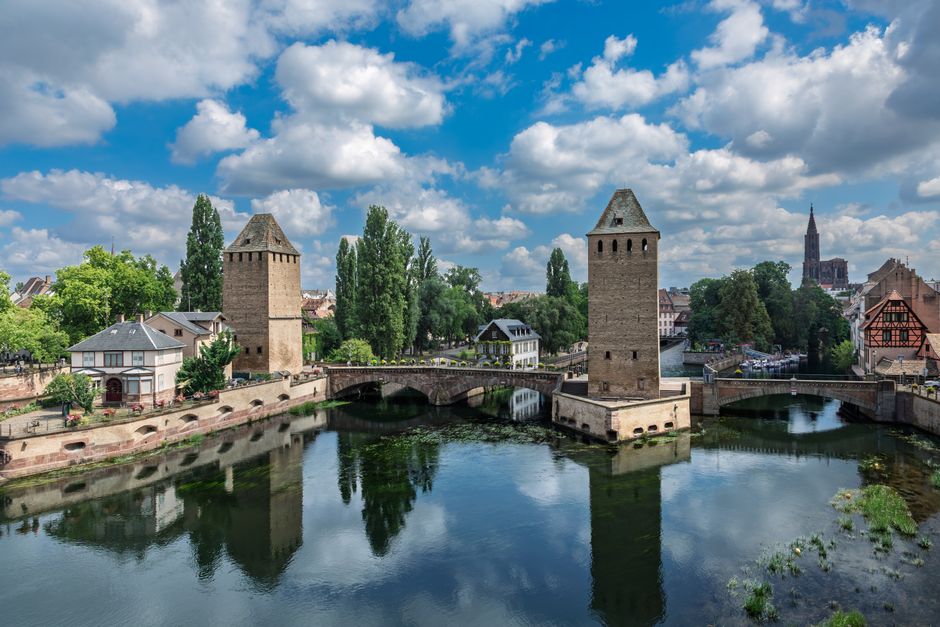
Strasbourg is where France meets Germany, and you feel it everywhere: in the half-timbered houses leaning over the canals of La Petite France, in the winstubs serving choucroute and tarte flambée, and in the soaring pink-sandstone cathedral that was the tallest building in the world for over two centuries. It is also a capital of Europe, home of the European Parliament, and from late November the “Capital of Christmas”, with one of the oldest Christmas markets in Europe. Give it two days for the city, three or four to add Colmar and the Alsace wine route.
Right now in Strasbourg
- Wed 10–24°C 51–74°F 3 mm Partly cloudy
- Thu 12–17°C 53–62°F 5 mm Light rain
- Fri 7–14°C 44–57°F Cloudy
Weather: MET Norway (CC BY 4.0) · Rates: ECB
Top tours in Strasbourg
See all tours for Strasbourg →
From local operators, with prices and reviews; you check availability and book on Viator, our partner. We may earn a commission at no extra cost to you. How we earn money
Strasbourg at a glance
- Best for: a fairy-tale old town, Gothic architecture, canal boat trips, Christmas markets, Alsace wine and food, and the European institutions.
- How long: 2 days for the city, 3–4 with Colmar and the wine route.
- Best time: May to September for warm days and terraces; late November to 24 December for the Christmas markets.
- Getting in: about 1 hour 50 minutes by TGV from Paris Gare de l’Est; a shuttle train links Strasbourg-Entzheim airport with the main station in under 10 minutes.
- Getting around: walk and use the trams; a single ticket is €1.90 and a 24-hour pass €4.60 (as of October 2026).
- Before you go: entry rules, money, trains and general safety are on our France travel guide.
Strasbourg’s neighbourhoods and who each one suits
The historic centre is an island, the Grande Île, wrapped by two arms of the River Ill. UNESCO listed it as a World Heritage Site in 1988 and, in 2017, extended the listing to the Neustadt, the German imperial quarter built after 1871, under the name “Strasbourg, Grande-Île and Neustadt”. You can walk across the centre in 20 minutes.
The Grande Île and the cathedral quarter
The heart of the city: the cathedral and its square, the carved Kammerzell House, the Palais Rohan with three museums, Place Kléber and Place Gutenberg, and shopping streets in between. Lively day and night, and the best base for a first or Christmas visit, at a price.
La Petite France
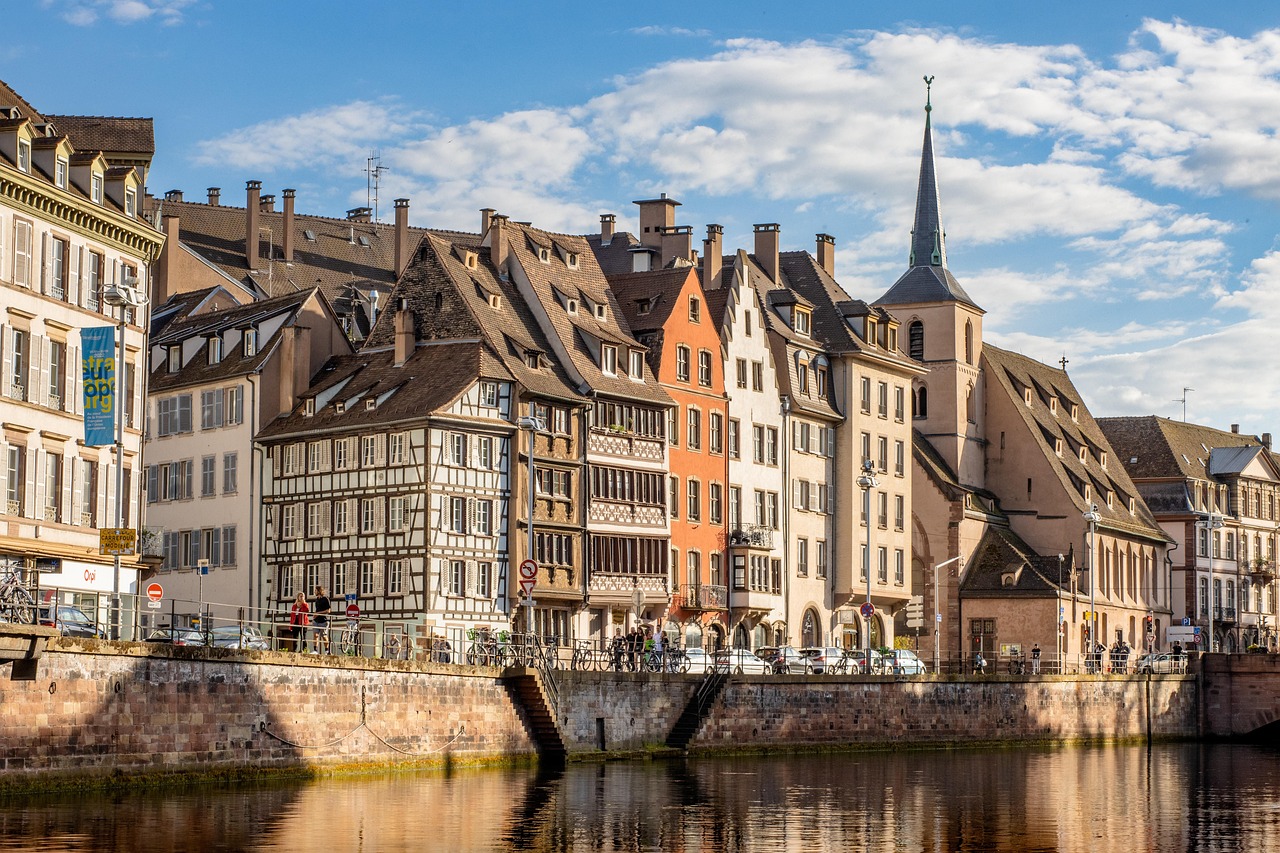
The picture-postcard corner at the western tip of the island, where tanners, millers and fishermen once worked. Half-timbered houses with flower boxes line the canals, locks and swing bridges, and the medieval towers of the Ponts Couverts guard the river. Romantic and crowded at midday; magical early morning and at dusk.
The Neustadt
North-east of the island, wide avenues and grand buildings from the German period surround Place de la République and the Palais du Rhin, with Art Nouveau facades, the university and quieter residential streets. Calm and elegant, a few minutes by tram from the centre.
Krutenau and the station area
Krutenau, just south-east of the island, is the student and nightlife quarter, with bars, small restaurants and riverside terraces. Around the main station, across the canal from Petite France, hotels are cheaper and handy for trains, and the walk into the centre takes 10–15 minutes.
Top things to see in Strasbourg
Prices and hours were checked in October 2026; check again before you go, especially in the busy Christmas season.
Strasbourg Cathedral
Notre-Dame de Strasbourg is one of the masterpieces of Gothic architecture, built in rosy sandstone from the Vosges mountains. Its single 142-metre spire made it the tallest building in the world from 1647 to 1874, and the lace-like west front, the stained glass and the carved pillar of angels are breathtaking. Entry is free. It is a working church, so visits pause during services; as a rule it opens Monday to Saturday from 8:30 to 11:15 and 12:45 to 17:45, and Sunday afternoons, with longer hours during the Christmas market.
- The astronomical clock: a 19th-century wonder that shows the planets, the date of Easter and a parade of mechanical figures, including the apostles passing before Christ, every day at 12:30. As of October 2026 the show costs €4 (€2 for ages 6–17, under-6s free); tickets are sold only on the day, from the morning, and you go in from about 11:30, with a short film before the show.
- The platform: climb 330 steps to the viewing platform 66 metres up, with views over the rooftops to the Vosges and the Black Forest. As of October 2026 a ticket costs €10 (€6 reduced, including ages 6–18 and students); buy it at the kiosk by Place du Château. Not suitable for people with reduced mobility.
La Petite France, the Ponts Couverts and the Barrage Vauban
Wander the lanes of Petite France, watch the boats go through the locks, and cross the Ponts Couverts with their three medieval towers. Then climb onto the roof of the Barrage Vauban, a 17th-century dam, for a free panoramic terrace with the best view of Petite France and the cathedral behind.
Museums
- Palais Rohan: the 18th-century bishops’ palace beside the cathedral, with the Decorative Arts, Fine Arts and Archaeology museums.
- Musée de l’Œuvre Notre-Dame: the cathedral’s original statues and stained glass, up close.
- Musée Alsacien: everyday Alsatian life, costumes and furniture in old houses on the river.
- Modern and Contemporary Art Museum (MAMCS): by the Barrage Vauban, with a café terrace overlooking the water.
A boat trip on the Ill
Batorama’s covered boats leave from beside the Palais Rohan and loop around the Grande Île, through the Petite France locks and out to the Neustadt and the European district, with audio commentary. The classic tour takes about 1 hour 10 minutes and costs around €16 for adults (as of October 2026). Book ahead in summer and December. It is the most relaxing way to see the city, and a good first activity; see our boat trips guide for more.
Parks and the Rhine
The Parc de l’Orangerie, opposite the Council of Europe, has a lake with rowing boats, a small free zoo and storks nesting in the trees, the symbol of Alsace. Further east, the Jardin des Deux Rives straddles the Rhine, with a footbridge to Kehl in Germany; tram line D also crosses the river.
Museums
- Alsatian Museum
- Musée des Beaux-Arts de Strasbourg
- Strasbourg Museum of Modern and Contemporary Art
Monuments
- Cathedral of Our Lady of Strasbourg
- Palais Rohan, Strasbourg
- Saint Thomas Church, Strasbourg
- St. Paul's Church, Strasbourg
Visiting the European Parliament
Strasbourg is the official seat of the European Parliament, which meets here for four-day plenary sessions about twelve times a year. The Council of Europe and the European Court of Human Rights, separate from the EU, are next door in the same European district, a short tram ride from the centre.
- Visits are free. Bring a valid physical passport or national ID card; photocopies, phone images and driving licences are not accepted. Children under 14 must be with an adult.
- Parlamentarium Simone Veil: an interactive exhibition with a 360° cinema, in all 24 EU languages, in the Louise Weiss building. Outside plenary weeks it opens Monday to Friday 9:00–18:00 and Saturday 9:30–12:00 and 13:00–18:00 (last entry 17:00); it is closed on Sundays and some holidays.
- Watching a debate: during plenary sessions (Monday afternoon to Thursday noon), individual visitors can watch from the public gallery for about 30 minutes by booking online in advance. The remaining 2026 Strasbourg sessions are 5–8 October, 19–22 October, 23–26 November and 14–17 December.
- Outside sessions: you can visit the hemicycle with a multimedia guide, without debates.
Activities and best months
- Boat tripsBatorama runs 70-minute boat tours on the Ill all year, past Petite France, the covered bridges, the Vauban dam, the Neustadt and the European institutions, with commentary in 12 languages. · source
- City sightseeingThe Alsace tourism board's weekend itinerary features the Gothic cathedral (142 m spire, 332 steps to the viewing platform), the UNESCO-listed Grande Île and Petite France, and museums such as the Alsatian Museum. · source
- CyclingThe Alsace tourism board says Strasbourg is France's 4th most bike-friendly city, with more than 600 km of cycle paths, and suggests seeing it by bike. · source
- Wine tastingThe historic wine cellar under Strasbourg's hospital, founded in 1395, keeps a white wine from 1472 and is run by about thirty Alsace wineries; entry is free and group tastings can be booked. The 170 km Alsace Wine Route starts at Marlenheim, west of the city. · source
The Strasbourg Christmas market
The Christkindelsmärik, first held in 1570, is one of the oldest Christmas markets in Europe and the oldest in France. Every year the city becomes “Strasbourg, Capital of Christmas”, with eight markets across the centre: the original market on Place Broglie, stalls around the cathedral, the giant Christmas tree on Place Kléber, and smaller markets in Petite France and the old squares, plus decorated streets, concerts and a market of Alsatian producers. Expect mulled wine (vin chaud), gingerbread, bredele biscuits, handmade decorations and crowds.
Dates: in 2025 the market ran from 26 November to 24 December. As of early October 2026, the city had not yet published the 2026 dates; expect it to open in the last week of November, around the first Sunday of Advent (29 November 2026), and to close on 24 December. Check the official noel.strasbourg.eu site before you book.
Tips: book accommodation months ahead, or stay in Colmar, Kehl or another town on the rail line. Come on a weekday, ideally in the morning, as weekends are packed. In past years the Grande Île has had security checks at the bridges and restricted car access during the market, so arrive by train or tram and keep bags small. Many stalls use returnable mugs for vin chaud; keep it as a souvenir or return it for the deposit. Colmar, Riquewihr, Kaysersberg and Obernai hold their own Christmas markets, smaller and just as pretty.
Eating and drinking in Strasbourg
Alsatian food is hearty and delicious. Eat in a winstub, a cosy wood-panelled wine tavern: try choucroute garnie (sauerkraut with sausages and pork), baeckeoffe (meat and potatoes baked in wine), and tarte flambée or flammekueche, a thin, crisp bread with cream, onions and bacon, shared at the table. For dessert, kougelhopf cake or a fruit tart; for cheese, strong Munster. Alsace makes mostly white wines, named after the grape: Riesling, Gewurztraminer, Pinot Gris, Sylvaner and Muscat, plus sparkling Crémant d’Alsace. Strasbourg also has a long brewing history, so local beer is everywhere. Pretzels (bretzels) from a bakery make the perfect walking snack.
Day trips: Colmar and the Alsace wine route
Colmar
Colmar is Alsace at its most colourful: painted half-timbered houses, canals in the Little Venice (Petite Venise) quarter and the Unterlinden Museum, home of the Isenheim Altarpiece. Regional TER trains take about 30 minutes from Strasbourg, several times an hour, so it is an easy day trip. It is very busy in summer and at Christmas; arrive early.
The Alsace wine route
The Route des Vins d’Alsace runs for about 170 km along the foot of the Vosges mountains, from Marlenheim near Strasbourg south to Thann, through vineyards and storybook villages. Highlights include Obernai, Ribeauvillé, Riquewihr, Kaysersberg and Eguisheim. Stop at family wineries for a wine tasting, often free or for a few euros, and drive up to the Château du Haut-Koenigsbourg, a restored mountaintop castle. The best way is by car, by bike on the signposted cycle route (see cycling), or with a small-group tour; some villages are on train or bus lines. Late September and October, during the grape harvest, are wonderful.
Across the Rhine
Take tram D to Kehl in Germany, or go further into the Black Forest for hiking and spa towns. Strasbourg also has fast trains to Frankfurt, Stuttgart and Basel, and to Paris and Lyon.
Nearby destinations
- Black Forest42 km
- Colmar62 km
- Stuttgart107 km
- Basel113 km
- Heidelberg116 km
- Zurich146 km
- Lake Constance155 km
- Luxembourg City165 km
Getting there and getting around
By train
TGV INOUI and OUIGO trains link Paris Gare de l’Est with Strasbourg in about 1 hour 50 minutes. There are also direct TGVs from Lyon, Marseille, Lille and Charles de Gaulle airport, and German ICE and TGV trains to Frankfurt and Stuttgart. The main station, with its glass dome, is 10–15 minutes’ walk from the cathedral.
By air
Strasbourg-Entzheim airport has a station a short covered walk from the terminal. Regional trains reach Strasbourg main station in about 9 minutes, several times an hour at busy times; a single costs a few euros, and a combined train-and-tram ticket is available. EuroAirport Basel-Mulhouse-Freiburg and Frankfurt airport have more international flights and rail links to Strasbourg.
Trams, buses and bikes
Strasbourg has one of France’s best tram networks, run by CTS. As of October 2026, a single ticket costs €1.90 and is valid for one hour with changes, including to Kehl on line D; the 24H Solo pass costs €4.60, the 24H Trio (for 1 to 3 people) €10.20 and the 72H Solo €10.20. Buy tickets from machines at stops or in the CTS app, and validate them before you board. The Europass 24H (€11) adds buses and trams in the German Ortenau district. Strasbourg is also one of France’s most bike-friendly cities, with hundreds of kilometres of cycle paths and Vélhop rental bikes.
Driving
You don’t need a car in the city, and the centre is largely pedestrian. Strasbourg’s low-emission zone requires a Crit’Air sticker: in 2026, Crit’Air 4, 5 and unclassified vehicles may not drive in it, and Crit’Air 3 vehicles are due to be banned from 1 January 2027. Use the park-and-ride car parks on the tram lines. A car is useful for the wine route.
When to go and how long to stay
Strasbourg has a continental climate: warm summers, cold winters and rain spread through the year, with summer thunderstorms. The table uses Météo-France’s official 1991–2020 normals for the Strasbourg-Entzheim station: average daily highs and lows, and days with at least 1 mm of rain.
| Season | Average high / low | Rainy days per month | What it’s like | Good for |
|---|---|---|---|---|
| Winter (Dec–Feb) | 5–7 °C / around 0 °C | 8–10 | Cold, grey, sometimes snowy | Christmas markets in December, cosy winstubs |
| Spring (Mar–May) | 12–21 °C / 3–10 °C | 9–11 | Blossom in the vineyards, showers | Walking, boat trips, the wine route |
| Summer (Jun–Aug) | 24–26 °C / 13–15 °C | About 10 | Warm with thunderstorms; heatwaves pass 35 °C | Terraces, cycling, evening light shows on the cathedral |
| Autumn (Sep–Nov) | 22 °C falling to 9 °C / 11 °C falling to 3 °C | 8–10 | Mild September, foggy November | Grape harvest on the wine route |
Strasbourg gets about 640 mm of rain a year, with the wettest months from May to July, when afternoon thunderstorms are common. Winter nights are often at or below freezing, so dress warmly for the Christmas markets. July is the warmest month, with average highs of about 26 °C.
How long to stay: 2-, 3- and 4-day plans
2 days: Day 1, the cathedral, the astronomical clock at 12:30, the Palais Rohan and a Batorama boat trip, then dinner in a winstub. Day 2, Petite France, the Ponts Couverts and the Barrage Vauban in the morning, the Neustadt and the Parc de l’Orangerie in the afternoon, and the cathedral platform for the view.
3 days: add the European Parliament and a day trip to Colmar. 4 days: add a day on the wine route, with Riquewihr, Kaysersberg and the Haut-Koenigsbourg castle.
Weather month by month
Averages from Météo-France normals 1991–2020, Strasbourg-Entzheim (airport) · Last reviewed 4 Oct 2026
Where to stay in Strasbourg
- Grande Île: the most atmospheric base, next to the cathedral and the markets; book very early for December.
- Petite France: canal views and charm; busy by day, quiet at night.
- Station area: cheaper, practical for day trips by train.
- Krutenau: young and lively, close to the centre.
- Neustadt and the European district: calm, good for families and business visitors, a few tram stops out.
Strasbourg adds a nightly tourist tax (taxe de séjour) per adult, depending on the type of accommodation; under-18s are exempt. Hotels fill up and prices jump during the Christmas market and in European Parliament session weeks, so check the session calendar before booking.
Practical tips for Strasbourg
- Time the clock: buy your astronomical clock ticket in the morning; the show is at 12:30 sharp.
- Bring ID: you need a physical passport or ID card for the European Parliament.
- Book December early: hotels, restaurants and boat trips sell out during the Christmas market.
- Say bonjour: greet staff with “bonjour” and thank them with “merci”; many locals also speak German, and some still speak Alsatian.
- Watch your bags: in market crowds and around the cathedral square.
What to pack for Strasbourg
Comfortable shoes for cobbles and the 330 steps up the cathedral. In summer, light clothes and a compact umbrella for thunderstorms; in spring and autumn, layers and a rain jacket. For the Christmas market, dress for long hours outdoors near freezing: a warm coat, hat, gloves, scarf, waterproof boots and thick socks. Leave room in your bag for Christmas decorations and a bottle or two of Alsace wine, and bring your passport or ID card if you plan to visit the European Parliament.
What to pack
- City walking shoesLisbon and Porto are steep, with polished limestone cobbles that get slippery, so grippy soles matter.
- Day packs and anti-theft bagsA small zipped or anti-theft bag makes crowded trams and viewpoints less stressful.
- Dry bags and phone pouchesSpray soaks phones and cameras on open boats to the Algarve caves and on whale-watching trips.
- Fleeces and warm layersIt is cooler at sea than on land, especially on morning whale-watching trips.
- Rain jacketsA windproof, waterproof shell keeps you warm on open boats, where wind and spray cool you quickly.
- Reef-friendly sunscreenSun reflects off the water on cruises and cave tours.
- Travel adapters and convertersPortugal uses Type C and F sockets at 230 V, so most visitors from outside Europe need an adapter.
- Water bottles and hydration packsRiding in the Algarve and Alentejo heat needs more water than you expect.
- Water shoesKayak and small-boat trips to the Algarve grottoes land on rock and wet sand.
- Wine bottle travel protectorsPort and Douro wines bought at the quintas travel home safely in checked luggage with padded bottle protectors.
Strasbourg travel FAQ
How many days do you need in Strasbourg?
Two days covers the cathedral, Petite France, a boat trip and the Neustadt. Three or four days lets you add the European Parliament, Colmar and the Alsace wine route.
When is the Strasbourg Christmas market in 2026?
The city had not published the 2026 dates by early October. In 2025 it ran from 26 November to 24 December, so expect late November to Christmas Eve; confirm on noel.strasbourg.eu before booking.
What is the best time to visit Strasbourg?
May to September for warm weather, terraces and the wine route, with average highs of about 21–26 °C. December is the most magical but busiest and coldest time, thanks to the Christmas markets.
Is Strasbourg Cathedral free to visit?
Yes, the cathedral itself is free. The astronomical clock show costs €4 and the climb to the platform €10 (as of October 2026).
What time does the astronomical clock perform?
Every day at 12:30, when the apostles parade and the cockerel crows. Buy your ticket on the day, in the morning, and go in from about 11:30.
Can you visit the European Parliament in Strasbourg?
Yes, for free, with a physical passport or ID card. The Parlamentarium Simone Veil is open six days a week outside sessions, and you can book online to watch a debate during plenary weeks.
How do I get from Strasbourg to Colmar?
By regional TER train, about 30 minutes and several times an hour. Colmar’s old town is a 15-minute walk from the station.
What is the Alsace wine route?
A signposted route of about 170 km along the Vosges foothills, from Marlenheim to Thann, through vineyards and villages such as Riquewihr, Kaysersberg and Eguisheim. It is best by car, bike or small-group tour.
How long is the train from Paris to Strasbourg?
About 1 hour 50 minutes by TGV from Paris Gare de l’Est. Book early for the cheapest fares, especially in December.
How do I get from Strasbourg airport to the city?
Walk to the Entzheim-Aéroport station next to the terminal and take a regional train to Strasbourg main station, about 9 minutes away. A combined train-and-tram ticket covers the onward tram.
Can you walk from Strasbourg to Germany?
Yes. A footbridge in the Jardin des Deux Rives crosses the Rhine to Kehl, and tram line D runs there on a standard €1.90 ticket.
Sources
- © OpenStreetMap contributors · ODbL · fetched 3 Oct 2026
- Wikidata · CC0 · fetched 3 Oct 2026
Sources and last review
Researched and last reviewed on 3 October 2026. Climate: Météo-France 1991–2020 normals for Strasbourg-Entzheim; Christmas market: the City of Strasbourg’s official Christmas site; European Parliament: the Parliament’s visitor service and 2026 session calendar; cathedral platform: the Fondation de l’Œuvre Notre-Dame; transport fares: CTS. Cathedral hours, clock and platform prices, the airport train, the boat tour price, the wine route length and the low-emission zone rules come partly from secondary sources and are flagged for checking. Prices, hours and timetables change, so check the official links before you go. For entry rules, money and general safety, see our France travel guide.
Plan your trip
Partner links: TravelerCenter may earn a commission if you book, at no extra cost to you.
🇫🇷 Useful French phrases for Strasbourg
All 38 French phrases: restaurant, hotel, emergencies, romance (printable) →