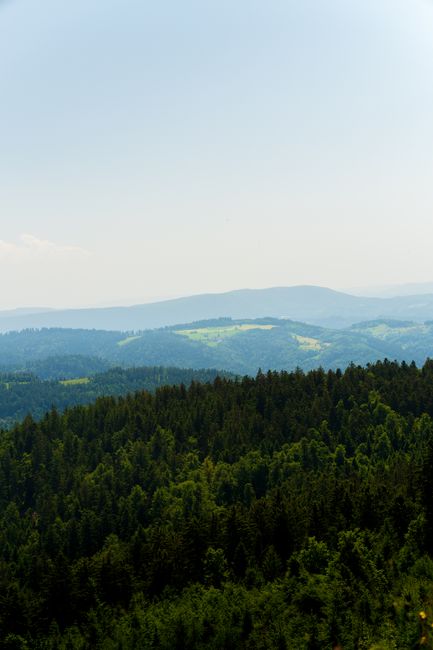
The Black Forest (Schwarzwald) is the wooded mountain range in Germany’s south-west corner, running about 160 km from Pforzheim and Baden-Baden down to the Swiss border near Basel. Behind the dark fir forests that gave it its name are open, sunny valleys with huge hip-roofed farmhouses, waterfalls, lakes, vineyards on its western slopes, elegant spa towns and lively university-town Freiburg. You come to hike and cycle, soak in the thermal baths of Baden-Baden, see the Triberg waterfalls, buy a cuckoo clock, drive the Black Forest High Road and eat the cherry cake. Most hotels give you a free bus and train pass, so it is easy to explore without a car.
Right now in Black Forest (Triberg im Schwarzwald)
- Wed 13–21°C 55–69°F 2 mm Partly cloudy
- Thu 8–15°C 46–58°F 19 mm Heavy rain
- Fri 5–10°C 41–51°F Partly cloudy
Weather: MET Norway (CC BY 4.0) · Air quality: OpenAQ · Rates: ECB
Top tours in Black Forest
See all tours for Black Forest →
From local operators, with prices and reviews; you check availability and book on Viator, our partner. We may earn a commission at no extra cost to you. How we earn money
The Black Forest at a glance
- Best for: hiking, cycling, spa days, scenic drives and train rides, waterfalls and lakes, traditional crafts, and food and wine.
- How long: 3–4 days for Freiburg, Titisee, Triberg and Baden-Baden; a week to hike and slow down.
- Best time: May to October for hiking and outdoor life; September and October for wine festivals and golden forests; January and February for snow on the high ridges; December for Christmas markets.
- Getting in: Basel-Mulhouse-Freiburg (EuroAirport), Karlsruhe/Baden-Baden, Stuttgart, Zurich or Frankfurt airports; fast trains along the Rhine to Baden-Baden, Offenburg and Freiburg.
- Money-saver: stay at an accommodation that issues the free KONUS guest card for buses and regional trains.
- Before you go: entry rules, money and general safety are in our Germany travel guide.
The Black Forest, area by area
Freiburg and the south
Freiburg im Breisgau is the region’s capital in spirit: a sunny, green university city with a red sandstone Gothic minster, a daily market in the cathedral square, and little water channels (Bächle) running along the old-town streets. From the southern edge of the city, the Schauinsland cable car climbs to a 1,284 m summit with views over the Rhine plain to the Vosges. South and east lie the highest mountains, the Feldberg (1,493 m) and the Belchen, and the lakes of Titisee and Schluchsee. Best for: city life, wine, the high mountains and easy access by train.
The central Black Forest
The heartland of the clichés, in the best way: Triberg and its waterfalls, Schonach, Furtwangen and the cuckoo-clock makers, the Gutach valley where women wore the famous pom-pom hats (Bollenhut), and the open-air farm museum at Gutach. To the west are the half-timbered towns of Gengenbach and Haslach in the Kinzig valley. Best for: traditions, waterfalls and the Black Forest Railway.
Baden-Baden and the north
Baden-Baden is a polished 19th-century spa town of thermal baths, a grand casino, a festival hall and the Lichtentaler Allee park, listed by UNESCO in 2021 as one of the Great Spa Towns of Europe. From here, the Black Forest High Road climbs south along the ridges through the Black Forest National Park to Freudenstadt, a town with Germany’s largest market square. Best for: spa days, culture and the scenic drive.
Top things to see in the Black Forest
Prices, dates and rules below were checked on the official sites in October 2026. They change, so check before you go.
Triberg waterfalls
Germany’s highest waterfalls, as the town of Triberg calls them, tumble 163 m down seven main steps through mossy forest, with red squirrels begging for nuts along the paths. The main entrance is a short walk from the town centre, and the falls are lit until about 22:00. As of October 2026, summer admission costs €9 for adults (€8.50 with a guest card) and €8.50 for children aged 6–17 and students, with a €20 family ticket; under-6s go free. Winter prices are lower (€7 for adults), and in winter only the lower part of the falls, up to the main fall, is cleared and gritted. Paths and bridges can be icy, and the falls area can close during storms or freezing rain. The waterfall ticket also gets you into the Black Forest Museum, with its clocks, costumes and a model of the Black Forest Railway.
Cuckoo clocks
Clockmaking took off in the Black Forest in the 18th century, as farmers carved clocks in the long winters and peddlers carried them across Europe. Around Triberg, Schonach and Furtwangen you will find workshops, two “world’s largest cuckoo clocks” you can walk into, and shops selling everything from simple carved clocks to elaborate chalet models. If you want an authentic one, look for the certificate of the Black Forest Clock Association (VdS), and ask whether the movement is mechanical (wound with weights) or quartz. Most shops ship home. The German Clock Museum in Furtwangen, the main collection of clocks in the region, was closed for building works as of October 2026, so check before you go.
Titisee and the Feldberg
The Titisee is a glacial lake about 2 km long at the foot of the Feldberg, ringed by forest. Its small resort town is busy with souvenir shops and day-trippers, but you can walk around the lake in about two hours, take a boat round the lake, or hire a pedal boat or rowing boat and swim from lidos in summer. The quieter Schluchsee is bigger and better for swimming and sailing. The Feldberg, the highest mountain in Germany outside the Alps, is reached by chairlift. It has a tower with views to the Alps on clear days, an easy summit loop, and the region’s main ski area in winter. In the Hochschwarzwald area around Titisee and the Feldberg, many hotels give guests the Hochschwarzwald Card, which covers about 100 free activities, including the Feldberg lift and a Titisee boat trip.
Baden-Baden’s thermal baths
The Romans were already bathing in Baden-Baden’s hot springs, and today there are two great bathhouses run by the town’s spa company. The Caracalla Spa is a modern thermal pool complex with indoor and outdoor pools, whirlpools, a grotto and a large sauna area. It is open daily 8:00–22:00, with last entry 1.5 hours before closing. As of October 2026, the bathing area costs €21 for 2 hours, €25 for 3 hours and €35 for a day; with the sauna area, it costs €26, €30 and €40. Swimwear is worn in the pools, but the sauna area is nude, as is usual in Germany. The Friedrichsbad is a 19th-century palace of a bathhouse where you follow a set Roman-Irish bathing ritual of about 17 steps through hot air, steam, a soap-and-brush massage and pools of different temperatures. It is done without clothes. It is open daily 9:00–22:00, with last entry 3 hours before closing, and as of October 2026 it costs €38, with towels and slippers included. Both are closed on 24 and 25 December.
Also in Baden-Baden: the Kurhaus and its casino, the Museum Frieder Burda and the Festspielhaus, one of Europe’s largest opera and concert halls. Take the Merkur funicular for views over the town.
The Black Forest High Road
The Schwarzwaldhochstrasse (B500), Germany’s oldest holiday road, runs for about 60 km along the ridges from Baden-Baden to Freudenstadt, mostly above 900 m. Stops along the way include Bühlerhöhe, the Mummelsee (a small, dark lake at 1,036 m, linked to legends of water nymphs), the Hornisgrinde, the highest point of the northern Black Forest, with a boardwalk across a high moor, and the Ruhestein visitor centre of the Black Forest National Park, Baden-Württemberg’s first national park, founded in 2014. On a clear day you look across the Rhine plain to the Vosges in France. Allow half a day with stops. The road can be busy with motorbikes on summer weekends, and in winter it has cross-country ski trails and small ski lifts.
The Black Forest open-air museum
At Gutach, the Vogtsbauernhof open-air museum has farmhouses from the 16th to 19th centuries, moved from all over the Black Forest, with mills, a sawmill, craft demonstrations and farm animals. It is a good family stop on the Black Forest Railway line, open from spring to early November.
Museums
- Black Forest Open Air Museum
Nature
- Titisee
- Triberg Waterfalls
Peaks and mountains
- Hornisgrinde
- Schauinsland
Viewpoints
- Feldberg
Monasteries and convents
- St. Blasien Abbey
KONUS: free buses and trains
The Black Forest’s best deal is the KONUS guest card. In about 150 participating towns and villages, around 9,000 hotels, guesthouses and holiday flats give it free to guests who pay the local tourist tax. It works as a free ticket for all buses and regional trains (2nd class) across nine transport networks, from Karlsruhe and Pforzheim in the north to Basel and Waldshut in the south, including the trams and buses of Freiburg and Karlsruhe. As of October 2026, it was not valid on ICE, IC, EC and ECE trains, mountain railways or ski lifts. It is valid from check-in until the day you leave (not for your journey there), it is personal, and you must carry photo ID with it. Some accommodation, such as some youth hostels, cannot issue it, so ask before you book. A digital version was being rolled out in 2026. The scenic Black Forest Railway (Schwarzwaldbahn) from Offenburg to Triberg and on to Lake Constance, and the Höllentalbahn from Freiburg to Titisee, are both covered when you use regional trains.
Hiking, cycling and winter sports
The Black Forest invented signposted hiking in Germany. The Black Forest Association (Schwarzwaldverein), founded in 1864, maintains about 24,000 km of marked trails, waymarked with diamonds of different colours.
- Long-distance: the Westweg from Pforzheim to Basel (about 285 km, 12–14 days), the Mittelweg and the Ostweg, all with luggage-transfer packages.
- Day hikes: the Wutach gorge, a wild river canyon east of the Titisee; the Ravenna gorge with its viaduct near Hinterzarten; the Feldberg summit loop; the Lotharpfad in the national park, which shows how forest regrows after a storm.
- Easy walks: around the Titisee, through the Triberg falls, through the vineyards above Freiburg or in the Kaiserstuhl wine hills.
See our hiking guide. For cyclists, there are long valley routes, the Black Forest Cycle Path along the western edge, and very good e-bike hire, as the climbs are long. See our cycling guide. In winter, the Feldberg has downhill skiing, and the high ridges have hundreds of kilometres of cross-country trails and snowshoe routes when snow allows. Snow is not reliable below about 1,000 m.
Food and wine
- Black Forest cake (Schwarzwälder Kirschtorte): chocolate sponge, cherries, cream and a real kick of kirsch, the local cherry brandy. Triberg’s cafés make a big deal of it.
- Black Forest ham (Schwarzwälder Schinken): cured and smoked over fir wood; try it on a farmhouse snack plate (Vesper).
- Wine: Baden is Germany’s warmest wine region. Pinot noir (Spätburgunder), pinot gris and pinot blanc grow on the slopes of the Ortenau, the Markgräflerland south of Freiburg and the volcanic Kaiserstuhl. Autumn wine festivals fill the villages. See our wine tasting guide.
- Fine dining: the region has an unusual number of Michelin-starred restaurants, especially around Baiersbronn.
Activities and best months
- CyclingThe Sudschwarzwald-Radweg is a 264 km loop round the Southern Black Forest Nature Park, made for leisure riders in three to four days. It passes Titisee lake, the Wutach gorge, the High Rhine and the Markgraflerland wine country, and is suited to e-bikes. In 2023 the German cycling club ADFC gave it four stars, and luggage transfer is available. · source
- HikingThe Westweg runs 285 km over the Black Forest heights from Pforzheim to Basel. First marked in 1900 with a red diamond on white, it is Germany's second-oldest long-distance trail and now a certified quality trail. Hikers take about 8-12 days, with highlights such as the Schliffkopf views, Herrenwieser lake and sunrise on the Feldberg. · source
- Wine tastingBlack Forest Tourism promotes the Baden Wine Cycle Route, about 460 km through seven of Baden's wine regions, among them Markgraflerland, Kaiserstuhl and Ortenau along the western Black Forest. Along the way are more than 300 wineries, cooperatives and wine shops plus about 40 distilleries. · source
Getting to the Black Forest
By air. EuroAirport Basel-Mulhouse-Freiburg is about an hour from Freiburg by bus or car. Karlsruhe/Baden-Baden airport is right next to Baden-Baden. Stuttgart, Zurich and Frankfurt have more flights: from Frankfurt, an ICE train reaches Freiburg in about 2 hours.
By train. The main Rhine valley line (Frankfurt–Karlsruhe–Basel) stops at Baden-Baden, Offenburg and Freiburg. From Offenburg, the Black Forest Railway climbs through dozens of tunnels to Triberg and continues to Villingen and Konstanz on Lake Constance. From Freiburg, the Höllentalbahn runs up to Hinterzarten, Titisee and Seebrugg on the Schluchsee. The Deutschland-Ticket (€63 a month in 2026) is valid on all these regional trains.
From nearby countries. Strasbourg is about 30 minutes from Offenburg and an hour from Baden-Baden, and Basel and Zurich are close to the southern Black Forest. A car is useful for the High Road and remote valleys. Heidelberg is about 1.5 hours north of Baden-Baden.
When to go and how long to stay
The Black Forest has two climates. Freiburg and the Rhine side are among the warmest and sunniest places in Germany, while the high ridges are cool, wet and snowy. The table uses the 1991–2020 normals of the German Weather Service (DWD) for Freiburg (237 m). On the Feldberg summit (1,490 m), July highs average only about 15 °C, January highs hover around freezing, and annual precipitation is about 1,590 mm, almost twice Freiburg’s.
| Season | Average high / low | Rain per month | What it’s like |
|---|---|---|---|
| Spring (Mar–May) | 12–21 °C / 3–10 °C | 55–105 mm | Fruit trees in blossom in the valleys, snow lingers on the Feldberg into April, good hiking from May |
| Summer (Jun–Aug) | 24–27 °C / 13–15 °C | 83–92 mm | Warm and sunny in Freiburg, fresher up high; lakes, hiking, festivals; occasional thunderstorms |
| Autumn (Sep–Nov) | 21 °C falling to 10 °C / 11 °C falling to 3 °C | 65–80 mm | Grape harvest and wine festivals, golden forests, misty mornings; quieter from November |
| Winter (Dec–Feb) | 6–8 °C / about 0 °C | 49–67 mm | Mild and grey in Freiburg, snowy on the ridges; skiing on the Feldberg; Christmas markets |
Freiburg gets about 1,800 hours of sunshine a year, with the most in June to August. The high Black Forest is cloudier and much wetter. Bring layers whatever the season.
The Black Forest in 4 days
Day 1: Freiburg: the minster, the market and the Schlossberg, then the Schauinsland cable car. Day 2: the Höllentalbahn to Titisee, a walk round the lake and up the Feldberg. Day 3: the Black Forest Railway to Triberg for the waterfalls and cuckoo clocks, with a stop at the Gutach open-air museum. Day 4: Baden-Baden for a long soak, and the High Road to the Mummelsee if you have a car.
A week in the Black Forest
Add a day hike in the Wutach gorge, a wine day in the Kaiserstuhl, Gengenbach’s half-timbered streets, and a trip into France to Strasbourg or on to Lake Constance by the Black Forest Railway.
Weather month by month
Averages from DWD normals 1991–2020, Freiburg · Last reviewed 4 Oct 2026
Where to stay in the Black Forest
- Freiburg: the best base without a car, with trains and trams everywhere and lots of restaurants. Check that your hotel issues KONUS.
- Hinterzarten or Titisee: for the lakes and the Feldberg, often with the Hochschwarzwald Card.
- Triberg, Schonach or Gengenbach: for the central Black Forest and the railway.
- Baden-Baden: for spa breaks, culture and the High Road.
- Baiersbronn or Freudenstadt: for the national park, hiking and gourmet food.
- A farm stay: many farmhouses rent holiday flats, and they are great for families.
Practical tips for the Black Forest
- Ask about guest cards: KONUS (free transport) and, in some areas, the Hochschwarzwald Card or SchwarzwaldCard (free or discounted attractions) can save a lot.
- Spa etiquette: German saunas are nude and mixed, and towels go under you on the benches. Book a Friedrichsbad slot outside weekends if you can.
- Sundays: shops close, but cafés, museums and the waterfalls stay open.
- Cuckoo clocks: buy from a workshop or a certified shop, and get shipping insured.
- Driving: mountain roads are narrow and twisty, and winter tyres are required in snow and ice.
- Plugs: Germany uses type C and F sockets at 230 V. See our travel adapters guide.
What to pack for the Black Forest
Comfortable walking shoes or light hiking boots with grip for wet forest paths, a rain jacket (the hills catch the rain), a warm layer for the ridges even in summer, a swimsuit and flip-flops for the thermal baths and lakes, and a day pack. In winter, warm boots and gloves. See our guides to hiking shoes and rain jackets.
What to pack
- City walking shoesQuinta visits and harvest days mean steep terraces, gravel and cellar floors.
- Day packs and anti-theft bagsA 20–30 litre pack carries layers, water, a head torch and snacks on full-day levada walks.
- Fleeces and warm layersSummits like Pico do Areeiro averaged about 11 °C over 2024, so a fleece is needed even in summer.
- HeadlampsLevada routes such as PR1 and PR9 pass through long, dark, wet tunnels.
- Hiking shoes and bootsMadeira's levadas and the Azores' crater rims are wet, rocky and slippery, so grippy shoes matter more than anywhere else in Portugal.
- Rain jacketsA packable shell covers showers and wind on coastal routes outside summer.
- Trekking polesLong stone staircases and steep descents on Madeira's peaks and the Azores' crater rims are easier on the knees with poles.
- Water bottles and hydration packsRiding in the Algarve and Alentejo heat needs more water than you expect.
- Wine bottle travel protectorsPort and Douro wines bought at the quintas travel home safely in checked luggage with padded bottle protectors.
Black Forest travel FAQ
What is the KONUS guest card?
A free pass that participating hotels and holiday homes give their guests. It covers buses and regional trains (2nd class) across the Black Forest for your whole stay. As of October 2026, it was not valid on ICE, IC or EC trains, mountain railways or ski lifts.
Does the KONUS card cover my journey to the hotel?
No. It is valid from check-in until the day you leave, so it covers your journey home but not your journey there. It is personal and must be shown with photo ID.
How much does it cost to see the Triberg waterfalls?
As of October 2026, €9 for adults in summer (€8.50 with a guest card) and €7 in winter, with a €20 family ticket in summer. The ticket also covers the Black Forest Museum in Triberg.
Are the Triberg waterfalls open in winter?
Yes, every day, and they are lit after dark. In winter only the lower section up to the main fall is cleared, and the area can close briefly in storms or freezing rain.
What is the difference between the Caracalla Spa and the Friedrichsbad?
Caracalla is a modern thermal pool complex where you wear swimwear in the pools, with a separate nude sauna area. The Friedrichsbad is a historic Roman-Irish bath with a set ritual, done without clothes. As of October 2026, Caracalla cost from €21 for 2 hours and the Friedrichsbad €38.
How long is the Black Forest High Road?
About 60 km on the B500 from Baden-Baden to Freudenstadt, past the Mummelsee and through the Black Forest National Park. Allow half a day with stops.
Where can I buy a real Black Forest cuckoo clock?
Around Triberg, Schonach and Furtwangen, from workshops and specialist shops. Look for the certificate of the Black Forest Clock Association, and choose a mechanical movement for a traditional clock.
Is Freiburg a good base for the Black Forest?
Yes, especially without a car. Trains run from Freiburg to Titisee and to Offenburg for the Black Forest Railway, and the Schauinsland cable car starts at the city’s edge.
Can you swim in the Titisee?
Yes, at the lidos and marked bathing spots from June to early September. The water stays cool, and the larger Schluchsee is better for long swims and sailing.
Is there snow in the Black Forest in winter?
Usually on the high ridges, especially around the Feldberg, from about December to March. Below about 1,000 m it is often grey and wet rather than snowy.
How many days do you need in the Black Forest?
Three or four days for Freiburg, Titisee, Triberg and Baden-Baden. A week or more to hike, cycle and visit the wine villages.
Nearby destinations
- Strasbourg42 km
- Colmar64 km
- Basel92 km
- Stuttgart93 km
- Zurich107 km
- Lake Constance113 km
- Heidelberg130 km
- Lucerne139 km
Sources
- © OpenStreetMap contributors · ODbL · fetched 4 Oct 2026
- Wikidata · CC0 · fetched 4 Oct 2026
Sources and last review
Researched and last reviewed on 4 October 2026. KONUS guest card: Schwarzwald Tourismus (the Black Forest tourist board); Triberg waterfalls prices and winter opening: the town of Triberg; Caracalla Spa and Friedrichsbad hours and prices: Carasana Bäderbetriebe Baden-Baden; German Clock Museum status: the museum’s own site; Hochschwarzwald Card: Hochschwarzwald Tourismus; Deutschland-Ticket: the official Deutschland-Ticket site; climate: German Weather Service (DWD) 1991–2020 normals for Freiburg and the Feldberg from the WMO climate normals collection. Prices, timetables and rules change, so check the official links before you go. For entry rules, money and general safety, see our Germany travel guide.
Plan your trip
Partner links: TravelerCenter may earn a commission if you book, at no extra cost to you.
🇩🇪 Useful German phrases for Black Forest
All 38 German phrases: restaurant, hotel, emergencies, romance (printable) →