Cap-Haïtien, known to Haitians simply as Okap or “Le Cap,” is Haiti’s second city and the historic heart of the north: a port on a wide bay, backed by green mountains, with a grid of colonial streets, pastel townhouses with wooden balconies and a cathedral on its main square. Founded by the French in 1670 as Cap-Français, it was the capital and the richest city of the colony of Saint-Domingue, and on its southern edge the Battle of Vertières, in November 1803, sealed Haiti’s independence. Today, most visitors come for the monuments of the UNESCO World Heritage site about 20 km (12 miles) to the south: the colossal mountaintop fortress of the Citadelle Laferrière, built by King Henri Christophe after independence, and the ruined Sans-Souci Palace at its foot in Milot. Along the coast to the west, a winding road leads to the beaches and coves of Cormier, Labadie and Paradis, where you can swim, snorkel and eat grilled fish under the palms. Cap-Haïtien has its own international airport, and three or four days is enough to see the Citadelle, explore the old town and enjoy the beaches. The driest, most comfortable months are February to May and the summer, with more rain on the north coast from about October to January.
Right now in Cap-Haïtien
- Sat23–29°C73–85°F1 mm rain
- Sun23–30°C73–87°F18 mm rain
- Mon22–29°C72–85°F1 mm rain
Cap-Haïtien: quick answers
- Things to do in Cap-Haïtien
- The Citadelle Laferrière, The Sans-Souci Palace and Milot, The Ramiers, The Vertières monument, The cathedral and the old town. More
- Best time to visit Cap-Haïtien
- February to May, when it is usually dry and breezy. Summer is also good for beaches, but it falls in the hurricane season, and October to January brings more showers to the north coast. More
- How many days in Cap-Haïtien
- Two days for the Citadelle, Sans-Souci and the old town; three or four to add the beaches, a boat trip and Fort-Liberté. More
- Where to stay in Cap-Haïtien
- The old town (centre-ville), The Boulevard, Carénage and the north of the city, The coast west of the city. More
Cap-Haïtien at a glance
- Best for: the Citadelle and Sans-Souci, Haitian history, colonial architecture, beaches and coves, seafood, art and kompa music.
- How long: three to four days; a full day for the Citadelle and Sans-Souci, half a day for the old town, and a day or two on the beaches.
- Best time: February to May and June to August are usually driest on the north coast; from about October to January, showers are more frequent. The Atlantic hurricane season runs from June to November.
- Getting there: by air to Cap-Haïtien International Airport (CAP), on the edge of the city; check current flights with the airlines.
- Getting around: the old town is walkable; for Milot and the beaches, hire a car with a driver or a guide through your hotel.
- Before you go: entry rules, money and general practical advice are in our Haiti travel guide.
Cap-Haïtien’s areas and where to stay
The city sits on a flat strip of land between the bay to the east and the steep Morne du Cap mountain to the west, with the airport on the southeastern edge and the road to Milot and the Citadelle heading south.
The old town (centre-ville)
The historic center is a grid of narrow streets laid out in colonial times, with numbered rues running one way and lettered ones the other, lined with two-story houses with wooden or wrought-iron balconies, shutters and arcades, many painted in bright colors. The Place d’Armes and the Cathedral of Notre-Dame de l’Assomption are at its heart. It is lively, busy and full of small shops, bakeries and street stalls, with a few guesthouses and small hotels.
The Boulevard
Cap-Haïtien’s seafront promenade, the Boulevard (Boulevard du Cap), runs along the bay on the eastern side of the old town, with benches, food stalls, bars and restaurants. In the evening, it is the place for a stroll, a cold drink and the sea breeze.
Carénage and the north of the city
North of the center, the Carénage district is a quieter, greener residential area along the bay, with some of the city’s better hotels and restaurants and the road out to Fort Picolet at the tip of the headland.
The coast west of the city
Over the hill from the city, a narrow, winding road follows the coast west toward the villages of Cormier and Labadie. Beach hotels and small resorts here make a relaxing alternative base, with swimming on your doorstep and the city about 30 to 45 minutes away by road. Some coves are reached only by boat.
Top things to see in and around Cap-Haïtien
The Citadelle Laferrière
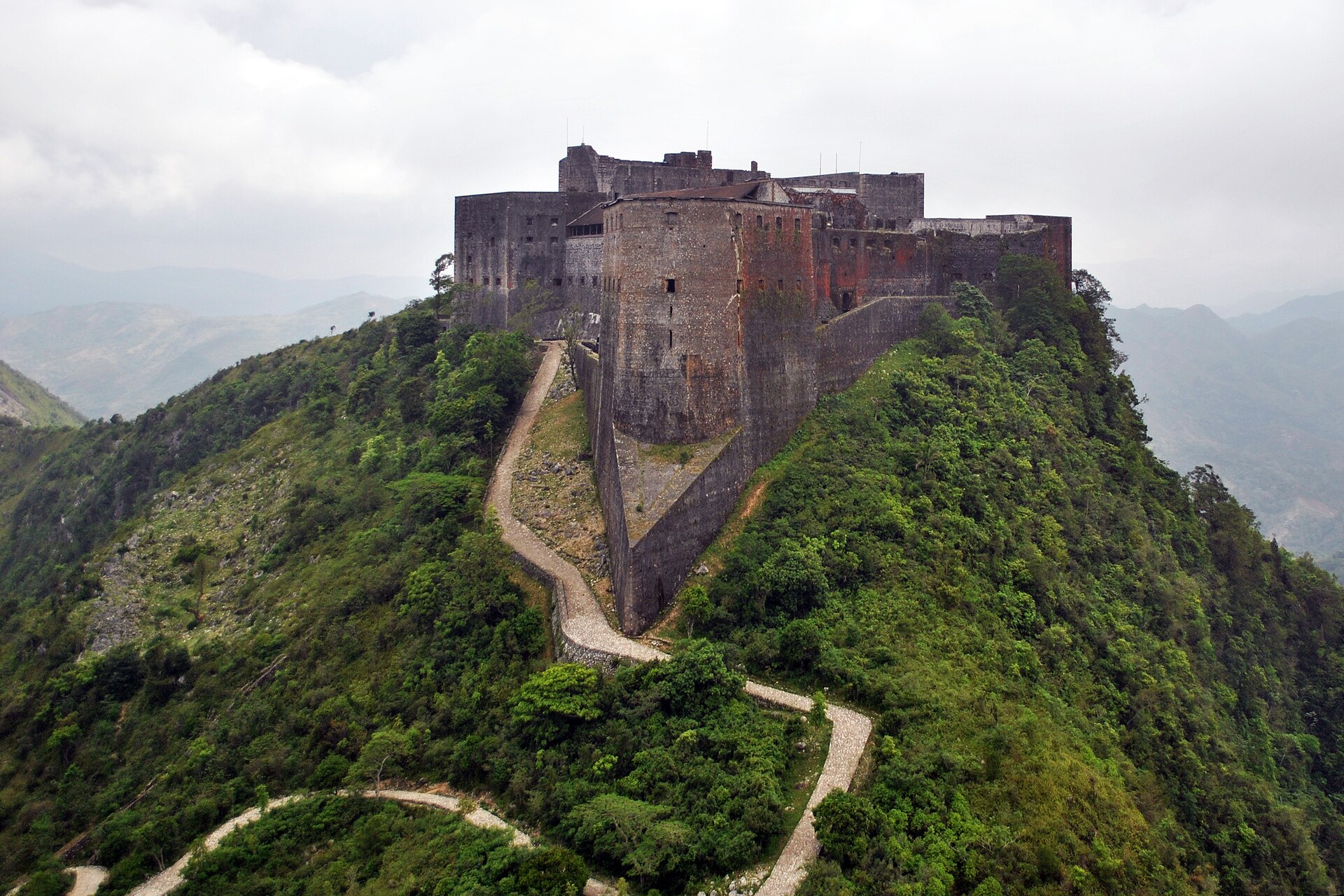
Haiti’s greatest monument stands on the summit of the Bonnet à l’Évêque (“Bishop’s Hat”) mountain at about 900 m (2,950 ft), high above the village of Milot. Built from about 1805 to 1820 under Henri Christophe, first a general of the revolution and later king of northern Haiti, to defend the new nation against any return of the French, it is one of the largest fortresses in the Americas. Its massive walls, up to about 40 m (130 ft) high in places, rise to a sharp prow on the north side, so that from below it looks like a stone ship sailing on the mountains. Inside, you can explore vaulted galleries, barracks, cisterns, the governor’s quarters and batteries still lined with dozens of old cannons, with neat pyramids of cannonballs in the courtyards. On a clear day, the view from the ramparts reaches across the northern plain to Cap-Haïtien and the sea. Together with Sans-Souci and the Ramiers, it forms the National History Park – Citadel, Sans Souci, Ramiers, inscribed by UNESCO in 1982.
How to visit: from Milot, vehicles climb a paved road to a parking area below the fortress, and from there it is a steep walk of roughly 30 minutes to an hour up a cobbled path, or a ride on a horse or mule hired from local handlers. Licensed guides wait at the site entrance and in Milot; a good guide brings the history to life and helps arrange horses. Start early to avoid the midday heat and the clouds that often gather on the summit in the afternoon, wear shoes with a good grip, and bring water, a hat and a light rain layer. The entry fee is set by the park authorities and may change, so check it on the day; carry small notes in gourdes or US dollars for the fee, the guide and the horse handlers.
The Sans-Souci Palace and Milot
At the foot of the mountain in Milot stand the ruins of Sans-Souci, Henri Christophe’s royal palace, completed in 1813 and badly damaged by an earthquake in 1842. Its grand staircases, terraces, arched windows and brick walls, with tropical trees growing through the ruins, are hauntingly beautiful, and you can still trace the king’s audience chamber, gardens and the channels that once carried cool spring water beneath the floors. Beside the palace, the domed Royal Chapel of Milot is still in use. Most visitors see Sans-Souci on the way up or down from the Citadelle; allow at least an hour.
The Ramiers
On a ridge near the Citadelle, the Site des Ramiers is a group of smaller fortifications that completed the defenses of the mountain. They are part of the World Heritage site and can be seen from the Citadelle’s ramparts; ask your guide about walking out to them.
The Vertières monument
On the southern edge of the city, on the road toward the airport and Milot, a monument marks the site of the Battle of Vertières of 18 November 1803, where the revolutionary army under Jean-Jacques Dessalines defeated the French, leading to the declaration of independence six weeks later. The anniversary, 18 November, is a national holiday celebrated with ceremonies at the site.
The cathedral and the old town
The Cathedral of Notre-Dame de l’Assomption, rebuilt several times since colonial days, faces the main square. A walk through the surrounding streets shows Cap-Haïtien’s colonial and 19th-century architecture at its best: arcaded houses, ornate balconies, old warehouses near the port and small squares. Look out for workshops and galleries selling Haitian painting, and for the busy markets near the waterfront.
More sights
- Fort Picolet: the ruins of an 18th-century French fort at the northern tip of the headland, with cannons and a fine view of the bay entrance.
- Bois Caïman: a site in the hills south of the city, near Morne-Rouge, traditionally linked to the Vodou ceremony of August 1791 that is said to have launched the revolution; a simple memorial and a large tree mark the spot.
- Fort-Liberté: about an hour east, a small town on a deep, almost enclosed bay, ringed by the remains of French colonial forts such as Fort Dauphin, reached on foot or by boat.
- Columbus’s landfall: the bay east of the city is where the Santa María ran aground on Christmas Eve 1492, leading to the first, short-lived Spanish settlement, La Navidad.
Other things to do in Cap-Haïtien
Beaches and coves
The coast west of the city is lined with small beaches backed by steep green hills. Cormier Plage has a sheltered bay of soft sand and calm water; around Labadie village, small boats ferry visitors to coves such as Paradis (Paradise Beach) and Belly Beach, and to snorkeling spots over the reefs. The headland of Labadee itself is a private beach resort used by Royal Caribbean cruise ships, open only to cruise passengers. A popular boat trip also visits Île-à-Rat (Amiga Island), a tiny sandy islet in the bay. See our beaches, snorkeling and boat trips guides.
Food and drink
Cap-Haïtien is a good place to try northern Haitian cooking. On the coast, order fresh grilled fish, lobster or lambi (conch) in Creole sauce at a beach shack; in town, try griot (fried pork) with pikliz and fried plantains, diri ak djon djon (black mushroom rice) and akra fritters from street stalls. Bakeries sell fresh bread and pastries, and fruit sellers have mangoes, avocados and coconuts in season. Wash it all down with fresh juice, a local beer or a glass of Haitian rum, and drink bottled or purified water.
Music and nightlife
Weekends bring live kompa bands to bars and hotels along the Boulevard and in the beach resorts, and twoubadou guitarists play in restaurants. Ask at your hotel about concerts and dances.
Day trips from Cap-Haïtien
- Milot, the Citadelle and Sans-Souci: about 20 km (12 miles) south, usually 45 minutes to an hour by road to Milot; allow most of a day.
- Cormier, Labadie and Paradis: 30 to 45 minutes west by road, with boat transfers to the coves.
- Fort-Liberté: about an hour east, for its bay and colonial forts.
- Île-à-Rat (Amiga Island): a short boat ride for a swim and a picnic on a sandy islet.
- Bois Caïman: a short drive south, often combined with the trip to Milot.
Getting there and getting around
By air
Cap-Haïtien International Airport (CAP) is on the southeastern edge of the city, a short drive from the center, and handles international and domestic flights. Airlines and routes change often, so check current flights directly with the airlines before you plan your trip. Most hotels offer airport pickups; arrange one in advance.
By road
A national highway links Cap-Haïtien with Port-au-Prince, about 250 km (155 miles) to the south, via the Artibonite valley; the journey takes many hours, so most visitors fly. Within the region, roads to Milot and Fort-Liberté are paved, while the coast road west to Cormier and Labadie is narrow, steep and winding.
Getting around
The old town and the Boulevard are easy to explore on foot. For everything else, the simplest option is a car with a driver arranged through your hotel or a local tour operator, often combined with a guide for the Citadelle. Tap-taps (shared, colorfully painted pickup trucks) run between the city and Milot, and moto-taxis cover short hops in town; agree the fare first. Boats from Labadie village shuttle visitors to the coves.
When to go and how long to stay
Cap-Haïtien is hot all year, cooled by sea breezes on the coast; the Citadelle, at about 900 m, is noticeably cooler and often wrapped in cloud in the afternoon. The north coast has a slightly different rainfall pattern from the rest of Haiti, with its rainiest months from about October to January, when cold fronts and trade winds bring frequent showers, while February to May and the summer months are usually drier. The Atlantic hurricane season runs from 1 June to 30 November, according to the US National Hurricane Center, peaking in September. We could not find official long-term climate averages for Cap-Haïtien, so the table describes typical conditions; the live widget on this page shows current weather.
| Season | Weather | What to expect in Cap-Haïtien |
|---|---|---|
| February–May | Warm, mostly dry, breezy | The best time for the Citadelle and the beaches; carnival and Easter |
| June–August | Hot and humid; occasional storms | Good beach weather; hurricane season begins |
| September | Hot; peak of hurricane season | Quiet; watch forecasts |
| October–January | Warm with frequent showers | Green hills; muddy paths at Milot; Vertières Day (18 November), Christmas and Independence Day |
2 days in Cap-Haïtien
Day 1: leave early for Milot, climb to the Citadelle in the cool of the morning, then visit Sans-Souci and the Royal Chapel on the way down, with lunch in Milot; return via the Vertières monument. Day 2: walk the old town and the cathedral in the morning, then head west to Cormier or Labadie for an afternoon on the beach and a seafood dinner.
4 days with the coast and Fort-Liberté
Add a boat day to Paradis and Île-à-Rat with snorkeling, and a trip east to Fort-Liberté and its bay of colonial forts, or a visit to Bois Caïman and the northern plain.
Where to stay in Cap-Haïtien
- The old town: guesthouses and small hotels in historic buildings, close to the cathedral, the Boulevard and restaurants.
- Carénage: quieter hotels on the bay north of the center, a short drive from everything.
- Cormier and Labadie: beach hotels and small resorts on the coast west of the city, best if you want to swim and relax between excursions.
Choose a hotel that can arrange airport transfers, a driver and a Citadelle guide, and book ahead for the carnival period, Easter and the Christmas holidays.
What a trip to Cap-Haïtien costs
Prices are our rough estimates for November 2026, in US dollars, which are widely accepted alongside the gourde (about 132 gourdes to the dollar at the central bank’s reference rate on 10 November 2026). Fees at the historic sites are set by the authorities and change, so check them on the day.
| Item | Typical cost |
|---|---|
| Airport transfer to the city center | US$10–25 |
| Car with driver to Milot and back, half to full day | US$60–120 |
| Licensed Citadelle guide, per group | US$15–40 |
| Horse or mule up to the Citadelle | US$10–25 |
| Street-food plate of griot or akra | US$2–5 |
| Seafood lunch at a beach restaurant | US$15–30 |
| Boat trip to a cove or Île-à-Rat, per boat | US$30–80 |
| Mid-range hotel double, per night | US$70–140 |
| Beach resort double, per night | US$120–220 |
Practical tips for Cap-Haïtien
- Start the Citadelle early: mornings are cooler and clearer; clouds often cover the summit by early afternoon.
- Hire a licensed guide: it is the best way to understand the monuments and to arrange horses fairly.
- Carry small notes: gourdes or small US dollar bills for fees, guides, horses, tips and boats.
- Agree prices first: for taxis, moto-taxis, boats and guides, settle the price, and the currency, before you set off.
- Ask before photographing people: a smile and a bonjou go a long way.
- Plan your transport: book airport pickups and drivers through your hotel, and confirm flights a day ahead.
Safety
On a typical visit, the main practical risks are physical. The path to the Citadelle is steep and slippery after rain, the ramparts have unguarded drops, and the sun is strong, so wear good shoes, keep to the paths and carry water. Swim at calm, sheltered beaches such as Cormier and the coves near Labadie, choose boats with life jackets, and watch for sea urchins on rocky shores. Keep valuables out of sight in crowded markets. Arrange transport through your hotel, avoid driving the winding coast road after dark, and keep up with weather forecasts in the hurricane season. For emergencies, call 114 for the police, 116 for an ambulance and 115 for the fire service; ask your hotel for local clinic and private ambulance numbers.
What to pack for Cap-Haïtien
Light, breathable clothes, a sun hat, high-factor sunscreen and insect repellent; shoes with a good grip for the Citadelle path, plus a light rain jacket for the summit and the wetter months; swimwear and water shoes for rocky coves; a reusable bottle with a filter or purification tablets; small US dollar notes; a power bank; and a type A or B plug adapter if your devices are not North American. See our hiking shoes, water shoes, rain jackets and travel adapters guides.
Cap-Haïtien travel FAQ
How far is the Citadelle from Cap-Haïtien?
About 20 km (12 miles) by road to the village of Milot, usually 45 minutes to an hour, then a drive up to the parking area and a steep walk or horse ride of roughly 30 minutes to an hour to the fortress.
Is the Citadelle a UNESCO World Heritage site?
Yes. UNESCO inscribed the National History Park – Citadel, Sans Souci, Ramiers on the World Heritage List in 1982.
Who built the Citadelle Laferrière?
It was built from about 1805 to 1820 under Henri Christophe, a leader of the Haitian Revolution who became king of northern Haiti, to defend the newly independent nation.
Can I ride a horse up to the Citadelle?
Yes. Horses and mules with handlers are available for the final climb from the parking area; agree the price before you start.
Can I visit Labadee without a cruise?
The Labadee headland is a private resort used by Royal Caribbean and is open only to its cruise passengers, but the nearby village of Labadie, Cormier Plage and boat trips to coves such as Paradis are open to everyone.
How many days do I need in Cap-Haïtien?
Two days for the Citadelle, Sans-Souci and the old town; three or four to add the beaches, a boat trip and Fort-Liberté.
What is the best time to visit Cap-Haïtien?
February to May, when it is usually dry and breezy. Summer is also good for beaches, but it falls in the hurricane season, and October to January brings more showers to the north coast.
What happened at Vertières?
On 18 November 1803, the revolutionary army defeated French forces at Vertières, on the edge of Cap-Haïtien, in the last major battle of the Haitian Revolution. A monument marks the site, and 18 November is a national holiday.
Plan your trip
Partner links: TravelerCenter may earn a commission if you book, at no extra cost to you.
🇫🇷 Useful French phrases for Cap-Haïtien
All 38 French phrases: restaurant, hotel, emergencies, romance (printable) →
Before you go: guidebooks and travel gear
Affiliate links: we may earn a commission at no extra cost to you. As an Amazon Associate we earn from qualifying purchases. We pick items for the place, not for the commission. How we earn money
Sources · last reviewed 10 November 2026
Researched and last reviewed on 10 November 2026. World Heritage inscription (1982) and description: UNESCO World Heritage Centre; Citadelle elevation and coordinates: Wikidata and OpenStreetMap; hurricane season: the US National Hurricane Center; exchange rate: Banque de la République d’Haïti (brh.ht); emergency numbers: the Government of Canada (114) and the UK government (116 and 115). History, monument dates and dimensions, sight descriptions, the north-coast rainfall pattern, distances, travel times, transport and prices are general references or our estimates and are flagged for checking. Fees and flights change, so check them before you go. For entry rules, money and general practical advice, see our Haiti travel guide.
Data: Weather: MET Norway (CC BY 4.0) · Sea temperature: NOAA CoastWatch · Rates: ECB · Wikidata (CC0)