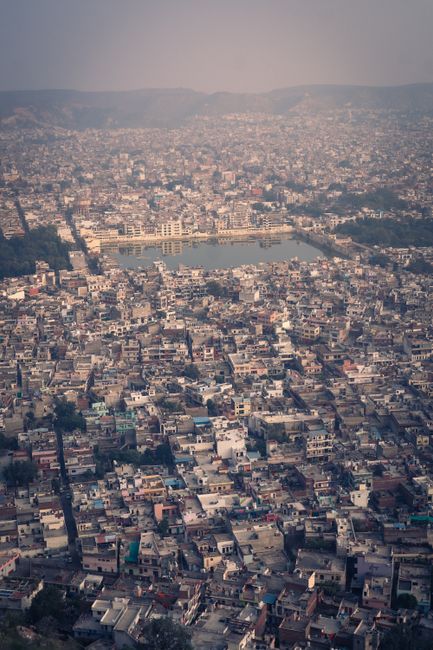
Jaipur, the capital of Rajasthan, is the most visited city in India’s desert state and the third corner of the Golden Triangle with Delhi and Agra. Founded in 1727 by Maharaja Sawai Jai Singh II as one of India’s first planned cities, it was laid out on a grid of wide bazaars inside crenellated walls and later painted the color of terracotta, which gave it the name Pink City; the walled city became a UNESCO World Heritage Site in 2019. Within a short drive are three of the state’s most photographed sights: the honeycomb facade of the Hawa Mahal, the giant astronomical instruments of Jantar Mantar, another UNESCO site, and the hilltop palace-fortress of Amber, part of the Hill Forts of Rajasthan World Heritage listing. The royal family still lives in part of the City Palace. Jaipur is also India’s capital of crafts, from block-printed textiles and blue pottery to jewelry, and a city of rich vegetarian food and sweets. With more than 3 million people, according to the 2011 census, it is busy and noisy, but easy to explore. The best months are October to March; May and June are scorching.
Right now in Jaipur
- Wed 25–35°C 76–95°F Clear
- Thu 25–35°C 77–94°F Clear
- Fri 25–33°C 77–92°F Clear
Weather: MET Norway (CC BY 4.0)
Top tours in Jaipur
See all tours for Jaipur →
From local operators, with prices and reviews; you check availability and book on Viator, our partner. We may earn a commission at no extra cost to you. How we earn money
Jaipur at a glance
- Best for: Rajput palaces and forts, bazaars and crafts, the Hawa Mahal and Jantar Mantar, and Rajasthani food.
- How long: 2 days for the city and Amber; 3 or 4 with Nahargarh, the crafts villages and a day trip.
- Best time: October to March; January has the Literature Festival and kite flying.
- Getting there: Jaipur International Airport (JAI), about 12 km (7 miles) south of the old city, and fast trains from Delhi in about 4½ hours.
- Getting around: app cabs, auto-rickshaws and a hired car for Amber and the hill forts; the old city is best on foot.
- Good to know: most monuments are run by Rajasthan’s archaeology department, which sells a composite ticket for foreigners covering Amber and the main city sights.
- Before you go: the e-Visa, money, trains and general safety are in our India travel guide.
Jaipur’s areas and where to stay
The old walled city sits in a valley ringed by rugged hills topped with forts. Modern Jaipur spreads south and west of it.
The Pink City
Inside the walls, the bazaars of Johari, Bapu, Tripolia and Chandpol, the City Palace, the Hawa Mahal and Jantar Mantar are all within walking distance. A few heritage havelis offer rooms, but most of the area is commercial and crowded, so most visitors stay just outside the walls.
Bani Park and Civil Lines
Quiet residential districts west of the old city, between the railway station and the walls, with many family-run guesthouses and heritage hotels in old mansions.
C-Scheme and MI Road
The modern center, south of the walls, has mid-range and business hotels, restaurants, cafés and shopping, close to the Albert Hall Museum and Ram Niwas Garden.
Amer and the palace hotels
A few hotels lie near Amber, 11 km (7 miles) north. Former royal palaces across the city have become some of India’s grandest heritage hotels.
Top things to see in Jaipur
Amber Fort (Amer)
Overlooking Maota Lake from a ridge of the Aravalli Hills, Amber Fort was the capital of the Kachhwaha rulers before Jaipur was built, a palace complex of honey-colored sandstone and white marble begun in the late 16th century. Climb through the courtyards to the Diwan-i-Am, the Ganesh Pol gateway with its painted frescoes, and the Sheesh Mahal, a hall whose walls and ceilings are set with thousands of tiny mirrors. Incredible India lists the fort as opening at 9 a.m., with an evening light-and-sound show in English at 7:30 p.m. and in Hindi at 8 p.m. Foreigners pay about ₹500, or use the composite ticket. Walk up the ramp from the lake or take a jeep; many visitors skip the elephant rides because of animal-welfare concerns. Arrive at opening time to avoid tour buses.
City Palace
At the heart of the Pink City, the City Palace is still partly the home of Jaipur’s former royal family and a museum of their textiles, weapons, carriages and paintings. Its highlights are the courtyard of Pritam Niwas Chowk with four gates painted to represent the seasons, the Mubarak Mahal, the Diwan-i-Khas with two enormous silver urns, and the seven-story Chandra Mahal. According to Incredible India, the palace opens at 9:30 a.m.; a standard ticket covers the main museum, and the pricier “Royal Splendour” ticket opens exclusive areas of the private palace.
Hawa Mahal
The “Palace of the Winds,” built in 1799, is a five-story screen of pink sandstone with 953 small windows, designed so that the women of the royal household could watch the street processions below unseen. Admire the facade from the street or from a café terrace opposite at sunrise, then go inside to climb its narrow ramps for views over the bazaars and Jantar Mantar.
Jantar Mantar
Next to the City Palace, Jantar Mantar is the largest of the five observatories built by Jai Singh II in the early 18th century: a collection of 19 giant masonry instruments for tracking the stars, measuring time and predicting eclipses, including the 27 m (89 ft) Samrat Yantra, the world’s largest stone sundial, accurate to about two seconds. It is a UNESCO World Heritage Site. Hire a guide or use the audio guide to understand the instruments.
Nahargarh and Jaigarh forts
Two forts guard the hills above Amber and the city. Nahargarh, the “Tiger Fort,” has a 19th-century palace of nine identical suites built for the maharaja’s queens and the city’s best sunset view. Jaigarh, connected to Amber by a walled road along the ridge, has palace courtyards and the Jaivana, one of the largest cannons on wheels ever made.
More classic sights
- Albert Hall Museum: Rajasthan’s oldest museum, in an Indo-Saracenic building of 1887, beautifully lit at night.
- Jal Mahal: a palace seemingly floating in Man Sagar Lake on the road to Amber, seen from the promenade.
- Galta Ji: a temple complex with sacred bathing tanks in a gorge east of the city, known as the Monkey Temple.
- Panna Meena ka Kund: a geometric stepwell near Amber.
- Patrika Gate: a colorful painted gateway in Jawahar Circle, a favorite photo spot.
- Birla Mandir: a modern white marble Hindu temple below Moti Dungri hill.
Other things to do in Jaipur
Food and drink
Rajasthani food was shaped by the desert: hearty, spicy and rich in ghee, lentils and dried beans. The classic is dal baati churma, baked wheat balls with lentil curry and sweet crumbled wheat. Try pyaaz kachori (onion-stuffed pastries) for breakfast, gatte ki sabzi (gram-flour dumplings in yogurt curry), ker sangri (desert beans and berries), and, for meat lovers, fiery laal maas, mutton in red chili gravy. The old city’s sweet shops sell ghewar, a honeycomb-like disc of fried batter soaked in syrup, especially during the monsoon festival of Teej, as well as thick lassi served in clay cups. Many heritage hotels offer Rajasthani thalis on rooftop terraces.
Crafts and shopping
Jaipur is one of India’s great shopping cities. Look for block-printed textiles from the villages of Sanganer and Bagru, where you can watch printers at work; blue pottery; lac bangles; carpets and dhurries; leather juttis; and silver and enamel jewelry. Johari Bazaar is the jewelers’ street, Bapu Bazaar sells textiles and shoes, and Tripolia Bazaar sells brass and lac. Bargain politely, and buy gems only from established shops with certificates.
Festivals
The Jaipur Literature Festival, in January, draws writers from around the world. On Makar Sankranti, January 14, the sky fills with kites. Gangaur, in March or April, and Teej, in the monsoon, are women’s festivals with processions from the City Palace, and the bazaars are lit up for Diwali.
Evenings in Jaipur
As the heat fades, Jaipur comes alive. Watch the sun set over the city from the ramparts of Nahargarh, see the Albert Hall Museum and the walls of Amber floodlit, and catch the light-and-sound show at Amber, which tells the story of the Kachhwaha rulers. Folk dance and puppet performances are staged at themed village restaurants on the edge of town and in many heritage hotels, and the bazaars stay open late, especially in the festival season.
Walks and cycling
Early-morning walking and cycling tours of the old city show the flower market, temples and workshops before the traffic builds. See our city sightseeing and cycling guides.
Day trips from Jaipur
- Abhaneri: the 13-story Chand Baori stepwell, one of the deepest in India, and the Harshat Mata temple, about 95 km (60 miles) east on the road to Agra.
- Sanganer and Bagru: hand-block printing villages on the edge of the city.
- Ajmer and Pushkar: the Sufi shrine of Ajmer Sharif and the holy lake town of Pushkar, about 2½ to 3 hours west; Pushkar’s camel fair takes place in October or November.
- Ranthambore National Park: one of the best places in India to see wild tigers, about 3 hours southeast; best on an overnight trip.
- Samode: a village with a painted palace hotel about an hour north.
- Agra and Delhi: the other corners of the Golden Triangle. See our Agra and Delhi guides, and our Udaipur guide for the lake city to the southwest.
Nearby destinations
- Ranthambore National Park121 km
- Agra220 km
- Delhi238 km
- Jodhpur286 km
Getting there and getting around
By air and train
Jaipur International Airport (JAI) is a designated e-Visa entry airport, with flights across India and to the Gulf. Jaipur Junction station is about 2 km (1 mile) west of the old city; fast trains, including the Vande Bharat Express and the Shatabdi Express, reach Delhi in about 4½ hours, and direct trains also run to Agra, Udaipur, Mumbai and other cities. Indian Railways has an international tourist booking office in Jaipur.
By road
The drive from Delhi takes about 4 to 6 hours on the expressway and highway; from Agra, about 4 to 5 hours via Fatehpur Sikri and Abhaneri. Most Golden Triangle travelers hire a car and driver, which is affordable and convenient for the forts outside town.
Around the city
Auto-rickshaws and app cabs are everywhere; agree auto fares before you set off. The Jaipur Metro runs from Mansarovar in the southwest to Badi Chaupar in the old city. For Amber, Nahargarh and Jaigarh, a car for half a day is easiest. Cycle-rickshaws are good for short hops through the bazaars.
When to go and how long to stay
Jaipur has a hot semi-arid climate. October to March is the best season: sunny days of 22 to 34 °C (72 to 93 °F), cold nights around 8 to 10 °C (47 to 50 °F) in December and January, and almost no rain. April to June is fiercely hot, with highs around 40 °C (104 °F) in May and June and hot desert winds. The monsoon, from July to September, brings short, heavy downpours, green hills and fewer visitors, and is the season of Teej. The table shows 1991–2020 normals for Jaipur’s weather station from the India Meteorological Department (IMD), as published by the World Meteorological Organization (WMO); rainy days are days with at least 2.5 mm of rain.
| Month | Average high / low | Rain (rainy days) | What to expect |
|---|---|---|---|
| January | 22 °C (72 °F) / 8 °C (47 °F) | 6 mm (0.2 in), 1 day | Cool, sunny; Literature Festival; kite flying |
| February | 26 °C (79 °F) / 12 °C (54 °F) | 10 mm (0.4 in), 1 day | Pleasant and dry |
| March | 32 °C (90 °F) / 17 °C (63 °F) | 4 mm (0.2 in), 1 day | Warm; Holi; Gangaur in some years |
| April | 38 °C (100 °F) / 23 °C (73 °F) | 7 mm (0.3 in), 1 day | Hot and dry |
| May | 41 °C (106 °F) / 27 °C (81 °F) | 12 mm (0.5 in), 1 day | Hottest month; dust |
| June | 40 °C (103 °F) / 28 °C (82 °F) | 62 mm (2.4 in), 4 days | Very hot; monsoon arrives late in the month |
| July | 35 °C (95 °F) / 26 °C (79 °F) | 190 mm (7.5 in), 9 days | Monsoon showers; Teej |
| August | 33 °C (91 °F) / 25 °C (77 °F) | 203 mm (8.0 in), 10 days | Wettest month; green hills |
| September | 34 °C (94 °F) / 24 °C (75 °F) | 80 mm (3.1 in), 5 days | Rains ending |
| October | 34 °C (93 °F) / 20 °C (68 °F) | 19 mm (0.8 in), 1 day | Warm, dry; season begins |
| November | 30 °C (85 °F) / 14 °C (58 °F) | 2 mm (0.1 in), under 1 day | Ideal; Diwali lights in some years |
| December | 25 °C (77 °F) / 10 °C (50 °F) | 4 mm (0.1 in), under 1 day | Sunny days, cold nights |
Jaipur gets about 600 mm (24 in) of rain a year, about two thirds of it in July and August.
Two days in Jaipur
Day one: Amber Fort at opening time, Panna Meena ka Kund and Jal Mahal on the way back, then the City Palace and Jantar Mantar in the afternoon, and the bazaars at dusk. Day two: the Hawa Mahal at sunrise, the Albert Hall Museum, a block-printing workshop in Sanganer, and sunset at Nahargarh.
Four days with day trips
Add Jaigarh Fort, Galta Ji and a day trip to Abhaneri, or continue to Ranthambore, Pushkar or Udaipur.
Where to stay in Jaipur
- Bani Park and Civil Lines: family-run guesthouses and heritage hotels, a short ride from the old city.
- C-Scheme and MI Road: modern mid-range hotels close to restaurants and shops.
- The old city: a few heritage havelis for travelers who want to be in the bazaars.
- Palace hotels: former royal residences around the city, for a splurge.
Rooms fill up from October to March, especially around Christmas, New Year and the Literature Festival.
What a trip to Jaipur costs
Prices are approximate, for October 2026, converted at about 96 rupees (₹) to the US dollar. Monument prices are for foreigners and should be checked locally.
| Item | Typical cost |
|---|---|
| Amber Fort, foreigners | about ₹500 (about US$5.20) |
| Composite ticket for state monuments, foreigners | about ₹1,000 (about US$10.40) |
| City Palace, standard ticket | ₹700–1,000 (about US$7.30–10.40) |
| Pyaaz kachori and lassi | ₹50–120 (about US$0.50–1.25) |
| Rajasthani thali in a mid-range restaurant | ₹400–1,200 (about US$4–12.50) |
| Auto-rickshaw across the city | ₹100–250 (about US$1–2.60) |
| Car and driver for half a day (Amber and forts) | ₹1,500–2,500 (about US$16–26) |
| Mid-range hotel double, per night | ₹4,000–10,000 (about US$42–104) |
Practical tips for Jaipur
- Buy the composite ticket: if you plan to see Amber and several state monuments, it saves money and queues.
- Start at Amber: arrive at opening time, before the tour groups and the heat.
- Carry small notes: for autos, snacks and bazaar shopping.
- Dress for temples: cover shoulders and knees at Galta Ji and Birla Mandir and remove your shoes.
- Keep away from monkeys: at Galta Ji and the hill forts, do not carry food openly.
Safety
Jaipur is generally safe, but visitors should know a few local hazards. The best known is the gem scam: friendly strangers, sometimes posing as students or traders, persuade tourists to buy gems to resell abroad at a profit, or to carry them through customs; there is no such profit, and many travelers lose large sums, so never buy gems as an investment and ignore such offers. Commission shopping by drivers and guides is common; decline politely. Heat is a serious risk from April to June, when the forts become ovens by midday; carry water and sightsee early. Food and water: drink bottled or filtered water and eat freshly cooked food. Road safety is poor, with chaotic traffic in the old city and on the highways, so avoid driving at night. Monkeys can bite; do not feed them. Women travelers may encounter staring and unwanted attention in crowded bazaars; dress modestly and use app cabs at night. In an emergency, call 112.
What to pack for Jaipur
A sun hat, sunglasses and sunscreen, light, loose clothes that cover shoulders and knees, comfortable shoes for fort ramps, a warm layer for winter nights and a scarf against dust. India uses 230 V, with round-pin plugs of types C, D and M. See our travel adapters guide.
Jaipur travel FAQ
How many days do I need in Jaipur?
Two days for Amber, the City Palace, the Hawa Mahal, Jantar Mantar and the bazaars; three or four with Nahargarh, crafts villages and a day trip.
Why is Jaipur called the Pink City?
Its old walled city is painted a terracotta pink, a tradition dating from the 19th century, when the buildings were painted to welcome a royal visitor.
How do I get from Delhi to Jaipur?
By fast train in about 4½ hours, by car in about 4 to 6 hours, or by a short flight.
What is the best time to visit Jaipur?
October to March, for sunny days and cool nights. May and June are extremely hot.
Is the Amber Fort worth it?
Yes. It is Jaipur’s finest monument, with mirrored halls, painted gateways and views over Maota Lake. Go at opening time to avoid crowds.
How do I get up to Amber Fort?
Walk up the stone ramp from Maota Lake in about 15 minutes, or take a jeep from the parking area. Elephant rides are offered, but many visitors avoid them because of animal-welfare concerns.
What is the Jaipur composite ticket?
A ticket for foreigners sold by Rajasthan’s archaeology department that covers Amber Fort and several state-run monuments in the city, such as the Albert Hall Museum, Nahargarh and Hawa Mahal, over two days.
Is Jaipur safe for tourists?
Generally, yes. Beware the gem scam and commission shopping, take care in the heat, and use app cabs at night.
What food is Jaipur famous for?
Dal baati churma, pyaaz kachori, gatte ki sabzi, laal maas, ghewar and lassi.
Can I visit Jaipur and Agra in one trip?
Yes. They are about 4 to 5 hours apart by road, via Fatehpur Sikri and Abhaneri, and together with Delhi form the Golden Triangle.
Sources and last review
Researched and last reviewed on 4 October 2026. Amber Fort and City Palace opening times, the light-and-sound show times and the City Palace ticket types: Incredible India (Ministry of Tourism); the designated e-Visa airport: the Bureau of Immigration’s e-Visa site; the international tourist booking office: Indian Railways; climate normals for Jaipur: the India Meteorological Department, via the World Meteorological Organization (1991–2020 normals archived by NOAA’s National Centers for Environmental Information); population: the 2011 census as recorded on Wikidata; the exchange rate: the Reserve Bank of India (FBIL reference rate). Rajasthan’s tourism and archaeology websites could not be reached, so the Amber Fort fee, the composite ticket and City Palace prices are general references, flagged for checking, as are monument history, UNESCO dates, train times, festival dates, the metro and typical prices. Fees and hours change, so check locally before you go. For the e-Visa, money and trains, see our India travel guide.
Plan your trip
Partner links: TravelerCenter may earn a commission if you book, at no extra cost to you.
🇮🇳 Useful Hindi phrases for Jaipur
All 38 Hindi phrases: restaurant, hotel, emergencies, romance (printable) →