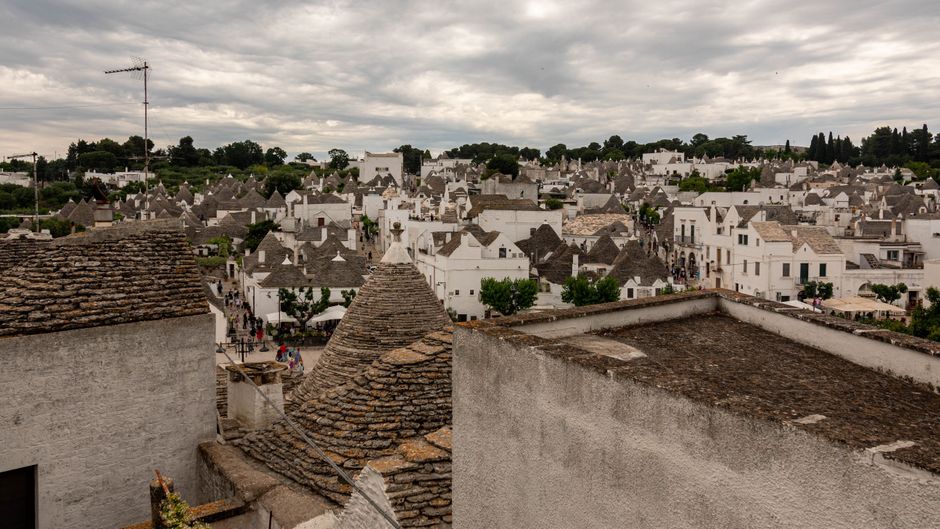
Alberobello is the little town in the hills of Apulia that looks like a fairy tale: around 1,500 trulli, whitewashed round stone houses with conical roofs of grey limestone slabs, crowd two hillside districts that together form a UNESCO World Heritage Site. Built without mortar using a prehistoric technique that survived only in this corner of Italy, many roofs are painted with white symbols and topped with carved pinnacles. Rione Monti is the famous postcard view, its lanes lined with shops and cafés in trulli; Aia Piccola, across the main road, is quieter and still lived in. You can visit a two-storey trullo museum, sleep in a trullo of your own and use the town as a base for the white towns of the Valle d’Itria. It is busy with day trips at midday, magical early in the morning and at night. The best months are April to June, September and October.
Right now in Alberobello
- Wed 16–23°C 61–74°F Cloudy
- Thu 18–26°C 64–78°F Partly cloudy
- Fri 19–24°C 66–76°F 1 mm Cloudy
Weather: MET Norway (CC BY 4.0) · Rates: ECB
Top tours in Alberobello
See all tours for Alberobello →
From local operators, with prices and reviews; you check availability and book on Viator, our partner. We may earn a commission at no extra cost to you. How we earn money
Alberobello at a glance
- Best for: the trulli, photography, a night in a trullo, food and wine, and touring the Valle d’Itria.
- How long: half a day sees the trulli districts; 1–2 nights let you enjoy them without the crowds; 3–4 nights as a base for the Valle d’Itria.
- Best time: April–June and September–October. August is hot and crowded; December has Christmas lights and nativity scenes.
- Book ahead: trullo stays for weekends and from June to September.
- Getting in: about an hour by car from Bari or its airport; Ferrovie del Sud Est trains from Bari Centrale; a car is best for the surrounding area.
- Before you go: entry rules, money, trains and general safety are on our Italy travel guide.
Alberobello’s districts and who each one suits
Alberobello is small: the trulli districts, the newer town centre and the station are all within a 10–15-minute walk. The town stands at about 400 m on the Murge plateau, which keeps evenings fresher than on the coast.
Rione Monti
The larger of the two trulli districts, with around a thousand trulli climbing a slope south of Largo Martellotta. Its steep lanes, especially Via Monte Pertica and Via Monte San Michele, are lined with trulli turned into shops selling linen, ceramics, olive oil and souvenirs, with the trullo-shaped church of Sant’Antonio at the top. Best for: the classic views and atmosphere; very busy from late morning to late afternoon.
Aia Piccola
East of the main road, about 400 trulli where families still live. There are few shops, so it is quiet and gives a truer picture of everyday life in a trullo. Please keep your voice down and do not step into courtyards. Best for: peaceful walks and photographs without crowds.
The town centre and the countryside
North of the trulli, the 19th-century town around Piazza del Popolo has the town hall, cafés, the basilica of the Santi Medici and the Trullo Sovrano. Beyond the town, the countryside is scattered with trulli among olive groves, vineyards and dry-stone walls, many turned into holiday homes with pools. Best for: a quieter stay with parking, or a rural retreat with a car.
Top things to see in Alberobello
Prices and hours below were checked on the official sites in October 2026, unless we say otherwise; check again before you go. Walking round the trulli districts is free.
The trulli of Rione Monti and Aia Piccola
A trullo is built of rough limestone blocks laid dry, with thick walls that keep it cool in summer and warm in winter, and a false dome of overlapping slabs, the chiancarelle, finished with a decorative pinnacle. Many roofs carry symbols painted in lime: crosses, hearts, planets and older signs whose meaning is debated. The story goes that the houses were built without mortar so they could be taken apart quickly when royal tax inspectors came, as the local counts avoided taxes on new settlements; whatever the truth, the town grew up with hundreds of them. UNESCO listed the trulli of Alberobello in 1996. Walk Rione Monti early in the morning or at dusk, then cross to Aia Piccola. Shops will often invite you in to see a trullo interior or a rooftop; you are not obliged to buy.
The Trullo Sovrano
The only two-storey trullo in town, built in the 18th century for a wealthy priest’s family, is now a house museum furnished as it once was, with a kitchen, bedrooms, a staircase to the upper floor and a small garden. As of October 2026 a ticket costs €2.50, and it is open 10:00–12:45 and 15:30–18:30 from April to October, closing at 18:00 from November to March. It is in Piazza Sacramento, behind the basilica, and also has a bookshop. Allow 30 minutes.
Belvedere Santa Lucia and the views
For the classic panorama of hundreds of cone roofs, go to the terrace by the church of Santa Lucia, on the edge of the town centre opposite Rione Monti; it is free and best at sunrise or when the lights come on. Some shops and cafés in Rione Monti also let customers onto their flat roof terraces for a closer view.
The church of Sant’Antonio and the basilica
At the top of Rione Monti, the church of Sant’Antonio, built in 1927, is shaped like a giant trullo, with a conical dome inside. In the town centre, the neoclassical basilica of the Santi Medici Cosma e Damiano, the town’s patron saints, has two tall bell towers and is the focus of the September feast.
More to see
- Casa Pezzolla: a group of 15 connected trulli on Piazza XXVII Maggio, home to the town’s local history museum; check opening times with the tourist office.
- Trullo Siamese: an unusual double trullo with two cones on a single base, in Rione Monti, with a local legend of two brothers who loved the same woman.
- Casa d’Amore: built in 1797, the first house in town made with mortar after Alberobello was freed from feudal rule; it now houses a tourist office.
Other things to do in Alberobello
Sleep in a trullo
Staying the night is the best way to experience Alberobello: once the day trips leave, the lanes empty and the white roofs glow under the street lamps. Restored trulli in Rione Monti and Aia Piccola are rented as rooms and small holiday homes, and many countryside trulli come with gardens and pools. Ceilings are high in the cone but doors and windows are small, and rooms can be compact, so check photos and access for luggage.
Food, wine and olive oil
Restaurants serve the hearty food of the Murge: orecchiette with turnip tops or tomato sauce, bombette, little rolls of pork stuffed with cheese, grilled meats, fresh burrata and capocollo from nearby Martina Franca. Try the white wines of Locorotondo and the reds of the area, and buy olive oil directly from local mills. See our wine tasting guide.
Shopping and crafts
Rione Monti is one long open-air market of local products. Good buys are hand-woven linen and cotton tablecloths, ceramics from nearby Grottaglie, small stone trullo models, olive oil, taralli, dried pasta and the local almond sweets. Quality varies, so look for shops that make or sell their own products and ask where things come from. Prices are often lower in the newer town centre and in the neighbouring towns, where locals do their everyday shopping.
Cycling and walking in the Valle d’Itria
The countryside between Alberobello, Locorotondo, Cisternino and Martina Franca is a web of quiet lanes between dry-stone walls, trulli and masserie, gently rolling and ideal for cycling, with e-bike rentals and guided rides available locally. Short walks lead out of town among olive groves; see our hiking guide.
Day trips from Alberobello
The white towns of the Valle d’Itria
Locorotondo, about 10 minutes away, is built in a circle and known for its white wine and balcony views over the valley. Martina Franca, about 15 minutes, has elegant baroque palazzi and a summer opera festival. Cisternino, about 25 minutes, is famous for its butchers who grill your choice of meat to order. Ostuni, the white city above the sea of olive trees, is about 40 minutes away. All are covered on our Apulia guide.
The coast and the caves
Polignano a Mare, with its cliff-top old town and the famous cove of Lama Monachile, and the fishing port of Monopoli are about 30–40 minutes away by car for a swim; see our beaches guide. On the way, the Grotte di Castellana, a vast cave system, is about 20 minutes from Alberobello.
Matera and Lecce
Matera, the cave city in neighbouring Basilicata, is about an hour west by car and worth at least a night. Lecce, the baroque capital of the Salento, is about an hour and a half south-east.
Nearby destinations
Getting there and getting around
By car
A car is by far the easiest way to explore Alberobello and the Valle d’Itria. The town is about an hour from Bari and Bari airport (BRI), and a little over an hour from Brindisi airport (BDS). Inside the trulli districts the lanes are pedestrian and steep, so park in one of the paid car parks around the centre, which are signposted as you arrive, and walk in. If your trullo is inside a district, ask your host where to park and how to bring your luggage.
By train and bus
The local railway Ferrovie del Sud Est (FSE) runs from its platforms at Bari Centrale to Alberobello, about 1½ hours, continuing to Locorotondo and Martina Franca. Buses replace trains on some runs, especially during engineering works and on Sundays, so check timetables on the operator’s site and allow extra time. Alberobello station is about a 10-minute walk from the trulli. Without a car, the other Valle d’Itria towns are reachable by the same line or by local buses, but services are infrequent.
Tours
Many day tours from Bari, Polignano, Lecce and Matera include Alberobello, often with Locorotondo or Ostuni. They are convenient, but arrive at the busiest time of day.
When to go and how long to stay
Alberobello has a hill climate: hot, dry summers, mild springs and autumns, and chilly winters with the odd frost. The table uses the WMO 1991–2020 climate normals of the Italian Air Force station at Gioia del Colle, at 345 m about 20 km to the west on the same plateau, the station also used on our Matera guide: average daily highs and lows, and days with at least 1 mm of rain. These are long-term averages; recent summers have often been hotter.
| Season | Average high / low | Rainy days per month | What it’s like | Good for |
|---|---|---|---|---|
| Winter (Dec–Feb) | 10–11 °C / 2–4 °C | 7–8 | Cool, sometimes frosty; Christmas lights and nativity scenes | Quiet lanes, low prices, cosy trullo stays |
| Spring (Mar–May) | 14–23 °C / 4–11 °C | 5–7 | Green countryside, wildflowers, cool evenings | Walking, cycling, photography |
| Summer (Jun–Aug) | 28–31 °C / 15–18 °C | 3–4 | Hot and busy by day, pleasant evenings | Early and late walks, pools, festivals |
| Autumn (Sep–Nov) | 26 °C falling to 15 °C / 15 °C falling to 8 °C | 6 in September, 8 in November | Warm September, grape and olive harvests | Food and wine, cycling, fewer crowds |
Day-trip crowds peak from about 10:00 to 16:00, all year but especially from Easter to October; plan your walks around them.
Events worth planning around
- Late September: the feast of the Santi Medici Cosma e Damiano, the town’s patron saints, with processions, pilgrims, a fair and lights.
- December–early January: Christmas lights on the trulli, nativity scenes and seasonal events.
- July–August: the Festival della Valle d’Itria opera festival in nearby Martina Franca, and village food festivals across the valley.
How long to stay: half day, 1 night and 3 nights
Half day: arrive early, walk Rione Monti to Sant’Antonio, cross to Aia Piccola, visit the Trullo Sovrano and finish at the Belvedere Santa Lucia.
1 night: add a sunset and evening walk through the empty lanes, dinner in town and a sunrise view the next morning. 3 nights: use Alberobello as a base for Locorotondo, Martina Franca and Cisternino, a beach afternoon at Polignano or Monopoli, and a day in Matera.
Where to stay in Alberobello and the tourist tax
- A trullo in Rione Monti or Aia Piccola: the unforgettable choice; check access and parking.
- Hotels in the town centre: easier with a car and luggage, a few minutes’ walk from the trulli.
- A countryside trullo or masseria: space, a pool and olive groves; you need a car.
- Locorotondo or Martina Franca: quieter bases a short drive away.
The town of Alberobello charges a tourist tax (imposta di soggiorno) per person per night for a maximum of three consecutive nights, collected by your accommodation. Under the rates published by the town on its official tourist-tax portal, it is €3 in hotels up to four stars, B&Bs, guesthouses, holiday homes and short-term rentals, €4 in five-star hotels and €1.50 at campsites; children up to 13 are exempt. Ask your host to confirm the rate when you book.
Practical tips for Alberobello
- Beat the crowds: come before 9:30 or after 17:00, or stay the night.
- Respect the residents: many trulli are homes; do not open gates, climb on roofs or fly drones over them.
- Mind your step: the stone lanes of Rione Monti are steep and slippery when wet.
- Check train days: FSE services are fewer on Sundays and holidays, with some replaced by buses.
- Emergencies: call 112.
What to pack for Alberobello
Comfortable shoes with good grip are the most important item for the steep, polished stone lanes. In summer, bring light clothes, a sun hat, sunglasses, sunscreen and a refillable bottle, plus a swimsuit if your trullo has a pool or you head to the coast. Evenings on the plateau are cooler than on the coast, so pack a light sweater in spring and autumn, and a warm jacket and umbrella from November to March, when stone trulli can feel chilly. Travel with a soft bag rather than a big hard suitcase if you are staying inside a trulli district.
Alberobello travel FAQ
Is Alberobello worth visiting?
Yes. Its trulli districts are unique in the world and a UNESCO World Heritage Site. Visit early or late, or stay the night, to enjoy them without the midday crowds.
How long do you need in Alberobello?
Half a day covers the trulli districts and the Trullo Sovrano. One night lets you see the town at its most magical, and three nights make it a base for the Valle d’Itria.
Is it free to visit the trulli?
Yes. Walking through Rione Monti and Aia Piccola is free. The Trullo Sovrano museum costs €2.50, and many shops let you look inside their trulli.
What are the Trullo Sovrano’s opening hours?
10:00–12:45 and 15:30–18:30 from April to October, and until 18:00 from November to March, as of October 2026.
How do I get from Bari to Alberobello?
By car in about an hour, or by Ferrovie del Sud Est train from Bari Centrale in about 1½ hours; check for replacement buses. Day tours also run from Bari.
Can I stay in a trullo?
Yes. Many restored trulli in town and in the countryside are rented as rooms or holiday homes. Book early for summer and check parking and luggage access.
Where is the best view of Alberobello?
The Belvedere Santa Lucia terrace, facing Rione Monti, at sunrise or dusk. Some shops in Rione Monti also open their roof terraces to visitors.
Do I need a car in Alberobello?
Not for the town itself, which is walkable, but a car makes it much easier to explore the Valle d’Itria, the coast and Matera, as trains and buses are infrequent.
How much is the tourist tax in Alberobello?
€3 per person per night in most hotels, B&Bs and rentals and €4 in five-star hotels, for up to three nights, under the town’s published rates; under-13s are exempt.
Can I combine Alberobello and Matera?
Yes. Matera is about an hour away by car. Many trips spend a night or two in each, with Alberobello as the base for the Valle d’Itria.
Sources and last review
Researched and last reviewed on 4 October 2026. Trullo Sovrano prices and hours: the museum’s official site, as on our Apulia guide; tourist tax: the Town of Alberobello’s rates on its official tourist-tax portal; climate: WMO 1991–2020 normals of the Italian Air Force station at Gioia del Colle. The town hall and Ferrovie del Sud Est websites could not be read, so parking, train times, Casa Pezzolla hours and event dates are general information flagged for checking. Prices, hours and timetables change, so check the official sites before you go. For entry rules, money and general safety, see our Italy travel guide.
Plan your trip
Partner links: TravelerCenter may earn a commission if you book, at no extra cost to you.
🇮🇹 Useful Italian phrases for Alberobello
All 38 Italian phrases: restaurant, hotel, emergencies, romance (printable) →