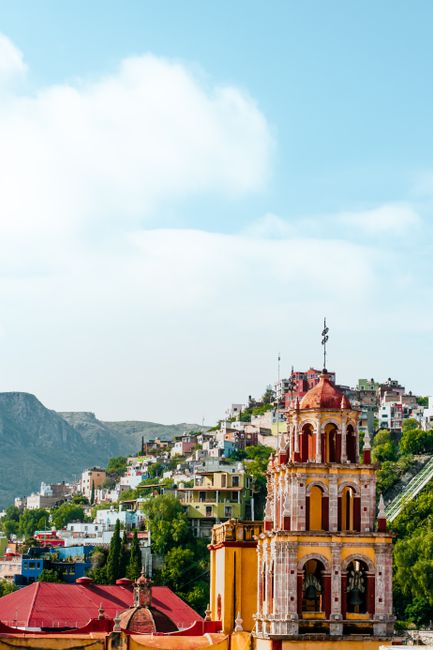
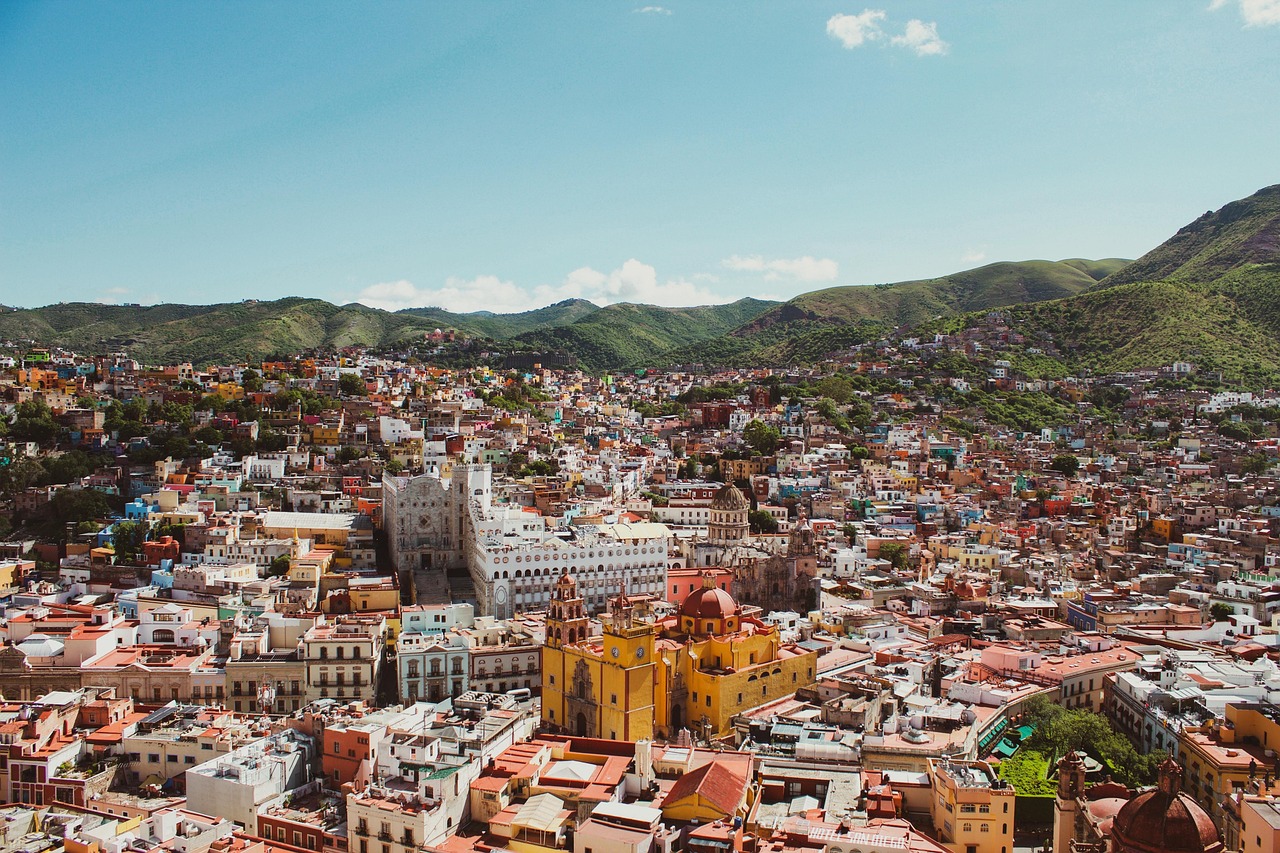
Guanajuato, the capital of the state of the same name, is a former silver-mining city packed into a narrow ravine in the central highlands, about 2,000 meters (6,600 feet) above sea level. Its brightly painted houses climb the hillsides, its streets are a maze of stepped alleys, and its traffic runs mostly through tunnels under the old town, some of them built in the riverbed. The city made fortunes from the La Valenciana mine in the 18th century, saw the first big battle of Mexico’s War of Independence in 1810, and is a lively university town. With its mines it is a UNESCO World Heritage Site, and every October it hosts the Festival Internacional Cervantino, one of Latin America’s biggest arts festivals. Fall and spring are the most pleasant times to visit.
Right now in Guanajuato
- Tue 14–23°C 56–74°F 3 mm Rain
- Wed 13–24°C 55–75°F Partly cloudy
- Thu 14–22°C 56–71°F Cloudy
Weather: MET Norway (CC BY 4.0) · Rates: ECB
Top tours in Guanajuato
See all tours for Guanajuato →
From local operators, with prices and reviews; you check availability and book on Viator, our partner. We may earn a commission at no extra cost to you. How we earn money
Guanajuato at a glance
- Best for: colonial architecture, wandering alleys, viewpoints, museums, student nightlife, the Cervantino festival and mining history.
- How long: 2 days for the center and viewpoints; 3–4 days to add La Valenciana, the mummies and a day trip to Dolores Hidalgo or San Miguel de Allende.
- Best time: October to April, with sunny days of 23–27 °C (73–81 °F) and cool nights; April and May are the hottest months, and June to September brings afternoon storms.
- Getting there: the nearest airport is Bajío International (BJX), near León and Silao, about 30–40 minutes away; first-class buses from Mexico City, Guadalajara and San Miguel de Allende.
- Getting around: on foot; taxis and city buses use the tunnels; a funicular climbs to El Pípila.
- Before you go: entry rules, money and general safety are in our Mexico travel guide; for the nearby colonial town, see our San Miguel de Allende guide.
Guanajuato’s areas: where things are
The old town follows the ravine from east to west. Most sights lie within a 20-minute walk of the Jardín de la Unión, the main square; above it, hillside neighborhoods are reached by stairs and alleys, and La Valenciana sits on a ridge about 5 km (3 miles) north.
Jardín de la Unión and the center
A small, triangular plaza shaded by clipped laurel trees, lined with café terraces and facing the Teatro Juárez and the church of San Diego. It is the starting point for callejoneadas and the city’s busiest spot in the evening.
Plaza de la Paz and the university
A short walk west, the Plaza de la Paz is surrounded by mansions and the yellow Basílica of Our Lady of Guanajuato. Behind it rises the white University of Guanajuato building with its grand staircase.
The Alhóndiga and the market
At the western end of the center stand the Alhóndiga de Granaditas and the iron-and-glass Mercado Hidalgo, built in the early 20th century. From here, roads lead out to the Mummy Museum and the bus station.
The hillsides and the tunnels
The houses on the slopes are linked by a web of callejones (alleys), some barely wide enough for two people. Below the city, the Calle Subterránea Miguel Hidalgo and other tunnels carry cars and buses, with stairs up to the streets above.
Top things to see in Guanajuato
Prices and hours below were checked on the official sites in October 2026, unless we say otherwise; check again before you go.
Teatro Juárez
Opened in 1903, this theater has a neoclassical facade topped by bronze muses and an opulent interior in a Moorish-inspired style of red, gold and carved wood. It is a main venue of the Cervantino; outside the festival, it opens for guided visits most days, and the steps outside are a favorite meeting place.
Callejón del Beso
The Alley of the Kiss is so narrow that the balconies on either side almost touch. According to legend, two lovers from feuding families met in secret here, and couples kiss on the third step for luck. Expect a line and local children telling the story for a tip.
Alhóndiga de Granaditas (Museo Regional de Guanajuato)
A massive grain warehouse where, on September 28, 1810, the insurgent army of Miguel Hidalgo stormed the Spanish defenders in one of the first battles of the War of Independence; the heads of the leaders were later hung from its corners. It now houses the National Institute of Anthropology and History’s (INAH) regional museum, with history exhibits and murals by José Chávez Morado. According to INAH, it opens Thursday to Sunday, 10 a.m. to 4 p.m., and costs MXN 65 (about US$3.60); that page was last updated in 2024, so check before you go.
El Pípila and the funicular
A giant statue on the hill above the Teatro Juárez honors El Pípila, a miner who, according to tradition, set fire to the Alhóndiga’s door under a stone slab. The view from its terrace takes in the whole colorful city. A funicular climbs up from behind the theater in a couple of minutes, or you can walk up the alleys in about 15–20 minutes.
La Valenciana mine and church
In the 18th century La Valenciana was one of the richest silver mines in the world. Next to its old shafts stands the Templo de San Cayetano, with three gilded baroque altarpieces paid for by the mine’s owner. Short tours take you down into a section of the mine. City buses and taxis make the climb from the center.
More to see
- Museo de las Momias: a museum of naturally mummified bodies exhumed from the city cemetery, a curiosity that is not for everyone.
- Museo Casa Diego Rivera: the house where the muralist was born in 1886, with early works and studies.
- Basílica of Our Lady of Guanajuato: a baroque basilica housing a wooden statue of the Virgin given by Spain in the 16th century.
- Museo Iconográfico del Quijote: a free-spirited collection of art inspired by Don Quixote.
Other sights
- Callejón del Beso
- Teatro Juárez
Museums
- Alhóndiga de Granaditas (Regional Museum)
- Mummies Museum of Guanajuato
Churches and cathedrals
- Basílica Colegiata de Guanajuato
- La Valenciana Church
Viewpoints
- El Pípila Monument
Activities and best months
- City sightseeingINAH's Museo Regional de Guanajuato in the Alhóndiga de Granaditas, the granary stormed in 1810 at the start of the War of Independence, opens Thursday to Sunday 10:00-16:00 (MXN 65).
Other things to do in Guanajuato
Callejoneadas
In the evening, student musical groups (estudiantinas) dressed in Spanish Renaissance costume lead singing walks through the alleys, telling stories and legends along the way. Groups gather around the Jardín de la Unión and the San Diego church; you pay the organizers to join, and the walk lasts about an hour. The banter is in Spanish, but the music needs no translation.
The Festival Internacional Cervantino
Founded in 1972 and named after Miguel de Cervantes, the Cervantino brings theater, dance, music and street performance to Guanajuato’s plazas, theaters and churches every October. The 54th edition in 2026, run by Mexico’s Ministry of Culture, has France as guest country; according to festival listings, it runs from October 3 to 18, 2026. Hotels fill up months ahead, and prices rise sharply.
Food and nightlife
Try enchiladas mineras (filled with cheese and topped with potatoes, carrots and chilies), guacamayas (pork crackling tortas) and the sweets of the Mercado Hidalgo. With its big student population, the city has lively bars around the Jardín de la Unión and the Plaza de San Fernando. See our city sightseeing guide.
Day trips from Guanajuato
- San Miguel de Allende: about 1.5 hours east by road, a colonial town of galleries and rooftop bars; see our San Miguel de Allende guide.
- Dolores Hidalgo: the town where Miguel Hidalgo began the War of Independence in 1810, about an hour north-east, known for its painted pottery and unusual ice-cream flavors.
- Mineral de Pozos: a partly abandoned mining town of ruins and chapels, about two hours east.
- León: the state’s largest city, about 50 km (31 miles) west, famous for its leather goods and shoes.
- Wineries: the young wine region around Dolores Hidalgo and San Miguel has vineyards open for tastings; see our wine tasting guide.
Nearby destinations
- San Miguel de Allende54 km
- Guadalajara220 km
- Tequila268 km
- Mexico City288 km
Getting there and getting around
By air
The Bajío International Airport (BJX), run by the airport group GAP, lies between León and Silao, about 30–40 minutes from Guanajuato by road. It has flights from Mexico City, Monterrey, Tijuana and several US cities; check which airlines currently fly your route. Taxis and shared shuttles go to Guanajuato; the airport is also convenient for San Miguel de Allende. Querétaro’s airport is about two hours away.
By bus and car
First-class buses run to Guanajuato’s bus station, west of the center, from Mexico City’s northern bus terminal in about five hours, and from Guadalajara, León, Querétaro and San Miguel de Allende. Taxis link the station with the center through the tunnels. Driving inside the old town is confusing; park at your hotel or a public garage and walk.
Getting around Guanajuato
Walk: the center is compact but hilly, with many stairs. City buses and taxis run through the tunnels and up to La Valenciana and the Mummy Museum; taxis have set fares within the city, so ask before you get in. The funicular is the easy way up to El Pípila.
When to go and how long to stay
Guanajuato has a mild, dry highland climate. The table uses the National Meteorological Service’s (SMN-Conagua) 1991–2020 climate normals for the Guanajuato observatory, at about 2,000 meters (6,560 feet): average daily highs and lows, and days with rain.
| Season | Average high / low | Rainy days per month | What it’s like | Good for |
|---|---|---|---|---|
| Winter (Dec–Feb) | 23–25 °C (73–78 °F) / 7–8 °C (45–47 °F) | 2–3 | Sunny days and chilly nights | Walking, museums, viewpoints |
| Spring (Mar–May) | 28–32 °C (83–89 °F) / 10–14 °C (51–58 °F) | 2–7 | Dry and warm; May is the hottest month | Sightseeing; Holy Week and the Viernes de Dolores flower festival |
| Summer (Jun–Aug) | 28–30 °C (83–86 °F) / 14–15 °C (58–59 °F) | 13–16 | Green, with afternoon storms | Museums and evening walks |
| Fall (Sep–Nov) | 25–27 °C (77–81 °F) / 14 °C falling to 10 °C (58 to 49 °F) | 12 in September, 2 in November | Rain eases by October; clear, mild days | The Cervantino, Day of the Dead |
The station records about 760 mm (30 in) of rain a year, mostly from June to September; July is the wettest month, with about 188 mm (7 in).
Storms: summer downpours can flood low streets and tunnels for short periods; wait them out in a café, and follow the instructions of Guanajuato’s civil protection authorities if heavy rain is forecast.
Weather month by month
2 days in Guanajuato
Day one, the Jardín de la Unión, the Teatro Juárez, the Basílica and university, the Callejón del Beso, then the funicular to El Pípila for sunset and a callejoneada at night. Day two, the Alhóndiga (Thursday to Sunday), the Mercado Hidalgo, the Diego Rivera house and La Valenciana.
3 to 4 days in Guanajuato
Add the Mummy Museum, the Quijote museum and a walk through the hillside alleys and tunnels, then a day trip to Dolores Hidalgo or a night in San Miguel de Allende.
Where to stay in Guanajuato and the hotel taxes
- Around the Jardín de la Unión: historic hotels in the middle of everything; lively and sometimes noisy at night.
- Hillside neighborhoods: small hotels and guesthouses with views, reached by stairs; pack light.
- Near La Valenciana and the Panorámica road: quieter hotels with parking and views, a taxi ride from the center.
- Marfil: a quiet former mining village a few kilometers west, with converted haciendas.
Room rates are often quoted before tax. The State of Guanajuato’s lodging tax is 4% under its state finance law, including stays booked through digital platforms, and federal VAT (IVA) of 16% is added on top. During the Cervantino and at Easter, rates rise sharply and minimum stays are common.
Practical tips for Guanajuato
- Stairs and altitude: the city is steep and about 2,000 meters (6,600 feet) up; take it slowly on your first day and wear good shoes.
- Cash: carry pesos for callejoneadas, taxis, markets and small museums.
- Cervantino: book rooms and tickets for main shows early; many street performances are free.
- Tipping: 10–15% in restaurants; a tip for the alley storytellers and musicians.
- Safety: the historic center is busy with students and visitors and generally calm. The state of Guanajuato has had high levels of organized-crime violence, mostly in industrial cities and rural areas away from the places visitors go. Use official taxis at night, keep valuables out of sight in crowds, travel by day on toll roads and don’t buy drugs.
- Emergencies: call 911.
What to pack for Guanajuato
Bring comfortable, grippy walking shoes for cobblestones and stairs, layers for warm days and cold evenings, a warm jacket from November to February, a hat and sunscreen for the highland sun, and a compact umbrella from June to September. A small daypack is easier than a wheeled suitcase on the alleys. Plugs are the US type.
What to pack
- City walking shoesLisbon and Porto are steep, with polished limestone cobbles that get slippery, so grippy soles matter.
- Day packs and anti-theft bagsA small zipped or anti-theft bag makes crowded trams and viewpoints less stressful.
- Rain jacketsFrom October to April Porto and Lisbon see rain on roughly a third of days.
- Travel adapters and convertersPortugal uses Type C and F sockets at 230 V, so most visitors from outside Europe need an adapter.
Guanajuato travel FAQ
When is the Festival Internacional Cervantino 2026?
According to festival listings, the 54th Cervantino runs from October 3 to 18, 2026, with France as guest country, organized by Mexico’s Ministry of Culture.
How much does the Alhóndiga de Granaditas cost?
MXN 65 (about US$3.60), Thursday to Sunday from 10 a.m. to 4 p.m., according to INAH’s page, last updated in 2024. Check before you go.
What is the closest airport to Guanajuato?
Bajío International Airport (BJX), between León and Silao, about 30–40 minutes by road.
How far is Guanajuato from San Miguel de Allende?
About 1.5 hours by road. Many visitors combine the two, with a night or two in each.
What is the Callejón del Beso?
A very narrow alley where balconies almost touch, the setting of a legend of two lovers. Couples kiss on the third step for good luck.
What is a callejoneada?
An evening singing walk through the alleys led by student musicians in Renaissance costume, telling local legends. It starts near the Jardín de la Unión and lasts about an hour.
How do you get up to El Pípila?
By the funicular behind the Teatro Juárez, or on foot up the alleys in about 15–20 minutes. The view over the city is best at sunset.
Is Guanajuato a UNESCO World Heritage Site?
Yes. The historic town and its adjacent mines, including La Valenciana, are listed together.
What taxes are added to Guanajuato hotel bills?
The State of Guanajuato’s 4% lodging tax plus 16% IVA. There is no VISITAX here.
What is the best time to visit Guanajuato?
October to April for dry, sunny weather; October for the Cervantino, if you book ahead. Summer afternoons are often rainy.
Plan your trip
Partner links: TravelerCenter may earn a commission if you book, at no extra cost to you.
🇪🇸 Useful Spanish phrases for Guanajuato
All 38 Spanish phrases: restaurant, hotel, emergencies, romance (printable) →
Sources · last reviewed 4 October 2026
Researched and last reviewed on 4 October 2026. Alhóndiga de Granaditas hours and fee: the National Institute of Anthropology and History (INAH); the Cervantino’s 2026 edition and guest country: the festival’s official site (Mexico’s Ministry of Culture); the lodging tax: the State of Guanajuato’s finance law (Ley de Hacienda para el Estado de Guanajuato), as reformed in November 2025; climate: SMN-Conagua 1991–2020 normals for the Guanajuato observatory. The festival dates, UNESCO listing, distances, airport routes, mine tours, museum details and the general safety summary come from secondary sources or general knowledge and are flagged for checking. Prices and timetables change, so check the official sites before you go. For entry rules, money and general safety, see our Mexico travel guide.
Also: inah.gob.mx · SMN normals 1991–2020, Guanajuato (climate)
Place data: © OpenStreetMap contributors (ODBL) · Wikidata (CC0)