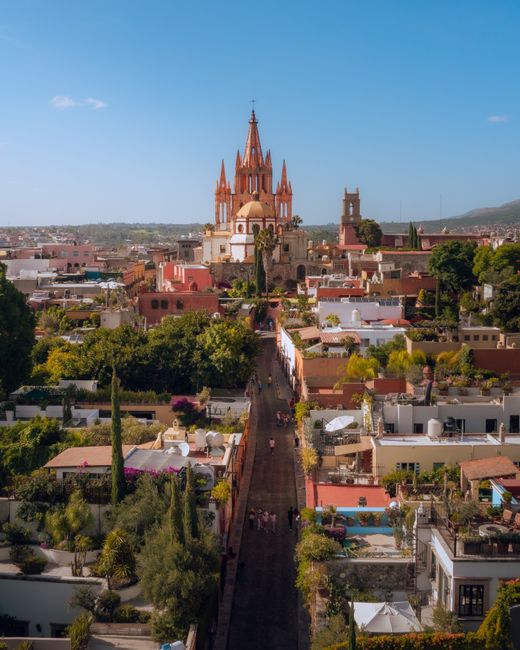
San Miguel de Allende is a small colonial town in the highlands of Guanajuato, in central Mexico, known for its pink neo-Gothic parish church, cobbled streets of ochre and terracotta houses, flowering courtyards and rooftop terraces. A center for artists since the mid-20th century, it is now full of galleries, design shops, cooking schools and restaurants, and home to a large international community. With the nearby sanctuary of Atotonilco it is a UNESCO World Heritage Site, and it makes a fine base for hot springs, the Cañada de la Virgen pyramid and the silver city of Guanajuato. At about 1,900 meters (6,230 feet), days are warm and sunny and nights are cool to cold.
Right now in San Miguel de Allende
- Wed13–24°C56–75°FPartly cloudy
- Thu12–23°C54–73°FPartly cloudy
- Fri14–21°C58–69°F13 mm rain
Top tours in San Miguel de Allende
See all tours for San Miguel de Allende →
From local operators, with prices and reviews; you check availability and book on Viator, our partner. We may earn a commission at no extra cost to you. How we earn money
San Miguel de Allende at a glance
- Best for: colonial architecture, art and crafts, food and rooftop bars, festivals, hot springs and a relaxed, walkable town.
- How long: 2–3 days for the town; 4–5 days to add Guanajuato, Atotonilco and the hot springs.
- Best time: October to April, dry and sunny; March to May are the warmest, with highs near 30 °C (86 °F). December and January nights can fall to about 5 °C (41 °F).
- Getting there: no airport in town; fly to Querétaro (QRO) or León/Bajío (BJX), about 1–1.5 hours by road, or take a first-class bus from Mexico City in about 3.5–4 hours.
- Getting around: on foot (the streets are steep and cobbled) and by inexpensive taxis; a car or tour for day trips.
- Before you go: entry rules, the immigration fee, money and tipping are in our Mexico travel guide.
San Miguel de Allende neighborhoods: where things are
The town climbs a hillside above a reservoir and a wide plain. Most sights are within a 15-minute walk of the main square, El Jardín, but the streets are steep, so expect hills in every direction.
El Centro
The historic center around El Jardín has the parish church, colonial mansions, churches, galleries, the Bellas Artes cultural center and most of the restaurants and boutique hotels. It is the liveliest and most convenient place to stay.
Guadalupe and San Antonio
North of the center, Colonia Guadalupe is the street-art district, with murals on many walls, and is close to the Fábrica La Aurora design center. South of the center, San Antonio is a residential area with good-value guesthouses, local taquerías and the Instituto Allende art school.
Atascadero and the hillsides
Uphill to the east, Atascadero and the hillside streets have quiet villas, small hotels and wonderful views across the domes and the plain, especially at sunset from the Mirador lookout on the road to Querétaro. You will want taxis to get back up after dinner.
Top things to see in San Miguel de Allende
Prices and hours below were checked on the official sites in October 2026, unless we say otherwise; check again before you go.
The Parroquia de San Miguel Arcángel and El Jardín
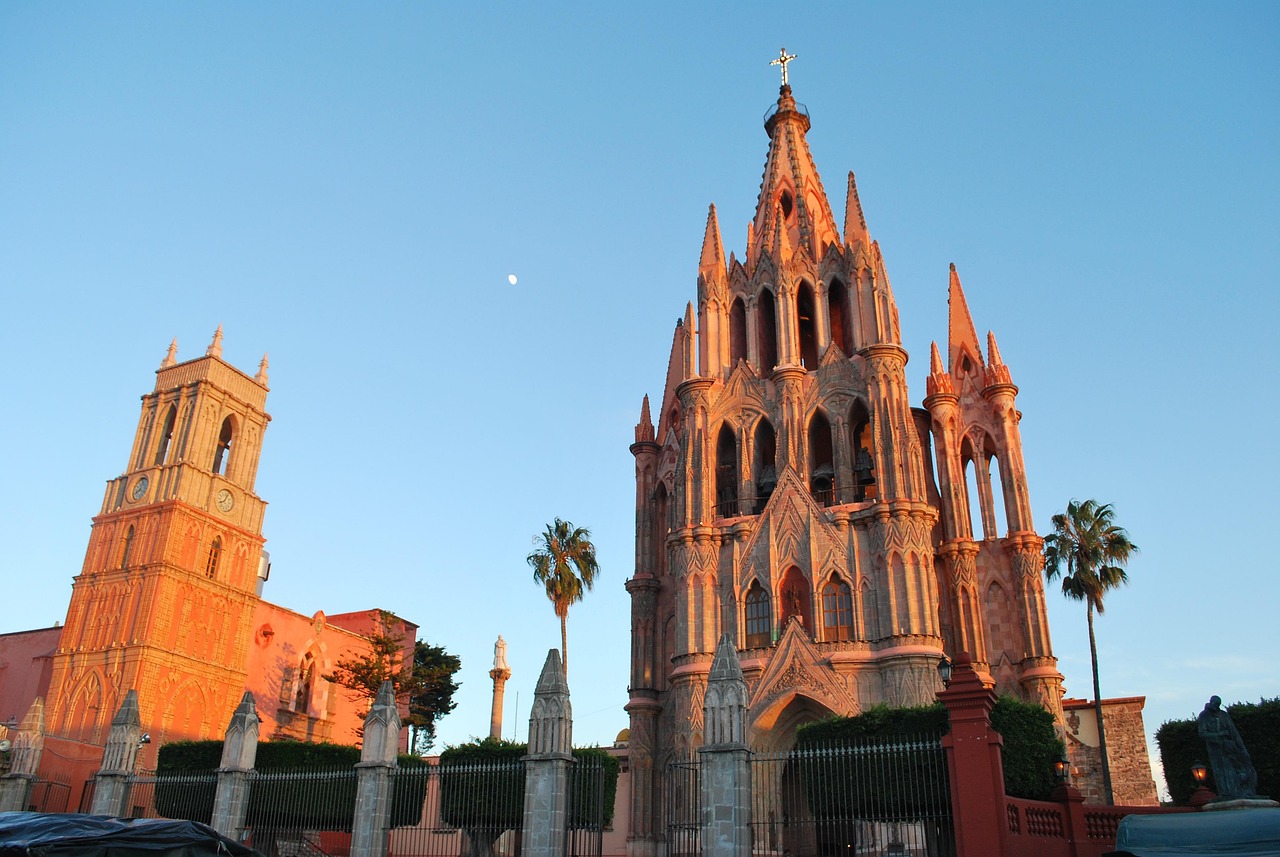
The parish church, with its fairy-tale pink stone towers, is the town’s symbol. Its neo-Gothic facade was added in the late 19th century by Zeferino Gutiérrez, a local stonemason said to have taken his ideas from postcards of European cathedrals. Entry is free outside services. In front of it, the Jardín Allende, simply El Jardín, is a square of clipped laurel trees and benches where locals, visitors, mariachis and balloon sellers gather all day and late into the evening.
Bellas Artes and the Allende house
The Centro Cultural Ignacio Ramírez “El Nigromante,” known as Bellas Artes, occupies a former convent with a beautiful cloister, art classes and an unfinished mural by David Alfaro Siqueiros. On the corner of El Jardín, the birthplace of independence hero Ignacio Allende, after whom the town was renamed, is now a small history museum run by INAH.
Fábrica La Aurora
A former textile mill north of the center has been turned into a design and art center, with dozens of galleries, studios, antique and furniture shops, and cafés in its old industrial halls. Entry is free, and it is an easy place to spend a morning, especially on a weekday.
El Charco del Ingenio
On the edge of town, this botanical garden and nature reserve surrounds a canyon and a small reservoir, with trails through cactus collections, a conservatory of Mexican succulents and views over the town. It charges a modest entrance fee that supports its conservation work. Go in the morning, with water and a hat.
The crafts market and the Tuesday market
The Mercado de Artesanías, down a long, stepped alley near the Ignacio Ramírez market, sells tin, brass, glass, papier-mâché, textiles and pottery from Guanajuato and beyond. On Tuesdays, the huge open-air Tianguis del Martes on the edge of town sells everything from fruit and street food to secondhand clothes and tools.
More churches, the library and the Instituto Allende
Within a few blocks of El Jardín are several more fine churches: the churrigueresque facade of San Francisco, the Oratorio de San Felipe Neri with its Indigenous-influenced stonework, and Las Monjas (La Concepción), whose dome is one of the landmarks of the skyline. The Biblioteca Pública, a nonprofit library in a former convent, is a meeting point for the international community, with a bilingual collection, a café and a theater; it is known for its house-and-garden tours of private colonial homes, a long-standing fundraiser (check the current schedule). South of the center, the Instituto Allende, an 18th-century hacienda turned art school, has courtyards, murals, galleries and classes open to visitors.
The Sanctuary of Atotonilco
About 14 km (9 miles) north, the 18th-century Sanctuary of Jesús Nazareno de Atotonilco is covered inside with folk-baroque murals and has been called the “Sistine Chapel of Mexico.” It is part of the World Heritage listing with San Miguel, and in 1810 Miguel Hidalgo took the banner of the Virgin of Guadalupe from here at the start of the War of Independence. Entry is free; dress respectfully, as it remains a place of pilgrimage and retreats.
Cañada de la Virgen
About 30 km (19 miles) southwest of town, this Otomí ceremonial site has a stepped pyramid and sunken courts aligned with the sky, in a quiet canyon landscape. You leave your car at the visitor center and continue in 20-seat minibuses run by the state institute of culture. According to INAH, it opens Tuesday to Sunday, 10 a.m.–6 p.m. (last entry 4 p.m.); INAH lists the entrance as free, with an additional site fee of MXN 90 (about US$5) for adults and MXN 25 for children, as of October 2026. Many visitors come on a guided tour from San Miguel.
Churches and cathedrals
- Sanctuary of Atotonilco
Archaeological sites
- Cañada de la Virgen
Other things to do in San Miguel de Allende
Hot springs
Thermal springs rise along the road north to Dolores Hidalgo, 8–15 km (5–9 miles) from town. Several balnearios have warm pools set in gardens: La Gruta is known for its tunnel leading into a domed cave pool, and Escondido Place has a series of indoor and outdoor pools. Go on a weekday morning to avoid crowds, bring a towel and cash, and take a taxi or a local bus heading for Dolores Hidalgo.
Food, rooftops and wine
San Miguel has an exceptional restaurant scene for its size, from street-corner gorditas and the market’s fondas to modern Mexican tasting menus. Try the regional enchiladas mineras, with potatoes, carrots and cheese, and look for the cart vendors selling tamales and atole in the evening. Rooftop bars look over the parroquia at sunset. The surrounding Guanajuato highlands also have a young wine region, with vineyards on the roads to Dolores Hidalgo and Querétaro open for tastings and lunch. See our wine tasting guide.
Art classes, walking tours and horse riding
Take a painting, pottery, silversmithing, Spanish or cooking class: the town has had art schools since the 1930s and many short courses accept visitors. Walking tours of the historic center explain the architecture and the independence story, and ranches outside town offer horse rides in the countryside. See our city sightseeing and hiking guides.
Day trips from San Miguel de Allende
Guanajuato: about 1.5 hours west by road, the state capital is a UNESCO World Heritage city of brightly painted houses stacked up a narrow ravine, with roads running through old tunnels beneath the center. See the Teatro Juárez, the university steps, the Basilica, the tiny Callejón del Beso (Alley of the Kiss), the Alhóndiga de Granaditas, a key site of the War of Independence, the birthplace of Diego Rivera, and the Mummies Museum. Ride the funicular to the Pípila monument for the view, and join a callejoneada, a street serenade by student musicians, in the evening. Guanajuato fills up in October for the Festival Internacional Cervantino, one of the biggest arts festivals in Latin America. Dolores Hidalgo: about 45 minutes north, the town where Miguel Hidalgo rang the church bell to start the War of Independence on September 16, 1810, known for its painted Talavera-style pottery and unusual ice cream flavors. Querétaro: about an hour southeast, a large city with an elegant colonial center and aqueduct, and wineries nearby. Pozos: Mineral de Pozos, about 45 minutes northeast, is a half-ruined mining town.
Nearby destinations
- Guanajuato54 km
- Mexico City242 km
- Guadalajara271 km
Getting there and getting around
By air
San Miguel has no commercial airport. The two nearest are Querétaro International (QRO), about 1–1.25 hours away by road, and Bajío International (BJX) near León, about 1.5 hours away, both with flights from Mexico City and several US cities. Shared shuttle vans and private transfers meet flights and must usually be booked ahead; taxis are also available. Mexico City’s airport is about 3.5–4 hours away by road, with direct buses from the airport to Querétaro.
By bus
First-class buses run from Mexico City’s Terminal del Norte to San Miguel in about 3.5–4 hours, and there are frequent connections from Querétaro, Guanajuato, León and Guadalajara. The bus station is on the western edge of town, a short taxi ride from the center.
Getting around
The center is compact, but the cobbles, high curbs and steep hills make good shoes essential. Taxis are inexpensive and charge flat fares within town; app-based rides also operate. A car is a burden in the narrow center, where parking is scarce, but useful for the hot springs, Cañada de la Virgen and the wineries; Guanajuato and Querétaro are easily reached by bus or tour.
When to go and how long to stay
San Miguel has a dry, sunny highland climate, with a short rainy season from June to September. The table uses the 1991–2020 climate normals of Mexico’s National Meteorological Service (SMN-Conagua) for the San Miguel de Allende station: average daily highs and lows, and days with rain.
| Season | Average high / low | Days with rain per month | What it’s like | Good for |
|---|---|---|---|---|
| Winter (Dec–Feb) | 22–25 °C (72–76 °F) / 5–6 °C (40–43 °F) | 2 | Sunny, dry days and cold nights | Sightseeing, hot springs, Christmas |
| Spring (Mar–May) | 28–31 °C (82–87 °F) / 9–13 °C (48–56 °F) | 2–6 | Warm to hot and dry; jacarandas in bloom | Rooftops, Holy Week, gardens |
| Summer (Jun–Aug) | 27–29 °C (81–84 °F) / 13 °C (55–56 °F) | 9–13 | Afternoon showers, green countryside | Art classes, vineyards, Guanajuato |
| Fall (Sep–Nov) | 24–26 °C (75–79 °F) / 8–12 °C (46–54 °F) | 3–10 | Rains end; clear, crisp days | Independence and patron saint fiestas, Day of the Dead |
The station records only about 630 mm (25 inches) of rain a year. San Miguel is far from the coasts and is not affected directly by hurricanes, though remnants of Pacific or Gulf storms occasionally bring a few days of heavy rain between June and October.
Events worth planning around
- March or April: Holy Week, with solemn processions and flower-decorated altars.
- September: Independence celebrations (the town is Ignacio Allende’s birthplace) and, late in the month, the fiestas of the patron saint, San Miguel Arcángel, with the Alborada fireworks at dawn and the dancing of the Indigenous concheros.
- October: the Cervantino arts festival in nearby Guanajuato.
- Late October to November 2: the Day of the Dead, with altars, catrinas and the La Calaca festival.
3 days in San Miguel de Allende
Day one: El Jardín, the parroquia, Bellas Artes, the churches and the crafts market, and sunset on a rooftop. Day two: Fábrica La Aurora and Colonia Guadalupe’s murals, then El Charco del Ingenio and the Mirador. Day three: Atotonilco and an afternoon at the hot springs.
5 days in San Miguel de Allende
Add a full day in Guanajuato (stay overnight to enjoy a callejoneada) and a morning at Cañada de la Virgen or a winery, and make time for a cooking or art class. With a week, add Querétaro or Dolores Hidalgo.
Where to stay in San Miguel de Allende and the hotel tax
- El Centro: boutique and luxury hotels in colonial houses, close to everything; book early for festivals.
- Guadalupe: near La Aurora, with B&Bs and apartments, a little quieter.
- San Antonio: good-value guesthouses and a local feel, 10–15 minutes’ walk from El Jardín.
- Atascadero and the hills: villas with views; you will need taxis.
Room rates are often quoted before tax. The State of Guanajuato’s lodging tax (impuesto sobre servicios de hospedaje) is 4% under its state finance law, and federal VAT (IVA) of 16% is added on top, so taxes add about 20% to the room price, as of October 2026. Short-term rentals booked through platforms collect the same taxes. Prices peak at Christmas and New Year, Holy Week, the September fiestas and the Day of the Dead.
Practical tips for San Miguel de Allende
- Altitude: at about 1,900 meters (6,230 feet), the hills feel steeper at first; drink water and take it slowly.
- Sidewalks: narrow, uneven and high; watch your step, especially at night.
- Money: cards are widely accepted in hotels, galleries and restaurants; carry pesos for taxis, markets, hot springs and tips.
- Water: drink bottled or filtered water.
- Safety: the center is generally calm and safe, with a visible police presence; take normal care with belongings, use taxis at night, and avoid driving on rural roads after dark. Cartel-related violence affects parts of Guanajuato state, mostly in its industrial cities, and rarely visitors to San Miguel’s center.
- Emergencies: call 911. Plugs and voltage (127 V, types A and B) are the same as in the United States.
What to pack for San Miguel de Allende
Pack for warm days and cool nights: from November to February a warm sweater or jacket is essential, as many old houses have no heating. Bring flat, sturdy walking shoes with good grip for cobblestones, a hat, sunglasses and sunscreen for the strong highland sun, and swimwear and flip-flops for the hot springs. A smart-casual outfit is useful for the town’s many good restaurants and rooftop bars, and an umbrella helps from June to September.
San Miguel de Allende travel FAQ
What is the nearest airport to San Miguel de Allende?
Querétaro (QRO), about 1–1.25 hours away, and León/Bajío (BJX), about 1.5 hours away. Book a shuttle or private transfer ahead.
How do I get from Mexico City to San Miguel de Allende?
By first-class bus from the Terminal del Norte in about 3.5–4 hours, or by car on the toll highway via Querétaro.
Can you visit the parroquia?
Yes, the Parroquia de San Miguel Arcángel is free to enter outside services; dress respectfully.
Is Guanajuato a good day trip from San Miguel?
Yes, it is about 1.5 hours away by road or bus, but it is worth staying a night to see it in the evening.
Where are the hot springs near San Miguel?
On the road north to Dolores Hidalgo, about 8–15 km away; La Gruta and Escondido Place are the best known. Go on a weekday morning.
How much is Cañada de la Virgen?
INAH lists free entrance plus an additional site fee of MXN 90 for adults and MXN 25 for children, as of October 2026; visits are by minibus from the visitor center, Tuesday to Sunday.
What is the hotel tax in San Miguel de Allende?
Guanajuato’s 4% state lodging tax plus 16% IVA.
Does it get cold in San Miguel de Allende?
Yes, at night in winter: average lows from December to February are about 5–6 °C (40–43 °F), even though afternoons are warm.
When is the best time to visit San Miguel de Allende?
October to April for dry, sunny weather; late September for the patron saint’s fiesta and early November for the Day of the Dead.
Plan your trip
Partner links: TravelerCenter may earn a commission if you book, at no extra cost to you.
🇪🇸 Useful Spanish phrases for San Miguel de Allende
All 38 Spanish phrases: restaurant, hotel, emergencies, romance (printable) →
Sources · last reviewed 4 October 2026
Researched and last reviewed on 4 October 2026. Cañada de la Virgen: INAH (Lugares INAH); hotel tax: the Guanajuato state finance law (Ley de Hacienda para el Estado de Guanajuato, Congreso de Guanajuato); climate: SMN-Conagua 1991–2020 normals for the San Miguel de Allende station. Travel times, hot springs, the botanical garden, Atotonilco, Guanajuato sights and event dates come from secondary or general sources and are flagged for checking. Check the official sites before you go. For entry rules, the immigration fee, money and tipping, see our Mexico travel guide.
Data: Weather: MET Norway (CC BY 4.0) · Rates: ECB · Costs: World Bank ICP and price levels · © OpenStreetMap contributors (ODBL) · Wikidata (CC0)