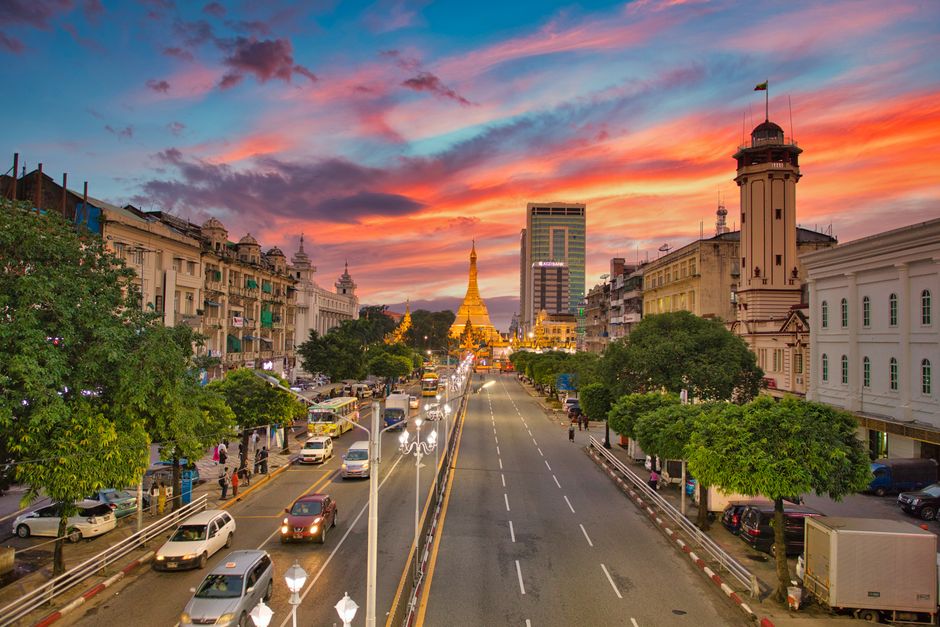
Yangon, the former capital and still the largest city of Myanmar, is where almost every trip to the country begins. It is a humid, green, slightly faded city on the Yangon River, where the gilded spire of the Shwedagon Pagoda, the most sacred Buddhist site in Myanmar, rises above lakes, parks and colonial boulevards. Downtown, laid out by the British in a grid in the 1850s, holds one of the largest collections of colonial buildings in Asia, from the Strand Hotel and the old Secretariat to banks, churches and courthouses, alongside mosques, Hindu temples, Chinese clan houses and the golden Sule Pagoda at its center. Life happens on the street: tea shops pour sweet milky tea from dawn, markets spill onto the pavements, and the slow Circular Railway loops through suburbs and paddy fields. Since 2021 the city has been calmer than much of the country, but security incidents still occur, township curfews can be imposed at short notice and checkpoints are common. The best months are November to February, when it is dry and warm; from June to September, heavy monsoon rain falls almost daily.
Right now in Yangon
- Wed 24–32°C 75–89°F 11 mm Heavy showers
- Thu 24–32°C 76–89°F 2 mm Partly cloudy
- Fri 25–32°C 77–89°F 3 mm Showers
Weather: MET Norway (CC BY 4.0)
Top tours in Yangon
See all tours for Yangon →
From local operators, with prices and reviews; you check availability and book on Viator, our partner. We may earn a commission at no extra cost to you. How we earn money
Yangon at a glance
- Best for: the Shwedagon Pagoda, colonial architecture, markets and street food, tea shops, Buddhist sites and local life on the Circular Railway.
- How long: 2 days for the main sights; 3 days with a day trip.
- Best time: November to February, dry and warm; March to May is hot, and June to October is the wet monsoon season.
- Getting there: Yangon International Airport is about 15 km (9 miles) north of downtown, 45–75 minutes by taxi depending on traffic; it is one of the four e-visa entry points.
- Getting around: by taxi or the Grab app, on foot downtown, and on the Circular Railway.
- Good to know: remove shoes and socks at every pagoda, and carry clean US dollars and kyat in cash.
- Before you go: the e-visa, restricted areas, money and current conditions are in our Myanmar travel guide.
Yangon’s areas and where to stay
The city spreads north from the river. Downtown lies along the waterfront; the Shwedagon Pagoda, Kandawgyi Lake and People’s Park are 3 km (2 miles) north; and the leafy residential areas around Inya Lake are farther north still, on the way to the airport.
Downtown
The colonial grid between the river and Bogyoke Aung San Road, in Kyauktada, Pabedan, Botahtaung and Lanmadaw townships, is the historic heart, with the Sule Pagoda, Maha Bandula Park, the Strand Hotel, the old Secretariat, Bogyoke Aung San Market, Chinatown and the Indian quarter. It has heritage hotels, guesthouses, street food and tea shops, and is the best area for walking, though it is noisy and crowded.
Shwedagon, Kandawgyi Lake and Bahan
The area around the Shwedagon Pagoda, Kandawgyi Lake, People’s Park and Bahan township is greener and quieter, with large hotels, lakeside restaurants and the Karaweik barge. It is the best base for sunrise or sunset visits to the pagoda.
Golden Valley, Inya Lake and the north
Farther north, the embassy district of Golden Valley, the shores of Inya Lake and townships such as Kamayut and Hlaing have villas, international hotels, cafés, shopping malls and the university, and are closer to the airport.
Where to stay in Yangon
- Downtown: colonial heritage hotels, boutique hotels and budget guesthouses, close to markets and street food.
- Kandawgyi and Bahan: large lakeside hotels near the Shwedagon.
- Inya Lake and Golden Valley: international hotels and serviced apartments, quieter and closer to the airport.
- Near the airport: business hotels for early flights.
Foreigners must stay in licensed accommodation. Confirm bookings directly, as some hotels have closed or changed hands since 2021, and ask the hotel to arrange the airport transfer.
Top things to see in Yangon
Shwedagon Pagoda
The great golden stupa of the Shwedagon Pagoda rises about 99 m (325 ft) on Singuttara Hill, covered in gold plates and topped by a spire set with thousands of diamonds and rubies. Tradition says it enshrines eight hairs of the Buddha and was founded more than 2,500 years ago; the present stupa took shape in the 15th century and has been rebuilt after earthquakes. Around it, a vast marble platform is crowded with shrines, pavilions, bells, Buddha images and planetary posts, where people pray at the corner of the day of the week they were born. Visit at sunrise or sunset, when the gold glows and families come to light candles. Enter by one of four covered stairways or the elevators; remove shoes and socks, cover shoulders and knees (longyis can be borrowed), and pay the foreigners’ entry fee, about 20,000 kyat.
Sule Pagoda and downtown
The octagonal Sule Pagoda, said to be more than 2,000 years old, stands in a traffic circle at the center of downtown, ringed by shops. Next to it, Maha Bandula Park faces the white City Hall and the Independence Monument, and the surrounding streets are lined with colonial buildings: the High Court, the former Rangoon General Post Office, the riverside Strand Hotel, opened in 1901, and the sprawling red-brick Secretariat, where independence hero General Aung San was assassinated in 1947. Walk the grid in the morning, when it is cooler, and stop at a tea shop.
Bogyoke Aung San Market
Built in 1926 as Scott Market, Bogyoke Aung San Market is a covered colonial market of hundreds of stalls selling longyis, lacquerware, puppets, jade, textiles, paintings and souvenirs. It closes on Mondays and public holidays. Buy gems only with a certificate from a licensed dealer, if at all.
Chaukhtatgyi and Ngahtatgyi
North of the center, the Chaukhtatgyi Buddha, a reclining Buddha about 66 m (217 ft) long, lies in an open-sided shed with a serene painted face and elaborately decorated soles. Across the road, the seated Ngahtatgyi Buddha, about 14 m (46 ft) tall, sits in front of a carved teak backdrop.
Kandawgyi Lake and the Karaweik
A boardwalk circles part of Kandawgyi Lake, with views of the Shwedagon reflected in the water. On the eastern shore, the Karaweik, a concrete replica of a royal barge with two golden mythical birds at the prow, houses a restaurant and cultural show.
Yangon Circular Railway
The Yangon Circular Railway loops about 46 km (29 miles) through the city and its suburbs, a trip of about three hours. Board at Yangon Central Railway Station, a 1950s building in Burmese style, and watch vendors climb on with snacks and produce, passing markets, villages and fields. Buy a ticket with your passport at the station; air-conditioned trains run on some services.
More classic sights
- Botahtaung Pagoda: a riverside pagoda with a hollow, gilded interior maze around a relic of the Buddha.
- National Museum: royal regalia, including the Lion Throne of the last king, and archaeology from the Pyu and Bagan periods.
- Kyauk Htat Gyi and Kaba Aye: the Kaba Aye “World Peace” Pagoda and the man-made cave of the Maha Pasana Guha, built for a Buddhist council in the 1950s.
- 19th Street and Chinatown: barbecue stalls and beer at dusk, and Chinese temples and night markets.
- St. Mary’s Cathedral and the Musmeah Yeshua Synagogue: a red-brick Gothic cathedral and a 19th-century synagogue that reflect the city’s diversity.
- Inya Lake: lakeside walks and sunset views in the north.
Other things to do in Yangon
Food and drink
Yangon is the best place in Myanmar to eat. Start the day with mohinga, fish and rice-noodle soup, at a street stall, then sit in a tea shop for sweet milk tea with samosas, steamed buns and palata flatbread. Try laphet thoke, the tea-leaf salad, Shan noodles, ohn no khao swe coconut noodles, and Burmese curry houses, where a curry comes with a table full of small side dishes. Downtown has Indian biryani and chapati stalls, Chinese dim sum and the barbecue skewers of 19th Street, with draft Myanmar beer. Cafés and restaurants around Inya Lake and Bahan serve international food.
Shopping and crafts
Look for longyis and woven textiles, lacquerware from Bagan, puppets, sand paintings and silver at Bogyoke Aung San Market and in fair-trade shops downtown that support artisans.
Walking tours and heritage
Downtown’s colonial buildings are best seen on foot, ideally with a local heritage walking tour that explains the stories of each street. See our city sightseeing guide.
Ferries across the river
Ferries cross the Yangon River from Pansodan Jetty to Dala in a few minutes, giving a view back to the downtown waterfront; on the far side, trishaw drivers offer tours of villages.
Day trips from Yangon
Check local conditions before any trip outside the city: parts of Bago Region east of the Yangon–Mandalay Expressway and Mon State are affected by fighting, and road travel there may not be possible.
- Twante: a pottery town across the river, with a riverside pagoda and canal, about 1–1.5 hours by road.
- Thanlyin and Kyauktan: the Kyaik Khauk Pagoda and the Yele Pagoda on an island in the river, reached by boat, about an hour southeast.
- Bago: the former Mon capital, about 80 km (50 miles) northeast, with the Shwemawdaw Pagoda, taller than the Shwedagon, and the Shwethalyaung reclining Buddha; check that the route is open.
- Golden Rock (Kyaiktiyo): a gilded boulder balanced on a cliff in Mon State, a pilgrimage site about 4–5 hours away; check access, as Mon State has been affected by fighting.
- Bagan and Inle Lake: fly from Yangon; better with several nights. See our Bagan and Inle Lake guides.
Getting there and getting around
By air
Yangon International Airport (RGN), about 15 km (9 miles) north of downtown, has flights from Bangkok, Singapore, Kuala Lumpur, Kunming and other Asian cities, and domestic flights to Nyaung-U (Bagan), Heho (Inle Lake), Mandalay and other towns. See our Bangkok, Singapore, Kuala Lumpur and Kunming guides. It is a designated e-visa entry point. Taxis from the official counter take 45–75 minutes to downtown, depending on traffic; hotels can arrange transfers.
By road and rail
Long-distance buses leave from the Aung Mingalar bus terminal, north of the airport, for Mandalay, Bagan and Taunggyi, and trains run from Yangon Central to Mandalay, but these routes cross areas with checkpoints and reported attacks, so most visitors fly.
Around the city
Motorbikes are banned in central Yangon, so the city runs on taxis: use the Grab app, which shows fares in advance, or agree on a price before getting in. Downtown is compact enough to walk, though pavements are uneven and traffic is heavy. City buses are cheap but hard to use without Burmese, and the Circular Railway is more an experience than transport.
When to go and how long to stay
Yangon is hot all year. The cool, dry season, from November to February, brings sunny days around 32–33 °C (90–91 °F) and pleasant evenings. March and April are the hottest months, with highs of about 37 °C (98–99 °F), and Thingyan, the water festival, brings the city to a halt in mid-April. The monsoon, from late May to October, brings heavy rain on most days from June to September, when streets flood and some sights are best visited between showers. The table uses the 1991–2020 climate normals for Mingaladon, Yangon’s airport station, from Myanmar’s Department of Meteorology and Hydrology, as submitted to the World Meteorological Organization (WMO): average daily highs and lows, total rain, and days with at least 1 mm of rain.
| Month | Average high / low | Rain (days with 1 mm or more) | What to expect |
|---|---|---|---|
| January | 33 °C (91 °F) / 18 °C (64 °F) | 5 mm (0.2 in), under 1 day | Dry and sunny; peak season |
| February | 35 °C (94 °F) / 19 °C (67 °F) | 3 mm (0.1 in), under 1 day | Dry and warming; Shwedagon festival around the Tabaung full moon (February or March) |
| March | 37 °C (98 °F) / 22 °C (71 °F) | 12 mm (0.5 in), 1 day | Hot |
| April | 37 °C (99 °F) / 24 °C (75 °F) | 40 mm (1.6 in), 2 days | The hottest month; Thingyan |
| May | 34 °C (94 °F) / 25 °C (77 °F) | 284 mm (11.2 in), 15 days | Monsoon arrives |
| June | 31 °C (88 °F) / 24 °C (76 °F) | 513 mm (20.2 in), 26 days | Very wet |
| July | 30 °C (87 °F) / 24 °C (76 °F) | 579 mm (22.8 in), 27 days | The wettest month |
| August | 30 °C (86 °F) / 24 °C (75 °F) | 520 mm (20.5 in), 27 days | Very wet; street flooding |
| September | 31 °C (88 °F) / 24 °C (75 °F) | 389 mm (15.3 in), 21 days | Wet |
| October | 32 °C (90 °F) / 24 °C (75 °F) | 195 mm (7.7 in), 14 days | Rains easing; Thadingyut festival of lights |
| November | 33 °C (91 °F) / 22 °C (72 °F) | 57 mm (2.3 in), 3 days | Dry and pleasant; Tazaungdaing |
| December | 32 °C (90 °F) / 19 °C (67 °F) | 4 mm (0.1 in), under 1 day | Dry; peak season |
Yangon receives about 2,600 mm (102 in) of rain a year, almost all from May to October.
One day in Yangon
An early tea-shop breakfast downtown, a walk past the Sule Pagoda and the colonial buildings to the Strand Hotel, lunch at a curry house, Bogyoke Aung San Market and the Chaukhtatgyi Buddha in the afternoon, and sunset at the Shwedagon Pagoda.
Two days
Add the Circular Railway, the National Museum, Kandawgyi Lake and an evening on 19th Street, or a ferry to Dala.
What a trip to Yangon costs
Prices are approximate, for October 2026, converted at the Central Bank of Myanmar’s reference rate of 2,100 kyat to the US dollar; money changers may give a different rate.
| Item | Typical cost |
|---|---|
| Shwedagon Pagoda entry for foreigners | 20,000 MMK (about US$9.50) |
| Bowl of mohinga at a street stall | 2,000–3,500 MMK (about US$1–1.70) |
| Tea and snacks in a tea shop | 2,000–5,000 MMK (about US$1–2.40) |
| Dinner at a mid-range restaurant | 15,000–35,000 MMK (about US$7–17) per person |
| Grab or taxi across downtown | 5,000–10,000 MMK (about US$2.40–4.80) |
| Taxi from the airport to downtown | 20,000–35,000 MMK (about US$9.50–17) |
| Circular Railway ticket | a few hundred to about 1,000 MMK (under US$0.50) |
| Mid-range hotel double, per night | US$40–90 |
Practical tips for Yangon
- Carry clean US dollars: exchange at banks or licensed counters, and keep kyat in small notes for taxis and stalls.
- Go barefoot at pagodas: carry a bag for your shoes and wear clothes that cover shoulders and knees.
- Visit the Shwedagon at the ends of the day: the marble platform burns bare feet at midday.
- Use Grab: it avoids haggling and shows the route.
- Get a local SIM and a VPN: foreign SIMs work poorly, and some apps are blocked.
- Check the news each day: curfews and closures can change quickly.
Safety
Yangon has been calmer than much of the country since 2021, but security incidents continue. Attacks with small explosives have targeted military and government sites, police stations, checkpoints and businesses linked to the military, and bystanders have been hurt, including in areas visited by foreigners; there is a higher risk after dark and around national holidays. There is no longer a city-wide curfew, but township curfews can be imposed at short notice. Stay away from security forces, checkpoints and any demonstration, never photograph the military or police, carry your passport with your visa, and follow local news and your hotel’s guidance. Petty crime is the most common problem for visitors: bag snatching, pickpocketing and gem or currency-exchange scams, so keep cash out of sight. Pavements are broken and drains open, especially in the monsoon, when streets flood. In an emergency, call 199 for police and 192 for an ambulance.
What to pack for Yangon
Light, breathable clothes and at least one outfit that covers shoulders and knees, sandals or slip-on shoes for pagodas, a small bag for your shoes, a hat, sunscreen, insect repellent, an umbrella or rain jacket from May to October, clean new US dollar notes and a universal adapter, since Myanmar uses several plug types at 230 V. See our rain jackets and travel adapters guides.
Yangon travel FAQ
Is Yangon worth visiting?
Yes. The Shwedagon Pagoda is one of the great sights of Asia, and the colonial downtown, markets, tea shops and street food make Yangon a rewarding introduction to Myanmar.
Is Yangon safe for tourists right now?
It is calmer than many parts of the country, and visitors are traveling there, but attacks targeting military and government sites occur, and curfews can be imposed. Follow local news and your hotel’s guidance.
How much is the Shwedagon Pagoda entry fee?
About 20,000 kyat for foreigners, including the elevator; locals enter free.
What is the best time to visit the Shwedagon Pagoda?
At sunrise or in the late afternoon and at sunset, when it is cooler and the gold glows.
How do I get from Yangon airport to downtown?
By taxi from the official counter, by Grab, or by hotel transfer, in 45–75 minutes depending on traffic.
Can I enter Myanmar at Yangon with an e-visa?
Yes. Yangon International Airport is one of the four e-visa entry points, with Mandalay and Nay Pyi Taw airports and the Kawthaung land border.
How long is the Yangon Circular Railway?
About 46 km (29 miles), taking about three hours for the full loop.
How many days do I need in Yangon?
Two days for the main sights, or three with a day trip.
What is the best time to visit Yangon?
November to February, when it is dry and warm. July is the wettest month, and April the hottest.
How do I get from Yangon to Bagan?
By domestic flight to Nyaung-U, in about 1 hour 20 minutes. Overland routes cross areas affected by fighting.
Sources and last review
Researched and last reviewed on 5 October 2026. E-visa entry points: the Ministry of Hotels and Tourism; exchange rate: the Central Bank of Myanmar; climate normals: the Department of Meteorology and Hydrology via the World Meteorological Organization’s 1991–2020 normals. Security conditions in Yangon, township curfews, checkpoints, crime and scams, photography and the risk after dark: the UK government’s factual safety pages. The Shwedagon’s height and history, the dates of downtown buildings, the Chaukhtatgyi Buddha’s size, the Circular Railway’s length, journey times, entry fees, emergency numbers and typical prices are general references or estimates, flagged for checking. Conditions change quickly, so check locally before you go. For entry rules, money and current conditions across the country, see our Myanmar travel guide.
Plan your trip
Partner links: TravelerCenter may earn a commission if you book, at no extra cost to you.
🇲🇲 Useful Burmese phrases for Yangon
All 38 Burmese phrases: restaurant, hotel, emergencies, romance (printable) →