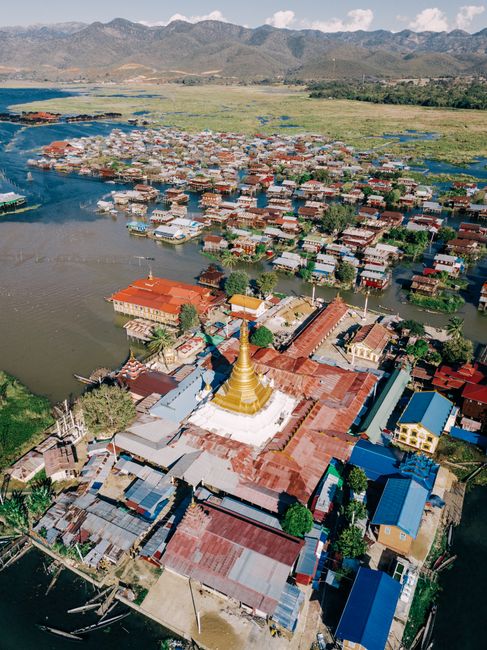
Inle Lake, in the hills of southern Shan State, is Myanmar’s most enchanting landscape: a long, shallow lake at about 880 m (2,900 ft), ringed by blue mountains, where whole villages of teak houses stand on stilts above the water and farmers grow tomatoes on floating gardens anchored with bamboo poles. It is the home of the Intha, the “sons of the lake”, whose fishermen famously row standing on one leg, wrapping the other around the oar to keep their hands free for the conical nets. A day on a long-tailed boat takes in the gilded Phaung Daw Oo Pagoda, the ruined stupas of In Dein, workshops weaving silk and rare lotus-stem fabric, blacksmiths and cheroot rollers, and the five-day rotating markets where Pa-O and Shan hill people come to trade. The lake is about 22 km (14 miles) long and up to about 11 km (7 miles) wide, with the town of Nyaungshwe at its northern end as the base for most visitors, and it is part of a UNESCO biosphere reserve. Southern Shan State and neighboring Kayah State have been affected by fighting since 2021, so check conditions around the lake before planning, especially for the southern end and for treks from Kalaw. The best months are October to February, when days are sunny and mornings misty and cold.
Right now in Inle Lake (Nyaungshwe)
- Wed 20–27°C 68–81°F 2 mm Light showers
- Thu 20–28°C 68–83°F Mostly clear
- Fri 21–28°C 70–82°F Mostly clear
Weather: MET Norway (CC BY 4.0)
Top tours in Inle Lake
See all tours for Inle Lake →
From local operators, with prices and reviews; you check availability and book on Viator, our partner. We may earn a commission at no extra cost to you. How we earn money
Inle Lake at a glance
- Best for: boat trips, stilt villages and floating gardens, leg-rowing fishermen, markets, weaving and crafts, monasteries and pagodas, cycling and gentle hikes.
- How long: 2–3 days; add 2–3 days for a trek from Kalaw when the route is open.
- Best time: October to February, dry and sunny with cold nights; the Phaung Daw Oo festival takes place in September or October.
- Getting there: fly from Yangon or Mandalay to Heho airport, then about an hour by road to Nyaungshwe.
- Getting around: by long-tailed boat on the lake; by bicycle, on foot or by taxi around Nyaungshwe.
- Fee: a zone fee is collected at the checkpoint on the road into Nyaungshwe.
- Before you go: the e-visa, restricted areas, money and current conditions are in our Myanmar travel guide.
Access, fees and rules (as of October 2026)
The Inle zone fee
Foreign visitors pay an Inle zone entrance fee at a checkpoint on the road from Shwenyaung into Nyaungshwe, or at hotels on the lake. The Shan State government contracts out the collection each financial year; in recent years the fee has been about 15,000 kyat or US$10 per person, valid for your stay. Keep the ticket, as it may be checked.
Rules to know
- Licensed accommodation: stay in registered hotels or guesthouses; homestays in villages need permission.
- Life jackets: ask for them on boats, and do not travel on the lake after dark.
- Respect monasteries and homes: remove shoes, dress modestly and ask before photographing people.
- No drones without a permit.
Getting into the area
The lake lies in southern Shan State. Nyaungshwe and the northern and central parts of the lake have continued to receive visitors, but fighting has affected parts of southern Shan and neighboring Kayah State, including areas south of the lake, and the roads to Kalaw, Taunggyi and Loikaw pass checkpoints. Flights to Heho are the usual way in. Ask your hotel about current conditions before trips to the southern end of the lake, Sagar, Kakku or the Kalaw trekking routes.
The main areas of Inle Lake
The lake in brief
Inle is shallow, only 2–4 m (7–13 ft) deep in the dry season, and fed by streams from the surrounding hills. Its water level rises in the rainy season, when the lake expands over the surrounding marshes. More than a dozen villages stand on stilts in and around it, connected by channels, and floating gardens of tomatoes, beans and flowers cover large areas of the water.
Nyaungshwe
The small town at the northern end, linked to the lake by a canal, is the base for most visitors, with guesthouses, hotels, restaurants, a morning market, the teak Shwe Yan Pyay Monastery with its oval windows, the Yadana Man Aung Pagoda and the former Cultural Museum in the haw (palace) of the last Shan saopha (prince).
The central lake
The heart of the lake holds the Phaung Daw Oo Pagoda, the stilt villages of Ywama and Nampan, weaving workshops at Inpawkhon, the former “jumping cat” monastery of Nga Phe Chaung, and the floating gardens. Several resorts stand on stilts along the eastern and western shores.
The western shore and In Dein
A narrow channel leads west to In Dein, where hundreds of weathered stupas, some overgrown, some restored, stand on a hillside above a village market.
The southern lake
The quieter south, toward Sagar and the Pa-O region, has traditional villages and pottery and was less visited even before 2021; ask locally before going, as this area borders zones affected by fighting.
Where to stay at Inle Lake
- Nyaungshwe: guesthouses and mid-range hotels, restaurants and easy boat hire; the best value.
- On the lake: stilt resorts with water views and boat transfers, more expensive and remote.
- The eastern shore near Maing Thauk: a few lodges with lake and mountain views.
Nights are cold from December to February, so check that rooms have hot water and blankets, and ask about generators, as power cuts are common.
Top things to see at Inle Lake
Leg-rowing fishermen and floating gardens
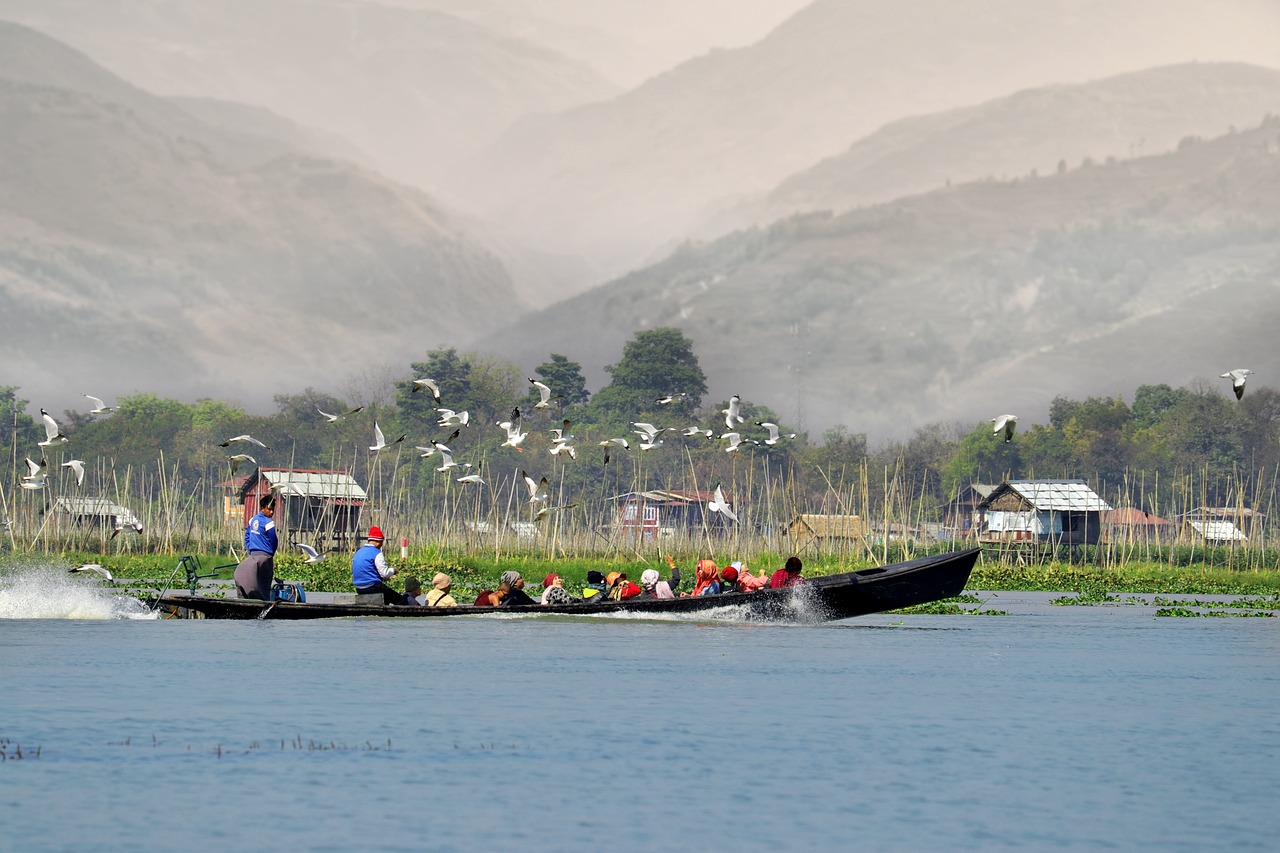
Inle’s fishermen stand at the stern of narrow boats and row with one leg, a technique unique to the lake that lets them see over the reeds and use both hands for their conical bamboo nets. Watch for them early in the morning, when the lake is calm; some pose for photos near the canal mouth and expect a tip. Nearby, the floating gardens (kyun hmaw) are strips of water hyacinth and silt anchored with bamboo, tended from canoes.
Phaung Daw Oo Pagoda
The lake’s most important shrine houses five small Buddha images so covered with gold leaf by devotees that they have become shapeless golden lumps; only men may apply gold leaf. During the Phaung Daw Oo festival, usually in September or October, four of the images are carried around the lake on a golden barge shaped like a mythical bird, towed by teams of leg-rowers, followed by boat races.
In Dein
At the end of a winding channel through the reeds, In Dein has a hillside of hundreds of stupas, the Shwe Inn Thein complex, many dating from the 17th and 18th centuries, some crumbling and sprouting trees, others restored and gilded. A covered walkway lined with stalls climbs to the top; visit in the afternoon, when the light is golden.
Weaving, silver and cheroots
The stilt villages host workshops where you can watch traditional crafts: lotus-stem weaving at Inpawkhon, where fibers drawn from lotus stalks are spun and woven into rare, expensive cloth; silk weaving on wooden looms; silversmiths at Ywama; blacksmiths; boat builders; and women rolling cheroots, Burmese cigars flavored with anise or honey. Some workshops are commercial, but watching is free.
Rotating markets
Markets rotate around five villages on a five-day cycle, including Nyaungshwe, Ywama, In Dein, Maing Thauk and Thaung Thut; Pa-O, Shan, Danu and Intha villagers come by boat and on foot to sell produce, fish, tea and tools. Ask your hotel where the market is each day, and go early.
More classic sights
- Nga Phe Chaung Monastery: a large wooden monastery on stilts, once famous for its “jumping cats”, with old Shan Buddha images.
- Maing Thauk: a village half on land and half on the water, linked by a long wooden bridge, with a forest monastery above it.
- Shwe Yan Pyay Monastery: a teak monastery near Nyaungshwe, with young monks studying at its oval windows.
- Red Mountain Estate: a hillside vineyard near Nyaungshwe with tastings at sunset.
- Khaung Daing: a village on the northwest shore with hot springs and tofu makers.
Boat trips, hiking and activities
A day on the lake
A full-day boat trip, booked through hotels or at the Nyaungshwe jetty, takes in the fishermen, floating gardens, Phaung Daw Oo, workshops, Nga Phe Chaung, the day’s market and In Dein. Boats take up to four or five passengers on wooden chairs; bring a jacket, as early mornings on the water are cold, and sunscreen for the afternoon. See our boat trips guide.
Cycling around the lake
Rent a bicycle in Nyaungshwe and ride to Maing Thauk on the eastern shore, or to the Red Mountain Estate vineyard and the Khaung Daing hot springs on the west, putting the bicycle on a boat to cross the lake. See our cycling guide.
Treks from Kalaw
The two- or three-day trek from the hill station of Kalaw to Inle Lake, staying in village homes and monasteries in Pa-O and Danu country, was one of Myanmar’s classic walks. Whether it can be done, and by which route, depends on local conditions and permissions each season; ask licensed trekking companies in Kalaw or Nyaungshwe. See our hiking guide.
Food and drink
Inle is known for Shan food: Shan noodles, sticky rice dishes, Shan tofu made from chickpeas, and Inle fish curry, often made with fish from the lake, served with tomato salad from the floating gardens. Nyaungshwe has noodle shops, tea shops, a night market and restaurants serving Burmese and international food, and the Red Mountain Estate makes local wine.
Around Inle Lake
- Kalaw: a former British hill station about 70 km (43 miles) west, at about 1,300 m (4,300 ft), with colonial houses, pine forests and trekking.
- Pindaya Caves: a limestone cave filled with more than 8,000 Buddha images, about 2–3 hours northwest of Nyaungshwe.
- Taunggyi: the capital of Shan State, about 30 km (19 miles) northeast, famous for its fire-balloon festival at Tazaungdaing, the November full moon.
- Kakku: a field of more than 2,000 stupas in Pa-O country south of Taunggyi; visits need a Pa-O guide, and access depends on local conditions.
- Bagan and Yangon: reached by domestic flights. See our Bagan and Yangon guides.
Nearby destinations
- Pai207 km
- Bagan225 km
- Chiang Mai292 km
Getting there
By air
Heho Airport (HEH), about 35 km (22 miles) northwest of Nyaungshwe, has domestic flights from Yangon in about 1 hour 10 minutes and from Mandalay and Nyaung-U (Bagan), usually on morning flights. Taxis to Nyaungshwe take about an hour, passing the zone-fee checkpoint. Schedules are thinner than before 2021, so reconfirm the day before.
By road
The nearest town on the main road is Shwenyaung, about 11 km (7 miles) north of Nyaungshwe. Express buses connect the area with Yangon, Mandalay and Bagan, but long journeys cross areas affected by fighting and pass checkpoints; most visitors fly.
Getting around: practical details
On the lake, everything is by long-tailed boat, rented for a full or half day from the Nyaungshwe jetty or through hotels; agree on the route and price in advance, and ask for life jackets. Boats are loud, so bring earplugs if you are sensitive to noise. Around Nyaungshwe, walk or rent a bicycle; taxis and pickup trucks link the town with Shwenyaung, Heho and Taunggyi.
When to go and how long to stay
Thanks to its altitude, Inle is much cooler than Yangon or Bagan. From November to February, days are sunny and pleasant, around 23–26 °C (74–78 °F), while nights are cold and mornings misty, often below 10 °C (50 °F). March to May is warmer and hazier, and the rainy season, from May to October, brings frequent showers, a higher lake and very green countryside; the Phaung Daw Oo festival in September or October is a highlight. The table uses the 1991–2020 climate normals for Taunggyi, the nearest station with published normals, from Myanmar’s Department of Meteorology and Hydrology, as submitted to the World Meteorological Organization (WMO). Taunggyi stands at 1,436 m (4,711 ft), about 550 m (1,800 ft) above the lake, so expect Nyaungshwe and the lake to be about 3 °C (5 °F) warmer.
| Month | Average high / low (Taunggyi) | Rain (days with 1 mm or more) | What to expect at the lake |
|---|---|---|---|
| January | 24 °C (74 °F) / 9 °C (48 °F) | 12 mm (0.5 in), 1 day | Sunny; misty, cold mornings |
| February | 26 °C (78 °F) / 10 °C (50 °F) | 4 mm (0.2 in), 1 day | Dry and clear |
| March | 28 °C (83 °F) / 14 °C (56 °F) | 9 mm (0.4 in), 2 days | Warm; haze from field burning |
| April | 30 °C (85 °F) / 17 °C (62 °F) | 51 mm (2.0 in), 6 days | The warmest month; Thingyan |
| May | 27 °C (81 °F) / 18 °C (64 °F) | 172 mm (6.8 in), 15 days | Rains begin |
| June | 25 °C (78 °F) / 18 °C (65 °F) | 171 mm (6.7 in), 19 days | Showers; green hills |
| July | 24 °C (76 °F) / 18 °C (65 °F) | 217 mm (8.6 in), 22 days | Wet; lake rising |
| August | 24 °C (75 °F) / 18 °C (64 °F) | 301 mm (11.8 in), 25 days | The wettest month |
| September | 25 °C (77 °F) / 18 °C (64 °F) | 258 mm (10.2 in), 21 days | Wet; Phaung Daw Oo festival (September or October) |
| October | 25 °C (77 °F) / 16 °C (61 °F) | 182 mm (7.2 in), 15 days | Rains easing; Thadingyut |
| November | 25 °C (76 °F) / 13 °C (56 °F) | 54 mm (2.1 in), 5 days | Dry; Taunggyi balloon festival |
| December | 23 °C (74 °F) / 10 °C (50 °F) | 13 mm (0.5 in), 2 days | Cool and clear; peak season |
Taunggyi receives about 1,440 mm (57 in) of rain a year, mostly from May to October.
Three days at Inle Lake
Day 1: Nyaungshwe’s market and monastery, then a sunset boat to watch the fishermen. Day 2: a full-day boat trip to Phaung Daw Oo, the stilt villages and workshops, the day’s market and In Dein. Day 3: cycle to Maing Thauk or the Red Mountain vineyard and the hot springs.
Two days
Combine Nyaungshwe and the full-day boat trip, ending at a sunset viewpoint.
What a trip to Inle Lake costs
Prices are approximate, for October 2026, converted at the Central Bank of Myanmar’s reference rate of 2,100 kyat to the US dollar; money changers may give a different rate.
| Item | Typical cost |
|---|---|
| Inle zone fee | about 15,000 MMK or US$10 |
| Full-day private boat (up to 4–5 people) | 30,000–50,000 MMK (about US$14–24) |
| Bicycle rental, per day | 3,000–6,000 MMK (about US$1.40–2.90) |
| Taxi from Heho airport to Nyaungshwe | 30,000–40,000 MMK (about US$14–19) |
| Shan noodles at a local restaurant | 2,500–4,000 MMK (about US$1.20–1.90) |
| Dinner at a mid-range restaurant | 12,000–25,000 MMK (about US$5.70–12) per person |
| Mid-range hotel double, per night | US$30–80 in Nyaungshwe; US$70–180 on the lake |
Practical tips for Inle Lake
- Dress in layers: mornings on the water can be close to freezing in December and January.
- Start early: the lake is calmest and the light best at dawn.
- Ask where the market is: it moves every day.
- Agree on boat routes: say which workshops and sights you want, and how long.
- Carry small notes: for tips, donations and market purchases.
- Bring sun protection: the glare off the water is strong by midday.
Safety
Nyaungshwe and the main parts of the lake have continued to receive visitors, but southern Shan State and neighboring Kayah State have seen fighting since 2021, and conditions can change quickly. Check with your hotel before traveling to the southern end of the lake, Kakku, Pindaya or Kalaw, and before any road journey; there are checkpoints, and you should carry your passport with your visa. Landmines have been reported in some conflict areas of Shan State, so stay on roads and well-used paths. On the water, ask for life jackets, do not travel after dark and avoid boats in storms. Do not swim in the lake or its streams, because of schistosomiasis. Nights are cold in winter, and some hotels have limited heating. In an emergency, call 199 for police and 192 for an ambulance; medical care is basic, and serious cases go to Yangon or abroad.
What to pack for Inle Lake
A warm fleece or jacket and a hat for cold mornings on the boat, layers, sunscreen and sunglasses, insect repellent, a rain jacket from May to October, comfortable shoes for walking, slip-on sandals for monasteries, a flashlight for power cuts, and clean US dollar notes. See our rain jackets, hiking shoes and travel adapters guides.
Inle Lake travel FAQ
Is Inle Lake open to tourists?
Yes. Nyaungshwe and the main sights on the lake continue to receive visitors. Parts of southern Shan State are affected by fighting, so check conditions for the southern lake and for treks.
How much is the Inle Lake zone fee?
In recent years about 15,000 kyat or US$10 per person, collected at the checkpoint on the road into Nyaungshwe.
How do I get to Inle Lake?
Fly to Heho airport from Yangon in about 1 hour 10 minutes, or from Mandalay or Bagan, then take a taxi to Nyaungshwe in about an hour.
Where should I stay at Inle Lake?
Nyaungshwe for good-value guesthouses and easy boat hire, or a stilt resort on the lake for the views.
How much is a boat trip on Inle Lake?
A full-day private boat for up to four or five people costs about 30,000–50,000 kyat.
Can I still do the Kalaw to Inle trek?
It depends on local conditions and permissions each season; ask licensed trekking companies in Kalaw or Nyaungshwe.
When is the Phaung Daw Oo festival?
Usually in September or October, in the weeks before the Thadingyut full moon, when Buddha images are carried around the lake on a golden barge.
How cold does Inle Lake get?
From December to February, nights and early mornings often fall below 10 °C (50 °F), and it feels colder on the water.
How many days do I need at Inle Lake?
Two to three days, plus two or three for a trek from Kalaw when it is possible.
What is the best time to visit Inle Lake?
October to February, when it is dry and sunny, with misty mornings.
Sources and last review
Researched and last reviewed on 5 October 2026. The zone fee collection by contractors for the Shan State government: the Global New Light of Myanmar (state media); climate normals for Taunggyi: the Department of Meteorology and Hydrology via the World Meteorological Organization’s 1991–2020 normals; exchange rate: the Central Bank of Myanmar. Conflict in southern Shan and Kayah, checkpoints, landmines, river safety and schistosomiasis: the UK government’s factual safety pages. The fee amount, the lake’s size, depth and altitude, village and workshop details, festival dates, the number of images at Pindaya and stupas at Kakku, travel times, emergency numbers and typical prices are general references or estimates, flagged for checking. Conditions change quickly, so check locally before you go. For entry rules, money and current conditions across the country, see our Myanmar travel guide.
Plan your trip
Partner links: TravelerCenter may earn a commission if you book, at no extra cost to you.
🇲🇲 Useful Burmese phrases for Inle Lake
All 38 Burmese phrases: restaurant, hotel, emergencies, romance (printable) →