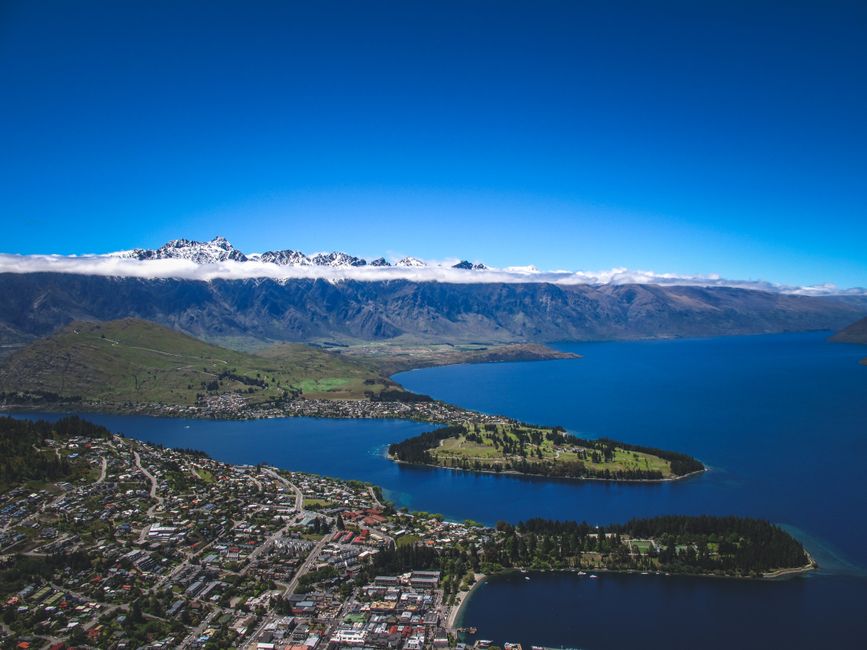
Queenstown sits on the shore of Lake Wakatipu, a long, deep, Z-shaped glacial lake in the Southern Alps of the South Island, under the jagged peaks of the Remarkables. It is New Zealand’s best-known resort town and its self-styled adventure capital: the place where commercial bungy jumping began, where jet boats skim through narrow canyons, and where four ski areas lie within easy reach in winter. But you don’t have to jump off anything to enjoy it. The town is a beautiful, walkable lakeside base with excellent restaurants and bars, a gondola to a ridge-top viewpoint, a 1912 steamship still sailing the lake, gold-rush Arrowtown nearby, Central Otago wineries along the Gibbston Valley, and the scenic road to Glenorchy at the head of the lake. It is also the most popular base for Milford Sound, Fiordland and the Routeburn Track. About 16,000 people live in the town itself, and the international airport is just 8 km (5 miles) away. Come from December to March for summer hiking, biking and lake days, or from late June to September for skiing; spring and autumn are quieter and colorful.
Right now in Queenstown
- Wed 8–17°C 47–62°F 5 mm Cloudy
- Thu 11–18°C 52–64°F 2 mm Partly cloudy
- Fri 6–18°C 43–64°F Partly cloudy
Weather: MET Norway (CC BY 4.0)
Top tours in Queenstown
See all tours for Queenstown →
From local operators, with prices and reviews; you check availability and book on Viator, our partner. We may earn a commission at no extra cost to you. How we earn money
Queenstown at a glance
- Best months: December to March for warm days, hiking and the lake; late June to September for skiing; April for autumn colors in Arrowtown.
- Time needed: three to four days, plus a full day (or overnight) for Milford Sound.
- Getting there: Queenstown Airport (ZQN) has direct flights from Auckland, Wellington, Christchurch and Australia. By road, it is about 1 hour from Wānaka, 2 hours from Te Anau and about 6 hours from Christchurch.
- Costs (as of October 2026): prices in New Zealand dollars; until 31 October 2026 a bus ride is NZ$2.50 with a Bee Card (about US$1.40) or NZ$4 cash, and the airport bus is NZ$10 cash; zoned fares start on 1 November 2026.
- Before you go: entry rules, the NZeTA and visitor levy, biosecurity and driving rules are in our New Zealand travel guide.
Queenstown’s areas and who each one suits
Queenstown town center
The compact grid of streets between the lakefront, the Queenstown Mall and the gondola base has most of the restaurants, bars, adventure booking offices and boutique hotels. It is the obvious base for a short stay without a car. Expect lively nights, particularly in winter and on summer weekends.
Fernhill, Sunshine Bay and the hillside
West of town, the slopes above the lake have hotels, apartments and holiday homes with big views. Many are a steep 10 to 20-minute walk or a short bus ride from the center. Good for couples and families who want a lake view and a quieter evening.
Frankton and Kelvin Heights
Near the airport, Frankton has supermarkets, newer hotels and the Frankton Hub bus interchange, while Kelvin Heights, on a peninsula across the lake, has a golf course and lakeside resorts. Convenient for early flights and for drivers heading to the ski fields or Cromwell.
Arrowtown
Twenty minutes northeast, this restored gold-rush village has a tree-lined main street, a historic Chinese miners’ settlement and some of the region’s best restaurants. Stay here for charm and calm, especially in autumn.
Glenorchy
At the head of the lake, 45 minutes along a scenic road, Glenorchy is a tiny village surrounded by mountains, rivers and beech forest, close to the Routeburn and Rees-Dart tracks. It suits hikers and anyone who wants wilderness on the doorstep.
Top things to see in Queenstown
The Skyline Gondola and Bob’s Peak
The gondola climbs from the edge of town to Bob’s Peak, about 450 m (1,500 feet) above the lake, for the classic view over Queenstown, Lake Wakatipu and the Remarkables. At the top are a restaurant, a café, viewing decks and the luge, a gravity-powered cart track that is fun for all ages; you can also hike up the steep Tiki Trail through the forest in about an hour. Sunset is the best time to go.
Lake Wakatipu and the TSS Earnslaw
New Zealand’s third-largest lake is 80 km (50 miles) long and cold, and its level rises and falls a few centimeters every few minutes, a seiche that Māori legend explains as the heartbeat of a sleeping giant. The TSS Earnslaw, a coal-fired twin-screw steamship launched in 1912, still sails from the town wharf to Walter Peak High Country Farm, where you can watch sheep-shearing and dog demonstrations or have a barbecue lunch. Kayaks, paddleboards, jet boats and a public ferry (NZ$10 with a Bee Card) also take you out on the water.
Bungy jumping and jet boats
Queenstown is where AJ Hackett opened the world’s first commercial bungy jump, from the historic Kawarau Gorge Suspension Bridge, in 1988; you can still jump (or just watch) there, or try the higher Nevis Bungy. The Shotover Jet spins jet boats through the narrow Shotover River canyons, and other operators run the Kawarau and Dart rivers. Skydiving, paragliding, canyon swings, ziplines and white-water rafting complete the list.
Arrowtown
The gold rush of the 1860s built Arrowtown, and its main street of stone and timber cottages, many now shops and cafés, looks the part. Wander the reconstructed huts of the Chinese settlement by the Arrow River, try gold panning, and visit the Lakes District Museum. In late April, the town is at its most beautiful, when the trees turn gold and red.
Glenorchy and the road to Paradise
The 46 km (29-mile) road along the lake to Glenorchy is one of the country’s most scenic drives, with lookouts at Bennetts Bluff. Beyond the village, gravel roads lead to the beech forests and braided rivers used as locations in The Lord of the Rings, the Routeburn Track trailhead and the hamlet of Paradise. Dart River jet boat and wilderness tours start here. Sandflies are fierce by the rivers; bring repellent.
Queenstown Gardens and the lakefront
On a peninsula next to town, the Queenstown Gardens have lakeside walks, a disc-golf course, a rose garden and an ice rink. The lakefront promenade and beach are the town’s living room on summer evenings.
Other things to do in Queenstown
- Skiing and snowboarding: Coronet Peak (about 20 minutes away, with night skiing in mid-winter) and The Remarkables (about 45 minutes) are the local fields; Cardrona and Treble Cone are closer to Wānaka. The season usually runs from about mid-June to early October, depending on snow.
- Hiking: Queenstown Hill (2 to 3 hours return), Ben Lomond (a full day), the Moke Lake loop and, for multi-day walkers, the Routeburn Track.
- Mountain biking and cycling: the Skyline bike park, and the Queenstown Trail, an easy network of more than 130 km (80 miles) of cycle trails linking the town, Arrowtown, Gibbston and Jacks Point.
- Wine: the Gibbston Valley, 25 minutes east, and the Bannockburn and Cromwell areas produce Central Otago Pinot Noir; join a tour or cycle between cellar doors.
- Scenic flights: helicopter and small-plane flights over the Remarkables or to Milford Sound, some landing on glaciers.
- Hot tubs and spas: cedar hot tubs on the Shotover River canyon edge at Onsen Hot Pools are popular in winter.
Food and drink
Queenstown punches far above its size for eating out. There are famous gourmet burgers (expect a queue), lakeside fine dining, Asian and Mexican restaurants, and wineries in Gibbston and Arrowtown with long lunches and Pinot Noir tastings. Look for Central Otago cherries and apricots in summer, lamb and venison from the high-country stations, and salmon from the region’s freshwater farms. Après-ski bars fill the town center from late June.
Day trips from Queenstown
Milford Sound/Piopiotahi
The famous fjord is about 290 km (180 miles) by road, roughly four hours each way via Te Anau and the Milford Road (State Highway 94), so most people take a coach and cruise day tour (about 12 to 13 hours in total) or a fly-cruise-fly trip. Driving yourself is spectacular but long; it is better to stay in Te Anau for a night. The Milford Road has avalanche zones where stopping is prohibited from about June to November, when you may also need to carry chains, and there is no fuel after Te Anau. See our Fiordland National Park guide for details.
Wānaka
An hour north over the Crown Range Road (New Zealand’s highest main road, which can need chains in winter), Wānaka has a calmer lakeside atmosphere, Roys Peak and the famous lone willow tree in the lake.
Cromwell and Central Otago
Cromwell, 45 minutes east via the Kawarau Gorge, has a restored heritage precinct by Lake Dunstan, fruit stalls and vineyards. Further on, Clyde and Alexandra are on the Otago Central Rail Trail.
Routeburn Track day walk
Even without booking the full Great Walk, you can walk the first section of the Routeburn from the Routeburn Shelter (an hour beyond Glenorchy) to Routeburn Flats or Routeburn Falls Hut and back in a day. If you want to stay overnight in season (1 November 2026 to 30 April 2027), huts cost NZ$132 a night for international adults and must be booked.
Nearby destinations
Getting there and getting around
Queenstown Airport (ZQN)
The airport is in Frankton, about 15 minutes from town. Air New Zealand flies from Auckland, Wellington and Christchurch, and several airlines have direct flights from Australian cities. Its approach between the mountains is famously scenic; flights are occasionally diverted in fog or strong winds. Orbus route 1 runs between the airport and town, as do taxis, rideshares and shuttles.
Orbus buses and the ferry
Queenstown’s public buses (Orbus) link the town, Frankton, the airport, Arrowtown and the newer suburbs. Bank cards cannot be used on the buses: pay cash or use a Bee Card, the regional travel smartcard, which costs NZ$5 plus a minimum NZ$5 top-up from the driver or a retailer.
| Orbus fare (October 2026) | Bee Card | Cash or bank card |
|---|---|---|
| Adult bus fare, around Queenstown | NZ$2.50 | NZ$4 (cash) |
| Adult bus fare to or from the airport | NZ$2.50 | NZ$10 (cash) |
| Child or youth (5–18) bus fare | NZ$1.50 | NZ$4 (NZ$8 to the airport) |
| Ferry, any age over 5 | NZ$10 | NZ$14 (bank card) |
These fares apply until 31 October 2026; according to the Otago Regional Council, zoned fares and new prices start on 1 November 2026, so check the Orbus website for the new fare table.
Driving
A car is useful for Glenorchy, Arrowtown, the ski fields and day trips. In winter, the ski-field access roads and the Crown Range need care: rental companies supply chains, and some ski roads have chain-fitting bays and shuttle buses. Town-center parking is limited and paid. In summer, cycling the Queenstown Trail is an excellent alternative.
When to go and how long to stay
Queenstown has the most continental climate of any New Zealand resort: warm, dry summers and crisp, cold winters. Summer (December to February) brings highs of about 22 °C (72 °F), long evenings and the occasional hot day above 30 °C (86 °F). Autumn (March to May) is calm and golden. Winter (June to August) is cold and frosty, with average lows just below freezing in town and snow on the mountains, but many days are clear. Spring (September to November) is changeable, with late snowfalls and blossom. Rainfall is moderate and spread through the year.
| Month | Average high | Average low | Rain | Rain days (≥1 mm) |
|---|---|---|---|---|
| Jan | 22 °C (72 °F) | 10 °C (50 °F) | 72 mm (2.8 in) | 8 |
| Feb | 22 °C (71 °F) | 10 °C (49 °F) | 51 mm (2.0 in) | 7 |
| Mar | 19 °C (66 °F) | 7 °C (45 °F) | 49 mm (1.9 in) | 7 |
| Apr | 15 °C (59 °F) | 4 °C (40 °F) | 58 mm (2.3 in) | 7 |
| May | 12 °C (53 °F) | 2 °C (36 °F) | 75 mm (3.0 in) | 10 |
| Jun | 9 °C (47 °F) | 0 °C (31 °F) | 62 mm (2.4 in) | 9 |
| Jul | 8 °C (47 °F) | −1 °C (29 °F) | 56 mm (2.2 in) | 8 |
| Aug | 10 °C (50 °F) | 0 °C (32 °F) | 53 mm (2.1 in) | 8 |
| Sep | 13 °C (55 °F) | 2 °C (36 °F) | 62 mm (2.5 in) | 8 |
| Oct | 15 °C (60 °F) | 4 °C (40 °F) | 62 mm (2.5 in) | 8 |
| Nov | 18 °C (64 °F) | 6 °C (43 °F) | 61 mm (2.4 in) | 8 |
| Dec | 20 °C (68 °F) | 8 °C (47 °F) | 60 mm (2.4 in) | 9 |
| Year | 15 °C (60 °F) | 4 °C (40 °F) | 721 mm (28.4 in) | 96 |
Figures are NIWA’s 1991–2020 climate normals for Queenstown. The town averages about 1,900 hours of sunshine a year, with only around 70 hours in June; the ski fields are much colder and snowier.
Events worth planning around
- Queenstown Winter Festival (late June): street parties, fireworks and on-snow events at the start of the ski season.
- The ski season (about mid-June to early October), busiest in the July school holidays.
- Arrowtown Autumn Festival (late April) when the trees are at their best.
- Christmas to January, the busiest weeks of the summer; book accommodation and the Milford Sound trip early.
Dates change every year; check the organizers’ sites before you book.
How long to stay: 2, 4 and 6 days
- Two days: the gondola and luge, a lake cruise or jet boat, Arrowtown, and a dinner in town.
- Four days: add a day trip to Milford Sound and a day in Glenorchy or on the Gibbston wine trail.
- Six days: add Wānaka, a day hike such as Ben Lomond or part of the Routeburn, a scenic flight or a ski day.
Where to stay in Queenstown
- Town center: boutique hotels, apartments and hostels within walking distance of everything.
- Fernhill and the hillside: lake-view hotels and apartments.
- Frankton and Kelvin Heights: resorts, motels and newer apartments near the airport and ski roads.
- Arrowtown: cottages, lodges and B&Bs.
- Glenorchy: lodges, cabins and a campground for walkers.
Queenstown has some of the highest accommodation prices in New Zealand, especially at Christmas, New Year and in the July ski holidays. Prices include 15% GST.
Typical costs in Queenstown
| Item (as of October 2026) | New Zealand dollars | About US dollars |
|---|---|---|
| Orbus bus ride with a Bee Card / cash | NZ$2.50 / NZ$4 | US$1.40 / US$2.20 |
| Airport bus, cash fare | NZ$10 | US$5.60 |
| Queenstown ferry, Bee Card / bank card | NZ$10 / NZ$14 | US$5.60 / US$7.80 |
| Routeburn Track hut, international adult, per night in season | NZ$132 | US$74 |
| Gondola and luge combo, adult | about NZ$75–95 | about US$42–53 |
| Milford Sound coach and cruise day tour | about NZ$200–300 | about US$110–170 |
| Ski lift pass, adult, one day | about NZ$170–200 | about US$95–110 |
| Mid-range hotel room, per night | about NZ$220–400 | about US$125–225 |
Bus, ferry and hut prices are official 2026 figures. Gondola, tour, lift-pass and hotel prices are typical ranges from operators and booking sites, not official prices. Conversions use about US$0.56 to NZ$1.
Safety in Queenstown
- Mountain weather: conditions change fast on the hills around town and on the Routeburn; snow can fall in any month above the bushline. Check the NIWA and MetService forecasts and carry warm, waterproof layers.
- Avalanches: outside the ski area boundaries in winter and spring, check the New Zealand avalanche forecast and go only with training and equipment.
- Winter roads: ice is common in shaded spots; slow down, and carry chains on the Crown Range and ski-field roads.
- Driving on the left and one-lane bridges: several on the Glenorchy road and around the region; give way as signed.
- Cold water: Lake Wakatipu stays cold even in summer (about 10–12 °C, 50–54 °F), so be careful swimming or paddling far from shore.
- Adventure activities: use established operators; New Zealand registers and audits commercial adventure activities.
- Sandflies: common at Glenorchy and along the rivers; use repellent.
- Emergencies: call 111.
Practical tips for Queenstown
- Book ahead: in peak season, book the Milford Sound trip, popular restaurants, rental cars and the gondola at sunset.
- Bee Card: buy one on arrival if you plan to use the buses; it pays for itself on the first airport ride.
- Free things: the lakefront and Queenstown Gardens, the Tiki Trail and Queenstown Hill walks, Arrowtown’s Chinese settlement, and the Glenorchy drive.
- Tipping: not expected; round up for good service.
What to pack for Queenstown
Bring layers year-round: a warm fleece or merino, a waterproof and windproof jacket, sturdy shoes, sunglasses and high-SPF sunscreen. In winter, pack thermal layers, gloves, a warm hat and boots with grip for icy streets. In summer, add a swimsuit, insect repellent for sandflies and a sun hat.
Queenstown travel FAQ
How do I get from Queenstown Airport to town?
Take Orbus route 1 (NZ$2.50 with a Bee Card or NZ$10 cash until 31 October 2026, zoned fares from 1 November; bank cards aren’t accepted on the bus), a taxi or a rideshare. The drive takes about 15 minutes.
Can I do Milford Sound as a day trip from Queenstown?
Yes, but it is a long day: about four hours each way by road plus a cruise, 12 to 13 hours in total. A fly-cruise-fly trip is faster, or stay overnight in Te Anau to break the journey.
How much is the bus in Queenstown?
NZ$2.50 for adults with a Bee Card or NZ$4 cash in October 2026; airport trips are NZ$2.50 with a Bee Card or NZ$10 cash. Zoned fares and new prices start on 1 November 2026; check Orbus for the new fares.
When is ski season in Queenstown?
Usually from about mid-June to early October at Coronet Peak and The Remarkables, depending on snow. The busiest weeks are the July school holidays.
Where did bungy jumping start?
At the Kawarau Gorge Suspension Bridge near Queenstown, where AJ Hackett opened the world’s first commercial bungy jump in 1988. You can still jump there.
Is Queenstown worth visiting if I don’t do adventure sports?
Yes. The lake and mountain scenery, the gondola, the TSS Earnslaw, Arrowtown, Glenorchy, wineries and food make it rewarding at any pace.
Do I need a car in Queenstown?
Not in town, where you can walk or take the bus, but a car helps for Glenorchy, the wineries, the ski fields and Wānaka.
What is the best time to visit Queenstown?
December to March for summer activities, late June to September for skiing, and late April for autumn colors in Arrowtown.
How many days do you need in Queenstown?
Three to four days, plus a day or an overnight trip for Milford Sound.
Is Queenstown expensive?
It is one of the most expensive places in New Zealand for accommodation and activities. Save with buses, free walks and self-catering, and travel in May, June or October to mid-November for lower prices.
Sources and last review
Researched and last reviewed on 6 October 2026. Bus, airport and ferry fares, Bee Card rules and the 1 November 2026 fare change come from the Otago Regional Council (Orbus); Routeburn Track seasons and hut fees from the Department of Conservation; Milford Road avalanche and chain rules from NZ Transport Agency Waka Kotahi; climate from NIWA’s 1991–2020 normals for Queenstown; holiday and daylight saving dates from Employment New Zealand and Govt.nz; exchange rates from the European Central Bank; population from Wikidata. The gondola height, lake facts, bungy history, ski-season dates, distances and drive times, and gondola, tour, lift-pass and hotel prices are general references and flagged for checking. Prices and schedules change, so check the official sites before you go. For entry rules, biosecurity and driving, see our New Zealand travel guide.
Plan your trip
Partner links: TravelerCenter may earn a commission if you book, at no extra cost to you.