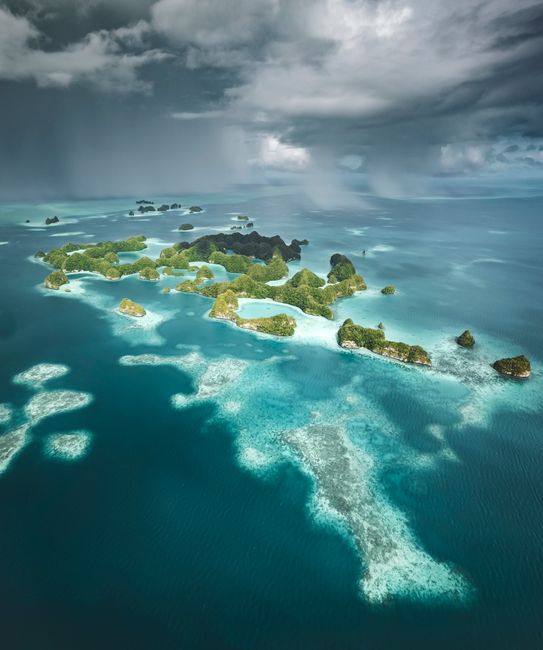
Palau is a small island nation in the western Pacific, about 800 km (500 miles) east of the Philippines and 1,300 km (800 miles) southwest of Guam, and one of the world’s great places to be underwater. Its best-known sight is the Rock Islands, hundreds of jungle-covered limestone knobs rising from a turquoise lagoon south of Koror, protected as a UNESCO World Heritage Site. Around them lie walls, channels and reefs where divers drift past gray reef sharks, manta rays and huge schools of fish, and Jellyfish Lake, a marine lake where snorkelers swim among stingless jellyfish. Palau has also become a model for protecting nature: most of its ocean is a no-take marine sanctuary, reef-toxic sunscreens are banned, and every visitor signs the Palau Pledge, stamped into their passport, promising to tread lightly. About 18,000 people live here, the currency is the US dollar, most visitors get a free 30-day visa on arrival, and every international air ticket includes a US$100 environmental fee.

Right now in Palau
- Wed 24–30°C 75–85°F 10 mm Rain
- Thu 24–28°C 75–82°F 9 mm Rain
- Fri 24–26°C 75–79°F 12 mm Heavy rain
Weather: MET Norway (CC BY 4.0)
Multi-day tours of Palau
Multi-day tours from local operators. You check dates and book on Viator, our partner; we may earn a commission at no extra cost to you. How we earn money
Palau at a glance
- Capital: Ngerulmud, a government complex in Melekeok State on the big island of Babeldaob. Koror, the former capital, is the only real town and where almost all visitors stay.
- Population and size: about 18,000 people in about 465 km² (180 sq miles), spread over more than 340 islands in 16 states; the main archipelago runs about 150 km (95 miles) from the Kayangel atoll in the north to Angaur in the south.
- Languages: Palauan and English are official, and English is widely used. Many tourism workers also speak Japanese, Mandarin, Cantonese or Korean. Hello is alii.
- Currency: the US dollar. Visa, JCB and Mastercard are widely accepted, but carry some cash.
- Time zone: UTC+9 all year, the same as Tokyo and Seoul, with no daylight saving.
- Driving: on the right, at a relaxed pace.
- Entry: a free 30-day visa on arrival for most nationalities (one year for US citizens), the online Palau Entry Form within 72 hours of arrival, and the Palau Pledge on arrival.
- Power: 120 volts with US-style plugs.
Palau’s islands and states
The main island group sits on a single reef system. Babeldaob, the second-largest island in Micronesia after Guam, is hilly and forested, with the airport, the capital, waterfalls and a ring road through ten quiet states. To the south, the islands of Koror State are joined by causeways and the Japan–Palau Friendship Bridge and hold most of the population, hotels and dive shops. Beyond them stretch the Rock Islands, also part of Koror State, then Peleliu and Angaur, sites of fierce World War II battles. Kayangel, a coral atoll, lies north of Babeldaob, and the remote Southwest Islands are 300 to 450 km (185 to 280 miles) away, reached only by charter boat or yacht.
Where to go: Koror, the Rock Islands and beyond
Koror
Koror is Palau’s commercial center, a strip of hotels, restaurants, shops and dive operators along one main road across a few connected islands. It is not a beauty in itself, but it is the base for everything: boats to the Rock Islands leave from its marinas, and it has the Belau National Museum, the Etpison Museum and the Palau Aquarium at the Palau International Coral Reef Center. Malakal Island holds the commercial harbor and several dive shops; Arakabesang has resort hotels and a quieter feel.
The Rock Islands Southern Lagoon
Koror State counts more than 400 Rock Islands in a lagoon about 37 km (23 miles) long between Koror and Peleliu. They are the remains of ancient reefs, uplifted and undercut by the sea so that many look like green mushrooms floating on the water. The area, including 52 marine lakes, was inscribed as a UNESCO World Heritage Site in 2012. A day trip by speedboat usually combines snorkeling on coral gardens, a picnic on a white-sand beach, the Milky Way, a cove where boat crews scoop white limestone mud for a natural face mask, and Jellyfish Lake. You need a Koror State permit to enter the lagoon.
Jellyfish Lake (Ongeim’l Tketau)
On the island of Mecherchar, about 45 minutes by boat from Koror, a short, steep trail climbs over a ridge to a marine lake connected to the sea only through cracks in the rock. Its golden jellyfish, a subspecies found only here, have lost most of their sting over thousands of years of isolation, and swimming among them is one of the strangest experiences in the Pacific. It is the only one of Palau’s marine lakes open to visitors. Snorkeling only: scuba is prohibited, because the deep layers of the lake hold toxic hydrogen sulfide. Jellyfish numbers rise and fall with water temperature; they collapsed to nearly zero during the warm periods of 1998–99 and 2016, and again fell sharply in 2022, then recovered each time. As of October 2026, Koror State lists the lake as open; ask your tour operator how many golden jellyfish are being seen when you book.
The great dive sites
Palau’s outer reefs are famous for strong currents and big animals. Blue Corner, a reef point where divers hook onto the wall and watch sharks, barracuda and Napoleon wrasse in the current, is the most famous; German Channel is a manta-ray cleaning station; Ulong Channel is a drift dive over giant clams and coral; Chandelier Cave is a series of air-filled caverns near Koror; and the lagoon holds dozens of World War II Japanese shipwrecks. Many sites suit experienced divers, but there are calm reefs for beginners and snorkelers too.
Babeldaob
Rent a car for a day on Babeldaob’s ring road. Highlights include Ngardmau Waterfall, the largest in Micronesia, reached by a jungle trail and river walk; the Badrulchau stone monoliths in Ngarchelong at the northern tip, rows of ancient basalt pillars on a grassy hill; the traditional bai (men’s meeting houses) with painted gables at Airai and Melekeok; and the grand capitol building at Ngerulmud. Most states charge small visitor fees at their sites.
Peleliu and Angaur
Peleliu was the scene of one of the bloodiest battles of the Pacific War in September to November 1944. The island is now quiet and rural, scattered with bunkers, tanks, aircraft wrecks, caves and memorials, with fine beaches and dive sites off its reefs. Angaur, further south, has more wartime relics, a lighthouse and a troop of wild macaques. Both are reached by boat from Koror, on scheduled state ferries for a small fee, or by small plane, and both need a state permit.
Kayangel
Palau’s northernmost state is a ring of four islands around a shallow lagoon, with white beaches and a single village. It is reached by boat charter or helicopter, usually as a day trip from Koror or northern Babeldaob.
Koror Travel Guide
Plan a trip to Koror, Palau: Rock Islands tours, Jellyfish Lake and its October 2026 status, the Milky Way, Blue Corner and German Channel,…
Best time to visit Palau
Palau is hot, humid and green all year, with water temperatures around 28 to 30 °C (82 to 86 °F) and rain in every month. The calmer, somewhat drier months are roughly November to April, when the northeast trade winds blow and the seas around the outer dive sites are usually best; February to April has the least rain. From about June to October the southwest monsoon brings more rain and wind, and some sites on the exposed western reefs can be rough. Diving, snorkeling and Rock Islands tours run all year.
| Month | Koror high / low | Rain | Days with 2.5 mm (0.1 in) or more |
|---|---|---|---|
| Jan | 31 / 24 °C (88 / 76 °F) | 284 mm (11.2 in) | 14 |
| Feb | 31 / 24 °C (88 / 76 °F) | 236 mm (9.3 in) | 12 |
| Mar | 32 / 24 °C (89 / 76 °F) | 205 mm (8.1 in) | 12 |
| Apr | 32 / 25 °C (89 / 77 °F) | 231 mm (9.1 in) | 13 |
| May | 32 / 25 °C (89 / 77 °F) | 312 mm (12.3 in) | 18 |
| Jun | 31 / 25 °C (89 / 76 °F) | 410 mm (16.1 in) | 19 |
| Jul | 31 / 24 °C (88 / 76 °F) | 420 mm (16.5 in) | 18 |
| Aug | 31 / 25 °C (87 / 76 °F) | 336 mm (13.2 in) | 16 |
| Sep | 31 / 25 °C (88 / 76 °F) | 344 mm (13.6 in) | 16 |
| Oct | 31 / 25 °C (88 / 77 °F) | 289 mm (11.4 in) | 15 |
| Nov | 32 / 25 °C (89 / 77 °F) | 283 mm (11.2 in) | 16 |
| Dec | 31 / 25 °C (89 / 76 °F) | 317 mm (12.5 in) | 17 |
Figures are the US National Oceanic and Atmospheric Administration (NOAA) 1991–2020 climate normals for the Koror Weather Service Office: mean daily maximum and minimum, total rainfall and days with at least 2.5 mm (0.1 in) of rain. Koror gets about 3,670 mm (144 in) of rain a year, much of it in short, heavy showers followed by sunshine.
Crowds and prices through the year
Palau never feels crowded by global standards, but the busiest times are the northern-hemisphere winter, the Christmas and New Year period, Lunar New Year, Japanese Golden Week (late April to early May) and summer holidays in East Asia. Liveaboard dive boats and the best hotels book out early for those dates. Prices are set in US dollars and don’t swing much by season.
Festivals and events
- Constitution Day (9 July) and Independence Day (1 October) bring parades, sports and traditional dance in Koror.
- State and village events, from canoe races to traditional dance and food fairs, are held through the year; the Palau Visitors Authority events calendar lists current dates.
- Christmas and New Year are busy family holidays.
How long to stay: sample itineraries
Plan at least five full days in Palau, as flights are infrequent and you should not dive within 18 to 24 hours before flying.
5 days: Rock Islands and Jellyfish Lake
Day 1, arrive and rest in Koror; days 2 and 3, a full-day Rock Islands snorkeling tour with Jellyfish Lake and the Milky Way, and a second boat day (diving or kayaking); day 4, drive around Babeldaob to Ngardmau Waterfall and the Badrulchau monoliths; day 5, museums in Koror and a sunset, then fly the next day.
7 to 10 days: diving Palau
Five or six days of two- or three-tank boat dives (Blue Corner, German Channel, Ulong Channel, the wrecks), with one non-diving day for Jellyfish Lake and a last day on land before your flight. Alternatively, join a liveaboard for a week to reach more distant sites.
10 days: the whole country
Add a night on Peleliu for the battlefield and beaches, a day trip to Kayangel and more time on Babeldaob.
Island hopping in Palau
Palau has no inter-island ferry network like Fiji or Tonga, but the main islands are linked in other ways. Koror and Babeldaob are joined by the Friendship Bridge, so you can drive from your hotel to the far north of Babeldaob in under two hours. For Peleliu, Koror State and Peleliu State boats make the crossing of about one to two hours several times a week, and dive and tour operators include Peleliu on day trips that combine wreck or wall dives with a battlefield tour. Angaur is a longer boat ride further south. Small planes and helicopters fly to Peleliu, Angaur and Kayangel, weather permitting, and also offer scenic flights over the Rock Islands. Overnight stays on Peleliu are possible in a few small guesthouses; Kayangel has very limited accommodation and is usually a day trip. To see the most remote parts of the archipelago, including the Southwest Islands, join a liveaboard dive boat, which also gives you early access to the outer reefs before day boats arrive.
Where to stay
- Central Koror: mid-range hotels, apartments and budget guesthouses close to restaurants, shops and dive shops; most tour pickups start here.
- Malakal: small hotels and lodges next to the harbor and several dive operators, handy for early boats.
- Arakabesang and the Koror waterfront: the larger resort hotels, with private beaches, pools and their own marinas.
- Babeldaob: a few eco-lodges and small resorts in the quieter states, best with a rental car.
- Peleliu and Kayangel: simple guesthouses and homestays for travelers who want to stay overnight.
- Liveaboards: several dive boats run week-long trips from Koror, the most efficient way to dive the outer reefs.
Book early for Christmas, Lunar New Year and Japanese holiday periods, when tour groups fill the bigger hotels.
Entry, fees and costs
Entry rules (as of October 2026)
According to the Palau Visitors Authority, all visitors need a passport valid for at least six months and proof of return or onward travel. Visas are not required in advance for most nationalities:
- A 30-day tourist visa is issued free on arrival. It can be extended twice, by 30 days each time, for US$50 per extension, up to a maximum stay of 90 days; apply to the Bureau of Immigration at least seven days before your visa expires.
- Citizens of the United States, the Federated States of Micronesia and the Marshall Islands, and residents of Guam and the Northern Mariana Islands with valid passports, are issued a one-year visa on arrival.
- Citizens of Myanmar and Bangladesh need a visa approved before travel.
Before you fly, complete the free online Palau Entry Form at palautravel.pw within 72 hours of arrival. One form covers a family or a single traveler; you receive a QR code by email to show at the airport.
The Palau Pledge
On arrival, every visitor is asked to read and sign the Palau Pledge, which is stamped into the passport. It is a promise, addressed to the children of Palau, to act in an ecologically and culturally responsible way: not to take what is not given, not to harm what does not harm you, and to leave only footprints that wash away. It is based on bul, the traditional moratorium declared by chiefs to protect a species or place. Palau was the first country to change its immigration procedures this way, in 2017.
The Pristine Paradise Environmental Fee
Since 1 January 2018, every international airline ticket to Palau includes the Pristine Paradise Environmental Fee (PPEF) of US$100, which funds Palau’s Protected Areas Network and conservation. It replaced the old green fee and departure tax, so you pay nothing extra at the airport; check that it appears in your ticket’s taxes and fees.
Rock Islands and Jellyfish Lake permits
To swim, snorkel, dive or kayak in the Rock Islands Southern Lagoon you need a Koror State Rock Islands permit. The Palau Visitors Authority lists two options:
| Permit | Price | Valid for |
|---|---|---|
| Rock Islands permit | US$50 | 5 days |
| Jellyfish Lake permit (includes the Rock Islands permit) | US$100 | 5 days |
Tour and dive operators sell the permits with your trip, or you can buy them at the Koror State Department of Conservation and Law Enforcement ranger office. Keep the permit with you on the water; rangers check boats. Peleliu, Angaur, Kayangel and several Babeldaob states charge their own visitor or site fees.
Customs
Each arriving passenger may bring up to 2 liters of alcohol and one opened pack of cigarettes duty-free. E-cigarettes and vapes are banned: you may not import, possess or use them, and fines apply; surrender them at the airport on arrival to avoid prosecution. Declare cash of US$10,000 or more. Only reef-safe sunscreen is allowed (see below).
Money and tipping
Palau uses the US dollar. Major cards are accepted at hotels, dive shops and larger restaurants; carry cash for taxis, small shops, state fees and markets. There are ATMs in Koror. Tipping is optional but appreciated, especially for dive guides and boat crews. A 10% goods and services tax applies to many purchases.
Typical travel costs
| Item (as of October 2026) | Price in US dollars |
|---|---|
| Pristine Paradise Environmental Fee (in your air ticket) | US$100 |
| Visa on arrival, 30 days | Free |
| Visa extension, 30 days | US$50 |
| Rock Islands permit, 5 days | US$50 |
| Jellyfish Lake permit, 5 days (includes Rock Islands) | US$100 |
| Rock Islands snorkeling day tour, permit extra | about US$110–160 |
| Two-tank boat dive | about US$160–220 |
| Taxi, airport to central Koror | about US$25–35 |
| Mid-range hotel room in Koror, per night | about US$150–300 |
| Casual restaurant meal | about US$15–30 |
Permit, visa and fee figures are from the Palau Visitors Authority. Tour, dive, taxi, hotel and meal prices are typical ranges, not official figures, and vary by operator and season.
Getting there and getting around
Flights
Palau International Airport (ROR) is on Babeldaob in Airai State, about 25 minutes by road from central Koror across the Japan–Palau Friendship Bridge. The main year-round link is United Airlines from Guam, which connects to the US mainland, Honolulu, Japan and other Asian cities. There are also flights from Taipei and, at times, direct services or charters from Manila, Seoul and Tokyo; schedules change often, so check the airlines. Many flights arrive or leave late at night.
On the islands
There is a limited public bus service (the Palau Visitors Authority website has a trip planner), but most visitors use taxis, hotel shuttles and their tour operator’s pickups. Taxis are not metered; the Palau Visitors Authority publishes a zone fare map and a directory of licensed drivers. Rental cars are easy to find in Koror and are the best way to explore Babeldaob; drive on the right, slowly, and watch for people walking on roads without sidewalks.
Boats and small planes
Rock Islands tours and dives leave from Koror’s marinas. State ferries run to Peleliu and Angaur for a small fee, and small aircraft and helicopters fly to Peleliu, Angaur and Kayangel. The Southwest Islands are reached only by charter or private yacht.
Culture, food and etiquette
Palauan society is matrilineal: land, titles and clan membership pass through the mother’s line, and women’s councils have real influence alongside the chiefs. The bai, a high-gabled meeting house painted with stories, is the symbol of traditional culture. Palau was ruled by Spain, Germany and Japan before coming under US administration after World War II, and became independent in 1994 in free association with the United States; you will see Japanese influence in food and words. Be respectful in villages and at bai, ask before photographing people, dress modestly away from the beach, and don’t take shells, coral or anything else from the reef or beaches.
Palau’s history in brief
People have lived in Palau for at least 3,000 years, building terraced hillsides on Babeldaob, stone platforms, the Badrulchau monoliths and villages linked by stone paths. Traditional money, made of glass and ceramic beads and turtle shell, is still exchanged at ceremonies. European contact grew from the late 1700s; Spain claimed the islands, then sold them to Germany in 1899, and Japan took over in 1914 and ran Palau as the administrative center of its Pacific territories, with Koror a town of tens of thousands of Japanese settlers. After the battles of 1944, Palau became part of the US-administered Trust Territory of the Pacific Islands. It adopted the world’s first nuclear-free constitution in 1981 and became independent on 1 October 1994 under a Compact of Free Association with the United States, which is why the US dollar is the currency and US citizens can stay a year.
Food and drink
Expect fresh reef fish and tuna, sashimi, crab, coconut crab (often served whole), taro, tapioca and breadfruit, alongside Japanese, Korean, Chinese, Filipino and American food. Restaurants in Koror range from simple diners to waterfront seafood places. Fruit bat soup is a traditional dish you may see on menus. Drink bottled or filtered water.
Conservation rules every visitor should know
- Reef-safe sunscreen only: since 1 January 2020, Palau has banned sunscreens containing ingredients known or suspected to harm reefs. Only mineral sunscreens whose active ingredients are zinc oxide and/or titanium dioxide, without parabens, triclosan, triclocarban or phenoxyethanol, are allowed. You can buy compliant sunscreen in Koror.
- Marine sanctuary: the Palau National Marine Sanctuary, created in 2015, closes about 80% of Palau’s ocean (some 500,000 km², 193,000 sq miles) to fishing. Palau declared the world’s first shark sanctuary in 2009.
- Plastic: tour operators provide reusable food and water containers under the Responsible Tourism Education Act.
- Drones: must be registered in advance through the Palau Visitors Authority.
- On the reef: don’t touch, stand on or kick coral; don’t feed or chase fish, sharks or turtles; and never take shells or coral.
Safety, health and connectivity
Safety
Palau is calm and friendly, with little crime. The main risks are in the water and in the heat.
- Currents and diving: outer reef dives such as Blue Corner have strong, changeable currents and are for experienced divers with a reef hook and surface marker buoy. Choose a reputable operator and be honest about your experience.
- Snorkeling: wear a life vest or flotation if you’re not a strong swimmer, stay near your boat and watch for boat traffic.
- Jellyfish Lake trail: short but steep, with rocks and roots that are slippery when wet.
- World War II ordnance: unexploded bombs, shells and grenades remain on Peleliu, Angaur, Babeldaob and in the Rock Islands, and clearance work continues. Stay on cleared paths and in sites shown by licensed guides, and never touch, move or collect any war relic; it is also illegal to remove them.
- Typhoons: Palau lies south of the main typhoon track and is rarely hit, but strong storms have caused damage, notably in 2012 and 2013. Follow local warnings, especially from about July to December.
- Saltwater crocodiles: a small population lives in mangroves and estuaries; don’t swim in mangrove channels or river mouths.
- Sun and heat: strong all year; use reef-safe sunscreen, a rash guard and a hat.
Health
Belau National Hospital in Koror handles outpatient and emergency cases and has a working hyperbaric chamber for diving accidents; call +680 488 2552. There are private clinics in Koror and health dispensaries in the outer states. Dengue occurs, so use insect repellent. Divers should carry dive accident insurance and allow at least 18 to 24 hours between their last dive and their flight. Yellow fever and cholera certificates are required only if arriving from infected areas.
Connectivity and power
Palau National Communications Corporation (PNCC) is the national network, with 4G in Koror and many states. You can buy a PNCC Visitor eSIM online before you travel and activate it on the free Wi-Fi at the airport, or buy a SIM in Koror. Wi-Fi hotspots and pocket Wi-Fi rentals are available. Palau’s country code is +680. Power is 120 volts with US-style plugs, and Palau is in the US postal system’s Zone 1.
Things to do: diving, snorkeling, kayaking and history
Dive the walls and channels; snorkel with golden jellyfish; kayak through the Rock Islands’ hidden coves, arches and marine lakes on a guided trip; spend a day on a deserted beach; hike to Ngardmau Waterfall; explore Peleliu’s battlefield with a guide; take a scenic flight over the Rock Islands; fish for bonefish and trevally on the flats with a licensed guide; and visit the Belau National Museum and the Etpison Museum for culture and history.
What to pack
Mineral, reef-safe sunscreen (or buy it in Koror), a rash guard, a hat and polarized sunglasses; your own mask and dive computer if you dive; reef shoes or water sandals for the Jellyfish Lake trail; a dry bag; insect repellent; light rain gear; modest clothes for villages; and a US-style power adapter if you need one. Leave vapes and e-cigarettes at home.
Palau travel FAQ
Do I need a visa to visit Palau?
Most visitors don’t need to apply in advance: a free 30-day tourist visa is issued on arrival with a passport valid for six months and a return ticket. US citizens get one year. Citizens of Myanmar and Bangladesh need a pre-approved visa.
What is the Palau Entry Form?
A free online form at palautravel.pw that every traveler or family completes within 72 hours before arrival. You receive a QR code by email to show at the airport.
What is the Palau Pledge?
A promise to protect Palau’s environment and respect its culture, which every visitor reads and signs on arrival. It is stamped into your passport.
What is the US$100 Palau environmental fee?
The Pristine Paradise Environmental Fee, US$100, included in every international air ticket to Palau since 2018. It funds the Protected Areas Network. You don’t pay it separately at the airport.
How much is the Rock Islands permit?
US$50 for a Koror State Rock Islands permit valid for five days, or US$100 for the Jellyfish Lake permit, which includes the Rock Islands. Tour and dive operators usually sell them with your trip.
Is Jellyfish Lake open?
Yes. As of October 2026 Koror State lists Jellyfish Lake (Ongeim’l Tketau) as open for snorkeling with the US$100 permit. Golden jellyfish numbers vary with water temperature, so ask your operator before booking.
Can I scuba dive in Jellyfish Lake?
No. Only snorkeling is allowed, because the lake’s deeper layers contain toxic hydrogen sulfide and the jellyfish live near the surface.
What sunscreen can I use in Palau?
Only reef-safe mineral sunscreen with zinc oxide and/or titanium dioxide as the active ingredients and no parabens, triclosan, triclocarban or phenoxyethanol. Other sunscreens are banned.
Can I bring a vape to Palau?
No. E-cigarettes are banned in Palau. Importing, possessing or using them can bring fines; hand them in at the airport on arrival.
When is the best time to visit Palau?
November to April usually has calmer seas and a little less rain, with February to April the driest months. Diving and tours run all year.
What currency does Palau use?
The US dollar. Cards are widely accepted in Koror, but carry cash for taxis, state fees and small businesses.
How do I get to Palau?
Most visitors fly in on United Airlines from Guam, connecting from the US, Hawaii or Asia, or on flights from Taipei and, at times, other Asian cities.
Is Palau safe for tourists?
Yes. Crime is low; the main risks are strong currents on outer reef dives, heat and sun, slippery trails and unexploded World War II ordnance on old battlefields, which should never be touched.
Sources and last review
Researched and last reviewed on 5 October 2026. Entry, visa extensions, the Palau Entry Form, the Palau Pledge, the Pristine Paradise Environmental Fee, Rock Islands and Jellyfish Lake permits, customs and the e-cigarette ban, the sunscreen rules, telecoms and medical services come from the Palau Visitors Authority (pristineparadisepalau.com) and the Bureau of Customs and Border Protection; Jellyfish Lake status and Rock Islands information from Koror State Government and the Palau Visitors Authority; UNESCO status from UNESCO; climate from NOAA’s 1991–2020 normals for Koror; population and area from the Palau Visitors Authority and Wikidata. Tour, dive, taxi, hotel and meal prices, flight routes, typhoon history, ordnance and some cultural details are general estimates or secondary sources. Prices and rules change, so check official sites before you go.
Plan your trip
Partner links: TravelerCenter may earn a commission if you book, at no extra cost to you.