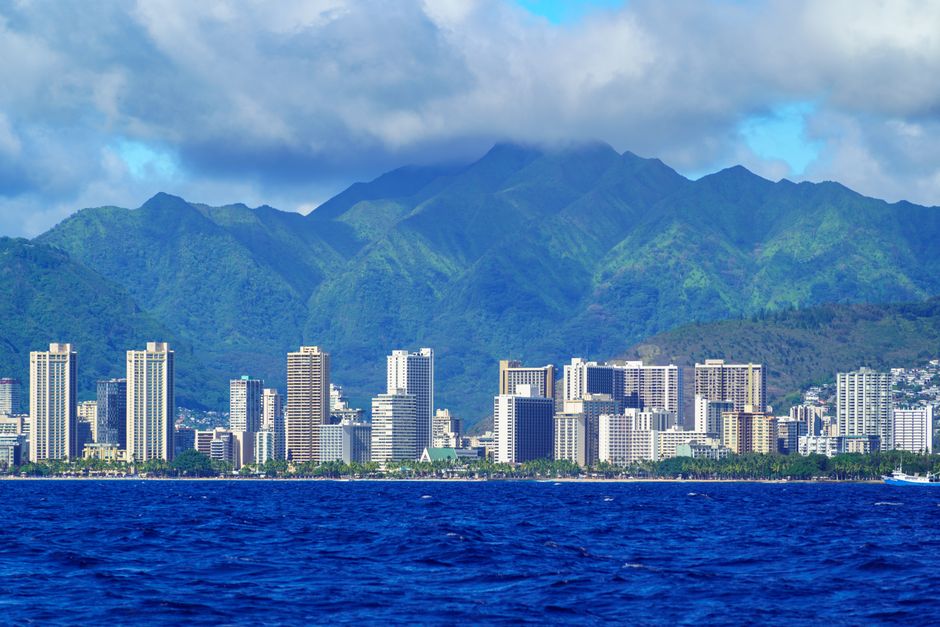
Honolulu, Hawaiʻi’s capital, sits on the south shore of Oʻahu between the green ridges of the Koʻolau Range and the Pacific. Most visitors stay in Waikīkī, a strip of hotels, surf schools and sand at the foot of Diamond Head, but the city reaches far beyond it: ʻIolani Palace and the historic downtown, the shops and food of Chinatown and Kakaʻako, the solemn memorials of Pearl Harbor, the reef at Hanauma Bay and, an hour’s drive north, the big winter surf of the North Shore. Several of the best-known sights now need advance reservations for visitors, the new Skyline rail line links the airport with the west side of the island, and hotel taxes rose in 2026, so a little planning goes a long way. Hawaiʻi is warm all year, with a drier summer and a wetter, breezier winter.
Right now in Honolulu
- Tue 22–28°C 72–82°F 1 mm Mostly clear
- Wed 22–28°C 72–83°F 9 mm Mostly clear
- Thu 22–26°C 71–79°F 11 mm Heavy showers
- Mon 12 Oct Columbus Day
- Mon 12 Oct Indigenous Peoples' Day · regional holiday in Hawaii
Weather: MET Norway (CC BY 4.0) · Sea temperature: NOAA CoastWatch · Holidays: Nager.Date
Top tours in Honolulu
See all tours for Honolulu →
From local operators, with prices and reviews; you check availability and book on Viator, our partner. We may earn a commission at no extra cost to you. How we earn money
Honolulu at a glance
- Best months: April to June and September to October, for warm, settled weather and fewer crowds; December to March is whale season and the North Shore’s big-wave season, and the busiest and priciest time.
- Time needed: 3–4 days for Waikīkī, Diamond Head, Pearl Harbor, Hanauma Bay and downtown; 5–7 days to add the North Shore, the windward beaches and a hike or two.
- Getting there: Daniel K. Inouye International Airport (HNL), about 9 miles (14 km) from Waikīkī, with nonstop flights from the US mainland, Asia and the Pacific, and short inter-island flights to Maui, Kauaʻi and Hawaiʻi Island.
- Costs (as of October 2026): Diamond Head $5 per person plus $10 per car for non-residents; Hanauma Bay $25 per non-resident aged 13 and over; the USS Arizona Memorial program is free (a $1 booking fee per ticket); bus and Skyline $3 for two hours or $7.50 a day; hotel bills add about 18.7% in taxes.
- Before you go: entry rules (ESTA or visa), money, driving and general safety are in our United States travel guide.
Honolulu neighborhoods: where things are
Waikīkī
The resort district fills a narrow wedge of land between the Ala Wai Canal and the sea, with high-rise hotels, shopping on Kalākaua Avenue, beach boys renting boards and outrigger canoes, and the long curve of sand from the Hilton Hawaiian Village to Kapiʻolani Park and the Waikīkī Aquarium. It is walkable, safe and lively until late, and the gentle waves offshore are where generations of visitors have stood up on a surfboard for the first time. Good for first-timers, families and anyone without a car.
Downtown, Chinatown and Kakaʻako
Downtown Honolulu holds ʻIolani Palace, the State Capitol, the King Kamehameha statue and Aloha Tower by the harbor. Next door, Chinatown mixes lei stands, noodle shops, markets and some of the city’s best bars, while Kakaʻako, between downtown and Ala Moana, is known for its street murals, breweries and new towers. Ala Moana Center, one of the largest open-air malls in the country, sits beside the calm lagoon of Ala Moana Beach Park.
Diamond Head, Kapahulu and Kaimukī
East of Waikīkī, the old crater of Diamond Head rises above Kapiʻolani Park. Kapahulu Avenue and Kaimukī, just inland, are the places to try local plate lunches, shave ice, poke and bakery malasadas away from the hotel crowds.
East Honolulu and the windward side
The road east past Hawaiʻi Kai leads to Hanauma Bay, the Makapuʻu lighthouse trail and the bodysurfing beaches of Sandy’s and Makapuʻu. Over the mountains, Kailua and Lanikai have soft white sand and turquoise water sheltered by offshore islets, ideal for kayaking and calm swims.
The North Shore
About an hour’s drive from Waikīkī, the North Shore is rural Oʻahu: the surf town of Haleʻiwa, shrimp trucks and fruit stands, and the famous breaks of Waimea Bay, ʻEhukai (the Banzai Pipeline) and Sunset Beach. In winter, huge swells draw surfers and spectators; in summer, the same bays are often flat enough for snorkeling.
Top things to see in Honolulu
Prices, hours and reservation rules below were checked on the official sites in October 2026; check again before you go.
Diamond Head State Monument (Lēʻahi)
Hawaiʻi’s best-known landmark is a broad tuff crater formed in a single explosive eruption about 300,000 years ago. The trail from the crater floor to the summit was built in 1908 as part of Oʻahu’s coastal defenses: it climbs 560 feet (171 m) in 0.8 mile (1.3 km) each way, starting on a paved path, then switching back up the crater wall, climbing steep stairs and passing through a lighted 225-foot (69 m) tunnel to the Fire Control Station of 1911 on the rim. From the top you look along the whole south shore from Koko Head to Waiʻanae, with the 1917 lighthouse below and, in winter, humpback whales offshore. Allow 1.5 to 2 hours; the trail is steep, uneven and not accessible for wheelchairs, though the crater floor facilities are.
Reservations are required for all non-residents. According to the Hawaiʻi Division of State Parks, the park is open from 6 a.m. to 6 p.m. daily; the last reservation slot is 4 p.m., the last entry 4:30 p.m., and everyone must be out of the crater through the tunnel by 6 p.m., when the gates are locked. As of October 2026 entry costs $5 per non-resident (children 3 and under free, card only) and parking $10 per non-resident vehicle. Book entry or parking on the state parks reservation site, gostateparks.hawaii.gov. Anyone without a reservation is turned away, except Hawaiʻi residents with a state ID or driver’s license; out-of-state friends traveling with residents still need their own tickets. Weather is not a reason for a refund unless the park officially closes. No pets are allowed except service animals. Bring water, a hat and sunscreen, and start early, when it is cooler.
Pearl Harbor National Memorial and the USS Arizona Memorial
The National Park Service’s Pearl Harbor Visitor Center, by the harbor about 10 miles (16 km) west of Waikīkī, tells the story of the attack of 7 December 1941 in two museums and a film, and is the departure point for the boat to the USS Arizona Memorial over the sunken battleship. According to the park, the visitor center is open 7 a.m. to 5 p.m. every day except Thanksgiving, 25 December and 1 January, and admission, the museums and the USS Arizona Memorial program are free. Parking costs $7 a day.
The 45-minute USS Arizona Memorial program (a short boat ride run by the US Navy, 10–15 minutes on the memorial and the ride back) leaves about every 15 minutes from 8 a.m. to noon and from 1 p.m. to 3:30 p.m. Tickets are free but must be reserved on Recreation.gov, which charges a non-refundable $1 per ticket. They are released daily at 3 p.m. Hawaiʻi time in two windows, 8 weeks and 24 hours ahead, with up to 10 tickets per person per day. Arrive an hour early and check in 10 minutes before your time; without a ticket you can join the standby callback list at the visitor center, but waits can last hours and standby may not run on busy days. The Navy may cancel or change boat trips in high wind or rain. The USS Oklahoma and USS Utah memorials on Ford Island are open only to people with military base access. Three separate museums share the site and charge their own admission: the USS Bowfin Submarine Museum, the Pearl Harbor Aviation Museum and the Battleship Missouri Memorial. Bag rules are strict, so check the park’s list of what you can bring before you go.
Hanauma Bay Nature Preserve
A curved bay in an old volcanic crater east of Honolulu, Hanauma Bay became Hawaiʻi’s first Marine Life Conservation District in 1967 and is the island’s best-known snorkeling spot, with reef fish and green sea turtles in shallow water. The City and County of Honolulu manages it with daily visitor limits. According to the city, the preserve is open Wednesday to Sunday (closed Monday and Tuesday, 25 December and 1 January), with entry from 6:45 a.m. to 1:30 p.m.; the beach is cleared at 3:30 p.m. and everyone must leave by 4 p.m. All entrants watch a short educational video first.
As of October 2026 non-residents aged 13 and over pay $25; children 12 and under are free. There are two ways to book: through the city’s PROS system, which opens at 7 a.m. Hawaiʻi time two days before your visit (so from Monday for a Wednesday), with a 2.35% online fee; or through the city’s concessioner Roberts Hawaiʻi, whose packages with round-trip electric-bus transport from Ala Moana and Waikīkī can be booked up to a month ahead. About a quarter of entries are kept for walk-ins, paid on site, but they go early. Parking costs $3 for non-residents, cash only. Tickets are non-refundable and non-transferable, and your photo ID must match the booking. Do not touch or stand on coral, keep away from turtles, and use mineral sunscreen.
ʻIolani Palace
Built in 1882 for King Kalākaua, ʻIolani Palace was the official residence of Hawaiʻi’s last monarchs, Kalākaua and Queen Liliʻuokalani, until the overthrow of the kingdom in 1893, and later the place where the queen was imprisoned. Restored rooms, the throne room and royal collections tell a story every visitor to Honolulu should know. The palace offers docent-led and self-led audio tours from Tuesday to Saturday; children must be 5 or older, and booking ahead is wise. The grounds, with the Royal Hawaiian Band’s free concerts, the bandstand and the Iolani Barracks, are open to all.
Waikīkī Beach and Kapiʻolani Park
The beach is really a chain of beaches, from Kahanamoku Beach by the Hilton Hawaiian Village to Kuhio Beach, with its breakwall pools and the Duke Kahanamoku statue, and quieter Queen’s and Sans Souci beaches at the Diamond Head end. Learn to surf or paddle an outrigger canoe from the beach stands, watch the sunset from the sand, and walk into Kapiʻolani Park for picnics under banyans, the Waikīkī Aquarium and the Honolulu Zoo.
Bishop Museum
Hawaiʻi’s state museum of natural and cultural history holds the world’s largest collection of Polynesian and Hawaiian artifacts, from feather cloaks to canoes, in the grand Hawaiian Hall, plus a planetarium and science center. Plan half a day; it is in Kalihi, west of downtown, best reached by car or bus.
More to see
- Chinatown and the Honolulu Museum of Art: markets, lei makers and galleries downtown, and Hawaiʻi’s leading art museum nearby.
- Mānoa Falls and Lyon Arboretum: a short, muddy rainforest walk at the head of Mānoa Valley, minutes from Waikīkī.
- Makapuʻu Point Lighthouse Trail: a paved, exposed climb with views of the windward coast and, in winter, whales.
- Nuʻuanu Pali Lookout: a windy viewpoint on the cliffs above Kāneʻohe, site of the 1795 battle that united Oʻahu under Kamehameha.
- Kualoa and the windward valleys: green cliffs where many films were shot, with ranch tours and beach parks along the coast road.
Beaches, ocean safety and reef rules
Oʻahu’s beaches change with the seasons. In summer (roughly May to September), south swells reach Waikīkī and the south shore while the North Shore lies calm; in winter, north swells can turn the North Shore into some of the most dangerous surf on Earth, and the bays are best left to experts. Swim at beaches with lifeguard towers, read the warning signs, and ask the lifeguards about currents. If you are caught in a rip current, do not fight it: swim parallel to the shore or float and signal for help. Never turn your back on the ocean on rocky shelves, where waves can sweep people off.
Green sea turtles (honu) are common on Oʻahu’s beaches and reefs, and endangered Hawaiian monk seals sometimes haul out on the sand. NOAA asks people to stay at least 10 feet (3 m) from turtles and 50 feet (15 m) from monk seals, and never to touch or feed them. Hawaiʻi has banned the sale of sunscreens containing oxybenzone and octinoxate since 2021; bring a mineral sunscreen or wear a rash guard. In Hanauma Bay and other marine conservation districts, taking fish, shells or coral is prohibited. See our beaches and snorkeling guides for general tips.
Other things to do in Honolulu
- Surfing and paddling: Waikīkī’s long, gentle waves are ideal for lessons; experienced surfers head to the North Shore in winter and the south shore in summer. See our surfing guide.
- Hiking: Diamond Head, Makapuʻu, Mānoa Falls and the ridge trails of the Koʻolau Range; many ridge trails are steep and slippery after rain, so start early and stay on marked paths. See our hiking guide.
- Boat trips: sunset catamaran sails from Waikīkī, whale-watching cruises from December to April, and snorkel trips along the west coast. See our boat trips guide.
- Diving: wrecks and reefs off Waikīkī and the west coast, with dive shops in town. See our diving guide.
- City walks and food: a walking tour of downtown’s royal and missionary history, then lunch in Chinatown or a plate lunch in Kapahulu. See our city sightseeing guide.
- Hula and music: free hula shows and Hawaiian music in Waikīkī on many evenings, and lūʻau dinners at resorts and cultural centers.
Getting there and getting around
Daniel K. Inouye International Airport (HNL)
Honolulu’s airport is the main gateway to Hawaiʻi, with nonstop flights from the West Coast in about five to six hours and from many other mainland, Asian and Pacific cities. Inter-island flights to Kahului (Maui), Līhuʻe (Kauaʻi) and Kona and Hilo (Hawaiʻi Island) take 30 to 50 minutes. From the airport to Waikīkī, take a taxi, rideshare or shuttle (about 25–45 minutes depending on traffic), or ride Skyline to the end of the line and change to TheBus. Hawaiʻi has an agricultural inspection for checked bags and carry-ons when you leave for the mainland.
Skyline rail and TheBus
Honolulu’s driverless Skyline trains run on an elevated line from East Kapolei to Kahauiki (Kalihi Transit Center), with 13 stations including Hālawa Aloha Stadium, Makalapa Joint Base Pearl Harbor–Hickam, Lelepaua (the airport station) and Āhua Lagoon Drive. According to the City’s Department of Transportation Services, trains run from 4 a.m. to 10:30 p.m. every day, every 10 minutes until 8:30 p.m. and every 15 minutes after that. The line does not yet reach downtown or Ala Moana; from Āhua Lagoon Drive, transfer to TheBus routes A or W for Ala Moana and Waikīkī. For Pearl Harbor, get off at Hālawa Aloha Stadium and walk across Kamehameha Highway, or take TheBus one stop.
Skyline and TheBus share the same fares. As of October 2026 (fares in effect from 1 July 2026), a HOLO card costs $2; on the card, a 2-hour pass is $3.00 and a 24-hour pass $7.50, with a daily cap of $7.50, so you never pay more than that in a day. A 3-day pass costs $20 and a 7-day pass $45. Cash on the bus is $3.25 with no transfers. TheBus covers the whole island, including the North Shore, though the ride from Waikīkī takes well over an hour.
| From Waikīkī to | Distance | By car | By public transport |
|---|---|---|---|
| Diamond Head State Monument | about 2 miles (3 km) | 10 minutes, parking reservation needed | TheBus, then walk; or walk about 1 hour |
| Pearl Harbor Visitor Center | about 12 miles (19 km) | 30–45 minutes | TheBus, or TheBus to Skyline and walk |
| Hanauma Bay | about 10 miles (16 km) | 25–35 minutes | Roberts Hawaiʻi package bus or TheBus |
| Kailua and Lanikai | about 15 miles (24 km) | 30–40 minutes | TheBus with a change |
| Haleʻiwa (North Shore) | about 35 miles (56 km) | 1–1.5 hours | TheBus, about 2 hours |
Driving and parking
You don’t need a car in Waikīkī, where hotel parking is expensive, but one is useful for the windward side and the North Shore. Rush-hour traffic on the H-1 freeway is heavy; avoid it on the way to the airport and Pearl Harbor. Lock your car and leave nothing on show at trailheads and beach parks.
Day trips from Honolulu
- The North Shore: Haleʻiwa town, shrimp trucks, Waimea Valley and the surf beaches; in summer, snorkel at Shark’s Cove when the sea is flat.
- The windward coast: Kailua and Lanikai beaches, the Nuʻuanu Pali Lookout, Kualoa and the Byodo-In Temple.
- The east end: Hanauma Bay in the morning, then the Hālona Blowhole, Sandy’s and the Makapuʻu lighthouse trail.
- Neighbor islands: a day flight to Maui for Haleakalā, or to Hawaiʻi Island for Hawaii Volcanoes National Park, is possible but rushed; most people stay a few nights (see our Maui, Kauai, Hawaii Island and Hawaii Volcanoes National Park guides).
When to go and how long to stay
Honolulu has two seasons: a dry, warmer summer and a slightly cooler, wetter winter, cooled most of the year by trade winds from the northeast. Waikīkī and the airport are on the dry, leeward side of the island; the windward coast and the mountains get far more rain. The table uses NOAA’s 1991–2020 climate normals for Honolulu International Airport: average daily highs and lows, and days with at least 0.10 in (2.5 mm) of rain.
| Season | Average high / low | Rainy days per month | What it’s like | Good for |
|---|---|---|---|---|
| Winter (Dec–Feb) | 81–82 °F (27–28 °C) / 67–69 °F (19–21 °C) | 3 | Warm, with passing showers and occasional storms; big North Shore surf | Whale watching, big-wave watching; peak prices |
| Spring (Mar–May) | 81–85 °F (27–29 °C) / 68–72 °F (20–22 °C) | 2–3 | Drier and sunny, calmer seas by May | Hiking, snorkeling, fewer crowds outside spring break |
| Summer (Jun–Aug) | 87–89 °F (31–32 °C) / 74–76 °F (23–24 °C) | 1 | Hot, dry and breezy; south-shore swells | Beaches, North Shore snorkeling, family trips |
| Fall (Sep–Nov) | 88 °F falling to 84 °F (31 to 29 °C) / 75 °F falling to 72 °F (24 to 22 °C) | 2–3 | Warm, quiet until the holidays; hurricane season ends 30 November | Deals, calm seas, events |
The airport averages only about 16.4 in (417 mm) of rain a year, falling on about 27 days, mostly from November to March. The Central Pacific hurricane season runs from 1 June to 30 November. In 2026 the islands felt Hurricane Lala in August and Hurricanes Lowell and Nolo in September; on Oʻahu, the Hawaiʻi Division of State Parks reported on 2 October 2026 that Kaʻena Point State Park still had closures because of storm damage, and that anyone whose state park reservation fell on a storm-closure day would be refunded automatically. If a storm threatens during your stay, follow the National Weather Service in Honolulu and the city’s emergency management department, and check park pages before you go.
Honolulu in 3 days
Day one, hike Diamond Head at opening time with a reservation, then spend the afternoon on Waikīkī Beach with a surf lesson and sunset on the sand. Day two, Pearl Harbor in the morning with a USS Arizona Memorial ticket, then ʻIolani Palace and Chinatown. Day three, snorkel Hanauma Bay early and drive the east coast past Makapuʻu to Kailua for an afternoon on the beach.
Five days to a week
Add a full day on the North Shore, with Haleʻiwa, Waimea Valley and the surf beaches, a morning at the Bishop Museum, a rainforest walk to Mānoa Falls, and a sunset sail from Waikīkī. With a week, spend a few nights on a neighbor island such as Maui or Kauaʻi, or rent a North Shore cottage for a slower pace.
Where to stay in Honolulu and the hotel taxes
- Waikīkī: most of Oʻahu’s hotel rooms, from large resorts on the sand to small hotels a few blocks back; walkable and lively.
- Ala Moana and Kakaʻako: newer hotels and condos close to the mall, beach park and restaurants.
- Ko Olina and the west side: resort lagoons and family hotels near Kapolei, quieter and drier, about 40 minutes from Waikīkī.
- The North Shore and windward side: a few resorts and licensed vacation rentals; Oʻahu strictly limits short-term rentals outside resort areas, so check that a rental is legal before booking.
Hotel taxes: room rates in Hawaiʻi are quoted before tax. Since 1 January 2026, under Act 96 of 2025, the state transient accommodations tax (TAT) is 11%, up from 10.25%. On Oʻahu, the City and County of Honolulu adds its own 3% transient accommodations tax, and hotels usually pass on the general excise tax at up to 4.712%. Together that is about 18.7% on top of the room rate. The same 2025 law tried to apply the TAT to cruise fares, but a federal appeals court blocked that part, and the state Department of Taxation is not enforcing it until further notice. Many hotels also charge a daily resort fee and parking; under the Federal Trade Commission’s fees rule in force since May 2025, mandatory fees must be included in the advertised total price.
Practical tips for Honolulu
- Book reservations early: USS Arizona tickets open 8 weeks ahead; Diamond Head and Hanauma Bay slots sell out on busy days, and Hanauma’s PROS tickets open only two days ahead at 7 a.m. Hawaiʻi time.
- Time zone: Hawaiʻi Standard Time (UTC−10), with no daylight saving time. After clocks change on the mainland on 1 November 2026, Honolulu is 2 hours behind California and 5 hours behind New York.
- Respect the land: stay on marked trails, don’t stack rocks or take lava or sand, and give space to people practicing cultural traditions.
- Car break-ins: don’t leave valuables in rental cars at beaches or trailheads.
- Sun and heat: the sun is strong even on cloudy days; drink plenty of water on hikes.
- Emergencies: call 911; lifeguards are on duty at the main beaches during the day.
What to pack for Honolulu
Pack light, breathable summer clothes, swimwear, a rash guard, mineral sunscreen, a hat and sunglasses, and sandals plus sturdy shoes with grip for Diamond Head and muddy rainforest trails. Bring a reusable water bottle, a light rain jacket for windward showers, a dry bag for boat trips, and a light sweater for air-conditioned restaurants and the flight home. If you plan to snorkel often, your own mask makes a difference. For Pearl Harbor, carry only small essentials, as bags are restricted.
Honolulu travel FAQ
Do I need a reservation for Diamond Head?
Yes, if you are not a Hawaiʻi resident. Book entry ($5 per person) or parking ($10 per car) on gostateparks.hawaii.gov; the last slot is 4 p.m. and the gates close at 6 p.m.
How do I get USS Arizona Memorial tickets?
Reserve free tickets on Recreation.gov ($1 booking fee each). They are released at 3 p.m. Hawaiʻi time 8 weeks and 24 hours ahead; without one, try the standby callback list at the visitor center.
How much is Hanauma Bay, and when is it open?
$25 for non-residents aged 13 and over; children 12 and under are free. It is open Wednesday to Sunday, with entry from 6:45 a.m. to 1:30 p.m.; book two days ahead on the city’s PROS site or up to a month ahead with transport through Roberts Hawaiʻi.
Does the Skyline train go to the airport?
Yes. Lelepaua station serves the airport, and the line runs from East Kapolei to Kalihi Transit Center from 4 a.m. to 10:30 p.m. It does not reach Waikīkī yet; change to TheBus at Āhua Lagoon Drive.
How much is the bus in Honolulu?
As of October 2026, $3 for a 2-hour pass on a HOLO card (valid on TheBus and Skyline), with a daily cap of $7.50. Cash on the bus is $3.25 with no transfers.
What is the hotel tax in Honolulu?
About 18.7% as of October 2026: the state’s 11% transient accommodations tax, Honolulu’s 3% county tax and up to 4.712% general excise tax. Resort fees and parking come on top.
Is it safe to swim at Waikīkī?
Generally yes: the waves are usually gentle and lifeguards watch the main beaches. Swim near a lifeguard tower, watch for currents and shallow reef, and check the flags and signs every day.
When is the best time to see the big waves on the North Shore?
In winter, roughly November to February, when north swells arrive. Watch from the beach; conditions can be deadly even for strong swimmers.
When is whale season in Honolulu?
Humpback whales visit Hawaiian waters in winter, usually from about December to April, with the peak from January to March. Look for them from Diamond Head, Makapuʻu or a whale-watching cruise.
Do I need a car in Honolulu?
Not for Waikīkī, downtown, Pearl Harbor or Hanauma Bay, which you can reach by bus, Skyline or tour. Rent one for a day or two for the North Shore and the windward coast.
Sources and last review
Researched and last reviewed on 4 October 2026. Diamond Head hours, fees and reservations, and storm-related park notices: Hawaiʻi Department of Land and Natural Resources, Division of State Parks; Hanauma Bay hours, fees and booking: City and County of Honolulu Department of Parks and Recreation; Pearl Harbor and the USS Arizona Memorial program: National Park Service; Skyline stations and hours: the City’s Department of Transportation Services; fares: TheBus (Oahu Transit Services); hotel taxes: Hawaiʻi Department of Taxation and the City and County of Honolulu; resort fees: Federal Trade Commission; sea turtle and monk seal distances: NOAA; climate: NOAA’s 1991–2020 normals for Honolulu International Airport. Travel times and distances, beach seasons and whale-season months are general knowledge, flagged for checking. Prices, hours and reservation rules change, so check the official sites before you go. For entry rules, money and general safety, see our United States travel guide.
Plan your trip
Partner links: TravelerCenter may earn a commission if you book, at no extra cost to you.