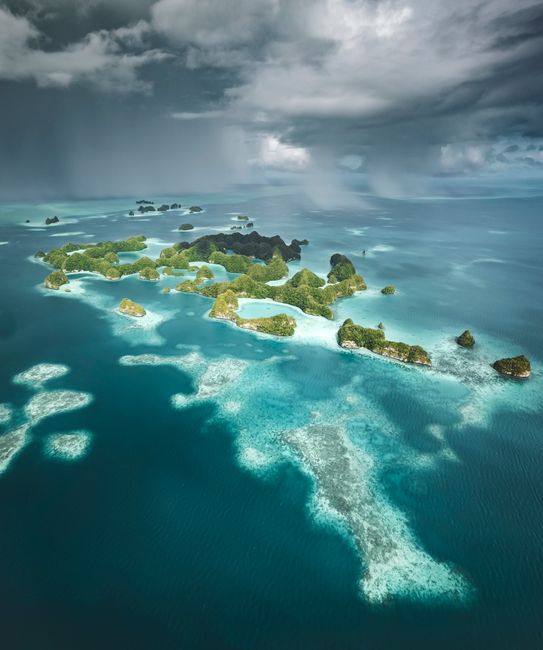
Koror is the hub of Palau: the largest town, the former capital and the place where nearly every visitor sleeps, eats and boards the boats for the Rock Islands. Koror State covers a cluster of islands joined by causeways, Koror itself, Malakal, Arakabesang and Ngerekebesang, plus the hundreds of uninhabited Rock Islands that stretch south toward Peleliu in a lagoon protected as a UNESCO World Heritage Site. The town is a laid-back strip of hotels, dive shops, restaurants and stores along one main road, with views of green islands and turquoise water around every corner. From the marinas, speedboats run out to Jellyfish Lake, the Milky Way, white-sand picnic beaches and some of the world’s most celebrated dive sites, such as Blue Corner and German Channel, all within an hour. Back on land, Koror has Palau’s best museums and an aquarium, and a bridge links it to the big island of Babeldaob, the airport and its waterfalls. Koror is warm and humid all year, with rain in every month; November to April usually brings the calmest seas.
Right now in Koror (Rock Islands) (Koror)
- Wed 27–29°C 81–84°F 3 mm Rain
- Thu 26–28°C 79–83°F 10 mm Rain
- Fri 26–27°C 79–81°F 9 mm Rain
Weather: MET Norway (CC BY 4.0) · Sea temperature: NOAA CoastWatch
Top tours in Koror (Rock Islands)
See all tours for Koror (Rock Islands) →
From local operators, with prices and reviews; you check availability and book on Viator, our partner. We may earn a commission at no extra cost to you. How we earn money
Koror at a glance
- Best months: November to April for calmer seas and slightly less rain; February to April are the driest. Diving and tours run all year.
- Getting there: fly into Palau International Airport (ROR) on Babeldaob, about 25 minutes from central Koror over the Japan–Palau Friendship Bridge.
- Getting around: taxis, hotel shuttles, tour pickups and rental cars; drive on the right.
- Permits (as of October 2026): a US$50 Koror State Rock Islands permit (valid 5 days) or a US$100 Jellyfish Lake permit that includes the Rock Islands.
- Time needed: at least four full days; a week or more for divers.
- Before you go: entry rules, the US$100 environmental fee, the Palau Pledge and the sunscreen ban are covered in our Palau travel guide.
Koror’s areas and who each one suits
Downtown Koror
The main road through Koror Island is lined with mid-range hotels, budget lodges, apartments, supermarkets, souvenir shops, banks and many of the restaurants. It suits travelers who want to walk to dinner, compare tour operators and keep costs down. It is busy by Palauan standards but quiet by any other.
Malakal
Across a causeway to the south, Malakal is home to the commercial port, the Palau International Coral Reef Center and its aquarium, several dive shops and small hotels by the water. Staying here puts you minutes from the boats, which divers appreciate on early starts.
Arakabesang and Ngerekebesang
To the northwest, these quieter islands hold Koror’s resort hotels, with private beaches, pools and their own jetties for dive and tour pickups. They suit couples, families and anyone who wants a beach on the doorstep; you’ll need taxis or a car to reach town restaurants.
Meyuns and the north side
Around Meyuns, near the bridge to Arakabesang, you’ll find the Belau National Museum area, local neighborhoods, some guesthouses and the Etpison Museum nearby. It is a good choice for longer stays and apartments.
Top things to see in and around Koror
The Rock Islands
The Rock Islands are the reason most people come. Over 400 limestone islands, some no bigger than a house, rise from the lagoon between Koror and Peleliu, their bases undercut by the sea so they look like green mushrooms. A full-day boat tour usually includes snorkeling on a shallow coral garden or a reef drop-off, lunch on a white-sand beach, a stop at the Milky Way and a visit to Jellyfish Lake. Others focus on kayaking through hidden lagoons, arches and the Long Lake, or on birdwatching and caves. The area was inscribed as a UNESCO World Heritage Site in 2012 and is managed by Koror State, whose rangers check that every visitor in the lagoon carries a permit.
Jellyfish Lake (Ongeim’l Tketau)
On Mecherchar island, about 45 minutes by boat from town, a short, steep trail of rocks and roots climbs over a ridge to a marine lake. Its golden jellyfish, a subspecies found only here, drift in their millions when conditions are good, following the sun across the lake; their sting is so weak most people feel nothing. It is the only one of Palau’s 50-plus marine lakes open to visitors, and the most visited. Rules are simple: snorkeling only (no scuba, because of toxic hydrogen sulfide in deeper water), no fins kicking the jellyfish, no lifting them out of the water and reef-safe sunscreen only. Jellyfish numbers have collapsed and recovered several times with warm-water events, most recently in 2022. As of October 2026 Koror State lists the lake as open; your operator can tell you how many golden jellyfish are currently present.
The Milky Way
In a sheltered cove in the Rock Islands, the seabed is covered with fine white limestone mud that turns the water a milky turquoise. Guides dive down and bring up the mud for a natural face and body mask, which you wash off in the sea. It is a fun, photogenic stop on most snorkeling tours.
Blue Corner and German Channel
Palau’s two most famous dive sites are both about 45 to 60 minutes from Koror. At Blue Corner, divers drop onto a reef plateau on the outer wall, clip a reef hook into dead rock and hang in the current while gray reef and whitetip sharks, barracuda, jacks, eagle rays and Napoleon wrasse patrol the edge; it is an advanced dive because currents can be strong and changeable. German Channel, cut through the reef in the early 1900s, is a cleaning station where manta rays come to be groomed by small fish, and a good bet for mantas from many dive boats. Nearby, Big Drop-off, Ulong Channel and New Drop-off are also world-class.
Chandelier Cave and the wrecks
Close to Malakal, Chandelier Cave is a series of flooded limestone chambers with air pockets and stalactites, an easy, shallow dive with a guide. The lagoon also holds dozens of Japanese ships and aircraft sunk by US air raids in 1944, such as the Iro and the Teshio Maru, now covered in coral and fish.
Belau National Museum
Palau’s oldest museum tells the story of Palauan culture and history, with storyboards, carvings, traditional money, fishing gear and displays on the Spanish, German and Japanese periods and World War II. A traditional bai stands in the grounds. Allow an hour or two.
Etpison Museum
A private museum in Koror with well-presented exhibits on Palauan traditional money, shell valuables, archaeology and natural history, plus a shop selling quality crafts and storyboards.
Palau Aquarium at the Palau International Coral Reef Center
On Malakal, the coral reef center’s aquarium recreates Palau’s habitats, from mangroves and seagrass to the outer reef, with live corals, giant clams, jellyfish and reef fish. It is a good introduction before your first snorkel or dive, and ideal for children or a rainy afternoon.
Japanese-era Koror
Look for traces of the 1920s and 1930s, when Koror was the capital of Japan’s Pacific territories: a stone lantern and shrine site, old administration buildings and the remains of Japanese-built roads. Your hotel or a local guide can point them out.
Other things to do in Koror
- Kayaking: guided kayak trips weave through the Rock Islands’ channels, arches and marine lakes at water level, usually including snorkeling and a beach lunch.
- Stand-up paddleboarding: calm water in the lagoon and around the resorts.
- Night snorkeling and dives: some operators run night dives to see mandarinfish and coral spawning, which happens on predictable nights in spring.
- Fishing: bonefish and trevally on the flats, and offshore fishing outside the marine sanctuary areas, with licensed guides.
- Scenic flights: helicopter and small-plane flights over the Rock Islands.
- Sunset: watch from the Friendship Bridge, the resort beaches on Arakabesang or a sunset cruise.
- Shopping: storyboards (carved wooden panels depicting legends), woven bags and local soaps and oils.
Food and drink
Koror’s restaurants reflect its history and visitors: Japanese sushi and ramen, Korean barbecue, Chinese, Filipino, Thai and American diners, plus waterfront seafood places serving reef fish, tuna sashimi, mangrove crab and sometimes coconut crab. Try Palauan staples such as taro, tapioca and fresh fish cooked in coconut milk, and look out for local fruits in the markets. Many restaurants close fairly early. Tap water is not reliably safe to drink, so stick to bottled or filtered water.
Day trips from Koror
Babeldaob
Rent a car or join a tour to explore Palau’s biggest island across the Friendship Bridge. Walk through jungle and wade a river to Ngardmau Waterfall, the largest in Micronesia; see the 37 ancient basalt Badrulchau monoliths at the northern tip in Ngarchelong; visit the traditional bai at Airai, one of the oldest surviving meeting houses; and drive past the grand capitol building at Ngerulmud in Melekeok. States collect small entrance fees at their sites, so carry cash.
Peleliu
Boats from Koror cross to Peleliu, scene of a brutal 1944 battle, in about an hour by speedboat or longer by state ferry. A guided tour takes in the airfield, Bloody Nose Ridge, caves, tanks, aircraft wrecks and memorials, and Peleliu’s walls offer some of Palau’s best diving. Stay on cleared paths: unexploded ordnance remains on the island.
Kayangel
A day trip by boat or helicopter to Palau’s northern atoll, with white beaches, a calm lagoon and a single village.
Getting there and getting around
By air
Palau International Airport (ROR), on Babeldaob, has flights from Guam on United Airlines, connecting to the US, Honolulu, Japan and other Asian cities, and from Taipei, with seasonal or charter flights from other Asian cities at times. Many flights arrive late at night; most hotels offer airport transfers.
From the airport
The drive to central Koror takes about 25 minutes. Taxis wait at the airport; fares are set by zone and charged per vehicle, not per person, and the Palau Visitors Authority publishes the zone map and a list of licensed drivers. Expect about US$25–35 to central Koror.
Getting around town
Taxis are easy to find and to call; agree the fare before you go. Many hotels run free shuttles into town, and tour and dive operators collect you from your hotel. Rental cars are available in Koror for trips to Babeldaob; drive on the right and watch for pedestrians, as sidewalks are few. A limited public bus service runs; check the trip planner on the Palau Visitors Authority website. Walking is pleasant in the cool of the evening, but distances along the main road are long in the midday heat.
When to go and how long to stay
Koror’s temperature hardly changes through the year, with highs of 31 to 32 °C (87 to 89 °F) and lows around 24 to 25 °C (76 to 77 °F). Rain falls in every month, often as short, heavy showers; June and July are the wettest, February to April the driest.
| Month | Koror high / low | Rain | Days with 2.5 mm (0.1 in) or more |
|---|---|---|---|
| Jan | 31 / 24 °C (88 / 76 °F) | 284 mm (11.2 in) | 14 |
| Feb | 31 / 24 °C (88 / 76 °F) | 236 mm (9.3 in) | 12 |
| Mar | 32 / 24 °C (89 / 76 °F) | 205 mm (8.1 in) | 12 |
| Apr | 32 / 25 °C (89 / 77 °F) | 231 mm (9.1 in) | 13 |
| May | 32 / 25 °C (89 / 77 °F) | 312 mm (12.3 in) | 18 |
| Jun | 31 / 25 °C (89 / 76 °F) | 410 mm (16.1 in) | 19 |
| Jul | 31 / 24 °C (88 / 76 °F) | 420 mm (16.5 in) | 18 |
| Aug | 31 / 25 °C (87 / 76 °F) | 336 mm (13.2 in) | 16 |
| Sep | 31 / 25 °C (88 / 76 °F) | 344 mm (13.6 in) | 16 |
| Oct | 31 / 25 °C (88 / 77 °F) | 289 mm (11.4 in) | 15 |
| Nov | 32 / 25 °C (89 / 77 °F) | 283 mm (11.2 in) | 16 |
| Dec | 31 / 25 °C (89 / 76 °F) | 317 mm (12.5 in) | 17 |
Figures are NOAA’s 1991–2020 climate normals for the Koror Weather Service Office: mean daily maximum and minimum, total rainfall and days with at least 2.5 mm (0.1 in) of rain.
How long to stay: 4, 6 and 8 days
- 4 days: a Rock Islands day with Jellyfish Lake and the Milky Way, a kayaking or second snorkeling day, a half day at the Belau National Museum and aquarium, and a drive to Ngardmau Waterfall.
- 6 days: add two days of diving (Blue Corner, German Channel) or a Peleliu day trip.
- 8 days: a full dive week with one non-diving day for Jellyfish Lake, and a rest day before your flight.
Where to stay in Koror
- Downtown: mid-range and budget hotels, apartments and guesthouses within walking distance of restaurants and dive shops.
- Malakal: small hotels and dive lodges close to the port and boats.
- Arakabesang and Ngerekebesang: the resort hotels with beaches, pools and jetties.
- Babeldaob: a few lodges in quiet states, for travelers with a car who don’t mind the drive.
Typical costs in Koror
| Item (as of October 2026) | Price in US dollars |
|---|---|
| Koror State Rock Islands permit, 5 days | US$50 |
| Jellyfish Lake permit, 5 days (includes Rock Islands) | US$100 |
| Rock Islands snorkeling day tour, permit extra | about US$110–160 |
| Guided kayak day trip, permit extra | about US$100–150 |
| Two-tank boat dive | about US$160–220 |
| Taxi, airport to central Koror | about US$25–35 |
| Mid-range hotel room, per night | about US$150–300 |
| Casual meal | about US$15–30 |
Permit prices are from the Palau Visitors Authority. Tour, dive, taxi, hotel and meal prices are typical ranges, not official prices. Palau uses the US dollar.
Safety in Koror
- Strong currents: outer-reef dives at Blue Corner and the channels can have powerful, shifting currents; dive within your experience, carry a surface marker buoy and follow your guide.
- Snorkeling: use a flotation vest if you are not a strong swimmer, stay close to the boat and watch for other boats.
- Jellyfish Lake trail: short but steep and slippery; wear sturdy water shoes.
- World War II ordnance: unexploded munitions still turn up in the Rock Islands, on Babeldaob and especially on Peleliu and Angaur. Never touch or collect war relics; stay on marked paths.
- Saltwater crocodiles: rarely seen, but avoid swimming in mangrove channels and river mouths.
- Typhoons: uncommon so far south, but follow local warnings, especially from about July to December.
- Heat and sun: drink plenty of water, wear a rash guard and use only reef-safe sunscreen.
- Diving and flying: leave at least 18 to 24 hours between your last dive and your flight; Belau National Hospital has a hyperbaric chamber.
- Roads: drive slowly and watch for people walking at the roadside, especially after dark.
What to pack for Koror
Reef-safe mineral sunscreen (or buy it in town), a rash guard, a hat, sunglasses, water shoes for the Jellyfish Lake trail, a dry bag, your own mask and dive computer if you dive, a light rain jacket, insect repellent and casual, modest clothes for town. Don’t bring e-cigarettes or vapes: they are banned in Palau.
Koror travel FAQ
Do I need a permit for the Rock Islands?
Yes. Everyone swimming, snorkeling, diving or kayaking in the Rock Islands Southern Lagoon needs a Koror State permit: US$50 for the Rock Islands for five days, or US$100 including Jellyfish Lake. Operators usually sell them with your tour.
How do I get to Jellyfish Lake?
On a guided boat tour from Koror, about 45 minutes each way, followed by a short, steep trail over a ridge to the lake. You need the US$100 Jellyfish Lake permit.
Are there jellyfish in Jellyfish Lake now?
The lake is open as of October 2026. Golden jellyfish numbers rise and fall with water temperature; they dropped sharply in 2016 and 2022 and recovered afterward. Ask your operator about current numbers.
Do the jellyfish sting?
The golden jellyfish have only a very weak sting that most people can’t feel. People with sensitive skin may feel a slight tingle, especially on the face. Don’t lift them out of the water or kick them with fins.
How far is the airport from Koror?
About 25 minutes by road. The airport is on Babeldaob, connected to Koror by the Japan–Palau Friendship Bridge. Most hotels arrange transfers; taxis charge by zone.
Where should I stay in Koror?
Downtown for restaurants and value, Malakal for quick access to dive boats, and Arakabesang or Ngerekebesang for resort hotels with beaches.
Is Blue Corner suitable for beginners?
Not usually. Blue Corner has strong, changing currents and is best for experienced divers with a reef hook. Beginners can dive calmer sites such as Chandelier Cave and sheltered lagoon reefs first.
Can I visit the Rock Islands without diving?
Yes. Snorkeling and kayaking tours visit coral gardens, beaches, the Milky Way and Jellyfish Lake, and scenic flights show the islands from above.
What is the best time to visit Koror?
November to April usually has calmer seas and slightly less rain; February to April are the driest months. It is warm all year.
Can I use any sunscreen in Palau?
No. Only reef-safe mineral sunscreens based on zinc oxide and/or titanium dioxide, without parabens, triclosan, triclocarban or phenoxyethanol, are allowed. Compliant brands are sold in Koror.
Sources and last review
Researched and last reviewed on 5 October 2026. Rock Islands and Jellyfish Lake permits, entry information, the sunscreen ban, the taxi zone system, getting around and medical services come from the Palau Visitors Authority; the Rock Islands, Jellyfish Lake and its status from Koror State Government and the Palau Visitors Authority; UNESCO status from UNESCO; climate from NOAA’s 1991–2020 normals for Koror. Tour, dive, taxi, hotel and meal prices, dive site descriptions, drive and boat times and museum details are general estimates or secondary sources. Prices and rules change, so check with Koror State and your operator before you go.
Plan your trip
Partner links: TravelerCenter may earn a commission if you book, at no extra cost to you.