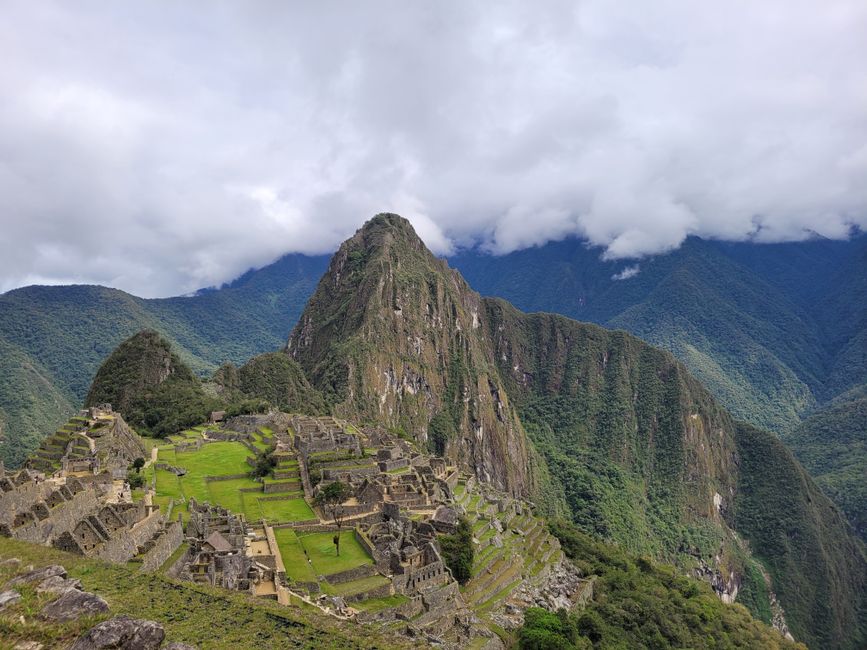
Machu Picchu, the Inca citadel built in the 15th century on a ridge high above the Urubamba River gorge, is the most famous sight in South America: a city of granite temples, palaces, plazas and terraces framed by the sugarloaf peak of Huayna Picchu and cloud forest on every side. Probably built for the Inca emperor Pachacútec, abandoned around the time of the Spanish conquest and brought to world attention in 1911, it lies inside the Historic Sanctuary of Machu Picchu, a UNESCO World Heritage Site for both its culture and its nature since 1983. Visiting takes planning: entry is by timed ticket for a fixed circuit and route, daily numbers are capped, the only access is by train to the town of Machu Picchu Pueblo (Aguas Calientes) or on foot along the Inca Trail, and the citadel sits at about 2,430 m (7,970 ft). This guide covers the rules as of October 2026.
Right now in Machu Picchu (Aguas Calientes)
- Tue 12–24°C 53–76°F 1 mm Light showers
- Wed 13–25°C 55–78°F 1 mm Partly cloudy
- Thu 13–23°C 56–73°F 3 mm Light showers
- Thu 8 Oct Battle of Angamos (Combate de Angamos)
Weather: MET Norway (CC BY 4.0) · Holidays: Nager.Date
Top tours in Machu Picchu
See all tours for Machu Picchu →
From local operators, with prices and reviews; you check availability and book on Viator, our partner. We may earn a commission at no extra cost to you. How we earn money
Machu Picchu at a glance
- Best months: April, May, September and October for drier weather with fewer crowds; June to August is dry but busiest; January to March is the wettest.
- Time needed: one visit of about 2.5 hours on most routes; a night in Machu Picchu Pueblo lets you go early or do two different routes on two days.
- Tickets: buy on the Ministry of Culture’s official platform, tuboleto.cultura.pe, for a specific circuit, route, date and entry hour.
- Daily caps (2026): 4,500 visitors a day, rising to 5,600 on high-season dates (including June 19 to November 2, 2026).
- Getting there: train from Cusco or Ollantaytambo to Machu Picchu Pueblo with PeruRail or Inca Rail, then a 25-minute bus up the mountain or a steep walk.
- Before you go: entry rules, money and general safety are in our Peru travel guide.
Circuits and routes (as of October 2026)
Since June 1, 2024, the Ministry of Culture has organized visits into three circuits with ten routes, to protect the site and spread visitors. You must stay on the route printed on your ticket; you can’t switch routes inside. According to the Ministry’s ticket platform and the official Machu Picchu site:
| Route | What you see | Distance and effort |
|---|---|---|
| 1-A Machupicchu Mountain | Climb to the summit of Machupicchu Mountain, with views of Salkantay and Pumasillo and the whole sanctuary | About 3.8 km (2.4 miles) round trip; high effort |
| 1-B Upper Terrace | The viewpoint for the classic panoramic photo, and the meandering Vilcanota River | About 1.6 km (1 mile); medium |
| 1-C Sun Gate (Intipunku), high season only | The gateway where the Inca Trail enters, with a different panorama | About 3.4 km (2.1 miles); medium |
| 1-D Inca Bridge, high season only | A stone-and-wood bridge on a cliff path | About 2.6 km (1.6 miles); medium |
| 2-A Classic designed route | The agricultural terraces, main gate, Temple of the Sun viewpoint, main plaza, Sacred Rock and water mirrors | About 2.5 km (1.6 miles); medium to high |
| 2-B Lower Terrace | The lower terraces, quarries, main plaza and Sacred Rock | About 2.7 km (1.7 miles); medium to high |
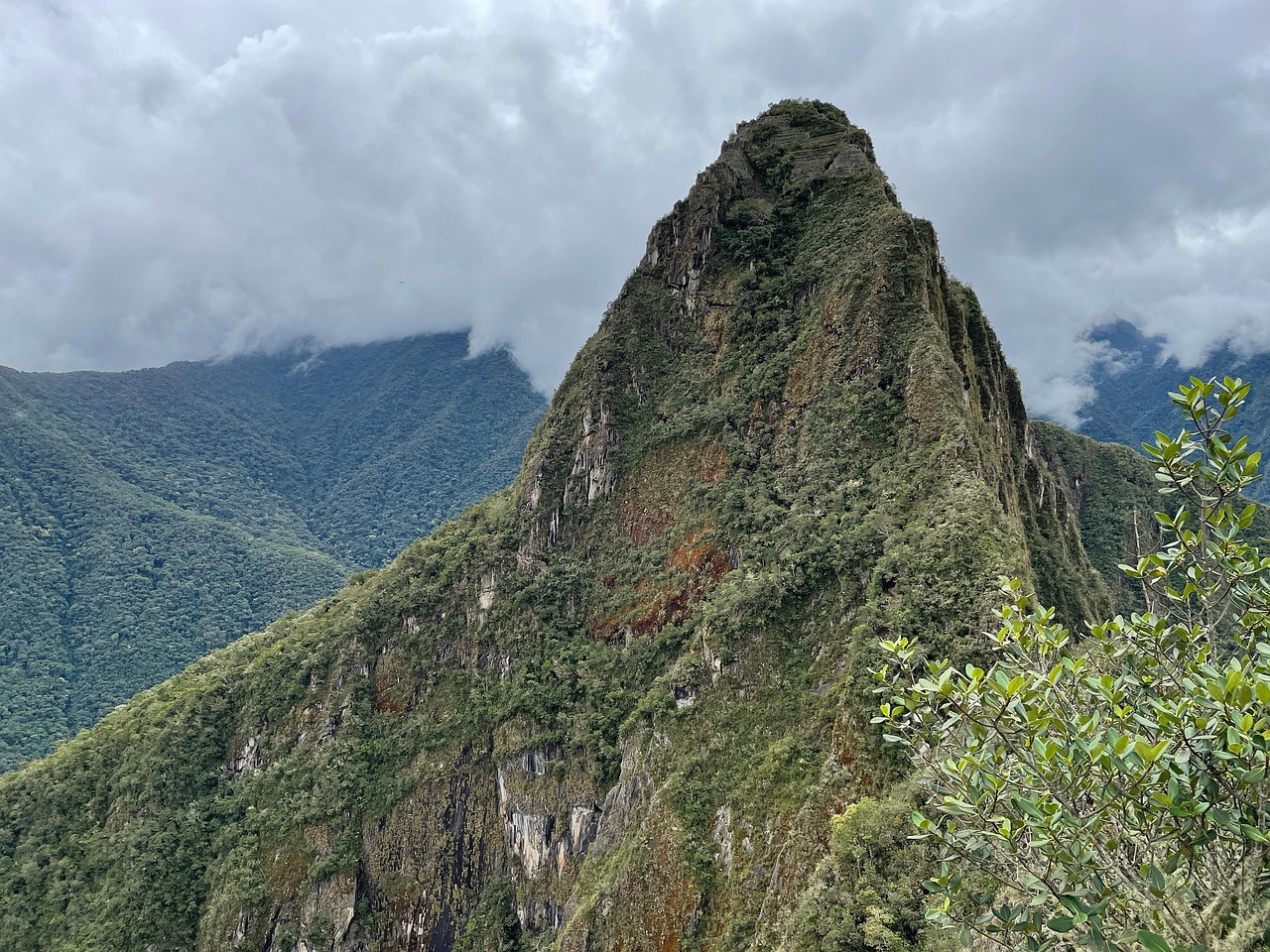
| 3-A Huayna Picchu (Waynapicchu) Mountain | The royal sector, then the steep climb up Huayna Picchu, returning past the Temple of the Condor | About 2.4 km (1.5 miles); high effort, with very steep stone steps |
| 3-B Royalty designed route | Temple of the Sun, House of the Inca, ceremonial fountains, Three Doorways sector and Temple of the Condor; part of it is wheelchair accessible | About 1.3 km (0.8 miles); medium |
| 3-C Great Cavern, high season only | The royal sector and the Great Cavern on Huayna Picchu’s flank | About 3 km (1.9 miles); high effort |
| 3-D Huchuy Picchu, high season only | The royal sector and the small peak of Huchuy Picchu | About 1.7 km (1.1 miles); medium |
Circuit 2 shows the most of the city itself; Circuit 1’s Upper Terrace gives the classic postcard view; Circuit 3 visits the finest stonework and adds the mountain climbs. Inca Trail hikers enter on Circuit 3B.
Tickets, daily caps and entry hours
- Daily caps: under Ministerial Resolution 528-2023-MC, the citadel’s capacity is 4,500 visitors a day, with up to 5,600 a day in high season. For 2026, Resolution 285-2025-MC applies the 5,600 limit on January 1, April 2–5, June 19 to November 2 and December 30–31, 2026. The quotas are split by route and by hour; Huayna Picchu, for example, has two entry times a day.
- Entry hours: tickets are sold for hourly entry slots from 6 a.m. to 3 p.m.; arrive at the gate at your time. The Ministry’s 2023 rules set a maximum stay of 2.5 hours from entry on standard visits; follow the time shown on your ticket and the guardians’ directions.
- Buying online: the only official online seller is tuboleto.cultura.pe, the state platform created by the Ministry of Culture. Register with your passport and email, choose “Llaqta Machupicchu,” then the circuit, route, date, entry hour and your nationality category, reserve and pay by Visa or Mastercard. You can also print the reservation and pay at a Banco de la Nación branch or the Ministry’s collection office at Calle Heladeros 165 in Cusco. Sales for 2026 opened on November 17, 2025. Avoid unofficial websites that resell tickets at a markup; licensed tour operators can buy tickets for their clients.
- Buying in person: the Ministry’s ticket office in Machu Picchu Pueblo sells up to 1,000 tickets a day in person, for entry on the following day; the platform shows how many remain in real time. In the busy season, lines form early.
- Prices: the platform shows the price of each route before you pay. The Ministry’s fee schedule from 2024 set the general adult rate at S/ 172 (about US$50), with discounts for university students and children aged 3 to 17 and free entry under 3; routes with a mountain cost more. Peruvians, foreign residents of Peru and citizens of the Andean Community (Bolivia, Colombia, Ecuador) get promotional rates set for 2026 by Resolution 284-2025-MC, from S/ 64 on most routes and S/ 112 for the mountain routes.
- Documents: bring the passport you used to buy the ticket; it is checked at the entrance with the ticket.
- Exchange: on October 4, 2026, SUNAT’s published rate was about S/ 3.44 per US dollar.
Rules inside Machu Picchu
According to the official Machu Picchu site of the Cusco culture directorate, visitors may not:
- Carry backpacks or bags larger than 40 × 35 × 20 cm (16 × 14 × 8 in); leave bigger bags at the luggage storage by the entrance.
- Bring food or utensils, alcohol, aerosols, umbrellas, walking sticks, portable seats, tripods, selfie sticks or other camera stabilizers, musical instruments, loudspeakers or drones.
- Wear high heels or hard-soled shoes, or bring baby strollers.
- Climb or lean on walls, touch or move stones, leave the route, make loud noise, smoke or vape, or feed animals.
Breaking the rules means removal without refund. There are toilets only at the entrance, outside the site, so go before entering.
Getting there
Trains to Machu Picchu Pueblo
Machu Picchu Pueblo has no road connection to Cusco, so most visitors take the train. Two companies run passenger trains on the line, which is operated under concession by Ferrocarril Transandino (FTSA):
- PeruRail: Expedition, Vistadome and Vistadome Observatory trains, plus the luxury Belmond Hiram Bingham. Since September 1, 2025, its bus-and-train (“bimodal”) services from Cusco transfer at Pachar station on selected schedules, and it has added a Cusco–Ollantaytambo route.
- Inca Rail: The Voyager, The 360°, The Prime and The First Class trains, mostly from Ollantaytambo, with bimodal services from Cusco.
- Times: Ollantaytambo to Machu Picchu Pueblo takes about 1.5 hours; from Cusco with a bimodal connection, about 3.5 to 4 hours.
- Disruptions in 2026: trains on the Ollantaytambo–Machu Picchu section were suspended in early August 2026 after a forest fire near kilometer 107 of the line, according to the tourism ministry, Mincetur, and on October 2, 2026, traffic was halted after an incident between an Inca Rail train and a PeruRail train near Pampacahua, with no injuries reported; that evening PeruRail said it was progressively resuming operations with authorization from FTSA, with rescheduling to follow. Check your train the day before and leave a buffer before onward flights.
- Booking: buy on the operators’ official websites; carry your passport, which is checked when boarding. Luggage on the trains is limited (generally one small bag), so leave big suitcases in Cusco or the Sacred Valley.
Buses and walking up to the citadel
Buses run from Machu Picchu Pueblo up the zigzag Hiram Bingham road to the entrance in about 25 minutes, starting early in the morning; buy tickets in town or online and carry your passport. Alternatively, walk up the steep stone stairway from the Puente Ruinas bridge, about 1.5 hours of climbing.
On foot: the Inca Trail
The classic Inca Trail (Route 1, about four days from Piscacucho at kilometer 82) and the shorter Route 5 (one day, from Chachabamba via Wiñay Wayna, reopened on August 1, 2026, after conservation work) arrive through the Sun Gate. Permits are limited, sold for 2026 from November 17, 2025, and booked through licensed operators; the network closes every February for maintenance, and in 2026 it reopened on March 1, according to SERNANP. Inca Trail hikers enter the citadel on Circuit 3B. See our Cusco guide for other treks such as Salkantay.
The budget route via Hidroeléctrica
Some backpackers travel by road from Cusco to the Hidroeléctrica station via Santa Teresa (about six hours) and walk about 11 km (7 miles) along the railway to Machu Picchu Pueblo, or take the short train from there. It is cheap but long, and the road can be blocked by landslides in the rainy season.
Around Machu Picchu
- Machu Picchu Pueblo (Aguas Calientes): the small town at the foot of the mountain, with hotels, restaurants, hot springs, a market and the Ministry’s ticket office.
- Manuel Chávez Ballón Site Museum: near Puente Ruinas, on the Inca city’s construction and discovery, with a botanical garden.
- Putucusi and Mandor: a steep ladder hike opposite the citadel, and an easy walk along the railway to a waterfall and bird-filled gardens.
- The Sacred Valley and Cusco: see our Sacred Valley and Cusco travel guides.
Nearby destinations
- Sacred Valley59 km
- Cusco79 km
When to go and how long to stay
Machu Picchu sits at about 2,430 m (7,970 ft) on the edge of the cloud forest, lower, warmer and more humid than Cusco. There is no official long-term weather station at the citadel in the WMO normals we use, so this is a general picture: days are mild, about 18–23 °C (64–73 °F), and nights cool all year. The dry season, from about April or May to September or October, brings sunnier mornings, though early mist often hides the ruins until mid-morning; the rainy season, from about November to March, brings frequent showers and occasional landslides on the railway and the Hidroeléctrica road, and January to March are the wettest months. In 2026–27, Peru’s El Niño commission expects normal-to-drier conditions in the southern Andes.
Machu Picchu month by month
There is no official long-term weather station at the citadel in the normals we use, so this is a general guide; the 5,600-visitor high-season dates come from the Ministry of Culture.
| Month | Weather | What to expect |
|---|---|---|
| January | Wettest months, warm and humid | Fewer visitors; landslide risk on the line and the Hidroeléctrica road |
| February | Very wet | Inca Trail closed all month; the citadel stays open |
| March | Rain easing | Quieter; Easter week can be busy |
| April | Mostly dry mornings, lush | Good balance of weather and crowds; 5,600 cap on April 2–5, 2026 |
| May | Dry season begins | Clear views, rising demand |
| June | Dry, cool nights | High season; 5,600 cap from June 19, 2026; Inti Raymi in Cusco |
| July | Dry, sunny | Busiest month with Peru’s holidays; book months ahead |
| August | Dry | Very busy |
| September | Dry, warming | Excellent; still high demand |
| October | Showers return | Shoulder season; high-season cap runs until November 2, 2026 |
| November | Wetter | Quieter, greener |
| December | Rainy | Busy around Christmas and New Year; 5,600 cap on December 30–31 |
Crowds: June to August and the Peruvian holidays of late July are the busiest; the 5,600 daily cap applies from June 19 to November 2, 2026. Early entry hours fill first, and many visitors prefer mid-morning, when the mist has lifted, or the last hours, when tour groups thin out.
One day at Machu Picchu
Take an early train from Ollantaytambo, ride the bus up for a late-morning entry on Circuit 2 for the full classic visit, and return by afternoon train. It is a long but doable day.
Two days
Stay a night in Machu Picchu Pueblo: enter early on day one on Circuit 3 with Huayna Picchu or Circuit 1 with Machupicchu Mountain, and return on day two for Circuit 2, or relax at the hot springs and walk to Mandor.
Where to stay
- Machu Picchu Pueblo: hotels from basic hostels to luxury lodges along the river; convenient for an early start.
- At the entrance: one hotel sits right beside the gate, at a premium.
- The Sacred Valley or Cusco: most visitors sleep in Ollantaytambo, Urubamba or Cusco and do Machu Picchu as a day trip.
Hotels can sell rooms to foreign tourists without Peru’s 18% IGV sales tax if you show your passport and immigration record; check whether quoted rates include tax.
Choosing where to stay
A night in Machu Picchu Pueblo is worth it if you want the first or last entry slots, two visits, or a hike up Huayna Picchu or Machupicchu Mountain without a pre-dawn train. Hotels near the station and the river are convenient but can be noisy from trains; quieter lodges sit at the edges of town. If you prefer more space and better value, sleep in Ollantaytambo the night before and take an early train. Cusco works for a day trip only with a long day and bimodal train services.
Food and drink in Machu Picchu Pueblo
There is no restaurant inside the citadel, and food may not be taken in. Just outside the entrance, a café and a buffet restaurant serve visitors, and there are snack stands near the bus stop. In Machu Picchu Pueblo, restaurants along Avenida Pachacútec and near the railway serve trout, pizza from wood-fired ovens, Andean dishes and set menus; the covered market near the station has cheap lunches and juices. Prices are higher than in Cusco because everything arrives by train. Bring a refillable water bottle and drink before going in.
What a Machu Picchu visit costs
Ticket figures are from the Ministry of Culture; other prices are our estimates for October 2026 at about S/ 3.44 per US dollar.
| Item | Typical price |
|---|---|
| Citadel ticket, general adult rate (2024 fee schedule) | S/ 172 (about US$50); check the route price on tuboleto.cultura.pe |
| Promotional rate for Peruvians, residents and Andean Community citizens, most routes | S/ 64, official |
| Mountain routes, promotional rate | S/ 112, official |
| Bus up and down from Machu Picchu Pueblo | about US$24 round trip |
| Train Ollantaytambo–Machu Picchu Pueblo, one way | about US$60–150, depending on class and date |
| Official guide at the entrance (shared group) | S/ 50–100 (US$15–29) per person |
| Lunch in Machu Picchu Pueblo | S/ 30–70 (US$9–20) |
| Hotel in Machu Picchu Pueblo, mid-range double | S/ 300–600 (US$87–175) |
Practical tips for Machu Picchu
- Book in the right order: secure your Machu Picchu ticket for the date and route you want first, then trains and hotels.
- Passport: carry it for the ticket check, the bus and the train; you can get a souvenir Machu Picchu stamp at the exit.
- Guides: official guides are available at the entrance and greatly enrich the visit.
- Altitude and fitness: the site is lower than Cusco, but the mountain routes are steep and exposed; Huayna Picchu has narrow stairs and drop-offs, and isn’t advisable if you suffer from vertigo.
- Weather: bring a rain jacket in any season, and sun protection: the sun is strong when the clouds lift.
- Bugs: tiny biting flies are common at the site and in town; use repellent.
- Safety: stay on the marked route and behind barriers, take care on wet steps, and follow the guardians’ instructions. Strikes or protests in the Cusco region occasionally stop trains; keep a buffer day before international flights. For emergencies, call 105 (police) or 106 (ambulance) or ask the site staff.
What to pack for Machu Picchu
A small daypack within the 40 × 35 × 20 cm limit, a rain jacket or poncho, a light warm layer, comfortable shoes with good grip, a sun hat, sunglasses and sunscreen, insect repellent, a refillable water bottle (single-use plastic is discouraged), your passport and printed or downloaded tickets. Peru uses 220 V, with sockets for US and European plugs.
Machu Picchu travel FAQ
How do I buy official Machu Picchu tickets?
Online at tuboleto.cultura.pe, the Ministry of Culture’s platform, choosing a circuit, route, date and entry hour; or in person in Machu Picchu Pueblo, where up to 1,000 tickets a day are sold for the next day.
How many visitors are allowed at Machu Picchu each day?
4,500 a day, and up to 5,600 on high-season dates, which in 2026 are January 1, April 2–5, June 19 to November 2 and December 30–31.
Which circuit is best for a first visit?
Circuit 2 (Classic) covers the most of the city itself; add the Upper Terrace (Circuit 1) for the postcard photo, or Circuit 3 with Huayna Picchu for the climb.
How long can I stay inside Machu Picchu?
Tickets are for one entry at a fixed hour, and the Ministry’s rules set a maximum stay of about 2.5 hours on standard visits. Follow the time on your ticket.
Which trains go to Machu Picchu?
PeruRail and Inca Rail, mainly from Ollantaytambo (about 1.5 hours) or with bus-and-train services from Cusco. Check for disruptions: the line was halted in August and on October 2, 2026.
Is the Inca Trail open in February?
No. The Inca Trail network closes every February for maintenance and reopens on March 1.
Can I climb Huayna Picchu?
Yes, with a Circuit 3 ticket for the Waynapicchu Mountain route (3-A), which has limited daily slots and sells out early.
What can’t I bring into Machu Picchu?
Bags larger than 40 × 35 × 20 cm, food, alcohol, umbrellas, tripods, selfie sticks, drones and walking sticks, among other items.
How much does a Machu Picchu trip cost?
With the ticket, round-trip train and bus, a day trip often costs more than US$200 per person; check the current route price on the official platform.
Should I stay overnight in Aguas Calientes?
It helps if you want early or late entries, two different routes or a mountain climb; otherwise a day trip from Ollantaytambo works.
Sources and last review
Researched and last reviewed on 4 October 2026. Circuits, routes, distances and effort: the Ministry of Culture’s ticket platform (tuboleto.cultura.pe) and the official Machu Picchu site of the Cusco culture directorate; daily capacity: Ministerial Resolutions 528-2023-MC and 285-2025-MC with its 2026 annex; entry hours and maximum stay: Resolution 528-2023-MC; ticket purchase steps: the Peruvian government’s service page and the Ministry of Culture’s announcement of November 17, 2025; in-person sales: the official Machu Picchu site; promotional rates: Resolution 284-2025-MC; the 2024 general rate: the Ministry of Culture’s February 2023 announcement of its fee schedule; rules: the official Machu Picchu site; Inca Trail closure, reopening and Route 5: SERNANP; trains and disruptions: PeruRail, Inca Rail and Mincetur; exchange rate: SUNAT. History, bus and walking times, the Hidroeléctrica route, nearby sights, hotel tax practice and weather are from general references and are flagged for checking; the current price for each route must be confirmed on the platform. For entry rules and money, see our Peru travel guide.
Plan your trip
Partner links: TravelerCenter may earn a commission if you book, at no extra cost to you.
🇪🇸 Useful Spanish phrases for Machu Picchu
All 38 Spanish phrases: restaurant, hotel, emergencies, romance (printable) →