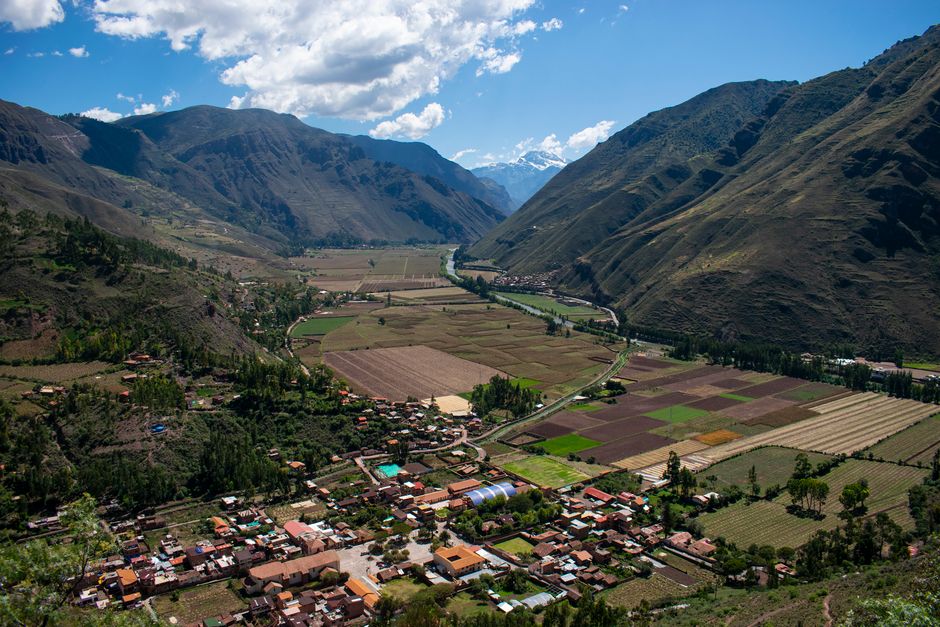
The Sacred Valley of the Incas is the green, fertile valley of the Urubamba (Vilcanota) River north of Cusco, running from Pisac down to Ollantaytambo, where the river drops toward Machu Picchu. For the Incas it was prime farmland and a royal estate, and its hillsides are still carved with terraces, fortresses and temples. Today it is one of the most rewarding parts of Peru to stay: villages with Sunday markets and weaving cooperatives, the hilltop ruins of Pisac, the stone town and fortress of Ollantaytambo, the strange circular terraces of Moray, the Maras salt pans glittering on a mountainside, and the weaving town of Chinchero on the high plateau. At about 2,800 to 3,000 m (9,200 to 9,800 ft) in the valley floor, it is lower and warmer than Cusco, which makes it a gentle place to start getting used to the altitude, and Ollantaytambo is the main station for trains to Machu Picchu.
Right now in Sacred Valley (Urubamba)
- Tue 7–25°C 44–77°F Mostly clear
- Wed 9–24°C 47–75°F Partly cloudy
- Thu 8–21°C 46–69°F 1 mm Mostly clear
- Thu 8 Oct Battle of Angamos (Combate de Angamos)
Weather: MET Norway (CC BY 4.0) · Holidays: Nager.Date
Top tours in Sacred Valley
See all tours for Sacred Valley →
From local operators, with prices and reviews; you check availability and book on Viator, our partner. We may earn a commission at no extra cost to you. How we earn money
Sacred Valley at a glance
- Best for: Inca ruins and terraces, markets and weaving, gentle acclimatization, valley lodges, hiking, biking and rafting, and the train to Machu Picchu.
- How long: 2–3 days, ideally before Machu Picchu and before Cusco’s higher altitude.
- Best time: May to September, the dry season; December to March is rainy.
- Getting there: about 1 to 1.5 hours by road from Cusco to Pisac or Urubamba, and about 2 hours to Ollantaytambo, by tour, taxi or colectivo.
- Fees to know: Pisac, Ollantaytambo, Moray and Chinchero are covered by the Boleto Turístico del Cusco; the Maras salt pans charge their own fee.
- Before you go: entry rules, money and general safety are in our Peru travel guide.
The Sacred Valley’s areas: where things are
The valley runs roughly north-west from Pisac to Ollantaytambo, about 60 km (37 miles), with the main road along the river. The high plateau between the valley and Cusco holds Chinchero, Maras and Moray.
Pisac
The first town coming from Cusco, about 33 km (21 miles) away, with a busy handicraft market around its main square (biggest on Sundays) and, high above, one of the finest Inca sites in the region.
Calca, Lamay and Yucay
Quieter farming towns along the river between Pisac and Urubamba, with country lodges and hiking trails into the side valleys.
Urubamba
The valley’s main town and transport hub, with markets, services and many of the larger hotels and lodges around it.
Ollantaytambo
At the lower end of the valley, a living Inca town of stone-walled streets and canals beneath a great terraced fortress-temple, and the main railway station for Machu Picchu.
Chinchero, Maras and Moray
On the plateau at about 3,700 m (12,100 ft), higher than Cusco: Chinchero’s colonial church on Inca foundations and its weaving centers, the agricultural terraces of Moray and the Maras salt pans.
Top things to see in the Sacred Valley
Pisac ruins
A sprawling Inca site on the mountain above town, with sweeping agricultural terraces, a ceremonial center of fine stonework, ritual baths and a cliff riddled with tombs. Drive or take a taxi to the top entrance and walk down to the town in about 1.5 to 2 hours. Covered by the Boleto Turístico del Cusco.
Ollantaytambo
The town keeps its Inca street grid and water channels. Above it, the fortress-temple climbs steep terraces to the Temple of the Sun, with six huge pink granite monoliths, and across the valley the Pinkuylluna storehouses cling to the cliff. Ollantaytambo was where the Inca Manco Inca defeated the Spanish in 1537. Covered by the Boleto Turístico del Cusco.
Moray
Concentric circular terraces sunk into natural hollows, thought to have been used by the Incas to experiment with crops at different temperatures. Covered by the Boleto Turístico del Cusco.
The Maras salt pans (Salineras de Maras)
Thousands of small salt pools terraced into a valley side and fed by a salty spring, worked by local families since before the Incas; the cooperative charges its own entrance fee, paid in cash. Buy salt at the stalls.
Chinchero
A plateau village with Inca terraces, a colonial adobe church built on an Inca palace (covered by the Boleto Turístico) and a Sunday market; weaving cooperatives demonstrate natural dyes and backstrap looms.
More to see
- Huchuy Qosqo: Inca ruins above Lamay, reached on a scenic hike.
- Awana Kancha: a living museum of llamas, alpacas and vicuñas with weaving demonstrations, on the road to Pisac.
- The Ollantaytambo–Machu Picchu line: the train itself, along the gorge of the Urubamba, is part of the experience.
Markets and weaving
Pisac’s market fills the main square daily with stalls of textiles, ceramics, jewelry and alpaca goods, and on Sundays local farmers come down from the hill villages to trade produce, often after Mass in Quechua. Chinchero’s Sunday market keeps more of its traditional character, with barter still practiced in the produce section. Weaving cooperatives in Chinchero and the villages of the Lares and Patacancha valleys show how wool is washed with a root soap, dyed with plants and cochineal insects and woven on backstrap looms; buying directly supports the weavers. Prices are higher for fine, naturally dyed pieces, which can take weeks to make.
Other things to do in the Sacred Valley
- Hiking: trails link Moray and Maras with the valley floor at Pichingoto, and lead into side valleys such as Lares; see our guide to hiking.
- Biking: downhill rides from the plateau to Maras and the river are a popular half day; see our guide to cycling.
- Rafting and ziplines: gentle rafting on the Urubamba, and via ferrata and ziplines on the cliffs near Urubamba.
- Food: valley farms supply some of Cusco’s best restaurants; try fresh trout, corn (choclo) with cheese and the giant white corn of Urubamba.
Food and drink in the Sacred Valley
The valley is Cusco’s garden, and many restaurants cook with produce from their own farms. Look for giant white corn (choclo) served with fresh cheese, trout from the rivers and highland lakes, quinoa and native potato dishes, pachamanca (meat and vegetables cooked underground with hot stones) on Sundays, and roast cuy in the picanterías around Urubamba and Lamay. In Pisac, bakeries fire empanadas and bread in clay ovens near the market. Chicha de jora, a mild fermented corn beer, is served in homes flying a red flag on a pole, and frutillada is its strawberry version. Several lodges and farm restaurants between Urubamba and Ollantaytambo serve long lunches with mountain views; book on weekends. In Ollantaytambo, cafés near the station serve early breakfasts before the trains.
The Boleto Turístico and site fees
Pisac, Ollantaytambo, Moray and Chinchero are on the Boleto Turístico del Cusco, the combined ticket sold by the regional tourism committee COSITUC, which covers 16 sites around Cusco over 10 days; a partial ticket covers the Sacred Valley sites over two days. According to tour operators, the full ticket costs about S/ 130 (about US$38) for foreign adults in 2026; we could not confirm the price on an official page, so check at the first site you visit. The Maras salt pans are run by a local cooperative and are not included.
Getting there and getting around
From Cusco
- Colectivos and buses: shared vans and minibuses leave from Cusco for Pisac and Urubamba, and for Ollantaytambo via Urubamba or Chinchero; cheap and frequent.
- Taxis and private drivers: the easiest way to combine Chinchero, Maras, Moray and Ollantaytambo in one day.
- Tours: full-day “Sacred Valley” tours from Cusco visit Pisac, a lunch buffet, Ollantaytambo and Chinchero.
Trains to Machu Picchu
Ollantaytambo is the main station for PeruRail and Inca Rail trains to Machu Picchu Pueblo, about 1.5 hours down the gorge; some services also stop at Urubamba. Trains on the Ollantaytambo–Machu Picchu section were suspended in early August 2026 after a forest fire near kilometer 107, and on October 2, 2026 after an incident between an Inca Rail and a PeruRail train near Pampacahua, with operations resuming progressively that evening, according to the operators and the tourism ministry. Check your train the day before. See our Machu Picchu travel guide.
Getting around: practical details
Colectivos and minibuses link Pisac, Calca, Urubamba and Ollantaytambo along the valley road every few minutes in daylight; flag them down and pay the driver in cash. Moray and the Maras salt pans are off the main road on the plateau, so most visitors use a taxi or a tour, or combine a colectivo to the Moray turn-off with a taxi from there; the hike or bike ride down from the salt pans to the valley floor at Pichingoto is a popular alternative. Mototaxis cover short hops within towns. For a full day covering several sites, hiring a driver from Cusco or Urubamba is convenient; agree the itinerary and price beforehand. Trains to Machu Picchu leave from Ollantaytambo station, a 10-minute walk from the town’s main square.
From the airport
Cusco airport is about 1.5 hours from Urubamba; many lodges arrange transfers, so you can go straight down to the valley on arrival. A new international airport is being built at Chinchero.
When to go and how long to stay
The valley shares Cusco’s seasons but is a few degrees warmer, being about 400 to 600 m lower: sunny, dry days and cold nights from about May to September, and rain, mostly in the afternoons, from about December to March. For reference, SENAMHI’s Granja Kcayra station near Cusco (3,214 m) averages highs of 21–22 °C (70–71 °F) in the dry season and nights around freezing in June and July, with about 670 mm (26 in) of rain a year, most of it from December to March, in the 1991–2020 normals published by the World Meteorological Organization. Chinchero, Maras and Moray on the plateau are colder and windier than the valley floor.
Sacred Valley month by month
A general guide: there is no valley station in the official normals we use, and the valley floor is a few degrees warmer than Cusco.
| Month | Weather | What to expect |
|---|---|---|
| January | Wettest; warm days, frequent showers | Green fields, few visitors |
| February | Rainy | The Inca Trail is closed; Carnival in the villages |
| March | Rain easing | Harvest of corn begins; quieter sites |
| April | Mostly dry, still green | Excellent time to visit |
| May | Dry, sunny | Corn harvest and Cruz Velacuy (May 3) festivals |
| June | Dry, cold nights | Busy with Inti Raymi visitors from Cusco |
| July | Dry, cold nights | Peak season; book lodges early |
| August | Dry, windy afternoons | Busy; Pachamama offerings on August 1 |
| September | Dry, warming | Great hiking weather |
| October | Some showers | Planting season, fewer crowds |
| November | Rain returns in the afternoons | Quieter, good value |
| December | Rainy | Christmas celebrations in the towns |
Crowds: busiest from June to August; Sunday markets in Pisac and Chinchero draw tour groups by mid-morning.
2 days in the Sacred Valley
Day one, Pisac ruins and market, then lunch and a night in Urubamba. Day two, Chinchero, Moray and Maras in the morning, then Ollantaytambo in the afternoon and an evening train to Machu Picchu Pueblo, or a night in Ollantaytambo and an early train.
3–4 days
Add a hike from Moray to Maras and the river, Huchuy Qosqo or a Lares village day, a rafting or biking half day, and a relaxed afternoon at your lodge.
More day trips
- Lares hot springs: thermal pools in a remote valley over the mountains from Calca, often combined with treks to weaving villages.
- The Huaran and Urquillos trails: hikes into side valleys with waterfalls and terraces, best with a local guide.
- Quillabamba and the high jungle: a long drive over the Abra Málaga pass descends to coffee and fruit country; best as an overnight.
- Huchuy Qosqo trek: a full-day hike from Tambomachay near Cusco or a steep climb from Lamay to Inca ruins above the valley.
Where to stay in the Sacred Valley
- Ollantaytambo: guesthouses and small hotels in the Inca town, steps from the train station.
- Urubamba and Yucay: the widest choice, including large country hotels and luxury lodges with gardens and spas.
- Pisac: small hotels and retreats near the market and the ruins.
Hotels can sell rooms to foreign tourists without Peru’s 18% IGV sales tax if you show your passport and immigration record; check whether quoted rates include tax.
Choosing where to stay
Ollantaytambo is best for travelers taking an early train to Machu Picchu or who want an atmospheric Inca town with cafés; it can feel crowded by day. Urubamba and Yucay suit those who want a resort or country lodge with a garden, pool or spa, and a central base for day trips by car. Pisac is the choice for markets, yoga retreats and a bohemian feel. Chinchero, higher on the plateau, is colder and better for a short stop than a stay. Many lodges are outside town centers, so check transport options if you won’t have a car.
What a Sacred Valley trip costs
These are our estimates for October 2026 at about S/ 3.44 per US dollar; the Boleto Turístico price comes from tour operators.
| Item | Typical price |
|---|---|
| Boleto Turístico del Cusco, full ticket | about S/ 130 (US$38), unconfirmed |
| Maras salt pans entry | a few soles in cash, set by the cooperative |
| Colectivo Cusco–Urubamba | S/ 10–15 (US$3–4) |
| Full-day Sacred Valley tour from Cusco | S/ 80–200 (US$23–58) plus entry tickets |
| Private driver for a day | S/ 300–500 (US$87–145) |
| Guesthouse double room in Ollantaytambo | S/ 150–300 (US$44–87) |
| Lodge or resort double room | S/ 500–1,500 (US$145–435) |
| Farm-to-table lunch | S/ 60–150 (US$17–44) |
Practical tips for the Sacred Valley
- Acclimatize here first: arriving in Cusco by air and going straight to the valley lets you adjust at a lower altitude before Cusco itself.
- Cash: carry soles for colectivos, markets, the Maras salt pans and small restaurants; ATMs are in Pisac, Urubamba and Ollantaytambo. On October 4, 2026, SUNAT’s published rate was about S/ 3.44 per US dollar.
- Sun: the UV is strong; wear a hat and sunscreen even on cloudy days.
- Markets: bargaining is normal, but politely.
Safety in the Sacred Valley
The valley is calm and rural. Take care on steep ruin paths and terraces, which have few railings; colectivo drivers can be fast on the valley road, so choose licensed vehicles. Strikes and road blockades in the Cusco region occasionally stop roads and trains; keep a buffer day before flights. Altitude: the valley floor at about 2,800–3,000 m is lower than Cusco, but altitude sickness is still possible, and Chinchero, Moray and Maras are higher, at about 3,400–3,800 m; rest on arrival, drink water and avoid alcohol at first. For emergencies, call 105 (police) or 106 (ambulance).
What to pack for the Sacred Valley
Layers for warm days and cold nights, a rain jacket from November to April, comfortable walking shoes for ruins and trails, a sun hat, sunglasses, sunscreen, insect repellent, cash in small notes, and a small bag for market finds. Peru uses 220 V, with sockets for US and European plugs.
Sacred Valley travel FAQ
Where is the Sacred Valley?
North of Cusco, along the Urubamba River from Pisac to Ollantaytambo, between Cusco and Machu Picchu.
Should I stay in the Sacred Valley or in Cusco?
Many visitors spend their first nights in the valley, which is lower than Cusco, then go to Machu Picchu and finish in Cusco.
Is the Sacred Valley covered by the Boleto Turístico del Cusco?
Pisac, Ollantaytambo, Moray and Chinchero are; the Maras salt pans charge their own fee.
How do I get from the Sacred Valley to Machu Picchu?
By train from Ollantaytambo (or sometimes Urubamba) with PeruRail or Inca Rail, about 1.5 hours to Machu Picchu Pueblo. Check for disruptions after the 2026 stoppages.
How do I get from Cusco to the Sacred Valley?
By colectivo, bus, taxi, private driver or tour; about 1 to 2 hours depending on the town.
How many days do I need in the Sacred Valley?
Two or three days for Pisac, Ollantaytambo, Moray, Maras and Chinchero at a relaxed pace.
Is altitude a problem in the Sacred Valley?
Less than in Cusco: the valley floor is about 2,800–3,000 m, but Chinchero, Moray and Maras are higher.
Where should I stay in the Sacred Valley?
Ollantaytambo for early trains to Machu Picchu, Urubamba or Yucay for country lodges, and Pisac for markets and retreats.
Can I visit Moray and Maras without a tour?
Yes, by colectivo to the turn-off and a taxi from there, or by hiring a driver; hiking or biking down from Maras to the valley is popular.
What food should I try in the Sacred Valley?
Giant white corn with fresh cheese, trout, pachamanca, clay-oven empanadas in Pisac and chicha de jora.
Sources and last review
Researched and last reviewed on 4 October 2026. Trains and their 2026 disruptions: PeruRail’s notices and the tourism ministry (Mincetur); exchange rate: SUNAT; climate reference: SENAMHI’s 1991–2020 normals for the Granja Kcayra station, as published by the World Meteorological Organization. Site descriptions, altitudes, distances and travel times, the Boleto Turístico’s sites and price, the Maras cooperative’s fee, the Chinchero airport, hotel tax practice and safety tips come from secondary sources or general knowledge and are flagged for checking. Prices change, so check locally before you go. For entry rules and money, see our Peru travel guide; for Cusco, see our Cusco travel guide.
Plan your trip
Partner links: TravelerCenter may earn a commission if you book, at no extra cost to you.
🇪🇸 Useful Spanish phrases for Sacred Valley
All 38 Spanish phrases: restaurant, hotel, emergencies, romance (printable) →