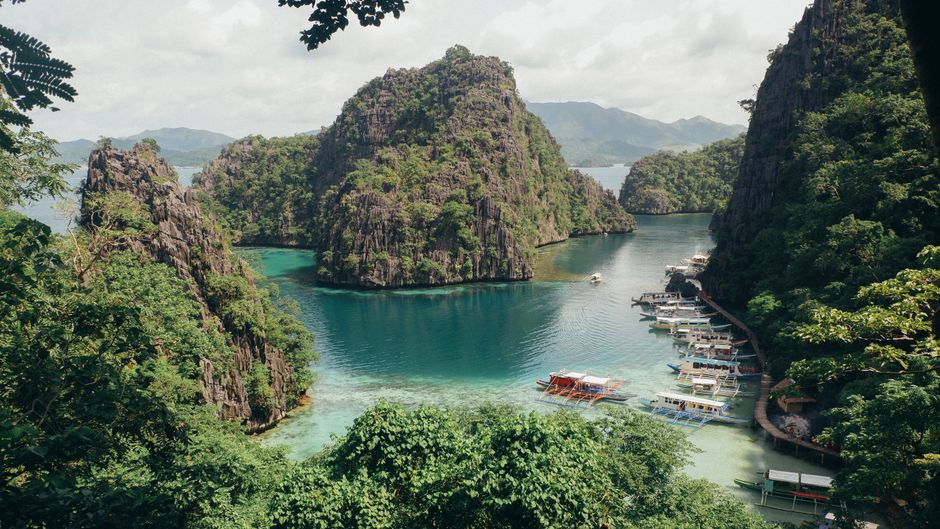
Coron is a small harbor town on Busuanga Island in the Calamian group of northern Palawan, and the base for some of the most extraordinary scenery in the Philippines. Across a narrow channel rises Coron Island, a wall of jagged limestone peaks hiding crystal-clear lakes, lagoons and coves, which belongs to the indigenous Tagbanua people and is managed by them. Around it, Coron Bay holds a fleet of Japanese ships sunk by American aircraft in September 1944, now among the world’s best wreck dives, while island-hopping boats visit white-sand islets, coral gardens and the famous Kayangan Lake viewpoint. The town itself is unglamorous, a jumble of guesthouses, dive shops, markets and waterfront restaurants climbing toward Mount Tapyas, where hundreds of steps lead to a sunset view, but it is friendly and easy. Coron is wilder and less crowded than El Nido, with excellent diving. The best time to visit is from about December to May, when seas are calm; from June to October the southwest monsoon brings heavy rain and canceled boat trips.
Right now in Coron
- Wed 26–30°C 79–85°F 2 mm Showers
- Thu 27–30°C 80–86°F 3 mm Showers
- Fri 26–29°C 78–84°F 9 mm Heavy showers
Weather: MET Norway (CC BY 4.0) · Sea temperature: NOAA CoastWatch
Top tours in Coron
See all tours for Coron →
From local operators, with prices and reviews; you check availability and book on Viator, our partner. We may earn a commission at no extra cost to you. How we earn money
Coron at a glance
- Best for: lakes and lagoons, wreck diving, island-hopping, snorkeling, hot springs and sunsets.
- How long: 3 to 4 days for the main island tours; 5 or more for diving or the northern islands.
- Best time: December to May, with February to April the calmest and driest; highs are about 31–33 °C (88–91 °F).
- Getting there: fly to Busuanga’s Francisco B. Reyes Airport, about 30 to 40 minutes from town, take an overnight ferry from Manila, or a fast boat from El Nido.
- Getting around: on foot and by tricycle in town, by van or scooter on Busuanga, and by banca to the islands.
- Fees to know: each lake, lagoon and beach on Coron Island, and many islets, charges its own entrance fee, collected by the local community or managers.
- Before you go: eTravel registration, visa-free stays, money and general safety are in our Philippines travel guide.
Coron’s areas and where to stay
The municipality of Coron covers the eastern half of Busuanga Island, Coron Island and dozens of smaller islands. According to the municipal government, it has 34 natural tourist attractions, 15 of them on Coron Island, which is managed by the Tagbanua.
Coron town
The town proper (Poblacion), facing Coron Bay, has most of the guesthouses, mid-range hotels, dive shops, tour agencies and restaurants, plus the public market and the port. It is compact and walkable, though hilly, with little beach.
The waterfront and Mount Tapyas
Hotels along the bay and on the slopes toward Mount Tapyas have views over the water and the islands. Some sit on stilts over the bay.
Coron Island
Nobody stays on Coron Island itself, apart from the Tagbanua communities who live in a few villages along its shore. The island’s lakes, lagoons and beaches are open to visitors by day only, on boats from town, and the Tagbanua collect the entrance fees, staff the docks and set the rules, such as limits on where you can swim and a ban on fishing and collecting. Their stewardship is a big part of why the lakes are still so clear. Treat the island as you would someone’s home: keep noise down, take all trash back to town and follow the instructions of the local wardens.
Island and Busuanga resorts
Resorts on private islands and on remote stretches of Busuanga, such as around Concepcion and the northern islands, offer seclusion, diving and their own boats, at a price and a long transfer.
Top things to see in Coron
Kayangan Lake
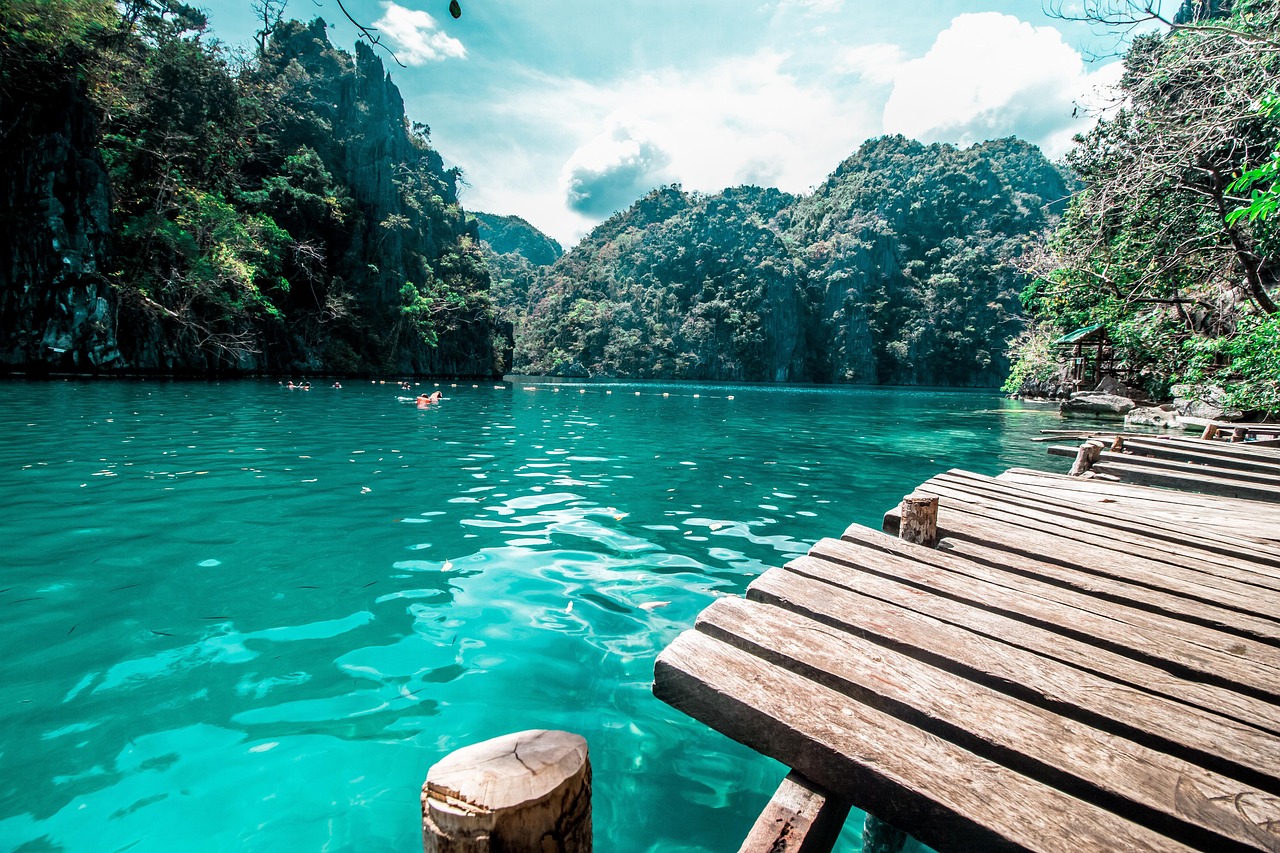
According to the Department of Tourism, Kayangan Lake is Coron’s ultimate treasure, considered the cleanest and greenest inland body of water in the country, a short 15-minute boat ride from town. A steep 10-minute climb of about 150 steps leads to a viewpoint over a cove framed by limestone peaks, the most photographed view in Palawan, then down to the lake itself, with brackish, clear water and underwater rock formations for swimming and snorkeling. The DOT lists it as open from 8 a.m. to 5 p.m., with March to June the best time to visit. Go on the first boat of the day to avoid the queue for the viewpoint.
Barracuda Lake
Also on Coron Island, Barracuda Lake is enclosed by sharp limestone walls, with layers of warm and cool water (a thermocline) that divers find eerie. Snorkelers and swimmers can explore its edges.
Twin Lagoon
Two lagoons separated by a limestone wall: swim or paddle through a small gap at low tide, or climb a ladder over the rocks at high tide, to reach the inner lagoon.
The World War II wrecks
On September 24, 1944, US carrier aircraft attacked a Japanese supply fleet anchored in Coron Bay, sinking about a dozen ships. Today the wrecks, at depths from a few meters to about 40 m (130 ft), are covered in coral and fish. Highlights include the Irako and Akitsushima for experienced divers, the Okikawa Maru and Olympia Maru, and the shallow Skeleton Wreck and Lusong Gunboat, which snorkelers can see. See our diving guide.
Mount Tapyas
About 700 steps climb from town to the viewpoint and big white cross of Mount Tapyas, which the municipal government names as Coron’s favorite sunset spot. Go about an hour before sunset and bring water.
More classic sights
- Maquinit Hot Spring: saltwater hot springs by the mangroves in Tagumpay, lovely after dark; the municipality classes it as Coron’s health and wellness attraction.
- Siete Pecados Marine Park: seven small islets near town with coral and fish for snorkeling, recognized in the Department of Tourism’s list of protected marine parks.
- Banol Beach and Atwayan Beach: small white-sand coves on Coron Island used as lunch stops on tours.
- Mount Dalara: a challenging hike with views and, according to the municipality, a spot for stargazing at night.
- De Vega Island: water sports near town.
Island-hopping, diving and snorkeling
Island-hopping tours
Tour operators in town sell standard day trips by banca. The Coron Island tour typically combines Kayangan Lake, Twin Lagoon, Barracuda Lake, a reef such as the Coral Garden, the Skeleton Wreck and a beach for lunch. The reef and beaches tours head out to white-sand islands such as Malcapuya, Banana Island and Bulog Dos, about an hour or more from town. Each site charges its own entrance fee, which may or may not be included in the tour price, so ask. Private boats cost more but let you beat the crowds. See our boat trips and snorkeling guides.
Diving
Coron is one of the best wreck-diving destinations in the world, and dive centers in town run daily trips, wreck specialty courses and nitrox. Barracuda Lake and reef dives add variety. Some wrecks are deep and have overhead environments, so dive within your training and with experienced guides.
Calauit Safari Park
On the northern tip of Busuanga, about 3 hours away by road, the Calauit Safari Park has giraffes, zebras and other African animals brought from Kenya in the 1970s, along with the endemic Calamian deer. It makes a long day trip, often combined with beaches on the way.
Other things to do in Coron
Food and drink
Coron’s restaurants serve fresh seafood, Filipino grills and a growing range of international cafés. Try grilled fish and squid, kinilaw (raw fish cured in vinegar), crab and lobster at seafood restaurants, and cashews, a Palawan specialty, sold in town. The public market and night stalls near the waterfront are cheap, and a few bars on the bay have sunset happy hours.
Festivals
According to the municipal government, the Kasadyaan Festival is held each year around the feast of Saint Augustine, Coron’s patron saint, on August 28, with masses, processions, street dancing and cultural performances.
Day trips from Coron
- Calauit Safari Park: African wildlife and Calamian deer on northern Busuanga.
- Culion: a former leper colony on the island of the same name, with a museum and a Spanish-era fort church, about 1.5 to 2 hours by boat.
- The northern islands: remote beaches such as Black Island and Pass Island, reached on long boat trips.
- El Nido: about 4 hours by fast boat; better as the next stop on your trip. See our El Nido guide.
Nearby destinations
- El Nido127 km
- Boracay187 km
- Puerto Princesa298 km
Getting there and getting around
By air
Francisco B. Reyes Airport (USU), also called Busuanga Airport, has flights from Manila and some other cities with Philippine Airlines, Cebu Pacific and smaller airlines on small planes; baggage limits are tight. Shared vans meet flights for the 30 to 40 minute drive to Coron town.
By sea
Overnight ferries, including 2GO’s, sail from Manila (Batangas or the Port of Manila, depending on the schedule) to Coron, a cheaper but slower option. Fast boats to and from El Nido take about 4 hours and run mainly in the dry season, and expedition boats make the trip over several days, camping on islands. All boats stop when the Coast Guard suspends sea travel in bad weather.
Around Coron
The town is small enough to walk, and tricycles cover short trips; agree on the fare first. Scooters are easy to rent for trips to Maquinit Hot Spring or around Busuanga. Island tours leave from the town pier. Grab does not operate in Coron.
When to go and how long to stay
Northern Palawan has a clear dry season and wet season. According to PAGASA, the national weather agency, the rainy season runs from June to November and the dry season from December to May, and in 2026 PAGASA declared the start of the rainy season in western areas on June 4. The table uses PAGASA’s 1991–2020 normals for its Coron station, as submitted to the World Meteorological Organization (WMO). The Coron normals do not include maximum temperatures, so the highs are from PAGASA’s station at Cuyo, also in Palawan.
| Month | Average high / low | Rain (days with 1 mm or more) | What to expect |
|---|---|---|---|
| January | 31 °C (87 °F) / 24 °C (74 °F) | 20 mm (0.8 in), 2 days | Dry season; occasional windy days |
| February | 31 °C (88 °F) / 24 °C (74 °F) | 25 mm (1.0 in), 2 days | Dry and calm; excellent visibility |
| March | 32 °C (89 °F) / 24 °C (76 °F) | 18 mm (0.7 in), 2 days | The driest month; peak season |
| April | 33 °C (92 °F) / 25 °C (77 °F) | 40 mm (1.6 in), 3 days | Hot; Holy Week crowds |
| May | 33 °C (91 °F) / 25 °C (77 °F) | 198 mm (7.8 in), 11 days | Hot and humid; first storms |
| June | 32 °C (89 °F) / 25 °C (76 °F) | 324 mm (12.8 in), 18 days | Southwest monsoon arrives |
| July | 31 °C (89 °F) / 24 °C (75 °F) | 540 mm (21.3 in), 21 days | The wettest month; many tours canceled |
| August | 31 °C (89 °F) / 24 °C (76 °F) | 480 mm (18.9 in), 20 days | Very wet; Kasadyaan Festival |
| September | 32 °C (89 °F) / 24 °C (75 °F) | 480 mm (18.9 in), 20 days | Very wet; typhoons possible |
| October | 32 °C (89 °F) / 24 °C (76 °F) | 239 mm (9.4 in), 14 days | Rain easing |
| November | 32 °C (89 °F) / 24 °C (76 °F) | 98 mm (3.9 in), 7 days | Drying out; season begins |
| December | 31 °C (88 °F) / 24 °C (75 °F) | 87 mm (3.4 in), 6 days | Dry and busy at Christmas |
Coron gets about 2,550 mm (100 in) of rain a year, almost all from May to October. Wreck diving continues in the wet season when boats can sail, though visibility drops after heavy rain. PAGASA said in September 2026 that a strong El Niño was expected to bring below-normal rainfall to most of the country into early 2027.
3 days in Coron
Day one, arrive and climb Mount Tapyas for sunset, then soak at Maquinit Hot Spring. Day two, the Coron Island tour: Kayangan Lake, Twin Lagoon, Barracuda Lake, the Skeleton Wreck and a beach lunch. Day three, the reef and beaches tour to Malcapuya and Banana Island, or a day of wreck dives.
5 days
Add a second dive day or a trip to Calauit Safari Park, and a lazy day at an island resort or Siete Pecados.
What a trip to Coron costs
Prices are approximate, for October 2026, converted at about ₱62.6 to the US dollar.
| Item | Typical cost |
|---|---|
| Shared van from Busuanga airport to town | ₱150–250 (about US$2.40–4) |
| Shared Coron Island tour with lunch | ₱1,400–2,200 (about US$22–35), fees sometimes extra |
| Site entrance fees, such as Kayangan Lake or Twin Lagoon | about ₱150–400 (about US$2.40–6.40) each |
| Private boat for a day | ₱6,000–10,000 (about US$96–160) |
| Two wreck dives with equipment | ₱4,000–6,000 (about US$64–96) |
| Maquinit Hot Spring entrance | about ₱200 (about US$3.20) |
| Scooter rental, per day | ₱500–700 (about US$8–11) |
| Meal at a local restaurant | ₱200–450 (about US$3.20–7.20) |
| Mid-range hotel double, per night | ₱3,000–6,500 (about US$48–104) |
Practical tips for Coron
- Ask what the tour price includes: entrance fees for each lake and beach are often paid separately.
- Go early: Kayangan Lake’s viewpoint and Twin Lagoon get crowded from mid-morning.
- Respect Tagbanua rules: Coron Island is ancestral domain; stay on marked paths, swim only where allowed, and don’t take anything.
- Bring cash: ATMs exist in town but can run out, and island sites take cash only.
- Allow a buffer day: flights from Busuanga and boats to El Nido can be canceled by weather.
Safety
Coron is safe and laid-back. The main risks are at sea and underwater: wear life jackets on boats, use established tour and dive operators, and dive the deeper wrecks only with appropriate training and guides. Boats stop when the Coast Guard suspends sea travel, especially when PAGASA raises Tropical Cyclone Wind Signals for northern Palawan, so keep plans flexible from June to November. The climb at Kayangan Lake is steep and slippery when wet. Scooter accidents happen on Busuanga’s roads, especially at night; ride slowly and wear a helmet. Petty theft is uncommon but occurs, so lock up valuables. Medical facilities are basic, and serious cases are flown to Manila; divers should have insurance that covers evacuation and decompression treatment. In an emergency, call 911; the municipal government also lists local hotlines for the police, the Coast Guard and its disaster office.
What to pack for Coron
Swimwear, a rash guard, reef-safe sunscreen and a hat, water shoes for slippery steps and rocky lake edges, a dry bag, a light rain jacket in the wet season, and your dive certification card and logbook. The Philippines uses 220 V and mostly flat two-pin US-style plugs. See our water shoes and travel adapters guides.
Coron travel FAQ
What is Coron famous for?
Kayangan Lake and the other lakes and lagoons of Coron Island, and the Japanese World War II shipwrecks in Coron Bay, among the best wreck dives in the world.
Is Coron town on Coron Island?
No. Coron town is on Busuanga Island; Coron Island, with Kayangan and Barracuda lakes, lies across a channel and is the ancestral domain of the Tagbanua.
How much are the entrance fees in Coron?
Each site, such as Kayangan Lake, Twin Lagoon or Barracuda Lake, charges its own fee, typically a few hundred pesos; ask whether your tour includes them.
How do I get to Coron?
Fly to Busuanga’s Francisco B. Reyes Airport, then take a 30 to 40 minute van ride to town, or take an overnight ferry from Manila or a fast boat from El Nido.
How do I get from Coron to El Nido?
By fast boat in about 4 hours, mainly in the dry season, or on a multi-day expedition boat; there are no direct flights.
Can beginners dive the Coron wrecks?
Some, such as the Skeleton Wreck and Lusong Gunboat, are shallow enough for snorkelers and new divers; the larger wrecks are deeper and best for experienced or advanced divers.
What is the best time to visit Coron?
December to May, with calm seas and little rain; March is the driest month. July is the wettest, and June to October brings frequent cancellations.
How many days do I need in Coron?
Three to four days for the Coron Island and beach tours and Mount Tapyas; five or more for diving or Calauit.
Is there Grab in Coron?
No. Use tricycles, vans and rented scooters.
Coron or El Nido?
Choose Coron for lakes, wrecks and a quieter town; El Nido for the lagoons of Bacuit Bay, more beaches and a livelier scene. Many travelers visit both.
Sources and last review
Researched and last reviewed on 4 October 2026. Coron’s 34 natural attractions, the Tagbanua management of Coron Island, Mount Tapyas, Mount Dalara, Maquinit Hot Spring, De Vega Island, the Kasadyaan Festival and local hotlines: the Municipality of Coron; Kayangan Lake hours, travel time and best season, and Siete Pecados Marine Park: the Department of Tourism; seasons, the 2026 rainy-season onset and the El Niño outlook: PAGASA, with climate normals for Coron and Cuyo via the World Meteorological Organization; Grab coverage: Grab Philippines; exchange rate: the European Central Bank. Site entrance fees, wreck history and depths, tour routes, airport and ferry details, Calauit and Culion and typical prices are general references or estimates, flagged for checking. Fees change, so check with the Coron tourism office before you go. For entry rules, money and general safety, see our Philippines travel guide.
Plan your trip
Partner links: TravelerCenter may earn a commission if you book, at no extra cost to you.
🇵🇭 Useful Filipino phrases for Coron
All 38 Filipino phrases: restaurant, hotel, emergencies, romance (printable) →