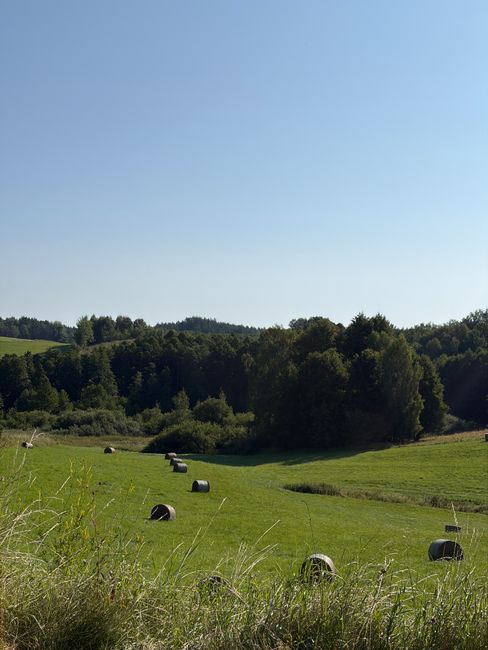
Masuria (Mazury), in Poland’s north-east, is the Land of a Thousand Lakes, though it actually has more than two thousand: long glacial lakes strung together by rivers and canals, framed by pine and beech forests, reed beds, storks’ nests and small red-brick towns. In summer it is Poland’s favourite holiday playground, with thousands of yachts on the Great Masurian Lakes, kayakers on the Krutynia river and families in lakeside cabins; out of season it is quiet, misty and wild. Masuria was part of German East Prussia until 1945, and its history shows in Teutonic castles, Prussian fortresses, a baroque pilgrimage church and, hidden in the forest, the bunkers of Hitler’s Wolf’s Lair. Give it at least three days, a week or more to sail or paddle properly.
Right now in Masuria (Giżycko)
- Wed 10–17°C 49–62°F Partly cloudy
- Thu 11–18°C 51–65°F Cloudy
- Fri 9–14°C 49–57°F 3 mm Cloudy
Weather: MET Norway (CC BY 4.0) · Rates: ECB
Top tours in Masuria
See all tours for Masuria →
From local operators, with prices and reviews; you check availability and book on Viator, our partner. We may earn a commission at no extra cost to you. How we earn money
Masuria at a glance
- Best for: sailing, kayaking, swimming in lakes, cycling, nature and quiet countryside.
- How long: 3 days for a taste of the lakes and the Wolf’s Lair; a week or more for a sailing or kayaking trip.
- Best time: June to early September for sailing and swimming; May and September for quieter lakes. Many services close from October to April.
- Getting in: trains run from Warsaw to Olsztyn and Giżycko (about 3 hours 30 minutes to Giżycko); a car is useful to explore.
- Key prices: as of October 2026, the Wolf’s Lair cost 30 zł in season (25 zł from November to March).
- Before you go: entry rules, money and trains are in our Poland travel guide.
Masuria, area by area
The Great Masurian Lakes
The heart of the region is a chain of large, connected lakes running about 100 km from Węgorzewo in the north to Ruciane-Nida in the south, including Mamry, Niegocin and Śniardwy, the largest lake in Poland at about 113 km². Canals and rivers link them, so you can sail from one end to the other. Best for: sailing and boat trips.
Giżycko
The main town of the northern lakes, between Lake Niegocin and Lake Kisajno, with a marina, a swing bridge over the canal, a waterfront promenade and the vast 19th-century Boyen Fortress. Best for: a base with good transport links.
Mikołajki
A small town on a narrow strait at the edge of Śniardwy, known as the “sailing capital of Poland”, with a busy marina, waterfront bars and cruise boats. It gets very lively in July and August. Best for: sailing and summer nightlife.
The Masurian Landscape Park and the Pisz Forest
South of Mikołajki, forests and quiet lakes surround the Krutynia river, Ruciane-Nida and the village of Wojnowo with its Old Believers’ monastery. Best for: kayaking, cycling and nature.
Olsztyn and Warmia
To the west, Olsztyn, the regional capital, has a Gothic castle where Copernicus lived and a lake within the city. Warmia, the historic Catholic bishopric around it, has Gothic towns such as Lidzbark Warmiński and Reszel. Best for: arrivals by train and city comforts.
Top things to see in Masuria
Prices and hours below were checked on official sites in October 2026. They change, so check before you go.
The Wolf’s Lair (Wilczy Szaniec)
Hidden in the forest at Gierłoż, near Kętrzyn, the Wolf’s Lair was Adolf Hitler’s main military headquarters on the Eastern Front, where he spent more than 800 days between 1941 and 1944. It was here, on 20 July 1944, that Colonel Claus von Stauffenberg’s bomb failed to kill Hitler. The Germans blew up the bunkers as they retreated in January 1945, and the huge slabs of broken reinforced concrete, some with walls several metres thick, now lie tumbled among the trees. Marked paths and information boards lead around about 200 ruined buildings. It is a sobering place; treat it as a historic site, not a theme park, and don’t climb on the ruins.
The site belongs to the Polish State Forests. As of October 2026, entry costs 30 zł (25 zł reduced) from 1 April to 31 October and 25 zł (20 zł reduced) from 1 November to 31 March, when the indoor exhibitions are closed; children under 6 go free. An audio guide costs 10 zł, and parking 15 zł for a car. It is open every day of the year, 8:00–16:00 from October to February and until 18:00–20:00 in spring and summer. Tickets are sold on site only. Guides can be hired locally.
Boyen Fortress
On the isthmus between two lakes at Giżycko, the Prussian army built this star-shaped fortress in the mid-19th century to guard the border with Russia. Its walls, bastions and ditches stretch for more than 2 km, with a small museum and summer events inside.
Święta Lipka
The baroque pilgrimage basilica of Święta Lipka (“Holy Lime Tree”), built by the Jesuits at the end of the 17th century, is one of the finest baroque churches in Poland. Its organ has moving figures of angels and saints that dance when it plays; short organ demonstrations and concerts are held through the summer season. Check times at the church.
The Elbląg Canal
On the western edge of the region, the Elbląg Canal, built in the 1840s to 1860s, overcomes a 100 m difference in height with a system of inclined planes, where boats are hauled out of the water on rail carriages and pulled over grassy hills by water-powered cables: “ships sailing on grass”. It is a Historic Monument of Poland. Cruise boats run from about late April to early October from Buczyniec, Elbląg and Ostróda; in 2026, according to secondary sources, a three-hour trip over the inclined planes from Buczyniec cost about 125 zł. Book ahead in summer.
Olsztyn
Olsztyn’s Gothic Castle of the Warmian Chapter, where Nicolaus Copernicus lived as an administrator in the 1510s and 1520s, now houses the Museum of Warmia and Masuria, with a table on the wall that he drew to observe the sun. The old town has a fine Gothic cathedral and the High Gate.
Protected areas
- Masurian Landscape Park
Nature
- Śniardwy
Monuments
- Barciany Castle
- Święta Lipka Sanctuary
Museums
- Wolf's Lair
Castles and forts
- Boyen Fortress
Palaces
- Drogosze Palace
Sailing on the Great Masurian Lakes
Masuria is the biggest sailing area in Central Europe. Charter companies in Giżycko, Mikołajki, Węgorzewo, Wilkasy and Ruciane-Nida rent out cabin yachts by the week (usually Saturday to Saturday), from small family boats to larger yachts with heating and showers, and many also offer skippers. Marinas and lakeside harbours with restaurants are spread along the whole route.
Do you need a licence? Under Polish law, you can sail a yacht with a hull length of up to 7.5 m, with an auxiliary engine, without a sailing licence (patent), and many charter companies offer licence-free boats of this size. For larger yachts, charter companies ask for a recognised sailing licence or a skipper. Even on a licence-free yacht, you need to know how to sail: the large lakes can get rough quickly, and summer storms with sudden squalls are dangerous. Watch the forecast and the storm warning lights around the lakes, wear life jackets and keep away from the reed beds in protected areas.
Not a sailor? Passenger cruise boats run between Giżycko, Mikołajki, Ruciane-Nida and Węgorzewo in summer, and you can rent motorboats, canoes, kayaks and pedal boats in every lakeside town. See our boat trips guide.
Kayaking the Krutynia
The Krutynia river, through the Masurian Landscape Park, is one of the most beautiful canoe routes in Poland: a clear, slow river winding through forests, reed beds and small lakes, with herons, kingfishers and beavers. The classic route runs about 100 km from Sorkwity to Ruciane-Nida over about a week, with campsites and guesthouses along the way; outfitters in Krutyń and Sorkwity rent kayaks and arrange transfers for one-day or multi-day trips. The stretch around the village of Krutyń is especially pretty and popular on summer weekends.
Things to do in Masuria
Swimming and beaches
Lake water warms up to about 20–24 °C in July and August, and towns have public beaches with lifeguards in summer. Swim only in designated areas, away from boat traffic. See our beaches guide.
Cycling
Quiet country roads, forest tracks and the Green Velo long-distance route make Masuria good cycling country, mostly flat with gentle hills. See our cycling guide.
Wildlife
Masuria has white storks in almost every village from April to August, cranes, white-tailed eagles and, in the forests, deer, wild boar and elk. Lake Łuknajno near Mikołajki is famous for its mute swans.
Eat like a Masurian
Try smoked and fried lake fish (whitefish, pike, eel and vendace), pierogi, potato pancakes and wild mushrooms and berries from the forests in late summer.
Activities and best months
- Boat tripsMasuria, the 'Land of a Thousand Lakes', has Poland's largest lakes, Śniardwy and Mamry, and is a centre for sailing and other water sports (Węgorzewo is called its nautical mecca). The Krutynia river, flowing through the Pisz Forest from Lake Warpuńskie to Lake Bełdany, is described as one of the most picturesque canoe routes in Poland. · source
- CyclingThe Masurian section of the Green Velo cycle route crosses North Masuria through the sailing town of Węgorzewo, then the hilly Mazury Garbate area to the spa town of Gołdap. · source
Day trips around Masuria
- The Wolf’s Lair and Święta Lipka: combine the two in a day from Giżycko, with Reszel’s castle on the way.
- The Mamerki bunkers: the well-preserved headquarters of the German army high command, near Węgorzewo.
- The Elbląg Canal: a day trip from Olsztyn or Ostróda.
- Lidzbark Warmiński: a Gothic bishops’ castle in Warmia.
- The Suwałki region and Wigry National Park: further east, hilly lake country near the Lithuanian border.
Nearby destinations
- Warsaw151 km
- Gdańsk180 km
- Curonian Spit188 km
- Kaunas236 km
- Vilnius299 km
Getting to Masuria
By train. PKP Intercity trains run from Warsaw to Olsztyn (about 2 hours 30 minutes to 3 hours) and to Giżycko (about 3 hours 30 minutes), and regional trains link Olsztyn, Kętrzyn, Giżycko and Ełk; the line through Giżycko has been rebuilt and electrified, so check for any remaining works. Mikołajki and Ruciane-Nida have slower regional links. Book on intercity.pl.
By air. Olsztyn-Mazury Airport at Szymany, in the south of the region, has a few routes; most visitors fly into Warsaw or Gdańsk, about 3 to 4 hours away by road.
By car. Masuria is about 3–4 hours’ drive from Warsaw and Gdańsk. Roads are mostly ordinary two-lane routes; a car is the easiest way to reach the Wolf’s Lair, Święta Lipka and the smaller lakes.
Getting around Masuria
Buses link the main towns, but services are sparse, especially outside summer. A car, a bike or a boat is the best way to explore. In summer, passenger boats link Giżycko, Mikołajki and Ruciane-Nida.
When to go and how long to stay
Masuria has the coldest winters in lowland Poland, with lakes often frozen in January and February, and warm, pleasant summers. The table uses the IMGW 1991–2020 averages for Mikołajki, in the middle of the Great Masurian Lakes.
| Season | Average high | Average low | Rain per month | What it’s like |
|---|---|---|---|---|
| Winter (Dec–Feb) | 0–1 °C | −5 to −3 °C | 30–36 mm | Cold, snowy and quiet; frozen lakes for ice-skating and ice-sailing in cold winters |
| Spring (Mar–May) | 6 °C rising to 18 °C | −2 °C rising to 8 °C | 35–59 mm | Storks return in April; the sailing season starts in May; cool water |
| Summer (Jun–Aug) | 22–24 °C | 12–14 °C | 73–82 mm | The high season: warm water, busy marinas and occasional violent storms |
| Autumn (Sep–Nov) | 18 °C falling to 6 °C | 10 °C falling to 2 °C | 41–55 mm | Calm, golden September; most charters and cruise boats end by early October |
Mikołajki gets about 610 mm of rain a year, most of it in summer thunderstorms. Mosquitoes can be fierce near water on still summer evenings.
Masuria in 3 days
Day 1: Giżycko, Boyen Fortress and a boat trip on Lake Niegocin. Day 2: the Wolf’s Lair, Święta Lipka and Reszel. Day 3: Mikołajki, a cruise on Śniardwy or a kayak trip on the Krutynia at Krutyń.
Masuria in a week
Charter a yacht for a week on the Great Masurian Lakes, or paddle the Krutynia from Sorkwity to Ruciane-Nida, with a day for the Elbląg Canal on the way in or out.
Weather month by month
Averages from IMGW-PIB normals 1991–2020, Kętrzyn · Last reviewed 4 Oct 2026
Where to stay in Masuria
- Giżycko: hotels, guesthouses and apartments, with the best transport links.
- Mikołajki: lakeside resort hotels and spas, lively in summer.
- Villages and farms: agritourism farms (agroturystyka), cabins and guesthouses by quiet lakes; the most Masurian experience, best with a car.
- Olsztyn: city hotels, convenient for the Elbląg Canal and Warmia.
Book early for July and August, especially for yacht charters. Some resorts charge a small local fee per night.
Practical tips for Masuria
- Watch the weather: summer storms on the big lakes can be sudden and dangerous; check forecasts and warnings before you sail.
- Licence-free yachts: up to 7.5 m hull length, but only if you can sail.
- Bring insect repellent: for mosquitoes by the lakes and ticks in the forests.
- Carry cash: for small marinas, kayak rentals and village shops, though cards are widely accepted.
- Respect the Wolf’s Lair: don’t climb on the ruins; they are unstable.
What to pack for Masuria
A waterproof jacket and warm layers even in summer (evenings on the water are cool), swimwear, sunscreen, a hat and sunglasses, insect repellent, quick-drying clothes and soft-soled shoes for sailing or kayaking, and a dry bag for your phone. For the Wolf’s Lair and the forests, bring sturdy shoes.
What to pack
- Dry bags and phone pouchesSpray soaks phones and cameras on open boats to the Algarve caves and on whale-watching trips.
- Fleeces and warm layersIt is cooler at sea than on land, especially on morning whale-watching trips.
- Rain jacketsA windproof, waterproof shell keeps you warm on open boats, where wind and spray cool you quickly.
- Reef-friendly sunscreenSun reflects off the water on cruises and cave tours.
- Water bottles and hydration packsRiding in the Algarve and Alentejo heat needs more water than you expect.
- Water shoesKayak and small-boat trips to the Algarve grottoes land on rock and wet sand.
Masuria travel FAQ
Do you need a licence to sail in Masuria?
Not for small yachts: under Polish law, you can sail a yacht with a hull length of up to 7.5 m without a licence. For larger boats, charter companies require a recognised sailing licence or a skipper.
How much is the Wolf’s Lair?
As of October 2026, 30 zł (25 zł reduced) from 1 April to 31 October and 25 zł (20 zł reduced) from 1 November to 31 March; children under 6 go free. Parking for a car costs 15 zł, and an audio guide 10 zł.
Is the Wolf’s Lair open all year?
Yes, every day, from 8:00; in October to February it closes at 16:00. The indoor exhibitions are closed from November to March.
What is the largest lake in Masuria?
Śniardwy, the largest lake in Poland, at about 113 km². Mamry is the second largest.
How do I get to Masuria from Warsaw?
By train to Olsztyn (about 2 hours 30 minutes to 3 hours) or Giżycko (about 3 hours 30 minutes), or by car in about 3 to 4 hours.
When is the best time to visit Masuria?
June to early September for sailing, swimming and kayaking; May and September are quieter. Many charters and cruise boats stop running in October.
What is the Elbląg Canal?
A 19th-century canal where boats are hauled over hills on rail carriages along inclined planes. Cruise boats run from late April to early October.
Can you kayak in Masuria?
Yes. The Krutynia river is one of Poland’s most beautiful kayak routes, with rentals in Krutyń and Sorkwity for day trips or week-long journeys.
Is Masuria good for families?
Yes: shallow lake beaches, boat trips, cycling and farm stays make it a favourite family holiday area in summer.
Sources
- © OpenStreetMap contributors · ODbL · fetched 4 Oct 2026
- Wikidata · CC0 · fetched 4 Oct 2026
Sources and last review
Researched and last reviewed on 4 October 2026. The Wolf’s Lair opening hours: the Polish State Forests (wilczyszaniec.olsztyn.lasy.gov.pl); Wolf’s Lair prices: the site’s ticket page (wilczy-szaniec.pl), effective 1 January 2026; climate: IMGW 1991–2020 averages for Mikołajki via secondary sources. Lake sizes, the licence-free sailing rule, the Elbląg Canal cruise season and price, train times to Olsztyn and Giżycko, the Krutynia route and the history of Boyen Fortress and Święta Lipka come partly from secondary sources and are flagged for checking. Prices, seasons and timetables change, so check the official links before you go. For entry rules and money, see our Poland travel guide; for the Baltic coast, our Gdańsk guide.
Plan your trip
Partner links: TravelerCenter may earn a commission if you book, at no extra cost to you.
🇵🇱 Useful Polish phrases for Masuria
All 38 Polish phrases: restaurant, hotel, emergencies, romance (printable) →