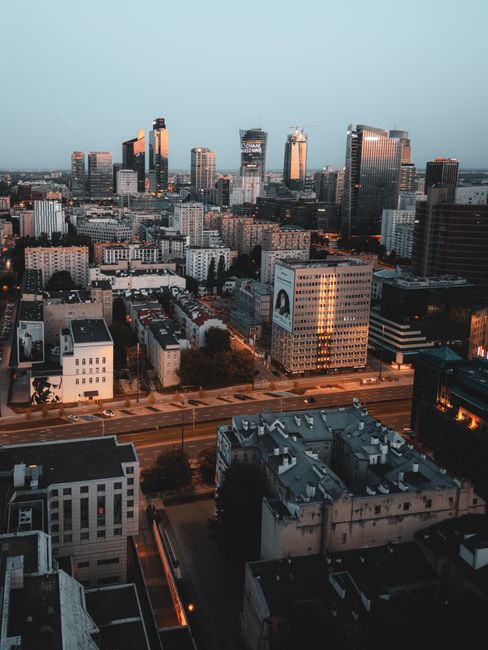
Warsaw is a city that refused to die. In 1944, after the Warsaw Uprising, German forces systematically blew up and burned the Polish capital, destroying most of its buildings; after the war, Varsovians rebuilt the Old Town brick by brick from paintings, photographs and drawings, so faithfully that it is now a UNESCO World Heritage Site. Today Warsaw is a dynamic, green capital of glass skyscrapers, riverside beaches, excellent restaurants and some of the most powerful museums in Europe: POLIN, the Museum of the History of Polish Jews, and the Warsaw Rising Museum. In summer, Chopin’s music drifts through Łazienki Park every Sunday. Give it two days for the highlights, three or four to add Wilanów, Praga and the neighbourhoods.
Right now in Warsaw
- Wed 9–20°C 48–67°F 1 mm Partly cloudy
- Thu 10–22°C 51–72°F Partly cloudy
- Fri 11–15°C 51–60°F Partly cloudy
Weather: MET Norway (CC BY 4.0) · Rates: ECB
Top tours in Warsaw
See all tours for Warsaw →
From local operators, with prices and reviews; you check availability and book on Viator, our partner. We may earn a commission at no extra cost to you. How we earn money
Warsaw at a glance
- Best for: 20th-century history, Jewish heritage, museums, Chopin, food and nightlife, parks and palaces.
- How long: 2 days for the Old Town, POLIN and the Warsaw Rising Museum; 3–4 days to add Łazienki, Wilanów and Praga.
- Best time: May to September; Sundays from July to September 2026 for the free Chopin concerts in Łazienki Park.
- Getting in: trains from Chopin Airport reach the centre in about 20–25 minutes on a normal city ticket. Trains from Kraków take about 2 hours 15 minutes, from Gdańsk about 2 hours 30 minutes to 2 hours 45 minutes, and from Berlin about 5 hours 30 minutes.
- Getting around: metro, trams and buses; as of October 2026, a 75-minute ticket cost 4.40 zł and a 24-hour ticket 15 zł.
- Before you go: entry rules, money and trains are in our Poland travel guide.
Warsaw, area by area
The Old Town and the New Town
The rebuilt heart of the city: the Old Town Market Square with its mermaid statue, the Royal Castle on Castle Square with Sigismund’s Column, St John’s Cathedral, the red-brick Barbican and the city walls. Just north, the New Town, despite its name, dates from the 15th century and is quieter. Best for: first visits and evening strolls.
The Royal Route
From Castle Square, the Royal Route runs south along Krakowskie Przedmieście and Nowy Świat, lined with palaces, churches (the Holy Cross Church holds Chopin’s heart), the university and cafés, to Łazienki Park and on to Wilanów. Best for: walking, cafés and classical Warsaw.
Śródmieście (the city centre)
Around the Palace of Culture and Science, Stalin’s “gift” to Poland, the modern centre has skyscrapers, shopping malls, the main station and the city’s best hotels and restaurants. Best for: transport connections and nightlife.
Muranów and Wola
The pre-war Jewish district, where the Nazis created the Warsaw Ghetto, is now a residential area built on its rubble, home to POLIN and the Ghetto Heroes Monument. Wola, to the west, holds the Warsaw Rising Museum and new office towers. Best for: history.
Praga
Across the Vistula, Praga survived the war better than the left bank and keeps its pre-war tenements, courtyard shrines and a gritty, creative character, with the Neon Museum, the Polish Vodka Museum and bars in former factories. Best for: street art, nightlife and a different side of the city.
Top things to see in Warsaw
Prices and hours below were checked on official sites in October 2026. They change, so check before you go.
The Old Town and the Royal Castle
The Old Town Market Square, rebuilt in the 1950s, is lined with colourful merchants’ houses, café terraces and the bronze mermaid (Syrenka), the city’s symbol. The Royal Castle, residence of Polish kings and seat of parliament, was blown up in 1944 and rebuilt in the 1970s with funds raised by Poles worldwide; inside are restored state rooms and paintings by Canaletto’s nephew Bernardo Bellotto, whose detailed views of Warsaw were used to rebuild the city. As of October 2026, the main routes through the castle cost 60 zł (45 zł reduced), and visitors aged 8 to 26 from the EU, Switzerland and EFTA pay just 1 zł. The castle opens Tuesday to Sunday 10:00–17:00, and admission to a special route is free on Wednesdays, with limited tickets from the box office on the day.
POLIN Museum of the History of Polish Jews
Opposite the Ghetto Heroes Monument, in Muranów, POLIN tells the thousand-year story of Jews in Poland, from medieval merchants to the vibrant culture of the inter-war years, the Holocaust and today, in a striking glass building. Its core exhibition, with a reconstructed painted wooden synagogue ceiling, is one of the best museums in Europe; allow at least three hours. As of October 2026 the core exhibition costs about 45 zł (35 zł reduced), including an audio guide, and is free on Thursdays. It is closed on Tuesdays, open 10:00–18:00 on other days and until 20:00 on Saturdays.
The Warsaw Rising Museum
In a former tram power station in Wola, this immersive museum tells the story of the 63-day uprising of August to October 1944, when the Polish Home Army rose against the German occupiers and the city was destroyed in reprisal. Highlights include a replica of a B-24 Liberator bomber, the sewers through which fighters escaped, and “City of Ruins”, a 3D film flying over the destroyed city. As of October 2026, tickets cost 35 zł (30 zł reduced), and admission is free on Thursdays. It opens Monday, Wednesday, Thursday and Friday 8:00–18:00 and weekends 10:00–18:00, and is closed on Tuesdays. Every year on 1 August at 17:00, “W-Hour”, sirens sound and the whole city stops for a minute to remember the uprising.
Łazienki Park and the Chopin concerts
Warsaw’s most beautiful park, the summer residence of the last king of Poland, Stanisław August Poniatowski, has peacocks, squirrels, an amphitheatre and the classical Palace on the Isle standing in a lake (50 zł, 25 zł reduced, free on Fridays as of October 2026). The park itself is free and open daily 6:00–21:00.
Every summer since 1959, pianists have played free open-air Chopin recitals at the Chopin Monument on Sunday afternoons. In 2026, the monument’s centenary year, the 67th season ran on Sundays from 5 July to 27 September, at 12:00 and 16:00; in most years the concerts start in mid-May. Bring a blanket and arrive early for a spot on the grass. The Fryderyk Chopin Museum in the Ostrogski Palace is closed for renovation throughout 2026 and is due to reopen in January 2027; meanwhile, many venues in the city hold daily Chopin recitals for visitors, and the composer’s heart lies in a pillar of the Holy Cross Church on Krakowskie Przedmieście.
Wilanów Palace
The baroque summer palace of King Jan III Sobieski, who defeated the Ottomans at Vienna in 1683, is one of the few royal buildings in Warsaw to have survived the war, with gardens running down to a lake. As of October 2026, the palace costs 70 zł (35 zł reduced) from April to October and 60 zł in winter, with visitors aged 8 to 26 paying 1 zł; it opens daily 10:00–16:00, and the palace and gardens are free on Thursdays (limited tickets). It is about 30 minutes from the centre by bus.
The Palace of Culture and Science
This 237 m Stalinist skyscraper, completed in 1955, is Warsaw’s most controversial landmark. Its viewing terrace on the 30th floor, 114 m up, has the best view of the city; as of October 2026 it costs 30 zł (25 zł reduced) and opens daily 10:00–20:00, without reservations.
More museums and memorials
The Museum of Warsaw on the Old Town Market Square tells the city’s story; the Neon Museum in Praga collects communist-era signs; the Copernicus Science Centre on the river is great with children; and the Museum of Modern Art opened its new building on Plac Defilad in 2024. The Umschlagplatz memorial marks the spot from which more than 250,000 Jews were deported from the ghetto to Treblinka in 1942.
Monuments
- Palace of Culture and Science
Museums
- POLIN Museum of the History of Polish Jews
- Royal Castle in Warsaw
- Warsaw Uprising Museum
- Wilanów Palace
Historic centres
- Warsaw Old Town
Parks and gardens
- Łazienki Park
Things to do in Warsaw
Walk the Vistula boulevards
The left bank of the Vistula has been rebuilt as a promenade with bars, food trucks and summer concerts, while the right bank keeps wild sandy beaches facing the skyline. In summer, ferries cross the river. See our boat trips guide.
Eat and drink
Warsaw has the best food scene in Poland, from cheap milk bars serving pierogi and soups to modern Polish restaurants, vegan bistros and the Hala Koszyki food hall. Try vodka tastings in the Polish Vodka Museum in Praga. See our city sightseeing guide.
Christmas in Warsaw
From early December, the Royal Route and the Old Town are lit with Christmas illuminations, with a huge tree on Castle Square and a Christmas market below the Barbican. A new design inspired by Warsaw legends, such as the Mermaid and the Basilisk, is planned for 2026 to 2029; the switch-on date for 2026 had not been announced as of October.
Activities and best months
- City sightseeingWarsaw's historic centre is on the UNESCO list as the only urban complex almost entirely rebuilt after its total destruction in the Second World War. The Polish Tourism Organisation suggests the Old Town Market Square with its galleries and café gardens, the Royal Castle (rebuilt from 1971) and the Krakowskie Przedmieście promenade. · source
Day trips from Warsaw
- Żelazowa Wola: Chopin’s birthplace, a manor house in a garden about an hour west, with summer recitals.
- Kampinos National Park: forests and sand dunes just north-west of the city, good for walking and cycling.
- Łódź: about 1 hour 15 minutes by train, a former textile city with red-brick factories turned into shopping centres, museums and lofts.
- Treblinka: the memorial at the former Nazi German extermination camp, about 1 hour 30 minutes north-east by car.
- Kraków: about 2 hours 15 minutes by train; better as an overnight trip.
Getting to Warsaw
By air. Warsaw Chopin Airport (WAW) is 10 km south of the centre. The SKM S2 and S3 trains and Koleje Mazowieckie trains leave from the station under the terminal and reach Warszawa Śródmieście and Centralna in about 15–25 minutes; a standard 75-minute city ticket (4.40 zł as of October 2026) is valid. Buses and taxis also run to the centre. Warsaw Modlin Airport, 40 km north, is served by low-cost airlines; a shuttle bus links it with Modlin station, from where trains take about 40 minutes to Warszawa Centralna, and direct coaches run to the centre.
By train. Warszawa Centralna is the main station, in the city centre next to the Palace of Culture. PKP Intercity trains arrive from Kraków (about 2 hours 15 minutes), Gdańsk (about 2 hours 30 minutes to 2 hours 45 minutes), Wrocław and Poznań, and international trains from Berlin, Vienna, Prague and Vilnius. Book on intercity.pl.
By car. The A2 links Warsaw with Poznań and Berlin; the state-run sections are free for cars, but the privately run section between Konin and the German border charges tolls.
Getting around Warsaw
Warsaw’s public transport (ZTM) is cheap and efficient: two metro lines, a dense tram network and buses, plus SKM suburban trains. As of October 2026, a 20-minute ticket costs 3.40 zł, a 75-minute ticket 4.40 zł and a 24-hour ticket 15 zł for zone 1, which covers the city and the airport. Buy tickets at machines (cards accepted), on board in many trams and buses, or in apps such as Jakdojade, and validate paper tickets when you board. The Veturilo bike-share system has stations across the city.
When to go and how long to stay
Warsaw has a continental climate: warm summers and cold winters, often with snow. The table uses the IMGW 1991–2020 averages for Warszawa-Okęcie, at the airport.
| Season | Average high | Average low | Rain per month | What it’s like |
|---|---|---|---|---|
| Winter (Dec–Feb) | 1–3 °C | −4 to −3 °C | 30–36 mm | Cold, grey and often snowy; Christmas illuminations and markets |
| Spring (Mar–May) | 7 °C rising to 20 °C | −1 °C rising to 9 °C | 29–56 mm | Parks in bloom; café terraces open from May |
| Summer (Jun–Aug) | 23–25 °C | 12–15 °C | 61–82 mm | Warm, with thunderstorms; river beaches, Chopin concerts and open-air events |
| Autumn (Sep–Nov) | 19 °C falling to 7 °C | 10 °C falling to 1 °C | 36–50 mm | Golden parks in September and October, damp and dark November |
Warsaw gets about 550 mm of rain a year. Winter can bring long cold spells well below freezing.
Warsaw in 2 days
Day 1: the Old Town and the Royal Castle in the morning, the Royal Route to the Holy Cross Church, and the Palace of Culture terrace at sunset. Day 2: POLIN in the morning, the Warsaw Rising Museum in the afternoon (remember both close on Tuesdays), and dinner in the centre or Praga.
Warsaw in 4 days
Add a day for Łazienki Park (on a summer Sunday for the Chopin concert) and Wilanów, and a day for Praga, the Neon Museum and the river.
Weather month by month
Averages from IMGW-PIB normals 1991–2020, Warszawa-Okęcie (airport) · Last reviewed 4 Oct 2026
Where to stay in Warsaw
- Śródmieście: the city centre, near the main station, with the widest choice of hotels.
- The Old Town and the Royal Route: atmospheric, close to the sights, a little pricier.
- Powiśle: a fashionable riverside district between the centre and the Vistula, with good cafés and bars.
- Praga: characterful and cheaper, a short tram ride across the river.
Book ahead for summer weekends and big conferences and concerts.
Practical tips for Warsaw
- Tuesdays: POLIN and the Warsaw Rising Museum are both closed.
- Free days: the Royal Castle on Wednesdays, POLIN, the Warsaw Rising Museum and Wilanów on Thursdays, the Palace on the Isle on Fridays.
- Young visitors: EU residents aged 8 to 26 pay 1 zł at the Royal Castle and Wilanów.
- Airport trains: a normal city ticket covers the train from Chopin Airport.
- 1 August: stop where you are at 17:00 when the sirens sound for the Uprising anniversary.
What to pack for Warsaw
Comfortable shoes for long museum days and walks along the Royal Route, layers and a light waterproof from spring to autumn, a blanket or something to sit on for the Łazienki concerts, and a warm coat, hat, gloves and boots for winter. Pack a type E/F plug adapter.
What to pack
- City walking shoesLisbon and Porto are steep, with polished limestone cobbles that get slippery, so grippy soles matter.
- Day packs and anti-theft bagsA small zipped or anti-theft bag makes crowded trams and viewpoints less stressful.
- Rain jacketsFrom October to April Porto and Lisbon see rain on roughly a third of days.
- Travel adapters and convertersPortugal uses Type C and F sockets at 230 V, so most visitors from outside Europe need an adapter.
Warsaw travel FAQ
Is the Warsaw Old Town original?
No. It was almost entirely destroyed in 1944 and rebuilt after the war using old paintings and photographs, especially Bellotto’s 18th-century views. The rebuilding was so thorough that UNESCO listed it as a World Heritage Site in 1980.
When are the free Chopin concerts in Łazienki Park?
On summer Sundays at 12:00 and 16:00 at the Chopin Monument. In 2026 they ran from 5 July to 27 September; in most years they start in mid-May.
Is the Chopin Museum in Warsaw open?
No. The Fryderyk Chopin Museum is closed for renovation throughout 2026 and is due to reopen in January 2027.
How much does POLIN cost?
As of October 2026, about 45 zł for the core exhibition (35 zł reduced), including an audio guide. It is free on Thursdays and closed on Tuesdays.
When is the Warsaw Rising Museum free?
On Thursdays. It is closed on Tuesdays; otherwise tickets cost 35 zł (30 zł reduced) as of October 2026.
How do I get from Warsaw Chopin Airport to the city centre?
Take the SKM S2 or S3 train or a Koleje Mazowieckie train from the station under the terminal to Śródmieście or Centralna, about 15–25 minutes. A normal 75-minute city ticket (4.40 zł) is valid.
How much is a public transport ticket in Warsaw?
As of October 2026, 3.40 zł for 20 minutes, 4.40 zł for 75 minutes and 15 zł for 24 hours in zone 1.
How many days do you need in Warsaw?
Two days for the Old Town and the two great museums, three or four to add Łazienki, Wilanów and Praga.
What are the best day trips from Warsaw?
Chopin’s birthplace at Żelazowa Wola, Kampinos National Park, the city of Łódź and the Treblinka memorial.
Sources
- © OpenStreetMap contributors · ODbL · fetched 4 Oct 2026
- Wikidata · CC0 · fetched 4 Oct 2026
Sources and last review
Researched and last reviewed on 4 October 2026. The Royal Castle: zamek-krolewski.pl; the Warsaw Rising Museum: 1944.pl; the Palace of Culture viewing terrace: pkin.pl; Wilanów: wilanow-palac.pl; the Chopin concerts: Łazienki Królewskie and the City of Warsaw; the Christmas illumination plans: the Warsaw Roads Authority (ZDM); airport trains: SKM Warszawa; climate: IMGW 1991–2020 averages for Warszawa-Okęcie via secondary sources. POLIN prices and hours, ZTM fares, the Chopin Museum closure, the Palace on the Isle and Modlin transfers come from search results of official sites or secondary sources because those sites could not be read directly, and are flagged for checking. Prices and timetables change, so check the official links before you go. For entry rules and money, see our Poland travel guide; for the old royal capital, our Kraków guide.
Plan your trip
Partner links: TravelerCenter may earn a commission if you book, at no extra cost to you.
🇵🇱 Useful Polish phrases for Warsaw
All 38 Polish phrases: restaurant, hotel, emergencies, romance (printable) →