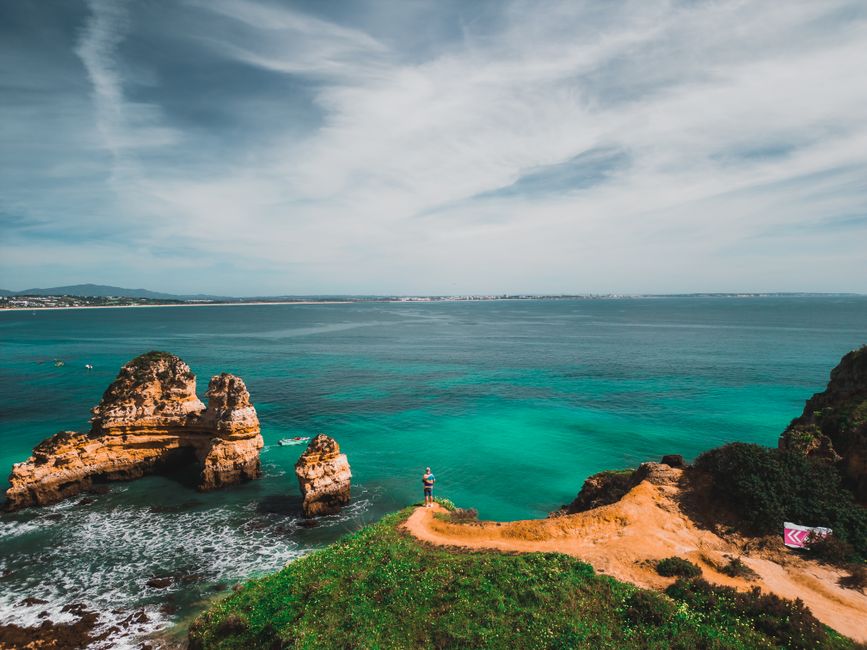
The Algarve is Portugal’s sunny south coast: golden sea cliffs and grottoes around Lagos and Benagil, big resort beaches near Albufeira, calm lagoon islands off Faro and Tavira, and wild surf beaches on the west coast. Come in May–June or September–October for warm sea and fewer people. Base yourself in one or two towns and give it 5 to 10 days.
Right now in Algarve (Faro)
- Wed17–25°C62–77°FMostly clear
- Thu19–27°C65–81°FClear
- Fri19–27°C66–80°FClear
Top tours in Algarve
See all tours for Algarve →
From local operators, with prices and reviews; you check availability and book on Viator, our partner. We may earn a commission at no extra cost to you. How we earn money
The Algarve at a glance
- What it is: Portugal’s southernmost region, the same area as the district of Faro, with 16 municipalities between the Atlantic west coast and the Spanish border on the Guadiana river. Faro is the regional capital.
- Best for: beach holidays, boat and kayak trips to sea caves, coastal walks, surfing, golf and seafood.
- Best time: May–June and September–October. July and August are hot, dry and the busiest months.
- Sea temperature: roughly 19–21 °C in late summer off Faro, a degree or two cooler around Sagres (as of October 2026).
- Airport: Faro (FAO), a few kilometres west of Faro city.
- Blue Flag 2026: 85 sea beaches plus one inland river beach in the Algarve won a Blue Flag this year, level with the North for the most of any region (as of October 2026).
- Need a car? Not for one base town with day trips by boat, bus or train. Yes for the west coast, hidden coves and the hills inland.
- Country basics: entry rules, money, phones and general safety are on our Portugal travel guide.
The four parts of the Algarve, and who each suits
Locals split the coast into the Barlavento (the west) and the Sotavento (the east). For planning, think in four parts.
Western Algarve and the Costa Vicentina: wild and surfy
From Sagres and Cape St Vincent (Cabo de São Vicente), the south-west tip of mainland Portugal, the coast turns north towards Odeceixe. This is the Algarve stretch of the Southwest Alentejo and Vicentine Coast Natural Park, protected by ICNF from Odeceixe down to Burgau. Expect high dark cliffs, long beaches in open valleys, Atlantic swell, surf camps and almost no high-rise building; the water is cooler and the wind stronger. Suits: surfers, hikers, campervanners, couples and anyone who wants space.
Barlavento: Lagos, Portimão, Carvoeiro and Benagil, cliffs and grottoes
This is the Algarve on the postcards: golden limestone cliffs, rock arches, sea stacks and small coves at the bottom of wooden staircases. Lagos has a walled old town and is the base for Ponta da Piedade. Portimão has the big sandy Praia da Rocha and the river-mouth beach at Alvor. Carvoeiro is a whitewashed village squeezed into a cove, and next door in Lagoa sit Benagil and Praia da Marinha. Suits: first-timers, couples, boat-trip and kayak fans, and families who want a lively town nearby.
Central Algarve: Albufeira and Vilamoura, the resort coast
Albufeira, Vilamoura, Quarteira, Vale do Lobo and Quinta do Lago have the most hotels, apartments, golf courses and nightlife. Beaches here are long and sandy with ochre cliffs behind them, like Falésia, with smaller coves around Albufeira’s old town. Suits: families who want everything close by, groups of friends, golfers, and anyone who wants an easy package-style week.
Sotavento: Faro, Olhão, Tavira and the Ria Formosa, calm water and islands
East of Faro the cliffs end. The Ria Formosa Natural Park runs for about 60 km from the Ancão peninsula to Manta Rota: a lagoon of channels, salt marsh and sandbanks behind a chain of barrier islands and peninsulas (ICNF figures). The sea beaches are on the outer side of the islands, reached by small ferries from Faro, Olhão, Fuseta, Tavira and Cabanas. Towns feel more Portuguese and less touristy, and the sea is usually calmer and warmer than in the west. Suits: families with small children, birdwatchers, slow travellers, food lovers and people who want a real town as a base.
Best beaches in the Algarve, by type
Pick by mood. A Blue Flag means the beach met the 2026 programme’s water-quality, safety and services criteria; many famous coves are simply not entered, so no flag doesn’t mean dirty water. Lifeguards work in the official bathing season: in 2026 that was 15 May to 15 October in Albufeira and 1 June to 30 September in most other Algarve municipalities.
Cliff coves
- Praia da Marinha (Lagoa): clear water, rock arches and stacks; one of the most photographed beaches in Portugal. Car park on top, then a steep path and steps down. The Seven Hanging Valleys trail starts here.
- Praia do Camilo and Praia Dona Ana (Lagos): small coves just south of Lagos town, Camilo at the bottom of a long wooden staircase. Both get very full in summer; go early or late.
- Praia de Benagil (Lagoa): a little fishing beach that is the starting point for boat and kayak trips to the famous cave next door. You can’t reach the cave from it on foot or by swimming (see the rules below).
- Vale Centeanes and Carvoeiro (Lagoa): a sheltered cove with a lifeguard and a village beach right in town, both Blue Flag in 2026.
Long sandy beaches
- Meia Praia (Lagos): several kilometres of sand east of Lagos, with room even in August. Blue Flag 2026.
- Praia da Rocha and Alvor (Portimão): wide town beaches with a promenade, cafés and watersports; all Blue Flag in 2026.
- Falésia (Albufeira): a long strip under red and orange cliffs, good for walks at sunset.
Island beaches
- Ilha de Tavira: a long island beach with a campsite and cafés near the ferry pier and quieter sand the further you walk. Ferry from Tavira town or Quatro Águas.
- Culatra, Farol and Armona (from Olhão): car-free islands with fishing communities, a lighthouse at Farol and shallow lagoon water on the inner side. As of October 2026, unofficial timetables list the one-way fare from Olhão at about €2.10 to Culatra and €2.40 to Farol.
- Ilha da Barreta, also called Ilha Deserta (Faro): almost empty sand reached by boat from Faro.
- Barril (Tavira): walk or ride the little train across the marsh from Pedras d’El Rei to a beach known for its “anchor cemetery” from the old tuna fishery.
Family beaches
For small children, choose beaches with gentle slopes, lifeguards and no long staircases: Meia Praia, Praia da Luz (Lagos), Alvor, Armação de Pêra, Vilamoura and Quarteira, Manta Rota and Monte Gordo near the Spanish border, or the lagoon side of the Ria Formosa islands. All the named beaches held a Blue Flag in 2026, as did the lagoon-side beaches at Armona and Fuseta.
Surf beaches
On the west coast, Arrifana (Aljezur) is a horseshoe bay under high cliffs, Amado (Carrapateira) is a classic beach for surf schools, and Monte Clérigo and Odeceixe are good family surf beaches. Around Sagres, Tonel and Beliche face the open swell while Mareta and Martinhal are more sheltered. Arrifana, Monte Clérigo, Odeceixe, Tonel, Mareta and Martinhal held a Blue Flag in 2026.
Towns to base yourself in
- Lagos: the best all-rounder. A real old town with restaurants and bars, a marina for boat trips, Ponta da Piedade cliffs a short walk away, a train station, and the west coast within 30–40 minutes by car. Lively and young in summer.
- Albufeira: the biggest resort. Old-town lanes above the beach, the busy “Strip” for nightlife, and dozens of beaches nearby. Easy and convenient, though not quiet in high summer.
- Tavira: the prettiest town in the east, with a river, an old bridge, churches, tiled houses and the Ilha de Tavira ferry. Calm, local and good for families and couples.
- Faro: a compact walled old town, the airport next door, and boats into the Ria Formosa. Good for a first or last night, or a short break with good public transport.
- Carvoeiro: a small, hilly cove village close to Benagil, Marinha and the Seven Hanging Valleys. Lovely for couples; bring a car or be ready for taxis.
- Sagres: the surf and nature base at the end of the road. Relaxed, windy, with a fort and Cape St Vincent’s lighthouse nearby. Few big-name sights, plenty of sunsets.
Combining Lisbon with the Algarve? See the itineraries on our Portugal guide.
Things to do in the Algarve
Boat and kayak trips to the grottoes, including Benagil
Seeing the cliffs from the water is the Algarve’s signature day out. The Algar de Benagil is a sea cave with a round hole in its roof that lets a column of light onto a small sandy beach. After safety problems with crowding, the Portimão harbour master (Capitania do Porto de Portimão, part of the National Maritime Authority) brought in navigation rules for the caves on 13 August 2024 (Edital 19/2024), amended by Edital 9/2025. As of October 2026 the rules are:
- No landing on, or using, the beach inside the cave, for private visitors and for tour companies.
- No swimming into the caves, and no reaching them on floats or other swimming aids.
- No renting kayaks without a guide in the caves area. Guided kayak tours need one guide kayak for every six visitor kayaks.
- Limits on how many boats and kayaks can be inside at once and on how long each visit lasts; no navigation between sunset and sunrise.
- The 2025 amendment separates boat traffic, with different entrances for rigid motorboats and inflatables, and requires life jackets near rockfall areas.
- Operators who break the rules face fines of €300 up to €216,000.
In practice: book a licensed boat trip (from Benagil, Carvoeiro, Armação de Pêra, Portimão or Albufeira) or a guided kayak or paddleboard tour from Benagil beach. Boats only go in when the sea allows, so book early in your stay to leave time for a second try. Calm mornings are best for kayaks. The area is also part of the Pedra do Valado marine natural park (Parque Natural Marinho do Recife do Algarve), so leave nothing behind.
Ponta da Piedade, Lagos
A headland of honey-coloured pillars, arches and caves just south of Lagos. Walk the clifftop paths and boardwalks from Praia Dona Ana and Camilo to the lighthouse, go down the steps to the water for the close-up view, and take a short boat or kayak trip from Lagos marina or the jetty below to paddle through the arches.
Seven Hanging Valleys trail
The Percurso dos Sete Vales Suspensos (Lagoa trail PR1 LGA) follows the clifftops for about 5.7 km one way between Praia da Marinha and Praia de Vale Centeanes, passing Benagil and the cave from above, Carvalho beach and the Alfanzina lighthouse. It is linear, so plan a taxi back or walk the return; allow 2–3 hours one way. Start early in summer: there is almost no shade.
Rota Vicentina hiking
The Rota Vicentina is a network of about 750 km of marked trails in south-west Portugal. Its coastal Fishermen’s Trail is 226.5 km in 13 day stages from São Torpes to Cape St Vincent, with the last stages in the Algarve (Odeceixe, Aljezur, Arrifana, Carrapateira, Vila do Bispo). The inland Historical Way is 263 km in 13 stages. The official site warns that 60–70% of the Fishermen’s Trail is on sand, it isn’t for people with vertigo, groups are limited to 15, and the cliff edges are eroding. Spring and autumn are the best walking seasons; summer days are hot and exposed.
Surfing at Sagres, Arrifana and Amado
Because the coast faces two directions, there’s usually a surfable beach somewhere: the west coast picks up Atlantic swell, and the south-facing bays near Sagres stay cleaner when the north wind blows. Surf schools at Amado, Arrifana and Sagres run lessons for all ages. Wear a wetsuit; the water is cooler here than on the south coast.
Dolphin watching
Boat trips from Lagos, Portimão, Albufeira, Vilamoura and Faro head offshore to find dolphins. Pick a licensed operator that doesn’t chase the animals, and a calm day if you get seasick.
Ria Formosa islands and birdlife
Ferry-hop to the islands, take a boat tour through the channels, or walk the trails at the park’s Quinta de Marim centre near Olhão or the Ludo marshes near Faro, where flamingos and spoonbills turn up depending on the season (ICNF). The coast near the park is also one of the few places in Portugal where the Mediterranean chameleon lives.
Golf
The Algarve is one of Europe’s best-known golf regions, with dozens of courses, most between Vilamoura, Quinta do Lago and Lagos. Spring, autumn and winter are the popular golf seasons; book tee times ahead.
Food: cataplana, sardines and the markets
Try a cataplana, the seafood stew cooked and served in a hinged copper pan and meant for sharing; grilled sardines, best from early summer; clams Bulhão Pato style; octopus; and fresh fish sold by weight. Visit Olhão’s riverside market halls on a Saturday morning, and try the almond and fig sweets.
Activities and best months
- Beaches and swimmingBeaches along the whole coast, for example Porto de Mós, Dona Ana, Camilo, Alvor, Vau and Carvoeiro.
- Boat tripsBoat trips go into the sea caves and grottos of Ponta da Piedade (Lagos) and to the Benagil cave (Lagoa); dolphin-watching trips leave from Portimão.
- HikingJanFebMarAprMayJunSepOctNovDecLong-distance Via Algarviana (about 300 km) and Rota Vicentina, plus the Seven Hanging Valleys cliff trail; September to June are the recommended walking months, summer is very hot.
- SurfingJanFebMarAprMayJunJulAugSepOctNovDecAround Sagres (Tonel, Martinhal) there are good waves all year thanks to beaches facing different directions; Praia da Rocha works only in winter.
Getting there and getting around
From Faro airport
- To Faro city: Próximo bus 16 takes about 20 minutes to the centre (single €2.80 paid on board, as of October 2026). Buses signed “Praia de Faro” go the other way, to the beach. A taxi takes about 12 minutes.
- To the western Algarve: the Vamus Aerobus (route 56) runs direct from the airport to Albufeira, Lagoa, Portimão and Lagos. As of October 2026 it runs five times a day from May to October and twice a day from 1 November 2026 to 1 May 2027. The faster TransRápido (route 57) runs from Faro bus station to Lagos.
- By train: there is no airport station. Take the bus or a taxi to Faro station, then the regional train along the coast.
From Lisbon
Five trains a day link Lisbon and Faro, calling at Tunes, Albufeira and Loulé; the fastest take about three hours, and two of them run through to or from Porto (as of October 2026). Seats must be booked on these long-distance trains. For Lagos or Portimão, change at Tunes to a regional train. Express coaches take a little over three hours, and the drive down the A2 and A22 takes about 2.5–3 hours. Arrival times and fares: see getting around Portugal.
Getting around: car, train or bus?
- Train: the single coastal line runs from Lagos to Vila Real de Santo António via Portimão, Silves, Tunes, Albufeira, Loulé, Faro, Olhão and Tavira. Since 19 July 2026 it runs with new electric trains, and there are now direct trains from end to end with no change at Faro. Faro to Lagos takes about 1 hour 40 minutes and costs €8.30 one way (as of October 2026). Some stations, including Albufeira’s and Loulé’s, are a bus or taxi ride from town.
- Bus: Vamus runs most regional buses: fine between towns, slow for beach-hopping, and thinner in winter and at weekends.
- Car: the best way to reach the west coast, Monchique and the quieter coves. The A22 motorway (Via do Infante) across the Algarve has been toll-free since 1 January 2025 under Law 37/2024; the A2 from Lisbon still has tolls. Parking at Marinha, Camilo and Benagil fills by mid-morning in summer.
- Boats: small passenger ferries cross the Ria Formosa from Faro, Olhão, Fuseta, Tavira and Cabanas. Summer timetables are frequent; winter ones are thin, so check the last boat back.
Best time to visit the Algarve, and how long to stay
Air temperatures and rain days below are the 1991–2020 climate normals for Faro from IPMA, Portugal’s weather institute. Sea temperatures are ten-year satellite averages for Faro and Sagres (seatemperature.info), as of October 2026.
| Season | Average daytime high (Faro) | Rainy days a month | Sea (Faro / Sagres) | Crowds |
|---|---|---|---|---|
| Winter (Dec–Feb) | 16–17 °C | 5–7 | 16–17 / 15–17 °C | Quiet; some beach restaurants and boat trips close. Good for golf and walks. |
| Spring (Mar–May) | 19–24 °C | 4–6 | 16–18 / 15–17 °C | Moderate; wildflowers on the west coast and lovely hiking. Sea still fresh. |
| Summer (Jun–Aug) | 27–29 °C | Under 1 | 20–21 / 18–19 °C | Busiest, especially August; book boats, beds and cars early. |
| Autumn (Sep–Nov) | 20–26 °C | 2–7 | 19–21 / 18–20 °C | September is still busy; October is the sweet spot, with the warmest sea and fewer people. |
For warm water, open restaurants and space on the sand, aim for June or mid-September to mid-October.
4 days: one base, the highlights
Stay in Lagos or Carvoeiro. Day 1: Ponta da Piedade walk and a boat trip to the grottoes. Day 2: a Benagil boat or kayak trip in the morning, then Praia da Marinha. Day 3: the Seven Hanging Valleys trail early, an afternoon on the beach. Day 4: Sagres, Cape St Vincent and a west-coast beach for sunset.
7 days: west and east
Four nights in Lagos or Carvoeiro (as above), then three in Tavira: a ferry to Ilha de Tavira, a day on the Ria Formosa islands from Olhão (with the Saturday market), and an afternoon in Faro’s old town before your flight.
10 days: the whole coast
Three nights around Sagres or Aljezur for surf lessons and a Rota Vicentina stage, three in Lagos or Carvoeiro for the cliffs and caves, one in the central Algarve for a lazy beach or golf day, and three in Tavira for the islands, Olhão and Faro.
Weather month by month
Where to stay in the Algarve, by area
- First visit without a car: Lagos or Faro, both on the train line with walkable centres and boat trips from town.
- Families: Alvor, Armação de Pêra, the Vilamoura–Quarteira area, Tavira or Manta Rota. Apartments and resorts with pools are common; choose a place a short, flat walk from the beach.
- Couples: Carvoeiro, Ferragudo, Tavira, or a rural guesthouse in the hills behind the coast.
- Nightlife and groups: Albufeira (the Strip and old town), Praia da Rocha and Lagos.
- Surf and nature: Sagres, Vila do Bispo, Carrapateira, Aljezur or Odeceixe.
- Golf and upscale resorts: Vilamoura, Vale do Lobo and Quinta do Lago.
Most Algarve municipalities, including Albufeira, Faro, Portimão and Lagoa, charge a tourist tax of about €1–2 per person per night (the higher rate in the warmer months), usually for a maximum of seven nights. It’s normally paid at check-in (as of October 2026).
Practical tips for the Algarve
- Sun: the UV index often reaches very high levels from late spring to early autumn (check IPMA’s daily UV forecast). Use high-factor sunscreen, a hat and a beach umbrella, and avoid the midday hours on cliff walks.
- Cliffs: the sandstone and limestone cliffs collapse without warning. Keep well back from the edges on top, don’t sit or lay your towel at the foot of a cliff, and respect the warning signs and taped-off areas.
- Beach flags: green means swimming is allowed; yellow means paddle at the water’s edge but don’t swim; red means don’t go in the water at all. A red-and-yellow striped flag marks the zone watched by lifeguards. Outside the bathing season most beaches have no lifeguard.
- August crowds: reach the famous coves before 10 am, book boat trips and car hire well ahead, and reserve dinner tables in Lagos, Albufeira and Carvoeiro.
- Water shoes: useful on rocky coves, on the lagoon side of the islands and for kayak launches. In shallow sandy water, weever fish can bury themselves and give a painful sting; shuffling your feet and wearing water shoes helps, and lifeguards can treat it with hot water.
What to pack for the Algarve
- Reef-friendly, high-factor sunscreen, sunglasses, a wide-brimmed hat and a UV rash vest for long boat or kayak trips.
- Water shoes and a dry bag for phones on kayak and boat tours.
- Trail shoes with grip for the Seven Hanging Valleys and the Rota Vicentina (much of it on sand and rock).
- A light windproof layer or fleece: west-coast evenings and boat trips can be cool even in summer, and winter nights are chilly.
- A reusable water bottle, shade for families, and snorkel gear for calm coves.
- A light rain jacket from November to March.
What to pack
- Day packs and anti-theft bagsCarries water, towel and sunscreen down the long stairways to Algarve coves.
- Dry bags and phone pouchesProtects phones and cameras from sand and spray on beaches reached by ferry or steep paths.
- Fleeces and warm layersIt is cooler at sea than on land, especially on morning whale-watching trips.
- HeadlampsLevada routes such as PR1 and PR9 pass through long, dark, wet tunnels.
- Hiking shoes and bootsMadeira's levadas and the Azores' crater rims are wet, rocky and slippery, so grippy shoes matter more than anywhere else in Portugal.
- Quick-dry beach towelsA sand-shedding quick-dry towel packs small for beach days and lido visits.
- Rain jacketsA windproof, waterproof shell keeps you warm on open boats, where wind and spray cool you quickly.
- Reef-friendly sunscreenSummer UV is strong on Portuguese beaches and there is little shade below the cliffs.
- Surf accessories (boots, leashes, wax)Neoprene boots keep feet warm in winter and protect them on rock and reef breaks.
- Trekking polesLong stone staircases and steep descents on Madeira's peaks and the Azores' crater rims are easier on the knees with poles.
- Water bottles and hydration packsAlgarve and Alentejo trails are hot and exposed with few refill points.
- Water shoesRocky coves, lava pools and weever fish in shallow sand make water shoes useful.
- WetsuitsOn the west and north coasts the sea stays around 16–18 °C even in summer, so a thin suit helps for long swims.
Algarve travel FAQ
Can you still go inside Benagil cave?
Yes, by licensed boat or on a guided kayak or paddleboard tour, but you can’t step onto the beach inside, swim in, or rent a kayak without a guide in the caves area. Those rules have applied since 13 August 2024 and were still in force as of October 2026.
What is the best part of the Algarve to stay in?
For a first trip, Lagos or Carvoeiro, close to the cliffs, caves and boat trips. Choose Tavira for calm water and a local feel, Albufeira for resorts and nightlife, and Sagres or Aljezur for surfing.
When is the sea warmest in the Algarve?
From August to October, when it averages about 20–21 °C off Faro. The east is usually warmer and calmer than the west coast, where it averages around 19 °C at its warmest.
Is the Algarve good in winter?
For walks, golf, cycling and a mild escape, yes: Faro averages 16–17 °C by day in winter. It’s not a swimming season, and many beach bars and boat tours shut or cut back their hours.
Do I need a car in the Algarve?
Not if you stay in Lagos, Faro, Tavira or Albufeira and use trains, buses, ferries and boat trips. A car makes it far easier to reach the west coast, quiet coves and the hills. The A22 coast motorway has had no tolls since January 2025.
How do I get from Faro airport to Lagos?
Take the direct Vamus Aerobus (route 56) when it runs, or the bus or a taxi to Faro station and then the regional train, about 1 hour 40 minutes from Faro to Lagos. By car it’s about an hour along the A22.
Which Algarve beaches are best for small children?
Long, gently shelving beaches with lifeguards: Meia Praia, Praia da Luz, Alvor, Armação de Pêra, Manta Rota and Monte Gordo, and the lagoon side of the Ria Formosa islands, which is shallow and calm.
Can I surf in the Algarve as a beginner?
Yes. Surf schools at Amado, Arrifana, Monte Clérigo and around Sagres pick the right beach for the day’s waves. Lessons run all year; spring and autumn often bring the friendliest conditions.
How do I visit the Ria Formosa islands?
Take a public ferry: from Olhão to Armona, Culatra and Farol; from Tavira or Quatro Águas to Ilha de Tavira; or from Faro to Ilha Deserta and Farol. Fares are a few euros. Or join a boat tour to see the lagoon’s channels and birdlife.
Is August too busy in the Algarve?
It’s the busiest and most expensive month, especially in Albufeira, Lagos and around Benagil. It still works if you book early, start the day early, and choose the long beaches or the islands over the famous small coves.
Can I go to Spain from the Algarve?
Yes, easily. A small passenger ferry crosses the Guadiana from Vila Real de Santo António to Ayamonte, and the motorway bridge carries cars and buses towards Huelva and Seville. There is no train across the border.
Plan your trip
Partner links: TravelerCenter may earn a commission if you book, at no extra cost to you.
🇵🇹 Useful Portuguese phrases for Algarve
All 38 Portuguese phrases: restaurant, hotel, emergencies, romance (printable) →
Traveler centers in Algarve
Tourist information offices, visitor centers and travel agencies in Algarve, from OpenStreetMap.
- Tourist information office
Centro Explicativo e de Acolhimento da Calçadinha de São Brás de Alportel
- Tourist information office
Posto de Turismo de Aljezur
- Travel agency
Algarve Offroad
- Tourist information office
Carvoeiro Tourist Information Centre
- Travel agency
Formosamar
- Travel agency
Futuro Destino
Sources · last reviewed 3 Oct 2026
Researched and last reviewed by TravelerCenter on 3 October 2026. Benagil cave rules come from the National Maritime Authority’s Portimão harbour master notices (Edital 19/2024 and 9/2025) as reported by the Lagoa e Carvoeiro parish council and the CCDR Algarve; Blue Flag beaches from the official 2026 list of the Associação Bandeira Azul de Ambiente e Educação; climate from IPMA’s 1991–2020 normals for Faro; Ria Formosa and Costa Vicentina park facts from ICNF and the Algarve Tourism Board; trail facts from Rota Vicentina; rail electrification from the Portuguese government; A22 tolls from Law 37/2024. Bus, ferry and train fares and timetables, sea temperatures and tourist taxes come partly from reputable unofficial sources, so check with the operator before you travel. Prices, timetables and access rules change.
Also: visitportugal.com · IPMA normals 1991–2020, Faro (climate)
Data: Weather: MET Norway (CC BY 4.0) · Sea temperature: NOAA CoastWatch · Rates: ECB · Costs: World Bank ICP and price levels · © OpenStreetMap contributors (ODBL) · Wikidata (CC0)