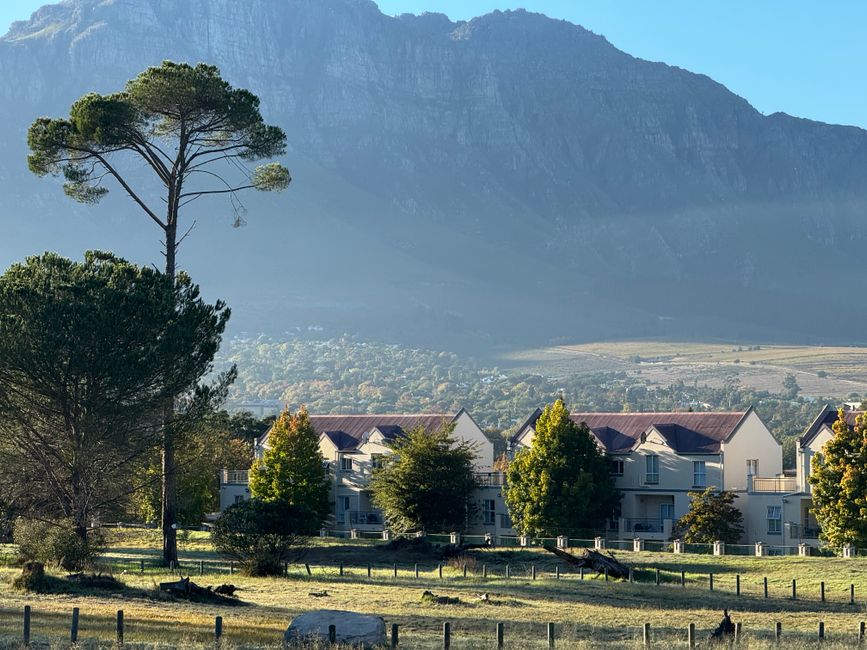
Stellenbosch is the heart of the Cape Winelands and one of the most charming towns in South Africa. Founded in 1679 by the Dutch governor Simon van der Stel, it is the country’s second-oldest European settlement after Cape Town, and its streets are still lined with whitewashed Cape Dutch, Georgian and Victorian buildings shaded by the oak trees that earned it the nickname Eikestad, the “city of oaks.” It is also a lively university town, home to Stellenbosch University, where the Pinotage grape was created in 1925, so the cafés, bars and restaurants are busy with students as well as visitors. But the main reason to come is the countryside: the town sits in a valley ringed by the Simonsberg, Jonkershoek and Helderberg mountains, and more than 150 wineries and grape growers belong to the Stellenbosch Wine Routes, many with tasting rooms, award-winning restaurants, art collections and gardens. It is under an hour’s drive from Cape Town and its airport, so it works as a day trip, but staying a few nights on a wine farm is a highlight of many South African trips. Stellenbosch has a Mediterranean climate: summer (December to February) is hot and dry, harvest runs from about February to April, and winter (June to August) is cool, green and rainy.
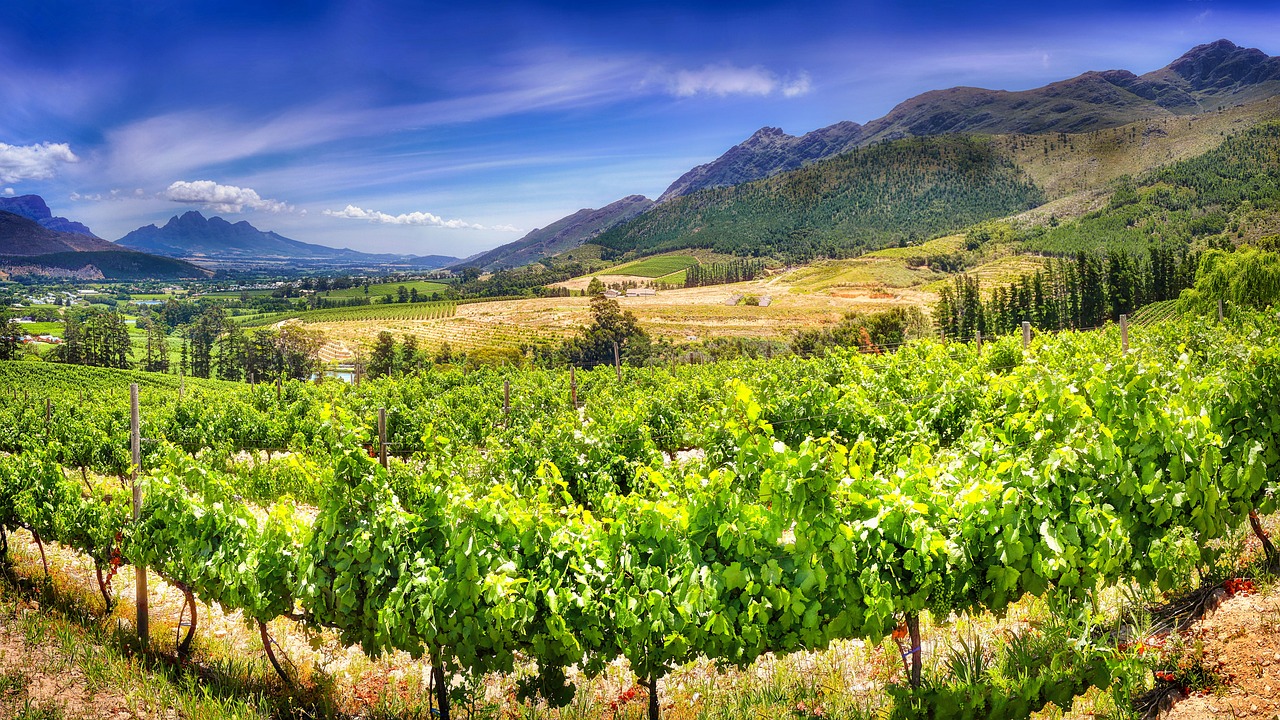
Right now in Stellenbosch
- Wed7–19°C44–67°FMostly clear
- Thu9–20°C48–69°FPartly cloudy
- Fri11–21°C52–70°FPartly cloudy
Top tours in Stellenbosch
See all tours for Stellenbosch →
From local operators, with prices and reviews; you check availability and book on Viator, our partner. We may earn a commission at no extra cost to you. How we earn money
Stellenbosch at a glance
- Best months: February to April (harvest season, warm, vines golden in autumn) and October to November (spring, green vines, comfortable temperatures). December and January are hot and busy; winter is quiet, cool and wet, with log fires and lower prices.
- Time needed: a full day for the town and three or four tastings; two or three nights to explore the wine routes and Franschhoek.
- Getting there: about 50 km (31 miles) east of Cape Town, around 45 minutes by car, and about 30 minutes from Cape Town International Airport.
- Costs (as of October 2026): a tasting of four to six wines usually costs about R80–200 (about US$5–12).
- Before you go: visas, money and safety basics are covered in our South Africa travel guide.
Stellenbosch areas and who each one suits
The historic town center
The compact center around Dorp Street, Church Street and Die Braak, the village green, is best explored on foot. Here are the Village Museum’s period houses, the Dutch Reformed Moederkerk, galleries, wine bars and the old-fashioned general store Oom Samie se Winkel. Staying in town suits travelers without a car and anyone who wants restaurants and nightlife on the doorstep.
Simonsberg and the Helshoogte Pass
North and east of town, the slopes of the Simonsberg mountain and the Helshoogte Pass toward Franschhoek are home to some of the most scenic estates, with mountain views, modern architecture and art collections. Stay on a wine farm here for the full Winelands experience; a car or driver is essential.
Jonkershoek Valley
A narrow valley southeast of town, ending at the Jonkershoek Nature Reserve, with hiking trails, waterfalls and a handful of wine farms. Good for hikers and those wanting quiet.
Helderberg and Somerset West
South of town, the Helderberg mountain area includes historic estates such as Vergelegen and is close to the beaches of False Bay at Strand and Gordon’s Bay.
Top things to see in Stellenbosch
Wine tasting on the Stellenbosch Wine Routes
The Stellenbosch Wine Routes group the area’s wineries into sub-routes such as Simonsberg-Stellenbosch, Bottelary Hills, Helderberg, Stellenbosch Berg and Banghoek, each with its own soils and microclimates. The region is best known for Cabernet Sauvignon, Bordeaux-style blends, Chenin Blanc, Syrah and Pinotage. Most estates open their tasting rooms daily or Monday to Saturday, and many require bookings at busy times. Plan three or four estates a day with a lunch stop, and don’t drink and drive: use a driver, a tour or a hop-on, hop-off wine bus. See our wine tasting guide.
Historic Dorp Street and the Village Museum
Dorp Street has one of the longest rows of historic buildings in the country. The Stellenbosch Village Museum spans four houses from different periods, from a simple 18th-century Cape Dutch home to a Victorian villa, furnished as they would have been. Combine it with a stroll past the university’s sandstone buildings, the botanical garden and the student-run galleries.
Jonkershoek Nature Reserve
Managed by CapeNature, the reserve has day hikes from easy riverside walks to steep climbs to the Jonkershoek peaks and the Panorama Circuit. Waterfalls flow best in winter and spring. A small conservation fee applies, and the gate closes in the evening. See our hiking guide.
Wine estates with art, gardens and food
Some estates are destinations in their own right: historic Lanzerac with its Cape Dutch manor; Spier, one of the oldest farms, with family picnics and art; Delaire Graff and Tokara on the Helshoogte Pass, known for views, sculpture and fine dining; Kanonkop, famous for Pinotage; and Vergelegen in Somerset West, with its gardens and camphor trees planted around 1700.
Stellenbosch University and the botanical garden
The university’s botanical garden, one of the oldest of its kind in South Africa, has succulents, ferns and the Welwitschia, and is free to visit. The campus has galleries and the Sasol Art Museum.
How a tasting works
At most estates you sit at a table or stand at a counter and choose from a short list of tasting options: a standard flight of four to six wines, a premium or reserve flight, or a pairing with chocolate, cheese, charcuterie or small plates. Staff pour a small measure of each wine and explain the grape, vineyard and winemaking; spittoons are provided, and nobody minds if you don’t finish a glass. Tasting fees are often waived if you buy bottles. Allow about an hour per estate, more for pairings or a cellar tour, and remember that many tasting rooms close around 17:00, earlier on Sundays. Families are welcome on many farms, with lawns, playgrounds and grape-juice tastings for children. If you’d like to learn more, some estates run blending sessions where you make your own wine to take home.
Stellenbosch on a budget
Wine country doesn’t have to be expensive. Walking the historic center, the university’s botanical garden and Die Braak costs nothing, and the Village Museum is inexpensive. Choose standard rather than premium tastings, share a picnic on an estate lawn instead of a tasting-menu lunch, and visit on weekdays, when some estates offer specials. Self-catering cottages and student-town guesthouses are cheaper than wine-farm hotels, and winter brings low-season rates across the Winelands.
Other things to do in Stellenbosch
- Cycling and mountain biking: trails on wine farms and in Jonkershoek and Banghoek; guided wine-cycling tours. See our cycling guide.
- Food and craft markets: weekend markets at wine estates and in town.
- Cheese, chocolate and gin tastings: many estates and artisan producers offer pairings.
- Horse riding: among the vineyards on several farms.
- Golf: courses at Pearl Valley and Stellenbosch Golf Club.
- Hot-air ballooning: early-morning flights over the Winelands and the Paarl valley in the calmer months, weather permitting.
- Picnics and family days: many estates sell picnic baskets to enjoy on lawns under the oaks, with children’s play areas and farm animals.
- Art and design: galleries in Dorp Street and Church Street, and sculpture gardens at several estates, showcase South African artists.
Food and drink
Stellenbosch is one of South Africa’s gastronomic centers, with many of its acclaimed restaurants on wine estates. Expect seasonal tasting menus, Cape Malay and farm-style dishes, game such as springbok, and long lunches overlooking the vines. In town, cafés and bistros on Church Street and Dorp Street are good for breakfast and casual dinners. Book ahead for estate restaurants, especially at weekends. Tip 10–15%.
From farm town to university town
After Simon van der Stel founded Stellenbosch on the banks of the Eerste River, French Huguenot refugees who arrived in the late 1680s settled in the surrounding valleys, especially Franschhoek, and helped develop the wine industry. The town became a center of Afrikaans education and culture; its university, established as such in 1918, educated many of the country’s leaders. Like the rest of the country, Stellenbosch is still confronting its apartheid history, including the forced removals of residents classified as “colored” from the town center in the 1960s, remembered at the Die Vlakte heritage project.
Day trips from Stellenbosch
Franschhoek
About 30 minutes over the Helshoogte Pass, Franschhoek, the “French corner,” has a Huguenot Monument and museum, a main street of restaurants and boutiques, and the Franschhoek Wine Tram, a hop-on, hop-off tram and bus service between wine estates.
Paarl and Wellington
North of Stellenbosch, Paarl has the granite domes of Paarl Mountain, the Afrikaans Language Monument and large estates; Babylonstoren, a farm with famous gardens, is between Paarl and Franschhoek.
Cape Town
Cape Town, 45 minutes away, is an easy day trip for Table Mountain and the Waterfront; many visitors combine nights in both.
Hermanus
Hermanus is about 1.5 hours southeast via Sir Lowry’s Pass or the coastal Clarence Drive, for whale watching and the Hemel-en-Aarde wine valley.
Nearby destinations
- Cape Town40 km
- Hermanus67 km
- Garden Route290 km
Getting there and getting around
By road
Most visitors drive or take a transfer from Cape Town or the airport via the N2 and the R310 or R44. A rental car gives the most freedom, but plan a designated driver for tasting days; South Africa’s drink-driving limit is low.
Wine tours, shuttles and ride-hailing
Guided wine tours from Stellenbosch and Cape Town, hop-on, hop-off wine shuttles, and private drivers make tasting days easy. Ride-hailing apps work in Stellenbosch, though cars can take longer to arrive on remote farms. Many estates are close enough for a guided bike tour.
By train
The Metrorail suburban line from Cape Town reaches Stellenbosch, but services are infrequent and not recommended for visitors.
When to go and how long to stay
Stellenbosch has hot, dry summers and cool, wet winters. Summer days are hotter than in Cape Town, often above 30 °C (86 °F) in January and February, because the town is inland and sheltered from the sea breeze, while winter brings rain to the mountains and occasional snow on the highest peaks. Harvest (February to April) is a favorite time, with busy cellars and autumn colors in April and May. Spring (September to November) brings fresh green vines and wildflowers.
| Month | Average high | Average low | Rain | Rain days (≥1 mm) |
|---|---|---|---|---|
| Jan | 27 °C (81 °F) | 17 °C (62 °F) | 9 mm (0.4 in) | 2 |
| Feb | 27 °C (81 °F) | 16 °C (62 °F) | 10 mm (0.4 in) | 2 |
| Mar | 26 °C (79 °F) | 15 °C (59 °F) | 12 mm (0.5 in) | 2 |
| Apr | 24 °C (74 °F) | 12 °C (54 °F) | 40 mm (1.6 in) | 5 |
| May | 21 °C (69 °F) | 10 °C (50 °F) | 61 mm (2.4 in) | 7 |
| Jun | 18 °C (65 °F) | 8 °C (47 °F) | 92 mm (3.6 in) | 10 |
| Jul | 18 °C (64 °F) | 7 °C (45 °F) | 85 mm (3.3 in) | 9 |
| Aug | 18 °C (64 °F) | 8 °C (46 °F) | 72 mm (2.9 in) | 9 |
| Sep | 20 °C (67 °F) | 9 °C (49 °F) | 44 mm (1.7 in) | 7 |
| Oct | 22 °C (72 °F) | 12 °C (53 °F) | 28 mm (1.1 in) | 4 |
| Nov | 24 °C (75 °F) | 13 °C (56 °F) | 25 mm (1.0 in) | 4 |
| Dec | 26 °C (78 °F) | 16 °C (60 °F) | 13 mm (0.5 in) | 3 |
| Year | 22 °C (72 °F) | 12 °C (54 °F) | 493 mm (19 in) | 65 |
Figures are the South African Weather Service’s 1991–2020 normals for Cape Town International Airport, about 25 km (16 miles) west of Stellenbosch, as published by the World Meteorological Organization; there is no Stellenbosch station in the WMO set. Stellenbosch is usually a few degrees hotter in summer and wetter in winter.
Events worth planning around
- Woordfees (usually March): a major Afrikaans arts and literature festival.
- Harvest celebrations (February to April): grape-stomping and harvest lunches at estates.
- Stellenbosch wine festival and Cabernet and Chenin Blanc events: check the Stellenbosch Wine Routes calendar.
Dates change each year; check with the organizers.
How long to stay: 1, 2 and 4 days
- One day: walk the historic center in the morning, then three tastings and lunch at an estate.
- Two days: add the Helshoogte Pass estates and Jonkershoek.
- Four days: add Franschhoek, Paarl and Babylonstoren, or the coast at Hermanus.
Where to stay in Stellenbosch
- Town center: boutique hotels and guesthouses within walking distance of restaurants.
- Wine farms: luxury hotels and cottages on estates, with tastings and restaurants on site.
- Jonkershoek and Banghoek valleys: quiet guest farms for hikers.
- Somerset West: larger hotels and easy access to the coast.
Book ahead for harvest weekends and December.
Typical costs in Stellenbosch
| Item (as of October 2026) | Rand | About US dollars |
|---|---|---|
| — | — | — |
| Wine tasting, 4–6 wines | about R80–200 | about $5–12 |
| Lunch at a wine estate restaurant | about R350–900 | about $21–54 |
| Full-day guided wine tour from Stellenbosch | about R1,200–2,500 | about $72–150 |
| Ride-hailing, town center to a nearby estate | about R60–150 | about $4–9 |
| Bottle of good Stellenbosch wine at the cellar door | about R120–400 | about $7–24 |
| Mid-range guesthouse or wine-farm room, per night | about R1,800–4,000 | about $110–240 |
All are typical ranges, not official prices. Conversions use about R16.60 to US$1.
Safety in Stellenbosch
Stellenbosch is a relaxed, well-kept town, and most visits are trouble-free.
- Drinking and driving: don’t drive after tastings; use spittoons, a designated driver, a tour or a ride-hail. Police run roadblocks and breath tests.
- Town: keep valuables out of sight and parked cars empty; use ride-hailing at night rather than walking through quiet streets.
- Hiking: in Jonkershoek and the mountains, carry water and layers, hike in daylight, and watch for sudden weather changes and fire risk in summer.
- Heat: summer can reach the high 30s °C (around 100 °F); drink water between tastings.
- Water and power: national load-shedding has been suspended; Cape Town’s dams, which also supply nearby towns, were about 75% full in early October 2026.
- Malaria: none; the Winelands are malaria-free.
- Emergencies: call 10111 for the police and 10177 for an ambulance, or 112 from a mobile.
Practical tips for Stellenbosch
- Book tastings: many estates take walk-ins on weekdays but prefer bookings at weekends and for food pairings.
- Shipping wine: estates can arrange shipping, or pack bottles in checked luggage within your country’s allowances.
- Sundays and Mondays: some tasting rooms and restaurants close; check opening days.
- Plugs and money: type M and N sockets at 230 V; cards accepted almost everywhere.
What to pack for Stellenbosch
Bring smart-casual clothes for estate restaurants, a sun hat, sunglasses and SPF 50 sunscreen, comfortable shoes for cobbled streets and vineyard walks, a light jacket for evenings, hiking shoes for Jonkershoek, and a rain jacket from May to September. See our hiking shoes and rain jackets guides.
Stellenbosch travel FAQ
How far is Stellenbosch from Cape Town?
About 50 km (31 miles), roughly 45 minutes by car from the city center and 30 minutes from Cape Town International Airport.
Can you do Stellenbosch as a day trip from Cape Town?
Yes. A day is enough for the historic center and three or four tastings, but staying a night or two lets you enjoy estate dinners without driving.
How much does wine tasting cost in Stellenbosch?
Usually about R80–200 (US$5–12) for four to six wines, more for premium or food-paired tastings.
How many wineries are there in Stellenbosch?
The Stellenbosch Wine Routes count more than 150 wineries and grape growers, grouped into several sub-routes.
What wine is Stellenbosch known for?
Cabernet Sauvignon and Bordeaux-style red blends, Chenin Blanc, Syrah and Pinotage, the South African grape created at Stellenbosch University in 1925.
How do I get around the wine farms without driving?
Join a guided wine tour, ride a hop-on, hop-off wine shuttle, hire a private driver, or use ride-hailing apps.
What is the best time to visit Stellenbosch?
February to April for harvest and autumn colors, or October and November for spring. Summer is hot and busy; winter is quiet and green.
Is Stellenbosch safe?
Yes, it is one of the more relaxed towns in the Western Cape. Take the usual care with valuables and parked cars and don’t drink and drive.
How far is Franschhoek from Stellenbosch?
About 30 km (19 miles), roughly 30 minutes over the scenic Helshoogte Pass.
Is Stellenbosch good for hiking?
Yes. The Jonkershoek Nature Reserve, run by CapeNature, has trails from easy river walks to strenuous mountain routes.
Plan your trip
Partner links: TravelerCenter may earn a commission if you book, at no extra cost to you.
Sources · last reviewed 5 October 2026
Researched and last reviewed on 5 October 2026. Load-shedding status: Eskom; Western Cape water situation: the City of Cape Town; exchange rate: the European Central Bank; climate: the South African Weather Service’s 1991–2020 normals for Cape Town International Airport via the World Meteorological Organization (nearest station; Stellenbosch has no station in the WMO set). The town’s history, the number of wineries, sub-routes, estates, Jonkershoek, distances, events and typical prices are general references and flagged for checking. For entry rules and money, see our South Africa travel guide.
Data: Weather: MET Norway (CC BY 4.0) · Rates: ECB · Costs: World Bank ICP and price levels · Wikidata (CC0)