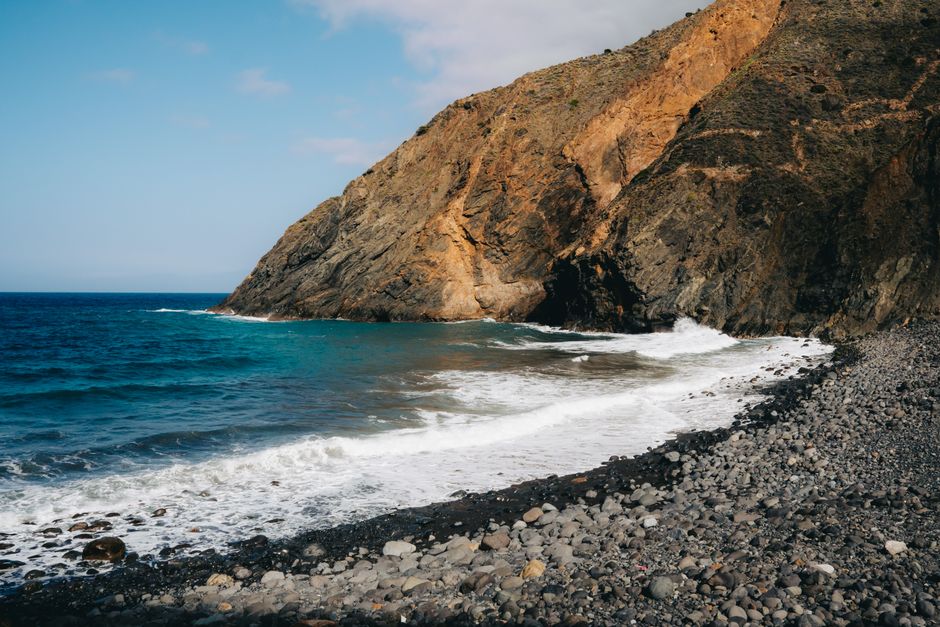
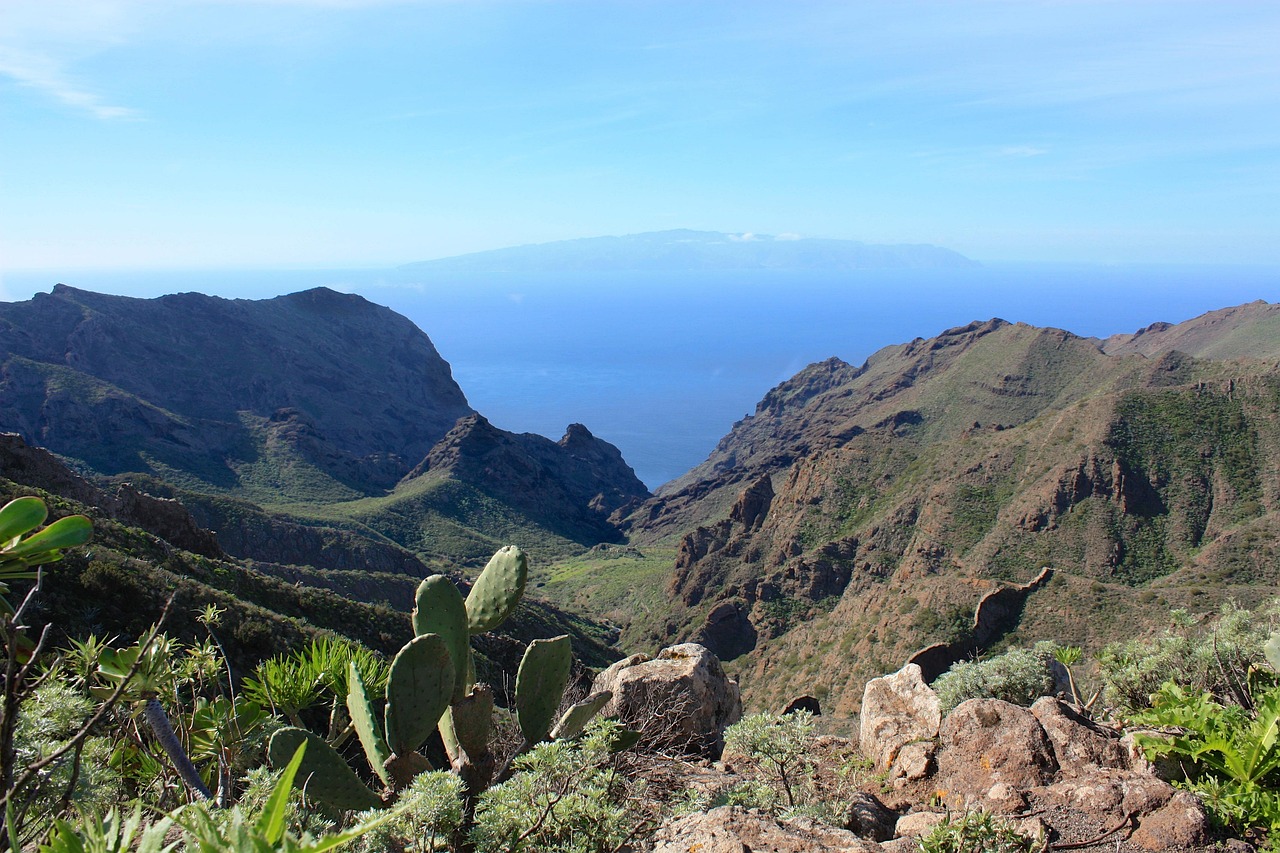
La Gomera is the small, round, steep island just west of Tenerife, a 50-minute ferry ride from Los Cristianos, and it feels a world away from the big resorts. Deep ravines (barrancos) run down from a misty central plateau to black-sand beaches, terraced hillsides of palms and bananas, and villages that cling to the slopes. At the top is Garajonay National Park, one of the best surviving laurel forests on Earth and a UNESCO World Heritage site since 1986. The island also gave the world the silbo gomero, a whistled language that UNESCO lists as intangible heritage and that schoolchildren still learn. There are no high-rise hotels and no big nightlife: La Gomera is for walkers, nature lovers, slow travellers and anyone who wants quiet coves and starry nights. It is pleasant all year; spring and autumn are the best months for hiking.
Right now in La Gomera (San Sebastián de La Gomera)
- Wed 22–27°C 71–81°F Cloudy
- Thu 21–26°C 70–79°F 2 mm Showers
- Fri 21–26°C 70–79°F 1 mm Clear
- Mon 12 Oct National Day of Spain (Fiesta Nacional de España)
Weather: MET Norway (CC BY 4.0) · Sea temperature: NOAA CoastWatch · Rates: ECB · Holidays: Nager.Date
Top tours in La Gomera
See all tours for La Gomera →
From local operators, with prices and reviews; you check availability and book on Viator, our partner. We may earn a commission at no extra cost to you. How we earn money
La Gomera at a glance
- Best for: hiking, laurel forest and ravine scenery, quiet black-sand beaches, whale and dolphin watching, and a slow, car-light holiday.
- How long: a day trip from Tenerife shows you Garajonay and a viewpoint or two; 4–5 days lets you walk properly and see both the north and the south-west.
- Best time: March to June and September to November for walking; the coast is warm all year, while the forest is cool, damp and often misty.
- Getting there: ferries from Los Cristianos on Tenerife to San Sebastián de La Gomera in about 50 minutes; short Binter flights from Tenerife North and Gran Canaria to La Gomera airport.
- Getting around: the Cabildo’s Guaguagomera buses link all six municipalities; a hire car is much more flexible on the winding roads.
- Before you go: entry rules, money, trains and general safety are on our Spain travel guide.
La Gomera’s towns and who each one suits
La Gomera is only about 25 km across, but the roads twist over ridges and round ravines, so distances feel much longer: the drive from San Sebastián to Valle Gran Rey takes well over an hour. The island has six municipalities, and the one you choose as a base shapes your trip.
San Sebastián de La Gomera
The capital and ferry port is a small, friendly town on the east coast with a town beach, a shady main square and a palm-lined promenade. Columbus took on supplies here in 1492 before sailing west; the 15th-century Torre del Conde stands in the centre. It is the easiest base if you arrive without a car, because every bus line starts or ends here.
Valle Gran Rey
A dramatic valley of terraced palms in the south-west that opens onto the sea at La Calera, La Playa and Vueltas harbour. It has the sunniest weather, the longest beaches and the most accommodation, with a laid-back atmosphere. Boats for whale watching and for Los Órganos leave from here. Best for longer stays, sunsets and anyone who wants a beach and a walk on the same day.
Hermigua, Agulo and Vallehermoso
The green north is wetter and lusher, with banana plantations, waterfalls after rain and rough Atlantic seas. Hermigua lies in a long, fertile valley with a natural rock pool by the sea; Agulo is a tiny, beautifully kept village of cobbled lanes beneath a cliff, with views of Teide across the water; Vallehermoso sits under the great volcanic plug of Roque Cano. Best for walkers and those who want rural peace.
Playa de Santiago
A former fishing and canning port on the dry south coast, close to the airport, with a pebbly beach, a few restaurants round the harbour and a large resort hotel on the cliffs above. Quiet, sunny and handy for the airport.
Top things to see on La Gomera
Prices and hours below were checked on the official sites in October 2026, unless we say otherwise; check again before you go. The national park and most viewpoints are free.
Garajonay National Park
The park protects the moist laurel forest (laurisilva) that covers the island’s central heights, a relic of the subtropical forests that grew around the Mediterranean millions of years ago. Moss hangs from the trees and trade-wind clouds drift through the branches. It was declared a national park in 1981 and was the first natural site in Spain on the UNESCO World Heritage list, in 1986. Entry is free. The park authority keeps a network of 18 numbered, marked routes, from 20-minute strolls to a six-and-a-half-hour circuit. Easy favourites are Raso de la Bruma (1.9 km, about 45 minutes) and the loops at La Laguna Grande. The park also runs guided walks for small groups, bookable on the national parks’ reservation site, reservasparquesnacionales.es. Park rules: stay on the paths, keep dogs on a lead, no camping or overnight stays, no fires outside the marked grills, no drones, and do not take plants or stones.
As of October 2026, the park’s notices list intermittent closures of the CV-14 road at El Rejo for slope works (weekdays 9:00–15:00 until the work ends), the Meseta de Vallehermoso track closed to vehicles but open on foot, and the grills at La Laguna Grande closed until 15 October. Trails and visitor centres also close on days of weather warnings for wind or rain, and in summer there is a forest fire pre-alert; check the park’s “Incidencias” page before you set out.
Alto de Garajonay and the visitor centre
The island’s highest point, at about 1,490 m, has a stone viewing platform with a view on clear days across the sea to Teide, La Palma, El Hierro and Gran Canaria. The quickest way up is official route 17 from the Pajarito car park on the main ridge road (2.2 km, about 1 hour 15 minutes there and back), or route 7 from El Contadero (2.5 km, about an hour). The park’s visitor centre, Juego de Bolas, is at La Palmita above Agulo, on the northern edge of the park: as of October 2026 it opens daily 9:30–16:30 (closed 25 December and 1 January), with an exhibition on the forest and the island, a garden of native plants and a viewpoint. The information point at La Laguna Grande, on the GM-2 road, opens daily 8:30–16:30 and is the starting point for several walks.
Roque de Agando and the Degollada de Peraza
The road from San Sebastián to the heights passes some of the island’s most striking scenery: the Roque de Agando, a sheer-sided volcanic plug rising from the edge of the forest, with its neighbours Ojila, La Zarcita and Carmona, best seen from the Mirador de los Roques. Official route 13 makes a short, medium-difficulty walk from Agando to Casa del Manco and back (2.7 km, about 1 hour 15 minutes).
Mirador de Abrante
Above Agulo, close to the Juego de Bolas visitor centre, this viewpoint has a glass-floored walkway jutting out over a cliff hundreds of metres above the village, with Teide on the horizon across the sea. Opening hours change with the season and have varied in recent years, so check locally; the walkway may close in strong wind.
The silbo gomero
Shepherds and farmers once talked across La Gomera’s deep ravines by whistling: the silbo gomero turns Spanish into whistled tones that carry for kilometres. UNESCO added it to its list of the Intangible Cultural Heritage of Humanity in 2009, and it has been taught in the island’s schools since 1999. You may hear demonstrations at restaurants and cultural events.
More to see
- Los Órganos: a cliff of tall, organ-pipe basalt columns on the north coast near Vallehermoso, visible only from the sea on a boat trip.
- Mirador César Manrique: the viewpoint and restaurant designed by the Lanzarote artist above Valle Gran Rey, looking straight down the terraced valley.
- Roque Cano: the volcanic plug that towers over Vallehermoso.
- Chipude and La Fortaleza: a hill village known for its hand-made pottery, below the flat-topped table mountain that was sacred to the island’s first inhabitants.
- Playa de Alojera and Charco del Conde: a black-sand cove in the west and a calm tidal lagoon in Valle Gran Rey, good for children.
Other things to do on La Gomera
Hiking the ravines and the GR 131 and GR 132
La Gomera is one of the best walking islands in Europe, with old stone mule tracks linking every village. Two long-distance trails cross it: the GR 131, part of the path that runs across the Canary Islands, climbs from San Sebastián through the Degollada de Peraza and Garajonay; the GR 132 circles the island near the coast in eight stages of about 128 km in total. Most visitors pick day walks: the descent into Valle Gran Rey from Arure, or the El Cedro valley from Hermigua. The slopes are steep and the terrain rough, so allow more time than the distance suggests, carry water and plan the return by bus or taxi. See our hiking guide.
Whale watching and boat trips
The waters between La Gomera and Tenerife are one of Europe’s best places to see whales and dolphins, with resident pilot whales and frequent dolphins. Boats leave Valle Gran Rey (Vueltas) and some sail along the north-west coast to Los Órganos. Choose an operator with the Canary Islands’ “Blue Boat” (Barco Azul) authorisation for whale watching, and expect a rolling sea on the open coast. See our boat trips guide.
Beaches and swimming
Gomera’s beaches are mostly dark sand and pebbles, and the Atlantic can be rough, so pick your spot carefully. The calmest swimming is in Valle Gran Rey (La Playa, Playa del Inglés when it is calm, and the Charco del Conde lagoon), at Playa de Santiago, and on the town beach in San Sebastián. In the north, swim in sea pools such as Hermigua’s rather than the open sea. Snorkelling is good off the rocks on calm days. See our beaches and snorkeling guides.
Food and drink
Try almogrote, a spicy spread of hard cheese, pepper and oil; miel de palma, a dark syrup made from palm sap; potaje de berros (watercress stew); and fresh fish with papas arrugadas and mojo sauce.
Day trips and onward travel
Tenerife
Most visitors combine La Gomera with Tenerife, where the international flights land: a few nights on each works well. See our Tenerife guide and Teide National Park, whose summit you can see from Garajonay on a clear day.
Gran Canaria, La Palma and El Hierro
Fred. Olsen Express lists sailings from La Gomera to Gran Canaria (about 2 hours 10 minutes), and Binter flies from La Gomera to Gran Canaria. For La Palma and El Hierro, island-hopping is easiest through Tenerife; check the operators’ timetables, which change by season. See our Gran Canaria guide.
Nearby destinations
- Tenerife63 km
- La Palma87 km
- Gran Canaria161 km
Getting there and getting around
Ferries from Tenerife
As of October 2026, Fred. Olsen Express sails from Los Cristianos, in the south of Tenerife, to San Sebastián de La Gomera in about 50 minutes, and Armas Trasmediterránea also runs fast ferries on the same route. Both carry cars. Fred. Olsen also runs an internal coastal service on La Gomera, linking San Sebastián with Playa de Santiago (about 30 minutes) and Valle Gran Rey (about 70 minutes). Fares shown on the operators’ home pages are often resident fares; check the full fare, and book ahead with a car.
Flights
La Gomera airport (GMZ), run by Aena, is on the south coast near Playa de Santiago. According to Aena, in 2026 it has daily Binter flights to Gran Canaria and Tenerife North; there are no international flights. Guaguagomera bus line 6 links the airport with Valle Gran Rey (via Chipude and Las Hayas), and line 7 with San Sebastián; both leave after flight arrivals and run to the airport about two hours (line 6) or 1 hour 45 minutes (line 7) before departures.
Buses, cars and taxis
The island’s public buses, Guaguagomera, belong to the Cabildo de La Gomera and run eight lines from the San Sebastián bus station to Valle Gran Rey, Vallehermoso, Alajeró and Playa de Santiago, plus the airport. Line 1 crosses the island from San Sebastián to Valle Gran Rey (67 km) through the national park, stopping at Pajarito and the Mirador César Manrique; as of October 2026 the full journey costs €5, with shorter trips from €1. Services are limited, so check the timetables on guaguagomera.com or its app. A hire car gives far more freedom; roads are good but narrow and very winding, and the drive is slow.
When to go and how long to stay
La Gomera has a mild subtropical climate, with big differences between the sunny, dry south and west coasts and the cloudy, cool forest above about 800 m. There is no AEMET climate-normals station on the island, so the table uses AEMET’s 1991–2020 normals for Tenerife South airport (64 m), about 55 km east of San Sebastián across the strait, which is close to conditions on La Gomera’s sheltered south and east coasts: average daily highs and lows, and days with at least 1 mm of rain. The north is wetter, and in Garajonay it is often 8–10 °C cooler than on the coast, with mist and drizzle on many days.
| Season | Average high / low | Rainy days per month | What it’s like | Good for |
|---|---|---|---|---|
| Winter (Dec–Feb) | 23–24 °C / 15–17 °C | 2–3 | Mild and sunny on the coast; cold, wet and misty in the forest | Coastal walks, escaping the northern winter |
| Spring (Mar–May) | 24–25 °C / 16–17 °C | 0–1 | Fresh and green, flowers in the ravines | Hiking, Garajonay, whale watching |
| Summer (Jun–Aug) | 26–29 °C / 19–21 °C | 0 | Hot and dry on the coast; fire pre-alert in the hills | Beaches, boat trips, early-morning walks |
| Autumn (Sep–Nov) | 28 °C falling to 25 °C / 21 °C falling to 18 °C | 1–2 | Warmest sea; the first rains arrive in October and November | Swimming, hiking from October |
The station records only about 120 mm of rain a year, mostly from October to February; the forest heights get far more moisture from cloud. Hot, dusty days of calima can come at any time of year. These are long-term averages; recent summers have often been hotter.
Events worth planning around
- Carnival (February or March): street parades in San Sebastián and Valle Gran Rey.
- Early September: the Fiestas Colombinas in San Sebastián, remembering Columbus’s departure in 1492.
- October, every five years: the Bajada de la Virgen de Guadalupe, when the island’s patron is carried by boat and through every village; it last took place in 2023.
How long to stay: 1, 4 and 7 days
1 day (from Tenerife): take the first ferry from Los Cristianos, hire a car or join a tour, drive up past the Roque de Agando, walk to the Alto de Garajonay or round Raso de la Bruma, look down from the Mirador César Manrique, have lunch in Valle Gran Rey and catch the evening ferry back.
4 days: base yourself in Valle Gran Rey; add a whale-watching trip and Los Órganos, a walk into El Cedro, the north (Hermigua, Agulo, the Juego de Bolas visitor centre and the Mirador de Abrante) and an evening in San Sebastián. 7 days: split the stay between Valle Gran Rey and the north or Playa de Santiago, and walk a different ravine every other day, with beach days in between.
Where to stay on La Gomera and the tourist tax
- Valle Gran Rey: the most choice of apartments and small hotels, beaches and sunsets; best for longer stays.
- San Sebastián: practical for the ferry and buses, with a historic parador above the port.
- Hermigua and Agulo: rural houses and small hotels in the green north, ideal for walkers.
- Playa de Santiago: a quiet south-coast village and the island’s large resort hotel, near the airport.
- Casas rurales: restored farmhouses in hill villages such as Chipude, El Cercado or Las Hayas; you will need a car.
As of October 2026 we found no tourist tax in force on La Gomera or anywhere in the Canary Islands at regional level; check when you book. Prices include the Canary sales tax, IGIC, not mainland VAT. Accommodation is limited and much of it is small, so book early for Easter, Christmas and the winter high season.
Practical tips for La Gomera
- Check the park notices: Garajonay closes trails and centres on days of weather warnings; look at the “Incidencias” page and the AEMET forecast before a walk.
- Allow time on the roads: an hour on the map can mean an hour and a half at the wheel, and buses are infrequent.
- Dress in layers: it can be 25 °C on the beach and 12 °C in the mist at Garajonay on the same day.
- Respect the sea: swim only where it is calm and sheltered, and never on red-flag days.
- Emergencies: call 112.
What to pack for La Gomera
Bring proper hiking shoes or boots with good grip, as the old paths are steep, stony and slippery when wet, and walking poles help on the long descents. Pack a daypack with a refillable bottle, snacks and a map or offline app. Layers matter more than anywhere else in the Canaries: a fleece and a waterproof jacket for the misty forest, and shorts, a sun hat, sunglasses and high-factor sunscreen for the coast. For the beach, add water shoes for the pebbles and a snorkel mask. If you get seasick, take tablets for the ferry and whale-watching boats.
La Gomera travel FAQ
How do I get from Tenerife to La Gomera?
By ferry from Los Cristianos to San Sebastián de La Gomera, about 50 minutes with Fred. Olsen Express; Armas Trasmediterránea also sails the route. There are also short Binter flights from Tenerife North airport.
Can I visit La Gomera as a day trip?
Yes, with an early ferry, a hire car or an organised tour you can see Garajonay, a viewpoint or two and Valle Gran Rey, but it is a long day of winding roads. A few nights is far more rewarding.
Do I need to book or pay to visit Garajonay National Park?
No. Entry and the marked trails are free and need no permit. Only the park’s guided walks, and in summer car access to the El Cedro (Riachuelo) area in the daytime, are booked on reservasparquesnacionales.es.
What is the easiest walk to the Alto de Garajonay?
Official route 17 from the Pajarito car park: 2.2 km there and back, about 1 hour 15 minutes, or route 7 from El Contadero, 2.5 km in about an hour. Go in the morning for the best chance of a clear view.
What is the silbo gomero?
A whistled form of Spanish that islanders used to talk across the ravines. UNESCO lists it as Intangible Cultural Heritage of Humanity (2009), and it is taught in La Gomera’s schools.
Do I need a car on La Gomera?
Not strictly: Guaguagomera buses link every municipality and pass through the national park. But services are limited, so a car makes day walks and viewpoints much easier.
Does La Gomera have good beaches?
It has dark-sand and pebble beaches rather than golden ones, and the sea can be rough. Valle Gran Rey, Playa de Santiago and San Sebastián have the calmest swimming; in the north use the sea pools.
Is there a tourist tax on La Gomera?
As of October 2026 we found no tourist tax in force on La Gomera or across the Canary Islands at regional level. Check when you book.
When is the best time to visit La Gomera?
March to June and September to November for hiking; the coast is warm enough for the beach all year. Winter brings the most rain and mist in the forest, and midsummer is hot for walking.
Sources and last review
Researched and last reviewed on 4 October 2026. Garajonay National Park routes, visitor centres, rules and notices: the park’s official site (Gobierno de Canarias) and the national parks’ reservation centre; ferries: Fred. Olsen Express and Armas Trasmediterránea; flights and airport buses: Aena; island buses and fares: Guaguagomera (Cabildo de La Gomera); climate: AEMET 1991–2020 normals for Tenerife South airport, as published by the WMO. The Mirador de Abrante’s hours, the GR 132 stages and length, and the event dates come from secondary sources or general knowledge and are flagged for checking. Prices, timetables and rules change, so check the official links before you travel. For entry rules, money and general safety, see our Spain travel guide.
Plan your trip
Partner links: TravelerCenter may earn a commission if you book, at no extra cost to you.
🇪🇸 Useful Spanish phrases for La Gomera
All 38 Spanish phrases: restaurant, hotel, emergencies, romance (printable) →