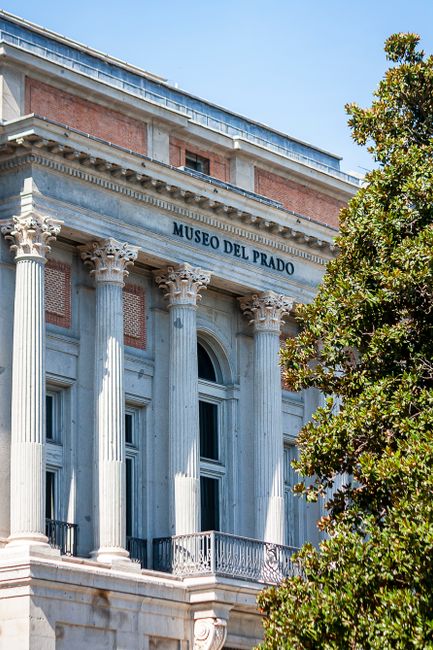
The Prado Museum (Museo Nacional del Prado) is Spain’s national art museum on Madrid’s Paseo del Prado, home to one of the world’s great collections of European painting, from Velázquez’s Las Meninas to Goya’s “Black Paintings”. As of October 2026 a ticket costs €15 (€7.50 reduced), and under-18s and students up to 25 get in free. It opens Monday to Saturday 10:00–20:00 and Sundays and holidays 10:00–19:00, with free entry for everyone in the last two hours. Buy a timed ticket online and allow two to three hours.
Right now in Museo del Prado
- Wed13–21°C56–70°F2 mm rain
- Thu12–19°C53–67°FMostly clear
- Fri8–18°C46–64°FClear
- Mon 12 Oct National Day of Spain (Fiesta Nacional de España)
Tickets and tours for Museo del Prado
See all tours for Museo del Prado →
From local operators, with prices and reviews; you check availability and book on Viator, our partner. We may earn a commission at no extra cost to you. How we earn money
Why the Prado matters
The museum opened on 19 November 1819 as the Royal Museum of Painting and Sculpture, in a building designed by Juan de Villanueva in 1785. Its first catalogue listed 311 paintings, chosen from about 1,500 brought from the royal palaces. That royal collection is still the Prado’s backbone. It grew from the 16th century under Charles V and kept growing under the Habsburg and Bourbon kings, who collected Titian, Rubens and Bosch and employed Velázquez and Goya as court painters. More than 2,300 paintings have been added since, through gifts, bequests and purchases.
Since 1995 the Prado has covered art made before 1881, the year of Picasso’s birth; later art belongs to the Reina Sofía. In 2021 UNESCO added the Paseo del Prado and the Retiro park, “a landscape of Arts and Sciences”, to the World Heritage list.
What you’ll see
Most visitors build their route around a handful of masterpieces:
- Velázquez: Las Meninas, the puzzle of a painting where the painter looks out at you, and his royal portraits.
- Goya: The Third of May 1808, his portraits of the royal family, and the dark, haunting “Black Paintings” he painted on the walls of his house.
- Bosch: The Garden of Earthly Delights, a crowded triptych of paradise, pleasure and hell.
- El Greco, Titian and Rubens: some of the best rooms of each anywhere, thanks to the Spanish kings’ taste.
The museum’s website suggests ready-made itineraries if you only have an hour or two. Pick five or six works in advance and you’ll enjoy it more than trying to see everything.
Tickets and how to visit
From the Prado’s official website, as of October 2026:
- Tickets: general €15; reduced €7.50 for over-65s, holders of a youth card and members of large families. Free for under-18s and students aged 18–25, with valid proof shown at the ticket office.
- Free hours: the last two hours every day, Monday to Saturday 18:00–20:00 and Sundays and holidays 17:00–19:00.
- Hours: Monday to Saturday 10:00–20:00; Sundays and public holidays 10:00–19:00. Closed 1 January, 1 May and 25 December; 10:00–14:00 on 6 January, 24 December and 31 December.
- Timed entry: you need a time pass; buy online and arrive at your time to skip the ticket queue.
- Audio guide: €5 extra.
- Paseo del Arte pass: €32.80 for the Prado, Reina Sofía and Thyssen-Bornemisza.
- Rules: no photography or filming in the galleries. Suitcases and items larger than 40 × 40 cm are not allowed, and the free cloakroom has limited space. Children under 14 must be with an adult.
How long to allow and when to go
Two to three hours covers the highlights without exhaustion; art lovers can easily spend a day. A timed morning ticket is the calm way to see it. The free last two hours are popular, so queue early and head straight to the rooms you’ve chosen.
Accessibility
The Jerónimos entrance on Calle Felipe IV gives priority access for visitors with reduced mobility. Inside there are lifts, ramps, platforms and accessible toilets, and wheelchairs and baby buggies can be borrowed at the cloakroom.
Getting there
The closest metro stations are Banco de España (650 m) and Estación del Arte (800 m); Retiro is about 1.3 km away. Atocha station, for Cercanías and long-distance trains, is about 1 km south, and buses 001, 10, 14, 27, 34, 37, 45 and C03 stop nearby. From Sol it is about a 15-minute walk.
Combine it with
The Reina Sofía, with Picasso’s Guernica, is 700 metres south, and the Thyssen-Bornemisza is just across the Neptune fountain. Behind the museum, the Retiro park is perfect for a rest after the galleries. The Royal Palace is about 2 km west. See our Madrid travel guide and our city sightseeing guide.
Prado Museum FAQ
When is the Prado free?
Every day in the last two hours: Monday to Saturday 18:00–20:00 and Sundays and holidays 17:00–19:00 (as of October 2026). Under-18s and students aged 18–25 enter free at any time.
Do I need to book the Prado in advance?
It’s best to. Entry works with timed passes, and buying online lets you skip the ticket-office queue, especially in summer and at weekends.
Can you take photos in the Prado?
No. Photography and filming are not allowed in the galleries.
How long do you need at the Prado?
Two to three hours for the highlights, such as Las Meninas, Goya’s Black Paintings and Bosch’s Garden of Earthly Delights.
Is the Prado open on Mondays?
Yes. It opens every day except 1 January, 1 May and 25 December, from 10:00 to 20:00 (to 19:00 on Sundays and holidays).
Is the Prado wheelchair accessible?
Yes. Use the Jerónimos entrance on Calle Felipe IV for priority access; there are lifts and ramps, and wheelchairs can be borrowed at the cloakroom.