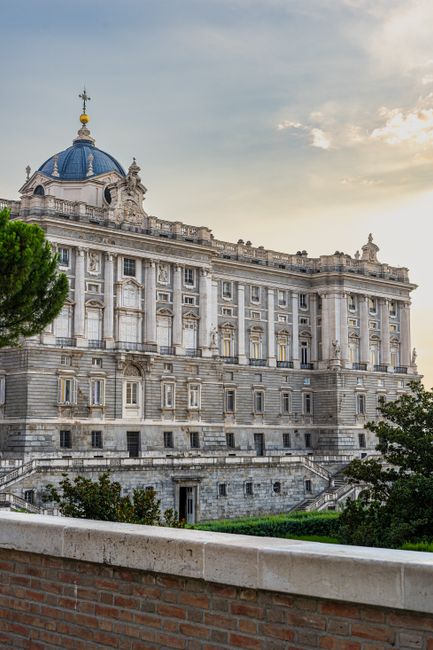
The Royal Palace of Madrid (Palacio Real) is the official residence of the Spanish royal family, still used for state ceremonies, and one of the largest palaces in Europe. It was built from 1738 on the site of the old Alcázar fortress. As of October 2026 a ticket costs €18 (€9 reduced, under-5s free), and it opens Monday to Saturday 10:00–18:00 and Sundays 10:00–16:00 until March. EU and Latin American citizens and EU residents get in free in the last two hours, Monday to Thursday. Allow 1½ hours with the Royal Armoury.
Right now in Royal Palace of Madrid
- Wed14–21°C56–69°F1 mm rain
- Thu11–19°C52–67°FMostly clear
- Fri7–16°C45–61°FClear
- Mon 12 Oct National Day of Spain (Fiesta Nacional de España)
Tickets and tours for Royal Palace of Madrid
See all tours for Royal Palace of Madrid →
From local operators, with prices and reviews; you check availability and book on Viator, our partner. We may earn a commission at no extra cost to you. How we earn money
Why the Royal Palace matters
For centuries Spain’s kings lived in the Alcázar, a Moorish castle on this ridge above the Manzanares that Philip II turned into the royal residence from 1561. On Christmas Eve 1734 it burned down. Philip V, the first Bourbon king, ordered a new palace that could never burn: the architect Giovanni Battista Sacchetti adapted the grand designs of his master Filippo Juvarra, and wooden ceilings were replaced by stone vaults. The foundation stone was laid on 6 April 1738, the main building was finished in 1751, and Charles III moved in in 1764.
With more than 135,000 square metres and over 3,000 rooms, it outsizes most of Europe’s famous royal palaces. The king no longer lives here (the royal family’s home is the Palacio de la Zarzuela outside the city), but the palace still hosts state banquets and official ceremonies, which can close it at short notice. It is managed by Patrimonio Nacional.
What you’ll see
The self-guided route climbs a grand staircase to the state rooms, decorated by the leading artists of the 18th century, with ceiling frescoes by Tiepolo, Giaquinto and Mengs. Highlights are the Throne Room, decorated to celebrate the glory of Spain’s kings, with a ceiling by Tiepolo; the Gasparini Room, Charles III’s richly decorated dressing room; and the Royal Chapel. The palace also keeps a quartet of instruments by Antonio Stradivari.
Outside the main route, the Royal Pharmacy shows the jars and remedies of the court’s apothecary. Across the Plaza de la Armería, the Royal Armoury holds Charles V’s Roman-style parade armour and harnesses of Philip II. It reopened in April 2026 after nearly two years of renovation, with about 2,500 pieces on show.
Tickets and how to visit
From Patrimonio Nacional’s official ticket site, as of October 2026:
- Self-guided visit: €18. Reduced €9 for ages 5–16, over-65s and students up to 25. Free for under-5s, unemployed visitors, members of large families and visitors with a disability of 33% or more plus a companion.
- Free hours: Monday to Thursday, 16:00–18:00 from October to March and 17:00–19:00 from April to September, for EU and Latin American citizens and EU residents and work-permit holders. Tickets only at the box office, self-guided only, with ID.
- Guided tour: €26 (reduced €17). English tours Monday to Saturday at 10:45, 11:45, 13:45 and 15:15.
- Combined tickets: palace plus the Royal Collections Gallery next door (Royal District Essential Pass) €24; palace plus the Royal Kitchens €24.
- Hours: October–March, Monday to Saturday 10:00–18:00; April–September to 19:00; Sundays all year 10:00–16:00. The box office closes an hour before the palace.
- Closed in 2026: 1 and 6 January, 1 May and 25 December, and from 15:00 on 24 and 31 December, plus days with official events.
- Rules: photos without flash are allowed, but no tripods or selfie sticks. Because of improvement works, large backpacks and suitcases are best left at your hotel.
The Changing of the Guard
The Royal Guard changes at the Puerta del Príncipe on Calle de Bailén every Wednesday and Saturday between 11:00 and 14:00 (10:00–12:00 in July and August). On the first Wednesday of most months a much grander ceremony, the Relevo Solemne, with about 400 people and 100 horses in uniforms of Alfonso XII’s day, takes place around noon and lasts about 50 minutes; spectators enter by the Puerta de Santiago. Both are free and can be cancelled for bad weather or official events; the next one is on 7 October 2026, and there is none in January, August or September.
How long to allow and when to go
The palace route takes about 45 minutes and the Royal Armoury about 30 more. Weekday mornings are the calmest; the free hours bring long queues. Check Patrimonio Nacional’s site the day before, as official events can close the palace.
Accessibility
The palace is accessible for visitors with reduced mobility, and wheelchairs can be borrowed.
Getting there
Ópera station, on metro lines 2 and 5, is a short walk across the Plaza de Oriente. Buses 3, 25, 39 and 148 stop nearby, and Cercanías trains stop at Príncipe Pío. Individual visitors enter through the Plaza de la Armería, the esplanade shared with the Almudena Cathedral.
Combine it with
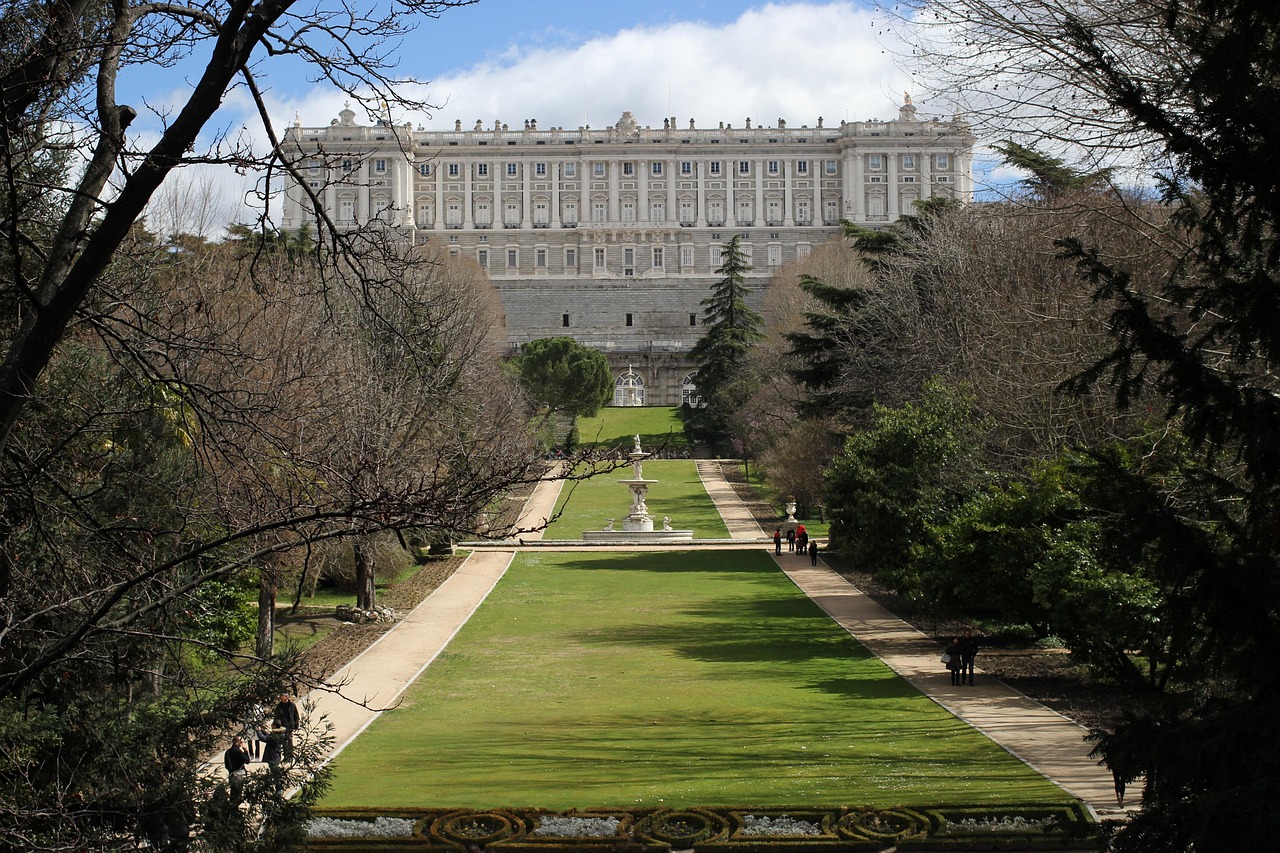
Next door are the Almudena Cathedral and the Royal Collections Gallery, and in front of the palace the Plaza de Oriente and the Sabatini Gardens. Walk to Plaza Mayor and the Mercado de San Miguel for lunch, and finish with sunset at the Temple of Debod. The Prado Museum is about 2 km east. See our Madrid travel guide and our city sightseeing guide.
Royal Palace of Madrid FAQ
Can I visit the Royal Palace for free?
EU and Latin American citizens, and EU residents or work-permit holders, can: Monday to Thursday, 16:00–18:00 from October to March and 17:00–19:00 from April to September, with ID, at the box office. Everyone else pays €18 (as of October 2026).
How long does the Royal Palace visit take?
About 45 minutes for the palace route and another 30 minutes for the Royal Armoury.
When is the Changing of the Guard?
Every Wednesday and Saturday between 11:00 and 14:00 (10:00–12:00 in July and August) at the Puerta del Príncipe. The grand ceremony is on the first Wednesday of the month, except January, August and September.
Does the king live in the Royal Palace?
No. The royal family lives at the Palacio de la Zarzuela, outside the city centre, but the Royal Palace is still used for state ceremonies and banquets.
Can you take photos inside?
Yes, without flash. Tripods and selfie sticks are not allowed.
Is the Royal Palace open on Sundays?
Yes, from 10:00 to 16:00 all year. It is closed on a few holidays and on days with official events.