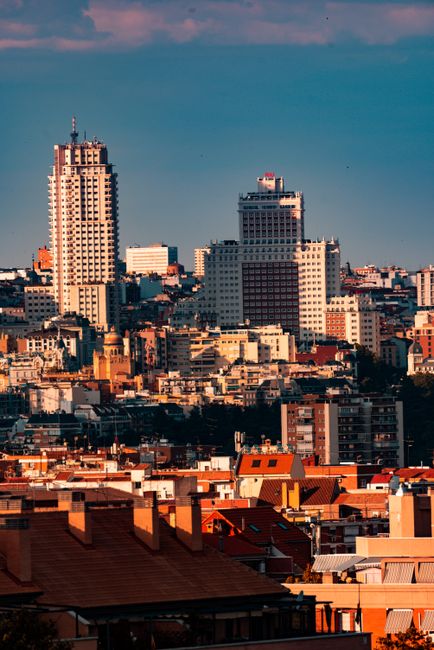
Madrid is Spain’s capital and its liveliest big city: three of Europe’s great art museums a short walk apart, a royal palace, a huge park for rowing boats and Sunday picnics, and neighbourhoods where tapas bars stay full past midnight. It sits high on the central plateau, so summers are hot and dry and winters crisp and sunny. Give it three days for the highlights, five to add Toledo and Segovia, and a week to live like a local.
Right now in Madrid
- Wed 13–21°C 56–70°F 1 mm Light showers
- Thu 12–20°C 53–67°F Clear
- Fri 8–18°C 46–64°F Clear
- Mon 12 Oct National Day of Spain (Fiesta Nacional de España)
Weather: MET Norway (CC BY 4.0) · Rates: ECB · Holidays: Nager.Date
Top tours in Madrid
See all tours for Madrid →
From local operators, with prices and reviews; you check availability and book on Viator, our partner. We may earn a commission at no extra cost to you. How we earn money
Madrid at a glance
- Best for: art, tapas and late nights, royal history, parks, football and easy day trips.
- How long: 3 days for the main sights, 5 with two day trips, 7 at a relaxed pace.
- Best time: April to early June and mid-September to October. July and August are very hot.
- Getting in: Metro line 8, the 24-hour Exprés Aeropuerto bus (€5) or a €33 flat-fare taxi from the airport; high-speed trains from all over Spain.
- Tourist tax: none on hotel stays (as of October 2026).
- Before you go: entry rules, money and general safety are on our Spain travel guide.
Madrid’s neighbourhoods and who each one suits
Most of what visitors want sits in a compact centre you can cross on foot in about 40 minutes, from the Royal Palace in the west to the Retiro park in the east.
Sol and Centro
Puerta del Sol is the city’s hub, with the “kilometre zero” plaque and the clock that chimes in the New Year. Pedestrian streets lead to Plaza Mayor, the Opera district and the palace. Busy and touristy, but unbeatable for a first visit, with several metro lines underneath.
Las Letras and Huertas
The Literary Quarter, between Sol and the Paseo del Prado, is where Cervantes lived; quotes from Spanish writers are set in brass in the pavement. Plaza de Santa Ana is ringed with terraces and old taverns. Ideal for museum lovers who want a lively evening on the doorstep.
La Latina
Medieval Madrid: crooked streets, domed churches and small squares south of Plaza Mayor. Calle de la Cava Baja is the best-known tapas street, and on Sunday afternoons the bars overflow after the Rastro market. Come for food and atmosphere.
Lavapiés
Madrid’s most diverse and bohemian barrio, with Indian and Senegalese restaurants, alternative theatres and cheap bars, close to the Reina Sofía and Atocha. It suits younger travellers and the curious; the streets are steep and some blocks scruffy.
Malasaña
North of Gran Vía, the heart of the 1980s Movida still feels young and creative: vintage shops, brunch cafés and late bars around Plaza del Dos de Mayo. Choose it for nightlife and independent shops.
Chueca
The centre of Madrid’s LGBTQ+ life and of the Pride celebrations: stylish and welcoming, with design shops, wine bars and the San Antón market and its roof terrace. A good base for couples and friends.
Salamanca
The elegant 19th-century grid north of the Retiro, with designer shopping on Calle de Serrano, smart restaurants and quiet, wide streets. It suits families and travellers who want calm nights, at a higher price.
Chamberí
Residential and local, with neighbourhood markets, old-style bars and the Sorolla Museum in the painter’s house and garden. Calle de Ponzano is a favourite strip for after-work tapas. Good value, a few metro stops from the centre.
Top things to see in Madrid
Prices and hours were checked on the official sites in October 2026; check again before you go. The three big museums have their own section below.
- Royal Palace (Palacio Real): the official residence of the Spanish royal family, still used for state ceremonies; the route through its grand halls takes about 45 minutes. As of October 2026 tickets cost €18, or €9 for ages 5–16, over-65s and students under 26; under-5s are free. It opens Monday to Saturday 10:00–18:00 from October to March and 10:00–19:00 from April to September, and Sundays 10:00–16:00. EU and Latin American citizens and EU residents enter free Monday to Thursday in the last two hours, with ID.
- Changing of the Guard: free at the Puerta del Príncipe on Calle de Bailén, Wednesdays and Saturdays between 11:00 and 14:00 (10:00–12:00 in July and August). The big ceremony with horses is around noon on the first Wednesday of the month, except January, August and September; the next is on 7 October 2026.
- Retiro park: 125 hectares of gardens and fountains, with a lake for rowing boats, the glass Palacio de Cristal (closed for restoration as of October 2026) and the Palacio de Velázquez, which hosts free Reina Sofía exhibitions. The park is free and opens 6:00–24:00 from April to September and 6:00–22:00 from October to March. It closes during wind or heat alerts.
- Paseo del Prado: since July 2021 the museum boulevard and the Retiro have been a UNESCO World Heritage Site, “Paseo del Prado and Buen Retiro, a landscape of Arts and Sciences”. Walk it from Cibeles to Atocha past the Neptune fountain and the Botanical Garden.
- Plaza Mayor: the arcaded 17th-century main square, free and always open. Have a coffee on a terrace, then a cheaper bocadillo de calamares (squid sandwich) in a side street.
- Mercado de San Miguel: an iron-and-glass market hall beside Plaza Mayor, now a gourmet tapas market with more than 20 stands. As of October 2026 it opens Sunday to Thursday 10:00–24:00 and Friday, Saturday and holiday eves 10:00–1:00. Pricey and packed at night; go mid-morning.
- Gran Vía and the Temple of Debod: admire the grand early-20th-century avenue from a rooftop bar, then watch the sunset at the ancient Egyptian temple in the park above the palace.
- El Rastro: the huge open-air flea market in La Latina on Sunday mornings. Go early, keep your bag in front, and finish with vermouth nearby.
Other sights
- Plaza Mayor
- Puerta del Sol
Museums
- Museo del Prado
- Museo Nacional Centro de Arte Reina Sofía
- Thyssen-Bornemisza Museum
Palaces
Parks and gardens
- El Retiro Park
Madrid’s great art museums
The Prado, Reina Sofía and Thyssen-Bornemisza, the “Golden Triangle of Art”, line the Paseo del Prado and cover European painting from the Middle Ages to today. Do one per morning or afternoon, not all three in a day, and use the free hours to pop back for a favourite room.
Museo del Prado
One of the world’s great painting collections, built on the Spanish royal collection: Velázquez’s Las Meninas, Goya’s Third of May 1808 and “Black Paintings”, Bosch’s Garden of Earthly Delights, plus El Greco, Titian and Rubens. As of October 2026 a ticket costs €15 (reduced €7.50). It opens Monday to Saturday 10:00–20:00 and Sundays and holidays 10:00–19:00, with free entry in the last two hours. A timed morning ticket is the calm way to see it.
Museo Reina Sofía
Spain’s modern art museum, in a former hospital near Atocha. Most visitors come for Picasso’s Guernica, shown with his sketches, but Dalí and Miró are here too. As of October 2026 a ticket is €12. It opens Monday and Wednesday to Saturday 10:00–21:00 and Sunday 10:00–14:30, and is closed on Tuesdays. The museum says 14:00–18:00 is the quietest time.
Museo Nacional Thyssen-Bornemisza
The Thyssen fills the gaps: Italian primitives, Dutch masters, Impressionists, Expressionists and American painting, in a palace opposite the Neptune fountain. As of October 2026 a ticket is €14 (€10 for over-65s and students; free under 18), temporary exhibitions included. From September to June it opens Tuesday to Friday and Sunday 10:00–19:00 and Saturday 10:00–23:00 (Tuesday to Friday and Sunday until 21:00 in July and August), and Mondays 12:00–16:00 only.
| Museum | Ticket (Oct 2026) | Closed | Free entry |
|---|---|---|---|
| Prado | €15 | A few holidays | Mon–Sat 18:00–20:00; Sun and holidays 17:00–19:00 |
| Reina Sofía | €12 | Tuesdays | Mon, Wed–Sat 19:00–21:00; Sun 12:30–14:30 |
| Thyssen | €14 | 1 Jan, 1 May, 25 Dec | Mon 12:00–16:00 (collection); Sat 21:00–23:00 (temporary exhibitions) |
Free slots are busy and for individuals only. If one museum matters to you, pay for a morning ticket and keep the free hours for a short second visit.
Other things to do in Madrid
Go out for tapas (and eat late)
Madrid runs on a late clock. Lunch, the main meal, is from about 14:00 to 16:00, and dinner rarely starts before 21:00. The local way is to hop between bars with a drink and a small plate in each: patatas bravas, croquetas, tortilla, callos (tripe stew) and, in winter, cocido madrileño. Start on Cava Baja, around Plaza de Santa Ana or on Calle de Ponzano, and end with chocolate con churros.
Tour the Santiago Bernabéu
Real Madrid’s rebuilt stadium runs a self-guided tour of the trophy museum, panoramic views, dressing rooms and players’ tunnel. As of October 2026 the classic ticket costs from €37 online or €40 at the ticket office. It opens Monday to Saturday 9:00–19:00 and Sundays and holidays 9:30–18:30, every day except 25 December and 1 January. On match days it closes 5 hours 30 minutes before kick-off. Metro line 10 stops at Santiago Bernabéu.
Parks, Madrid Río and bikes
Row a boat on the Retiro lake, then join the locals on the grass. Along the Manzanares river, Madrid Río is a long, flat park built over a buried motorway, with paths, playgrounds and summer fountains for children. BiciMAD shared e-bikes make it an easy ride.
Rooftops, flamenco and nightlife
Have a sunset drink on a rooftop along Gran Vía or at the Círculo de Bellas Artes, then move on to Malasaña, Chueca or Huertas; clubs fill after 1:00. For tradition, book a flamenco show in a tablao or see a zarzuela, Madrid’s light opera. For a cheaper lunch, try the bar counters at the San Antón, San Fernando or Antón Martín markets.
Day trips from Madrid
Five UNESCO-listed towns are within about an hour. Times are approximate: Spanish high-speed trains have run slower since speed restrictions were introduced in 2026, so check the timetable when you book.
Toledo
The “city of three cultures” crowns a hill in a loop of the Tagus, with a Gothic cathedral, synagogues and El Greco’s paintings in a maze of steep lanes. Renfe’s Avant trains from Madrid-Puerta de Atocha take about 30 minutes; buses from Plaza Elíptica take about an hour.
Segovia
A two-tier Roman aqueduct, a fairy-tale Alcázar and roast suckling pig. High-speed trains from Chamartín reach Segovia-Guiomar in about 30 minutes, but the station is 7 km out, so add a local bus. Direct buses from Moncloa take about 1 hour 20 minutes and stop at the bus station, a 5–10 minute walk from the aqueduct.
San Lorenzo de El Escorial
Philip II’s vast granite monastery-palace, with royal tombs and a superb library, at the foot of the Guadarrama mountains and noticeably cooler in summer. Cercanías line C3 takes about an hour from Atocha and Sol. Patrimonio Nacional runs it; check its hours, as it usually closes on Mondays.
Ávila and Alcalá de Henares
Ávila has Spain’s best-preserved medieval walls; trains take roughly 1 hour 20 minutes to 2 hours, and at over 1,100 metres it is cold in winter. Alcalá de Henares, Cervantes’ birthplace and an old university city, is the easiest trip: Cercanías C2 and C7 run often from Atocha in about 35–40 minutes.
Getting there and getting around
Flying in
Adolfo Suárez Madrid-Barajas is Spain’s busiest airport: AENA reports a record 68.2 million passengers in 2025. It lies about 12 km north-east of the centre, with T1–T2–T3 in one building and T4 in another, linked by a free shuttle bus. Check your terminal before you fly home.
From the airport to the city
- Metro line 8: from T1–T2–T3 and T4 to Nuevos Ministerios, where you change lines. As of October 2026 a single costs €1.50–€2.00 plus a €3 airport supplement; the 10-trip ticket (€7.30) also needs the supplement, but the Tourist Travel Pass does not.
- Cercanías from T4: lines C1 and C10 run from the station under Terminal 4 to Chamartín, Nuevos Ministerios and Atocha, handy for onward high-speed trains.
- Exprés Aeropuerto bus (EMT): 24 hours a day between T1, T2 and T4 and Cibeles and Atocha, for a flat €5 paid on board by card or phone (as of October 2026). Buses run every 15–20 minutes by day and about every 35 minutes at night. Allow about 40 minutes from Atocha to T4. The tourist pass is not valid.
- Taxi: official taxis are white with a red stripe. Any trip between the airport and a point inside the M-30 ring road costs a fixed €33, day or night, with no luggage extras (as of October 2026). Use the ranks outside arrivals.
By train from the rest of Spain
Madrid is the hub of the high-speed network, with Renfe, Iryo and Ouigo on the main routes. Trains south and east mostly use Atocha, trains north use Chamartín, and Barcelona trains use both. Córdoba is under two hours away and Seville and Valencia a little more; Barcelona has been about three hours since the 2026 restrictions.
Metro, buses and the Tourist Travel Pass
The metro has more than 300 stations on 15 lines, and blue EMT buses fill the gaps. The Tourist Travel Pass (Abono Turístico) gives unlimited travel on consecutive days from first use. As of October 2026 Zone A (the city) costs €10.30 for 1 day, €17.50 for 2, €23.10 for 3, €27.80 for 4, €33.40 for 5 and €43.20 for 7; Zone T, covering the whole region including Alcalá and El Escorial, costs €15.40 to €62.80. Children under 11 pay half. It covers metro, EMT buses and Cercanías in its zone, but not the Exprés bus or high-speed trains. The centre itself is best on foot: Sol to the Prado takes about 15 minutes.
Driving and the low-emission zones
You do not need a car in Madrid. The whole city is a camera-watched low-emission zone (ZBE): vehicles without a Spanish environmental label may not drive inside the M-30, and unlabelled cars registered outside Madrid can be fined anywhere in the city. The Distrito Centro zone (the old “Madrid Central”) is stricter: non-residents generally get in only with a qualifying label and to park in a public car park or hotel garage. Spanish rental cars carry a label; foreign-plated cars may not. Pick up a rental car at the airport or on the edge of town, and check the Madrid 360 rules first.
When to go and how long to stay
Madrid has a dry continental climate at about 650 metres. The table uses AEMET’s official 1981–2010 normals for the Madrid Retiro station in the city centre: average daily highs and lows, and days with at least 1 mm of rain.
| Season | Average high / low | Rainy days per month | What it’s like | Good for |
|---|---|---|---|---|
| Winter (Dec–Feb) | 10–12 °C / 3–4 °C | 5–7 | Cold mornings, bright sunny days | Museums without crowds, Christmas, New Year at Sol |
| Spring (Mar–May) | 16–22 °C / 6–11 °C | 4–7 | Fresh and green, showers in April and May | Walking, terraces, San Isidro |
| Summer (Jun–Aug) | 28–32 °C / 16–19 °C | 2–3 | Hot and very dry; the city empties in August | Pride, open-air culture, August fiestas |
| Autumn (Sep–Nov) | 26 °C falling to 14 °C / 15 °C falling to 6 °C | 3 in September, 6–7 in October–November | Warm September, golden October | Sightseeing and day trips |
Madrid gets only about 420 mm of rain a year. July is the hottest month, with an average high of about 32 °C, and heatwaves push towards 40 °C. In summer, sightsee in the morning, spend the afternoon in a museum or over lunch, and go out again after 19:00. Some family-run bars close for part of August.
Events worth planning around
- Autumn: Hispanidad festival 2–12 October 2026, ending with the national day parade on 12 October; shepherds lead sheep through the centre at the Transhumance Festival, 24–25 October 2026.
- Christmas and New Year: lights and a market in Plaza Mayor; on 31 December crowds at Puerta del Sol eat 12 grapes with the midnight chimes (with a rehearsal on the 30th). The Three Kings parade is on 5 January.
- San Isidro: the patron-saint festival around 15 May, with a picnic at the Pradera de San Isidro, concerts in Plaza Mayor and chotis dancing.
- Madrid Pride (MADO): centred on Chueca. In 2026 it ran 25 June to 5 July, with the parade from Atocha to Colón on 4 July; book early.
- Summer: Veranos de la Villa brings open-air concerts and theatre in July and August, and three street fiestas follow in August: San Cayetano (around the 7th, Rastro area), San Lorenzo (around the 10th, Lavapiés) and La Paloma (around the 15th, La Latina).
How long to stay: 3-, 5- and 7-day plans
3 days: Day 1, Sol, Plaza Mayor, San Miguel and the Royal Palace, sunset at the Temple of Debod, tapas on Cava Baja. Day 2, the Prado in the morning, then the Retiro and a rooftop drink on Gran Vía. Day 3, the Reina Sofía (not on a Tuesday) and the Thyssen, with dinner in Malasaña or Chueca; on a Sunday, start at the Rastro.
5 days: add Toledo and Segovia or El Escorial. 7 days: add Ávila or Alcalá, the Bernabéu, Madrid Río and a slow morning in Chamberí, or take the train south to Córdoba or Seville.
Weather month by month
Averages from AEMET normals 1991–2020, Madrid, Retiro · Last reviewed 4 Oct 2026
Where to stay in Madrid
- Sol and Centro: the most practical first-time base; noisy and crowded.
- Las Letras and Huertas: between Sol and the museums, with character and bars.
- La Latina and Lavapiés: atmospheric and good value, but hilly and lively late.
- Malasaña and Chueca: young and sociable; ask for a quiet room.
- Salamanca and Retiro: calm and elegant, near the park and the Prado; pricier.
- Chamberí: local and relaxed, a few metro stops out.
In summer, make sure your room has air conditioning. Prices rise around Pride, big matches and New Year.
Practical tips for Madrid
- Shift your clock: lunch around 14:00, dinner from 21:00.
- Plan around closing days: the Reina Sofía closes on Tuesdays, and the Thyssen opens only 12:00–16:00 on Mondays.
- Respect the heat: from June to September carry water, walk on the shady side and stay indoors from 14:00 to 18:00.
- Watch your pockets: pickpockets work the metro, Sol, Gran Vía and the Rastro.
- Book the big ones: buy timed tickets online for the palace, the Prado and the Bernabéu in high season.
What to pack for Madrid
Comfortable walking shoes come first. In summer, pack light clothes, a sun hat, sunglasses, high-factor sunscreen and a refillable bottle. In winter, bring a warm coat, scarf and gloves for near-freezing mornings; in spring and autumn, layers and a light rain jacket. Madrileños dress up a little in the evening, and a zip-up cross-body bag keeps pickpockets at bay.
Madrid travel FAQ
How many days do you need in Madrid?
Three days covers the palace, the big museums, the Retiro and some tapas nights. Five adds Toledo and Segovia; a week leaves time for quieter neighbourhoods.
What is the best time to visit Madrid?
April to early June and mid-September to October, with average highs of about 18–26 °C. July and August average 31–32 °C in the afternoon; winter is cold but often sunny.
How do I get from Madrid airport to the city centre?
Metro line 8 (€1.50–€2.00 plus a €3 supplement), Cercanías C1 or C10 from T4, or the 24-hour Exprés Aeropuerto bus for €5. A taxi to anywhere inside the M-30 is a fixed €33 (as of October 2026).
When is the Prado free?
Monday to Saturday 18:00–20:00 and Sundays and holidays 17:00–19:00 (as of October 2026). Queue early and pick a few rooms in advance.
Is the Tourist Travel Pass worth it?
Yes if you arrive by metro and ride several times a day: 3 days in Zone A cost €23.10 (as of October 2026), airport supplement included. If you mostly walk, the 10-trip ticket at €7.30 is cheaper.
Does Madrid have a tourist tax?
No. Unlike Barcelona or the Balearics, Madrid did not charge a tourist tax on accommodation as of October 2026.
How hot does Madrid get in summer?
Very hot: average July highs are about 32 °C, heatwaves approach 40 °C, and nights stay warm. Sightsee early and late, and book air conditioning.
What time do people eat dinner in Madrid?
Usually 21:00 to 23:00, later at weekends. Tapas bars serve small plates all evening if you get hungry earlier.
Can I visit the Royal Palace for free?
EU and Latin American citizens and EU residents can, Monday to Thursday, 16:00–18:00 from October to March and 17:00–19:00 from April to September, with ID. Others pay €18 (as of October 2026). The Changing of the Guard outside is free.
What is the best day trip from Madrid?
Toledo, about 30 minutes by Avant train. Segovia is a close second, and El Escorial suits royal history and cooler air.
Can I drive a rental car into central Madrid?
Best not. The city is a camera-controlled low-emission zone, and Distrito Centro admits non-residents only to park in a car park or hotel garage with a qualifying label. Use a car only for trips out.
Sources
- © OpenStreetMap contributors · ODbL · fetched 3 Oct 2026
- Wikidata · CC0 · fetched 3 Oct 2026
Sources and last review
Researched and last reviewed on 3 October 2026. Climate: AEMET 1981–2010 normals for Madrid Retiro; fares: Consorcio Regional de Transportes de Madrid, EMT Madrid and the 2026 taxi fares; airport: AENA; museums and palace: the Prado, Reina Sofía, Thyssen-Bornemisza and Patrimonio Nacional; stadium tour: Real Madrid; market: Mercado de San Miguel; parks, driving rules and events: esMADRID, the city’s official tourism site. Prices, hours and timetables change, so check the official links before you go. For entry rules, money and general safety, see our Spain travel guide.
Plan your trip
Partner links: TravelerCenter may earn a commission if you book, at no extra cost to you.
🇪🇸 Useful Spanish phrases for Madrid
All 38 Spanish phrases: restaurant, hotel, emergencies, romance (printable) →