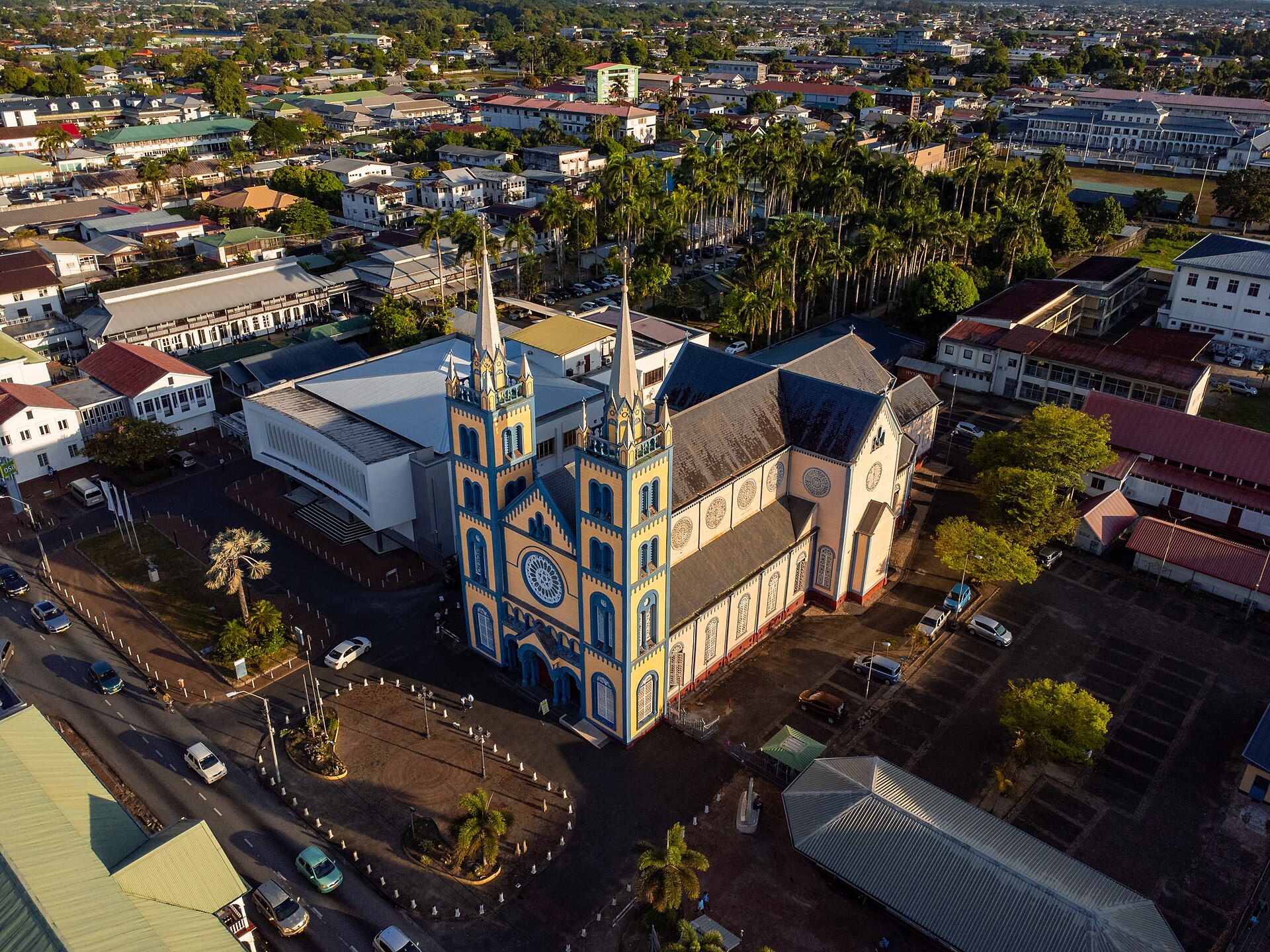
Suriname is the smallest country in South America and one of its most surprising: a former Dutch colony on the Atlantic coast, between Guyana and French Guiana, where more than nine-tenths of the land is tropical rainforest and almost everyone lives along the coast. Its people are among the most diverse anywhere, descended from Indigenous nations, Africans, Maroons (the descendants of people who escaped slavery and built free communities in the forest), Indians, Javanese, Chinese, Lebanese, Jews and Europeans, and in the capital, Paramaribo, a mosque and a synagogue stand side by side. Paramaribo’s historic center, a grid of white-painted wooden houses, churches and squares on the Suriname River, is a UNESCO World Heritage Site, with Fort Zeelandia on the waterfront and one of the largest wooden cathedrals in the Americas. Across the river lie the old plantations of Commewijne, where you can cycle between colonial estates and spot river dolphins; to the south, the forest begins, with the plateau of Brownsberg, the Maroon villages of the Upper Suriname River and the vast Central Suriname Nature Reserve, another World Heritage Site. Dutch is the official language, the currency is the Surinamese dollar (SRD), and most visitors, including US, Canadian, British and EU citizens, can stay up to 90 days without a visa by paying an online entry fee before they travel. The long dry season, from about August to November, is the best time to visit.
Right now in Suriname
- Sat25–31°C76–88°F6 mm rain
- Sun24–31°C76–88°F6 mm rain
- Mon25–29°C77–85°F2 mm rain
- Wed 25 Nov Independence Day
Weather, sun and air quality here are for one point near the centre of Suriname, not the whole country; conditions elsewhere can differ. Readings refresh through the day.
Suriname: quick answers
- Best time to visit Suriname
- Suriname is hot and humid all year, with daytime highs of 29–32 °C (84–90 °F) in Paramaribo and warm nights. More
- Places to visit in Suriname
- Paramaribo, Commewijne and the plantations, Jodensavanne and the creeks south of Paramaribo, Brownsberg Nature Park, The Upper Suriname River, The deep interior. More
- Things to do in Suriname
- Wooden streets, plantations and the rainforest. More
- Entry rules for Suriname
- Most nationalities, including US, Canadian, British and EU citizens, do not need a visa for tourism or family visits of up to 90 days, but must pay the online entry fee before they travel. More
Suriname at a glance
Suriname covers about 163,270 km² (63,000 square miles), roughly the size of Tunisia or the US state of Georgia, with only a little over half a million people. A narrow coastal plain of mangroves, swamps, rice fields and old plantations, crossed by broad brown rivers, gives way inland to savanna belts and then to unbroken forest on the ancient Guiana Shield, rising to granite domes and low mountains near the borders with Brazil. The main rivers, the Corantijn (Corentyne) in the west, the Suriname and Commewijne in the middle and the Marowijne (Maroni) in the east, are still the highways of the interior. The country has three UNESCO World Heritage Sites: the Central Suriname Nature Reserve (listed in 2000), the Historic Inner City of Paramaribo (2002) and the Jodensavanne Archaeological Site, the remains of a 17th-century Jewish settlement on the Suriname River (2023).
Dutch is the official language, used in schools, signs and government, but on the street most people speak Sranan Tongo, an English-based Creole that is Suriname’s common language, and many also speak Sarnami (a form of Hindustani), Javanese, Chinese, Maroon and Indigenous languages; English is widely understood in tourism. The currency is the Surinamese dollar (SRD). Suriname keeps UTC−3 all year, with no daylight saving time, one hour ahead of Guyana. Cars drive on the left. The international dialing code is +597.
Suriname’s regions
- Paramaribo: the capital on the west bank of the Suriname River, with the UNESCO-listed historic center, the Waterkant riverfront, markets, restaurants and nightlife, and nearly half the country’s people.
- Commewijne: across the Jules Wijdenbosch Bridge, a district of old sugar, coffee and cocoa plantations, Fort Nieuw Amsterdam, river villages and mangrove shores, popular for cycling and boat trips.
- Para and Brokopondo: south of the capital, the savanna and forest belt with the international airport at Zanderij, blackwater creeks and resorts, the Jodensavanne ruins, Brownsberg Nature Park and the huge Brokopondo Reservoir.
- The Upper Suriname River: Saramaccan Maroon villages and river lodges reached by dugout boat from Atjoni, at the end of the road.
- Sipaliwini and the interior: the vast forested south, with the Central Suriname Nature Reserve, Raleighvallen, the Voltzberg granite dome and remote Indigenous villages, reached by small plane or boat.
- Marowijne and the east: the border town of Albina, opposite Saint-Laurent-du-Maroni in French Guiana, and the turtle-nesting beaches around Galibi.
- Nickerie and the west: rice country around Nieuw Nickerie, the Bigi Pan wetlands with their birdlife, and the ferry to Guyana at South Drain.
Videos of Suriname
Hand-picked travel videos from YouTube creators to help you picture the trip. They play from YouTube; the facts in this guide come from our own research.
Where to go: a wooden capital, plantations and the rainforest
Nearly all visitors base themselves in Paramaribo, which is easy to explore on foot and by bicycle, and take day trips to the plantations and the nearby forest, then spend a few nights at a lodge in the interior. Our Paramaribo guide covers the capital in detail.
Paramaribo
The capital’s historic center, inscribed by UNESCO in 2002, is a rare surviving example of a Dutch colonial town in the tropics, with straight streets of white-painted wooden houses with green shutters and red-brick bases, laid out on the river. Start at Fort Zeelandia, the 17th-century star-shaped fort on the waterfront, now home to the Suriname Museum; walk across Independence Square (Onafhankelijkheidsplein) past the Presidential Palace and into the shady Palmentuin, a garden of tall royal palms; visit the Cathedral Basilica of Saints Peter and Paul, an enormous wooden church with a richly carved interior; and see the Keizerstraat Mosque and the Neveh Shalom Synagogue next to each other, a symbol of the country’s religious harmony. In the evening, the Waterkant riverfront fills with food stalls and people watching the sunset.
Commewijne and the plantations
Across the river, the district of Commewijne was the heart of the plantation economy, and dozens of estates still line its rivers and canals. Rent a bicycle or join a tour to see Peperpot, a former coffee and cocoa plantation with a nature park where you can look for monkeys and birds; Fort Nieuw Amsterdam, an 18th-century fortress at the meeting of the Suriname and Commewijne rivers, now an open-air museum; and the old sugar estate of Marienburg. Boat tours from Paramaribo head to the river mouth at dusk to watch Guiana dolphins, which live in these brackish waters, and then back past the mangroves.
Jodensavanne and the creeks south of Paramaribo
On a bluff above the Suriname River, the ruins of Jodensavanne, one of the oldest Jewish settlements in the Americas, with the brick foundations of its synagogue and gravestones in the forest, were added to the UNESCO World Heritage List in 2023, together with the Cassipora Creek cemetery nearby. The surrounding Para district has white-sand savannas and blackwater creeks with simple resorts, popular with Paramaribo families at weekends for swimming and relaxing.
Brownsberg Nature Park
About two to three hours south of Paramaribo by road, Brownsberg is a forested plateau about 500 m (1,600 ft) high with sweeping views over the Brokopondo Reservoir, trails to waterfalls and good chances of seeing howler and spider monkeys, toucans and agoutis. It is the easiest place to get a taste of the rainforest from the capital, as a long day trip or with a night in the park’s lodges. Many trips combine it with a boat ride on the reservoir, where the drowned trees still stand in the water.
The Upper Suriname River
From Atjoni, where the road ends, motorized dugout canoes carry travelers up the Suriname River past rapids and Saramaccan Maroon villages to river lodges on islands and sandbanks. Stays of two to four nights include forest walks, swimming in the river, visits to villages to learn about Maroon history, woodcarving and food, and evenings of drumming and storytelling. Book through a tour operator or the lodge, and follow your guide’s lead on village customs.
The deep interior
The Central Suriname Nature Reserve, about 1.6 million hectares of protected forest, rivers and granite domes, is one of the largest tropical forest reserves in the world. At Raleighvallen, on the Coppename River, a lodge on an island beside the rapids is the base for climbing the Voltzberg, a bare granite dome rising above the forest, and for looking for Guianan cock-of-the-rock and monkeys. Other remote lodges, such as Awarradam on the Gran Rio and Kasikasima in the far south, are reached by small plane from Paramaribo’s Zorg en Hoop airport and offer some of the wildest rainforest experiences in South America.
A few more worth your time
Galibi, near the mouth of the Marowijne, where leatherback and green turtles nest on the beaches, reached by boat from Albina or the village of Christiaankondre; the Bigi Pan wetlands near Nieuw Nickerie, with scarlet ibis, flamingos and herons; the Javanese and Hindustani communities and temples of Wanica, just west of Paramaribo; and the riverside villages of Commewijne for a night away from the city.
Paramaribo Travel Guide
Plan a visit to Paramaribo, Suriname's UNESCO-listed wooden capital: Fort Zeelandia and the Suriname Museum, Independence Square and the Palmentuin, the wooden Cathedral Basilica,…
Best time to visit Suriname
Suriname is hot and humid all year, with daytime highs of 29–32 °C (84–90 °F) in Paramaribo and warm nights. The year is usually divided into four seasons by rainfall, as described by the Royal Netherlands Meteorological Institute (KNMI), which works with Suriname’s Meteorological Service: a short dry season in February and March, a long rainy season from April to July, a long dry season from August to November, and a short rainy season in December and January. The long dry season, with the least rain and the most sunshine, is the most popular time to visit, especially for river trips and turtle-watching; it is also the hottest. In the rainy season, heavy showers usually come in bursts, often in the afternoon, and the forest is at its greenest, but trails are muddy and some roads become difficult.
The table shows averages for Paramaribo (Zorg en Hoop station, in the city) from the World Meteorological Organization’s (WMO) climate normals for 1991–2020, rounded. The station’s figures do not include the number of rainy days.
| Month | Average high / low | Rain | What to expect |
|---|---|---|---|
| January | 29 °C (85 °F) / 24 °C (75 °F) | 173 mm (6.8 in) | Short rainy season |
| February | 29 °C (85 °F) / 23 °C (74 °F) | 146 mm (5.8 in) | Short dry season begins; Chinese New Year |
| March | 29 °C (84 °F) / 24 °C (74 °F) | 130 mm (5.1 in) | Short dry season; Holi Phagwa in most years |
| April | 30 °C (86 °F) / 24 °C (76 °F) | 216 mm (8.5 in) | Long rainy season begins; Easter |
| May | 30 °C (86 °F) / 24 °C (75 °F) | 307 mm (12.1 in) | Wettest month |
| June | 30 °C (86 °F) / 24 °C (76 °F) | 296 mm (11.6 in) | Very wet; Indian Arrival Day (June 5) |
| July | 31 °C (87 °F) / 24 °C (76 °F) | 234 mm (9.2 in) | Rains easing; Keti Koti (July 1) |
| August | 32 °C (89 °F) / 25 °C (76 °F) | 148 mm (5.8 in) | Long dry season begins |
| September | 32 °C (90 °F) / 25 °C (77 °F) | 90 mm (3.6 in) | Dry and hot; good for the interior |
| October | 32 °C (90 °F) / 25 °C (77 °F) | 86 mm (3.4 in) | Driest and hottest month |
| November | 31 °C (88 °F) / 25 °C (77 °F) | 126 mm (4.9 in) | Dry; Independence Day (November 25) |
| December | 30 °C (86 °F) / 24 °C (76 °F) | 184 mm (7.2 in) | Short rains return; New Year’s Eve fireworks |
Paramaribo gets about 2,135 mm (84 in) of rain a year; October is the driest month and May the wettest. Suriname lies south of the Atlantic hurricane belt. The interior is a little cooler at night and often wetter than the coast.
Festivals and holidays
- Chinese New Year: in January or February, a public holiday, with lion dances.
- Holi Phagwa: the Hindu spring festival, in March in most years, with colored powder in the streets.
- Indian Arrival Day: June 5, marking the arrival of the first indentured workers from India in 1873.
- Keti Koti: July 1, Emancipation Day (“the chains are broken” in Sranan Tongo), remembering the end of slavery in 1863, with traditional dress, music and food.
- Javanese Arrival Day: August 9, for the arrival of workers from Java from 1890; Indigenous Peoples’ Day is also on August 9.
- Maroons Day: October 10.
- Diwali and Eid: Hindu and Muslim holidays that follow the lunar calendars.
- Independence Day: November 25, the anniversary of independence from the Netherlands in 1975.
- Owru Yari (New Year’s Eve): Paramaribo’s biggest party, when long strings of firecrackers called pagara are set off along the Waterkant and in the center.
How long to stay: sample itineraries
- 3 days: a day in Paramaribo’s historic center; a day cycling or touring the Commewijne plantations, with Fort Nieuw Amsterdam and a dolphin-watching boat trip at sunset; and a day trip to Brownsberg or the creeks and Jodensavanne.
- 7 days: three days in and around Paramaribo as above, then three or four nights at a lodge on the Upper Suriname River, traveling by road to Atjoni and on by dugout canoe.
- 10–14 days: add a flight to Raleighvallen and the climb of the Voltzberg, or a remote lodge such as Awarradam, plus, from about March to August, a night watching turtles nesting at Galibi.
- The Guianas: combine Suriname with Guyana, by air or overland via the Corantijn ferry, and with French Guiana, across the Marowijne River from Albina; or continue to Brazil.
Entry, money and costs
The entry fee (as of November 2026)
According to Suriname’s Ministry of Foreign Affairs, International Business and International Cooperation, since July 1, 2022, citizens of most countries, including the United States, Canada, the United Kingdom and the EU, have not needed a visa for tourism and family visits of up to 90 days. Instead, they must pay an entry fee of US$50 or €50, plus a US$8 or €8 service fee charged by VFS Global, which runs the online system, for every entry. Pay online on the official VFS Global Suriname portal (suriname.vfsevisa.com) before you travel; the voucher is emailed to you as a PDF, and you must show it at the airline check-in desk when you leave for Suriname. If you arrive overland, the ministry lists payment points at the Suriname consulate in Cayenne and its office in Saint-Laurent-du-Maroni, for travel from French Guiana, and at the Canawaima ferry company in South Drain, Nickerie, for travel from Guyana.
The entry fee does not apply, according to the ministry, to holders of passports of CARICOM member states, travelers who already hold a valid Suriname visa, holders of a PSA document (for people of Surinamese origin) or a Suriname residence permit, holders of diplomatic, service and official passports, and passengers in transit at the airports. The visa waiver does not apply to nationals of 21 countries, among them India, Venezuela, Cuba, the Dominican Republic, Pakistan, Bangladesh, Nigeria, Ghana and South Africa, who need a visa. Anyone traveling for business, work, study or an internship also needs a visa, applied for online through the same VFS Global portal.
The Immigration and Customs Form
Everyone traveling to and from Suriname, including children and babies, must also complete the free online Immigration and Customs Form (ICF) at icf.sr, which replaced the yellow and white paper forms, according to the Government of Suriname. Fill it in during the few days before you arrive, and again before you leave; you receive a QR code to show to the immigration and customs officers, on your phone or printed. The form is available in several languages.
Passports and health
Your passport must be valid for at least six months after the date you arrive, and a yellow fever vaccination certificate is required if you arrive from a country with a risk of yellow fever transmission, according to the UK government’s summary of Suriname’s rules. Rules change, so check the Ministry of Foreign Affairs, the VFS Global Suriname portal or a Surinamese embassy before you travel.
Money and cards
The currency is the Surinamese dollar (SRD). Its value has changed a lot in recent years, so check the Central Bank of Suriname’s daily rates before you go. Bring US dollars or euros in cash to exchange: they are the easiest currencies to change, and British pounds cannot be exchanged, according to the UK government. Change money at banks and official exchange offices (cambios), not on the street. Credit cards are not widely accepted outside major hotels, shops and restaurants in Paramaribo; Belgium’s foreign ministry notes that Mastercard and Maestro are accepted more often than Visa, that ATMs in the capital accept European cards but are fewer outside it, and that machines are sometimes empty, so carry enough cash. Interior lodges are usually paid in advance.
Tipping
Some restaurants add a service charge, so check your bill. Where none is included, about 10% is usual in restaurants, and guides, boat drivers and lodge staff appreciate a tip for good service.
What a trip costs
Paramaribo is moderately priced, while interior trips are expensive because of transport by boat and small plane. These are approximate prices for November 2026, given in US dollars because the exchange rate moves often:
| Item | Typical cost |
|---|---|
| Entry fee plus VFS service fee | US$58 (or €58) |
| Roti or a Javanese warung meal | US$4–8 |
| Local Parbo beer in a bar | US$2–4 |
| Bicycle rental, per day | US$8–15 |
| Dinner for two at a mid-range restaurant | US$35–70 |
| Taxi, J.A. Pengel Airport to Paramaribo | US$35–50 |
| Guided day tour (plantations, Brownsberg or dolphins) | US$50–120 |
| Mid-range hotel double in Paramaribo, per night | US$80–160 |
| Interior lodge package, per person per night, with transport and meals | US$120–300 |
A comfortable trip with a mid-range hotel, tours and meals out costs roughly US$120–200 per person per day for two people sharing, more with interior lodges. Apart from the entry fee, these figures are our estimates, not official prices.
Getting there and getting around
Flights
International flights land at Johan Adolf Pengel International Airport (PBM), at Zanderij, about 45 km (28 miles) south of Paramaribo, roughly an hour by road. There are direct flights from Amsterdam, with KLM and Surinam Airways, the national airline, and connections from Miami, the Caribbean, Brazil and neighboring Guyana; the Guyana Tourism Authority lists flights between the two countries with Surinam Airways and Trans Guyana Airways. The small Zorg en Hoop airport, inside Paramaribo, handles domestic flights to interior airstrips and some regional flights. Check current routes with the airlines, as schedules change from season to season.
Overland from Guyana and French Guiana
From Guyana, the Canawaima ferry crosses the Corantijn River from Moleson Creek to South Drain, south of Nieuw Nickerie, where Suriname’s Ministry of Foreign Affairs lists an entry-fee payment point; from there it is about four hours by road to Paramaribo. From French Guiana, ferries and boats cross the Marowijne River between Saint-Laurent-du-Maroni and Albina, about two to three hours by road east of the capital. Use the official crossings and ferries, and have your entry fee and ICF ready.
Getting around
Driving is on the left. Visitors who want to drive should bring an International Driving Permit along with their license, as Belgium’s foreign ministry advises its citizens. The coastal East–West road links Nieuw Nickerie, Paramaribo and Albina, and paved roads run south to Zanderij, Brownsberg and Atjoni; beyond that, travel is by boat or small plane. In and around Paramaribo, taxis are not metered, so agree on the fare first or ask your hotel to book one; ride-hailing apps also operate in the capital. Privately run minibuses leave from stops in the center for the districts and towns, cheaply but on no fixed timetable. Many visitors rent a bicycle, especially for Commewijne, which is flat and quiet. Tour operators and lodges arrange transport to the interior, with motorized dugout canoes on the rivers and small planes from Zorg en Hoop to remote airstrips, where baggage limits are strict.
Rainforest, rivers and wildlife
With most of its forest still standing and few roads, Suriname is a wonderful place to experience the Amazon-Guiana rainforest. The forest holds jaguars, tapirs, giant otters, sloths, eight species of monkey, and hundreds of bird species, among them toucans, macaws, harpy eagles and the brilliant orange Guianan cock-of-the-rock, which displays on rocks near Raleighvallen. On the coast, the mangroves and mudflats shelter scarlet ibis and huge flocks of shorebirds, the river mouths hold Guiana dolphins, and the beaches of Galibi and the northeast are nesting grounds for leatherback and green turtles. Activities include forest hikes, canoe trips, birdwatching, fishing, swimming in rivers and creeks, cycling the plantation roads and visiting Maroon and Indigenous villages with a local guide. See our hiking, boat trips and cycling guides.
Culture, food and everyday etiquette
A short history
Indigenous peoples, among them the Kaliña, Lokono, Trio and Wayana, lived here long before Europeans arrived. English settlers founded a colony on the Suriname River in 1650, and in 1667 the Dutch took it over, keeping it in exchange for New Amsterdam (New York). Over the next two centuries, sugar, coffee and cocoa plantations were worked by enslaved Africans, many of whom escaped into the forest and founded the Maroon nations, such as the Saramaccan and Ndyuka, whose independence was recognized by treaties in the 18th century. Slavery was abolished in 1863, and in the following decades contract workers came from China, India, from 1873, and Java, from 1890. Suriname became independent from the Netherlands on November 25, 1975, and today many Surinamese also live in the Netherlands.
Food and drink
Suriname’s food reflects every group that has settled here. Try roti with curried chicken, potatoes and long beans; pom, a Creole oven dish of grated pomtajer root and chicken, also eaten in a sandwich; moksi alesi, rice cooked with meat, salted fish and vegetables; Javanese bami, nasi and saoto soup from the warungs of Lelydorp and Blauwgrond; pastei, a chicken pie; bakabana (fried plantain) with peanut sauce; heri heri, boiled roots and plantains with salted fish; and Chinese-Surinamese dishes. Wash it down with fresh fruit juices such as soursop or passion fruit, a cold Parbo beer or the local rum. Sandwich shops and food stalls are everywhere, and many restaurants are casual and inexpensive.
Etiquette
Surinamese are relaxed and hospitable; greet people when you enter a shop or a bus with “goedemorgen” or the Sranan Tongo “fa waka?” (“how are you?”). Dress is casual, but cover up away from the river beaches, and dress modestly in mosques, temples, churches and the synagogue, removing your shoes where asked. In Maroon and Indigenous villages, visit with a guide, ask before photographing people, and follow local customs, which may include rules about where you can walk or bathe.
Language and a few useful words
Dutch is the official language, Sranan Tongo the everyday language of the street, and English is widely understood in hotels, restaurants and tourism. In Dutch, try goedemorgen (good morning), dank je wel (thank you), alstublieft (please) and ja and nee (yes and no); in Sranan Tongo, fa waka? (how are you?), mi de (I’m fine) and grantangi (thank you).
Health, practical tips and connectivity
- Vaccinations and health: carry your yellow fever certificate if you need one, and ask your doctor about other vaccinations and about malaria prevention for the interior; take travel insurance that covers medical treatment and evacuation from remote areas.
- Insects and sun: use insect repellent, wear long sleeves and trousers at dusk and in the forest, and protect yourself from the strong sun.
- On the rivers: travel with established tour operators and lodges, wear the life jacket provided, and do not swim where currents are strong.
- Everyday precautions: keep your passport and cards secure, with photocopies in a separate place, avoid displaying expensive jewelry or large amounts of cash, and ask your hotel about the area you are staying in.
- Medicines: bring enough of any prescription medicines, labeled, as some can be hard to find.
- Emergencies: call 115 for the police, fire service and ambulance; you can also reach the ambulance service on 113 and the fire service on 110.
Local mobile networks use GSM 900 and DCS 1800, so most phones work, and local SIM cards are sold in Paramaribo; Belgium’s foreign ministry names Telesur among the operators and notes that mobile internet works well in the capital. Coverage is limited in the interior, where lodges often have generators or solar power for only part of the day. Electricity is supplied at 115 V and 230 V, and the two voltages use different socket types, according to Belgium’s foreign ministry, so check the outlet and your devices before plugging in, and bring a travel adapter.
Things to do: wooden streets, plantations and the rainforest
Walk the UNESCO-listed streets of Paramaribo and visit Fort Zeelandia; see the mosque and synagogue side by side on Keizerstraat; step inside the great wooden cathedral; eat roti, pom and saoto soup; cycle between the old plantations of Commewijne and watch dolphins at sunset; explore the ruins of Jodensavanne; hike to the waterfalls of Brownsberg; travel by dugout canoe to the Maroon villages of the Upper Suriname River; climb the Voltzberg at Raleighvallen; watch leatherback turtles nesting at Galibi; and join the New Year’s Eve pagara in Paramaribo. See our city sightseeing, cycling, hiking and boat trips guides.
What to pack
Light, breathable clothes, with long sleeves and long trousers for the evenings and the forest; a sun hat, sunglasses and sunscreen; a light rain jacket; comfortable walking shoes and hiking shoes for trails; sandals or water shoes for rivers and boats; strong insect repellent; a flashlight or headlamp and a power bank for the lodges; dry bags for boat trips; and modest clothes for places of worship. Bring US dollars or euros in cash, your entry-fee voucher and your ICF QR code.
Suriname travel FAQ
Do I need a visa for Suriname?
Most nationalities, including US, Canadian, British and EU citizens, do not need a visa for tourism or family visits of up to 90 days, but must pay the online entry fee before they travel. Nationals of 21 countries, and anyone traveling for business, work or study, need a visa, applied for online through VFS Global.
How much is the Suriname entry fee?
US$50 or €50, plus a US$8 or €8 VFS Global service fee, paid online for every entry, according to the Ministry of Foreign Affairs. CARICOM passport holders and some other groups are exempt.
What is the ICF form for Suriname?
The Immigration and Customs Form, a free online form at icf.sr that every traveler, including children, completes shortly before arriving in and leaving Suriname. You show the QR code you receive to the officers.
What language is spoken in Suriname?
Dutch is the official language, and Sranan Tongo is spoken by almost everyone. English is widely understood in tourism, and many people also speak Sarnami, Javanese or other languages.
What is the best time to visit Suriname?
The long dry season, from about August to November, which is also the hottest. February and March, the short dry season, are another good option; May and June are the wettest months.
What currency is used in Suriname?
The Surinamese dollar (SRD). Bring US dollars or euros in cash to exchange at banks or cambios, as cards are not accepted everywhere and British pounds cannot be exchanged.
Can I travel overland between Suriname, Guyana and French Guiana?
Yes. The Canawaima ferry links South Drain, near Nieuw Nickerie, with Moleson Creek in Guyana, and ferries and boats cross the Marowijne River between Albina and Saint-Laurent-du-Maroni in French Guiana.
Which side of the road do they drive on in Suriname?
The left, unlike neighboring French Guiana and Brazil. Bring an International Driving Permit if you plan to drive.
What is the emergency number in Suriname?
115 for the police, fire service and ambulance; 113 also reaches the ambulance service and 110 the fire service.
What is the time difference in Suriname?
Suriname is on UTC−3 all year, with no daylight saving time: one hour ahead of Guyana and the same as French Guiana.
Plugs and power in Suriname
Suriname uses 115 V, 60 Hz and these plugs (left) and wall sockets (right):
Supply is 115 V and 230 V, with a different socket type for each; check the outlet and your device before plugging in.
All plug types and voltages by country → · Check what you need to pack →
Plan your trip
Partner links: TravelerCenter may earn a commission if you book, at no extra cost to you.
🇳🇱 Useful Dutch phrases for Suriname
All 38 Dutch phrases: restaurant, hotel, emergencies, romance (printable) →
Before you go: guidebooks and travel gear
Affiliate links: we may earn a commission at no extra cost to you. As an Amazon Associate we earn from qualifying purchases. We pick items for the place, not for the commission. How we earn money
Sources · last reviewed 10 November 2026
Researched and last reviewed on 10 November 2026. Visa waiver, entry fee and service fee, exemptions, countries that need a visa, payment points and visas for business: Suriname’s Ministry of Foreign Affairs, International Business and International Cooperation (gov.sr); the Immigration and Customs Form: the Government of Suriname (gov.sr) and icf.sr; passport validity, yellow fever, currencies to bring and emergency numbers: GOV.UK; cards, ATMs, electricity, mobile networks and the driving permit: Belgium’s Federal Public Service Foreign Affairs; flights to Guyana: the Guyana Tourism Authority; the four seasons: the Royal Netherlands Meteorological Institute (KNMI); climate averages: the WMO 1991–2020 normals for Zorg en Hoop, Paramaribo (NOAA archive); World Heritage Sites, area and population: Wikidata; time zone: IANA. History, holidays, languages, places in the interior, wildlife, food, flights to Europe, road times, plug types, tipping and prices other than the entry fee are general references or our estimates, flagged for checking. Rules and prices change, so check the official sites before you go.
Data: Weather: MET Norway (CC BY 4.0) · Rates: ECB · Holidays: Nager.Date · Wikidata (CC0)