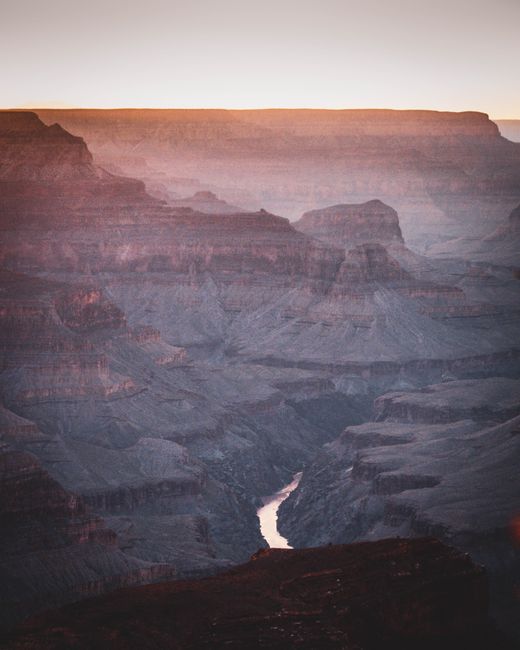
Grand Canyon National Park protects 277 miles (446 km) of the Colorado River’s mile-deep gorge in northern Arizona, layer upon layer of red, orange and cream rock that tells almost two billion years of the Earth’s history. Most people see it from the South Rim, open all year at about 7,000 ft (2,134 m), where Grand Canyon Village, the Rim Trail and free shuttle buses put the great viewpoints within easy reach. The higher, quieter North Rim opens only in the warmer months. The canyon is unforgettable at sunrise and sunset, but it is also a serious desert, and the park warns every visitor never to hike to the river and back in one day. In autumn 2026 the park is open but recovering from a deadly August flash flood that closed Phantom Ranch and suspended hotel stays inside the park, so check what is open before you go.
Right now in Grand Canyon National Park (Grand Canyon Village)
- Wed11–24°C52–74°FMostly clear
- Thu11–23°C53–74°FClear
- Fri10–24°C50–74°FClear
- Mon 12 Oct Columbus Day · regional holiday in Arizona
Top tours in Grand Canyon National Park
See all tours for Grand Canyon National Park →
From local operators, with prices and reviews; you check availability and book on Viator, our partner. We may earn a commission at no extra cost to you. How we earn money
Grand Canyon at a glance
- Best months: April–May and September–October, for mild days on the rim. Summer is busy, with afternoon storms from July; winter is snowy and quiet.
- Time needed: one full day for the South Rim viewpoints; two or three days to add Desert View, a longer hike and a sunrise.
- Getting there: the South Rim is 63 miles (101 km) from Williams, 81 miles (130 km) from Flagstaff, 231 miles (372 km) from Phoenix and 278 miles (447 km) from Las Vegas, or take the train from Williams.
- Fees (as of October 2026): $35 per car for 7 days, plus $100 per person for non-US residents aged 16 and over without an annual or America the Beautiful pass. Cards only.
- Before you go: entry rules for international visitors (ESTA or visa), driving and tipping are in our United States travel guide.
What’s open in October 2026
The South Rim: day visits only
On 29 August 2026 a severe flash flood swept through Bright Angel Canyon and Phantom Ranch, taking hikers’ lives and destroying the water intake and much of the old Transcanyon Waterline that supplies the South Rim. Since 31 August the park has been under Stage 4 water restrictions: all overnight lodging inside the park is suspended (El Tovar, Bright Angel, Maswik and Yavapai lodges, Trailer Village and Phantom Ranch), and campgrounds allow dry camping only. The South Rim stays open 24 hours a day for day use, with restaurants, shops, the clinic and the post office open. Hotels in Tusayan, outside the South Entrance, are not affected. Bring your own drinking water. The park’s tentative plan is to pump water again by about 16 November and let hotels start a phased return to overnight guests around Thanksgiving; dates may change.
The inner canyon: Phantom Ranch closed
Closed with no reopening date: Phantom Ranch and Bright Angel Campground, the Black and Silver bridges over the river, the South Kaibab Trail below Tipoff, part of the River Trail and the whole North Kaibab Trail. Open: the Bright Angel Trail down to the River Resthouse, the Plateau Point Trail, the South Kaibab Trail to Tipoff and the Tonto Trail between them. There is no drinking water anywhere below the rim; fill up from the tanks at the Bright Angel and South Kaibab trailheads.
The North Rim after the Dragon Bravo Fire
The Dragon Bravo Fire, started by lightning on 4 July 2025, destroyed the historic Grand Canyon Lodge, the visitor center and many cabins. In 2026 the North Rim is open for day use only, with no lodging inside the park. The campground (no water or hookups) closes on the morning of 16 October and the general store on 15 October; there is no fuel in the park, so fill up at Jacob Lake, about 45 miles (72 km) north. Cape Royal and Point Imperial roads close from sunset 15 October to sunrise 3 November 2026 for repairs, and the Highway 67 gate closes for winter at sunset on 30 November, or earlier after a major snowstorm. Bright Angel Point, Transept and Widforss trails remain closed. The park expects services to return gradually from 2027–2028.
Entrance fees and passes (as of October 2026)
No reservation or timed entry is needed. Passes last 7 days and are sold at the entrances (cards only) or on Recreation.gov.
| Pass | Price | What it covers |
|---|---|---|
| Private vehicle | $35 | One car or van (up to 15 passengers), 7 days |
| Motorcycle | $30 | Up to 2 motorcycles, 4 riders, 7 days |
| Per person (foot, bike, train) | $20 | Each person 16 or over; under-16s free |
| Non-resident fee | +$100 per person | Non-US residents 16 and over, unless entering with an annual or America the Beautiful pass |
| Grand Canyon annual pass | $70 | This park, 12 months; US citizens and residents |
| America the Beautiful pass | $80 residents / $250 non-residents | All national parks and federal lands for 12 months |
For international visitors: four adults from abroad in one car would pay $35 plus $400 in non-resident fees, so the $250 non-resident America the Beautiful pass, which covers one vehicle or four people paying per person, is the better deal, especially if you are also visiting Zion or Yosemite. The non-resident fee applies on commercial tours too. US residents enter free on the remaining 2026 fee-free days, 27 October and 11 November. In peak season the South Entrance can have waits of up to two hours; arrive before 10 a.m. or after 2 p.m.
South Rim, North Rim or Grand Canyon West?
- South Rim: about 90% of visitors, open all year, with the most viewpoints, trails, services, shuttles and the railway. Best for a first visit.
- North Rim: higher and forested, about 10% of visitors, normally open 15 May to 15 October. It is 212 miles (341 km) by road from the South Rim, about 4.5 hours, though only about 10 miles (16 km) across.
- Grand Canyon West: home of the Skywalk, on Hualapai tribal land, not part of the national park; park passes are not valid there. Closest to Las Vegas, but not the classic South Rim views.
Top things to see at the Grand Canyon
Mather Point and Yavapai Point
A short walk from the Grand Canyon Visitor Center, Mather Point gives most people their first view: a rocky promontory over a vast sweep of buttes, crowded at midday and wonderful at sunrise. Walk the Rim Trail west to the Yavapai Geology Museum, whose big windows and exhibits explain the rock layers and look down to the river.
Grand Canyon Village historic district
The village grew around the 1910 railway depot. Along the rim stand the El Tovar Hotel, Mary Colter’s Hopi House, Lookout Studio and Bright Angel Lodge, which seem to grow out of the canyon edge, and the Kolb Studio, home of two pioneer photographers, at the top of the Bright Angel Trail. Walk the paved Rim Trail between them in the evening light.
Hermit Road and Hermits Rest
This 7-mile (11 km) road runs west past superb overlooks, including Hopi Point and Mohave Point for sunset, to Hermits Rest, a stone rest house by Mary Colter. Hermit Road is closed to private cars from 1 March to 30 November 2026: take the free Red shuttle, walk the Rim Trail or cycle. Cars can use it from December to February.
Desert View Drive and the Watchtower
Desert View Drive runs 23 miles (37 km) east from the village and is open to all vehicles all year, snow permitting. Stop at Grandview Point, Moran Point, the Tusayan Ruin and Lipan Point, with one of the widest views of the river. At Desert View, Mary Colter’s stone Watchtower has a View Room at its base; when staffing allows, the upper floors open 8 a.m.–6 p.m. with free tickets for 25 people at a time, 20 minutes each, last tickets at 5:40 p.m. Desert View has a market, deli, trading post and 24-hour pay-at-the-pump fuel, but no lodging.
North Rim: Point Imperial and Cape Royal
Point Imperial, the highest viewpoint in the park, looks across the eastern canyon to the Painted Desert. Cape Royal has a short paved trail to Angels Window, a natural arch framing the river. Both roads close from 15 October to 3 November 2026.
Getting around the South Rim: free shuttle buses
Park at the Visitor Center and ride the free shuttles, included in your entrance fee and wheelchair-accessible. Autumn timetable, 12 September to 30 November 2026:
| Route | Where it goes | Hours |
|---|---|---|
| Village (Blue) | Visitor Center, lodges, campgrounds, Backcountry Information Center, Market Plaza | 7 a.m.–9 p.m., every 12–15 minutes |
| Kaibab Rim (Orange) | South Kaibab Trailhead, Yaki Point, Mather Point, Yavapai Geology Museum | 6 a.m. to an hour after sunset, every 15–20 minutes |
| Hermits Rest (Red) | Hermit Road overlooks; 80-minute round trip | 8 a.m. to sunset, every 12 minutes |
| Hikers’ Express | Bright Angel Lodge to South Kaibab Trailhead | 6, 7 and 8 a.m. |
The Tusayan (Purple) route runs in summer only. Visitors with reduced mobility can get a free Scenic Drive Accessibility Permit at entrance stations to drive some roads closed to traffic.
Hiking and heat safety
The park’s warning is blunt: there are no easy trails into or out of the Grand Canyon, and more than 300 people are rescued each year. Going down feels easy; the climb back up at altitude takes about twice as long. Day hikes need no permit. See our hiking guide for general advice.
- Rim Trail: easy, partly paved and accessible, from the South Kaibab area through the village to Hermits Rest; hop on and off the shuttles. No water west of Bright Angel Lodge.
- Bright Angel Trail: steep, with some shade. Turn around at the 1.5-Mile Resthouse (3 miles / 4.8 km round trip) or the 3-Mile Resthouse (6 miles / 9.7 km); Plateau Point, about 12 miles (19 km) round trip, is a very long day. No water on the trail in autumn 2026.
- South Kaibab Trail: reached by shuttle; the best views for a short hike, but no water and little shade. Day hikes up to about 6 miles (9.7 km) round trip; open only to Tipoff in 2026.
Do not hike to the river and back in one day. The park asks everyone not to try, especially from May to September. The river is a mile (1.6 km) below the rim, and it gets about 5.5 °F hotter for every 1,000 ft you descend (about 3 °C per 300 m): average summer highs at Phantom Ranch are 101–104 °F (38–40 °C) in the shade, and much more in the sun. In summer, avoid hiking between 10 a.m. and 4 p.m.; start before dawn and turn back early. Carry water and salty snacks, drink when thirsty but don’t force fluids, and check the park’s daily Key Hiking Messages for heat risk and closures. Watch for flash floods, especially in the monsoon from mid-July to early September, and ice on the upper trails in winter.
Viewpoints
- Cape Royal
- Desert View Watchtower
- Mather Point
- Point Imperial
- Yavapai Point
Other sights
- El Tovar Hotel
Nature
- Bright Angel Trail
Monuments
- Hermit's Rest
Mule rides, rafting and backcountry permits
Mule rides are run by Grand Canyon National Park Lodges (Xanterra) and can be booked up to 15 months ahead. The 3-hour Canyon Vistas rim ride costs $192.96 and the 7-hour Havasupai Gardens ride down the Bright Angel Trail $510.31, including taxes. Overnight rides to Phantom Ranch cannot run while it is closed. Riders must be at least 9 years old and 57 in (145 cm) tall, weigh under 200–225 lb (91–102 kg) depending on the trip, and understand English. Check with the operator whether rides are running during the water emergency.
Rafting: licensed companies run guided whitewater trips of 3 to 18 days on the 226 river miles (364 km) between Lees Ferry and Diamond Creek, often booked a year or two ahead. Private trips of 12 to 25 days go through a weighted lottery. With less time, try a half-day or full-day smooth-water float, or a one-day trip with the Hualapai Tribe from Peach Springs. See our boat trips guide.
Backcountry permits are needed to camp anywhere below the rim or outside the developed campgrounds. Book on Recreation.gov, starting with an early-access lottery that runs from the 16th of the month, five months before your start month, to the 1st, four months before. The cost is $10 per permit plus $15 per person per night below the rim ($4 above). A few last-minute permits for Havasupai Gardens are sold at the South Rim Backcountry Information Center (8 a.m.–12 p.m. and 1–5 p.m.), but not guaranteed after the flood.
Activities and best months
- HikingAfter the 29 August 2026 flash flood, Phantom Ranch, the North Kaibab Trail and parts of the inner canyon are closed and there is no drinking water below the rim; the Bright Angel Trail to the River Resthouse and South Kaibab to Tipoff stay open.
Getting there
The South Entrance is 6 miles (10 km) north of Tusayan; the East Entrance at Desert View is 25 miles (40 km) west of Cameron on the Navajo Nation. A car gives the most freedom; driving tips are in our United States travel guide.
| From | Distance to the South Rim | Route and time |
|---|---|---|
| Williams, AZ | 63 miles (101 km) | Highway 64 from Interstate 40; about 1 hour |
| Flagstaff, AZ | 81 miles (130 km) | Highway 180; about 1.5 hours |
| Phoenix, AZ | 231 miles (372 km) | Interstate 17 via Flagstaff; about 4 hours |
| Las Vegas, NV | 278 miles (447 km) | Highway 93 and Interstate 40 via Williams; about 4.5–5 hours |
By train: the Grand Canyon Railway leaves Williams daily at 9:30 a.m. (8:30 a.m. in November and December) and takes 2 hours 15 minutes to cover 65 miles (105 km) to the historic Grand Canyon Depot, giving you more than 3 hours at the rim before the 3:30 p.m. return (2:30 p.m. in November and December). Classes range from 1920s coaches with opening windows to dome and parlor cars. You still need a park entrance pass.
By air: the nearest big airports are Phoenix Sky Harbor and Las Vegas Harry Reid; Flagstaff has a small regional airport. If you book a tour from Las Vegas (see our Las Vegas travel guide), check whether it goes to the South Rim or to Grand Canyon West.
Around the Grand Canyon
- Grand Canyon West and the Skywalk: on Hualapai land, about 2.5 hours’ drive from Las Vegas. The All-Access Pass with the Skywalk glass bridge was $99 in October 2026 ($59 without the Skywalk).
- Havasu Falls: on the Havasupai Reservation, outside the park; visits need an overnight reservation with the tribe.
- Williams, Flagstaff and Sedona: Route 66 diners and neon in Williams, a lively mountain town in Flagstaff, and red-rock hiking in Sedona, 119 miles (192 km) from the South Rim.
- Page and the Navajo Nation: Horseshoe Bend, the slot canyons near Page and Monument Valley lie beyond Desert View. The Navajo Nation uses daylight saving time while the rest of Arizona does not, so check tour times.
Nearby destinations
- Sedona136 km
- Zion National Park149 km
- Bryce Canyon National Park176 km
- Monument Valley208 km
- Las Vegas272 km
- Scottsdale285 km
- Phoenix290 km
When to go and how long to stay
The rims are high, dry and sunny, with big swings between day and night. Spring is windy and changeable; summer on the South Rim is warm, with thunderstorms and lightning in the monsoon; autumn is clear and calm, the best time to hike; winter brings snow and the quietest viewpoints. The canyon bottom is about 20–30 °F (11–17 °C) hotter than the rim in summer.
| Season | South Rim average high / low | Phantom Ranch high | What it’s like |
|---|---|---|---|
| Spring (Mar–May) | 54–71 °F (12–22 °C) / 22–32 °F (−6 to 0 °C) | 73–91 °F (23–33 °C) | Cool and windy; snow possible in March. |
| Summer (Jun–Aug) | 82–85 °F (28–29 °C) / 38–49 °F (3–10 °C) | 101–104 °F (38–40 °C) | Busiest; afternoon storms from July; extreme heat below the rim. |
| Autumn (Sep–Nov) | 77–54 °F (25–12 °C) / 40–21 °F (5 to −6 °C) | 95–68 °F (35–20 °C) | Clear and pleasant; cold nights. |
| Winter (Dec–Feb) | 44–47 °F (7–8 °C) / 14–17 °F (−10 to −8 °C) | 56–63 °F (13–17 °C) | Snow, icy trails, few crowds. |
South Rim figures are NOAA 1991–2020 normals for Grand Canyon National Park Airport near Tusayan, at about 6,600 ft (2,014 m); it gets about 13.4 inches (339 mm) of rain and snow a year, most in July and August. Phantom Ranch figures are the park’s shade averages from the National Weather Service.
Weather month by month
The Grand Canyon in one day
Start early at Mather Point and walk the Rim Trail to Yavapai Point. After lunch, explore the historic village and walk a short way down the Bright Angel Trail, then take the Red shuttle along Hermit Road for sunset at Hopi Point.
Two or three days
Add Desert View Drive and the Watchtower, with sunrise at Yaki Point, and an early-morning hike on the South Kaibab or Bright Angel Trail, back before the midday heat. With more time, continue to Sedona, Page or, in a normal summer, the North Rim.
Where to stay near the Grand Canyon
Rooms inside the park, booked through Xanterra (El Tovar, Bright Angel, Kachina, Thunderbird, Maswik) and Delaware North (Yavapai Lodge), sell out months ahead in normal times. All of them are closed to overnight guests from 31 August 2026 until the water supply is restored; if you hold a booking, check with the hotel.
- Tusayan: 7 miles (11 km) south of the village, with several large hotels; the best base while park lodging is closed.
- Williams (60 miles / 100 km) and Flagstaff (80 miles / 130 km): more choice and lower prices.
- Camping: Mather Campground and the seasonal Desert View Campground are booked on Recreation.gov; in 2026 only dry camping is allowed, with no campfires.
Arizona room rates are quoted before tax; the bill adds state and local lodging taxes.
Practical tips for the Grand Canyon
- Check the alerts on the park’s website on the day you travel; road information is on 928-638-7496.
- Altitude: take it slowly on your first day at 7,000 ft (2,134 m).
- Stay back from the edge: many viewpoints have no railings. Keep children close.
- Wildlife: never feed squirrels, ravens or elk, and keep well away from elk.
- Money: park fees are card-only; shop and restaurant prices exclude sales tax. Tip 18–22% in sit-down restaurants (see our United States travel guide).
- Time zone: Arizona stays on Mountain Standard Time all year, one hour ahead of Las Vegas in winter and the same in summer.
- Drones are not allowed. Emergencies: call 911.
What to pack for the Grand Canyon
Bring layers in every season (rim mornings are cold even in summer), sturdy shoes with good grip, a sun hat, sunglasses and sunscreen, two large water bottles if you hike, salty snacks, a headlamp and a light rain jacket for summer storms. In winter, add a warm coat, gloves and microspikes for icy trails.
What to pack
- Day packs and anti-theft bagsA 20–30 litre pack carries layers, water, a head torch and snacks on full-day levada walks.
- Fleeces and warm layersSummits like Pico do Areeiro averaged about 11 °C over 2024, so a fleece is needed even in summer.
- HeadlampsLevada routes such as PR1 and PR9 pass through long, dark, wet tunnels.
- Hiking shoes and bootsMadeira's levadas and the Azores' crater rims are wet, rocky and slippery, so grippy shoes matter more than anywhere else in Portugal.
- Rain jacketsMountain and island weather changes fast; a real shell beats an umbrella in the wind.
- Trekking polesLong stone staircases and steep descents on Madeira's peaks and the Azores' crater rims are easier on the knees with poles.
- Water bottles and hydration packsAlgarve and Alentejo trails are hot and exposed with few refill points.
Grand Canyon travel FAQ
How much does it cost to enter the Grand Canyon in 2026?
$35 per car, $30 per motorcycle or $20 per person, valid 7 days. Non-US residents aged 16 and over also pay $100 each unless they have an annual or America the Beautiful pass ($250 for non-residents).
Do I need a reservation to enter the Grand Canyon?
No. There is no entry reservation or timed entry, but lodging, campgrounds, mule rides and backcountry permits must be booked ahead.
Is the Grand Canyon open in October 2026?
Yes, for day visits. Hotel stays inside the park are suspended after the August flood, and Phantom Ranch and some inner-canyon trails are closed. The North Rim is open for day use until 30 November or the first major snowstorm.
Is the North Rim open after the fire?
Partly. The Grand Canyon Lodge burned in July 2025; in 2026 the North Rim is day use only, with no lodging inside the park.
Can you hike to the bottom of the Grand Canyon and back in a day?
The park strongly advises against it, especially from May to September, when the heat can kill. Choose a shorter day hike or an overnight trip with a permit.
Can I drive on Hermit Road?
Not from 1 March to 30 November 2026. Use the free Red shuttle, walk or cycle; cars may drive it from December to February.
Is the Skywalk in Grand Canyon National Park?
No. It is at Grand Canyon West, on Hualapai tribal land, with its own tickets; national park passes are not valid there.
How far is the Grand Canyon from Las Vegas?
The South Rim is 278 miles (447 km) away, about 4.5–5 hours each way by car. Grand Canyon West is about 2.5 hours away.
What is the best time to visit the Grand Canyon?
April–May and September–October, for mild weather on the rim and safer hiking.
Plan your trip
Partner links: TravelerCenter may earn a commission if you book, at no extra cost to you.
Sources · last reviewed 4 October 2026
Researched and last reviewed on 4 October 2026. Fees, passes, closures, the flood recovery and water restrictions, the North Rim’s 2026 status, shuttles, trails, heat advice, permits, river trips, lodging and distances come from Grand Canyon National Park (National Park Service); mule rides from Grand Canyon National Park Lodges; the train from Grand Canyon Railway; the Skywalk from Grand Canyon West (Hualapai Tribe); climate from NOAA’s 1991–2020 normals and the park’s Phantom Ranch averages. Conditions are changing quickly during the 2026 recovery, so check the park’s alerts before you travel. For entry rules, driving and tipping, see our United States travel guide.
Also: nps.gov · NOAA NCEI normals 1991–2020, Grand Canyon National Park Airport (climate)
Data: Weather: MET Norway (CC BY 4.0) · Rates: ECB · Holidays: Nager.Date · Costs: World Bank ICP and price levels · © OpenStreetMap contributors (ODBL) · Wikidata (CC0)