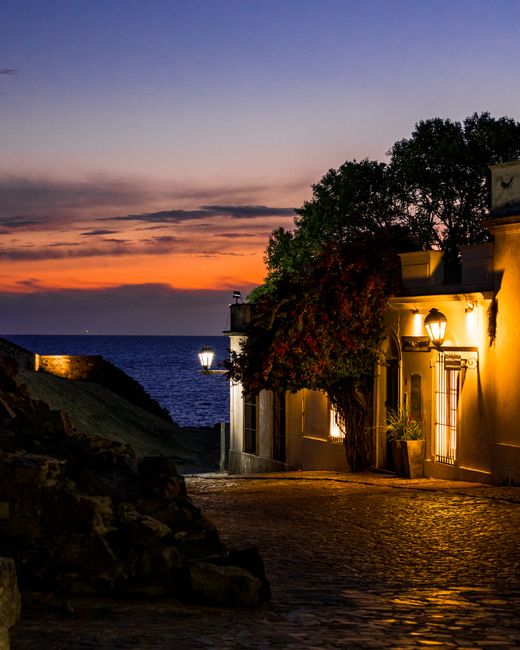
Colonia del Sacramento is a small, peaceful town on the Uruguayan shore of the Río de la Plata, looking across the water to the skyline of Buenos Aires about 50 km (31 miles) away. Founded by the Portuguese in 1680 as a smuggling outpost on Spain’s doorstep, it changed hands between the two empires again and again for a century, and the result is a Barrio Histórico (historic quarter) of cobbled lanes, low tiled houses, crumbling walls and flowering bougainvillea that mixes Portuguese and Spanish styles. It has been on the UNESCO World Heritage List since 1995. Colonia is the most popular day trip from Buenos Aires, just over an hour away by fast ferry, but it’s at its best in the evening, when the day visitors leave and the sun sets over the river. Around it are a riverside promenade and beaches, a forgotten Edwardian bullring, wineries near Carmelo and Swiss-founded villages. The climate is mild, with warm summers and cool, damp winters.
Right now in Colonia del Sacramento
- Tue 13–17°C 55–62°F Cloudy
- Wed 15–17°C 59–62°F 53 mm Heavy rain
- Thu 14–16°C 58–60°F 1 mm Cloudy
- Mon 12 Oct Day of the race (Día de la Raza)
Weather: MET Norway (CC BY 4.0) · Sea temperature: NOAA CoastWatch · Holidays: Nager.Date
Top tours in Colonia del Sacramento
See all tours for Colonia del Sacramento →
From local operators, with prices and reviews; you check availability and book on Viator, our partner. We may earn a commission at no extra cost to you. How we earn money
Colonia del Sacramento at a glance
- Best for: wandering a colonial old town, river sunsets, small museums, relaxed restaurants and wine, cycling, and an easy taste of Uruguay from Buenos Aires.
- How long: a day trip covers the old town; one or two nights let you enjoy the evening and the surroundings.
- Best time: October to April for warm weather, with highs of 21–29 °C (71–84 °F); spring and fall are ideal for walking and cycling.
- Getting there: fast ferries from Buenos Aires in about 1 hour 15 minutes with Colonia Express or Buquebus; buses from Montevideo in about 2.5 hours.
- Money: Uruguayan pesos and US dollars; UYU 1,000 is about US$25. Foreign visitors pay no VAT on hotels.
- Before you go: entry rules, taxes and general safety are in our Uruguay travel guide.
Colonia’s areas: where things are
Colonia is small and easy to understand. The ferry port and bus terminal sit side by side at the edge of the modern town, about a 10-minute walk from the old town.
The Barrio Histórico
The historic quarter fills the tip of a small peninsula, surrounded on three sides by the river. Its edge on the land side is marked by the reconstructed city wall and gate, the Portón de Campo. Inside are the Plaza Mayor 25 de Mayo, the lighthouse, the basilica, a cluster of small museums, restaurants in old houses, and lanes such as the Calle de los Suspiros running down to the water.
The modern town
East of the old town, a grid of streets centered on Avenida General Flores holds shops, banks, supermarkets, mid-range hotels and the main square, Plaza 25 de Agosto. It’s a working Uruguayan town, much less touristy.
The Rambla and Real de San Carlos
A riverside promenade runs north along the shore past small beaches to Real de San Carlos, about 5 km (3 miles) away, where an Argentine entrepreneur built a resort complex in the early 20th century, including a bullring, a jai alai court and a racetrack.
A short history of Colonia
Portugal founded Colonia in 1680, directly across the river from Spanish Buenos Aires, to claim the north bank of the Río de la Plata and to trade, legally or not, with the Spanish colonies. Spain captured it within months, and over the next century the town passed back and forth between the two crowns through sieges and treaties, until it finally became Spanish in 1777. After independence, Colonia became part of Uruguay, while the port of Montevideo grew far bigger. Because Colonia was left behind by later development, its old streets survived largely intact, and the mix of Portuguese houses, with their sloping tiled roofs and stone walls, and flat-roofed Spanish buildings is what makes the historic quarter unique.
Top things to see in Colonia del Sacramento
Many of the old town’s museums are small and share opening hours, usually closing one day a week; a single ticket from the town’s museum system usually covers several of them. Check current hours and prices locally.
Portón de Campo
The old city gate, with a wooden drawbridge and a stretch of rebuilt stone wall and moat, marks the entrance to the historic quarter on its land side. It was reconstructed in the 20th century on the line of the original Portuguese fortifications.
Calle de los Suspiros
The “Street of Sighs,” a steep, cobbled lane with a drainage channel down its center, lined with low colonial houses, slopes down to the river. It’s the most photographed street in Uruguay; go early in the morning or at sunset to avoid the crowds.
The lighthouse and the San Francisco convent ruins
The white lighthouse, built in the 1850s on the ruins of a 17th-century Franciscan convent, rises from the Plaza Mayor. Climb its narrow spiral staircase, for a small fee, for a view over the rooftops, the river and, on a clear day, Buenos Aires.
Plaza Mayor 25 de Mayo
The large, tree-shaded main square of the old town, lined with historic houses, the ruins of the viceroy’s house and the Portuguese museum; it’s the natural place to start a walk.
Basílica del Santísimo Sacramento
One of the oldest churches in Uruguay, first built by the Portuguese in the late 17th century and rebuilt several times since, after fires and an explosion of gunpowder stored inside. It’s simple and whitewashed, with a quiet square in front.
The museums
The town’s museum system includes the Portuguese Museum, with furniture, maps and tiles from the Portuguese period; the Municipal Museum in a colonial house; the Casa Nacarello, a furnished 18th-century home; the Spanish Museum; the Indigenous Museum; and the Tile Museum. Each takes 15–30 minutes.
Bastión del Carmen
A cultural center in a 19th-century factory beside the river, with exhibitions, a theater and a garden facing the water, at the northern edge of the old town.
Real de San Carlos
The bullring (Plaza de Toros), opened in 1910 and closed soon after when bullfighting was banned in Uruguay, stood abandoned for decades before its restoration as a venue for events; next to it are the old jai alai court and the racetrack. Walk or cycle along the Rambla to reach it.
Other things to do
Sunset on the river
Colonia faces west across the Río de la Plata, so every evening brings a sunset over the water. Popular spots are the rocks at the end of the Calle de los Suspiros, the Bastión del Carmen, the old pier and the Rambla.
Cycling, scooters and golf carts
The town is flat and quiet, and renting a bike, scooter or golf cart is a popular way to explore the Rambla, the beaches and Real de San Carlos. Drive slowly on the cobbles and watch for pedestrians. See our guide to cycling.
Beaches
The small river beaches along the Rambla, such as Playa Ferrando and the beaches toward Real de San Carlos, are busy on summer weekends. The water is brownish river water, calm and shallow. See our guide to beaches.
Food and drink
Restaurants in the old town serve Uruguayan parrilla, homemade pasta, fresh river fish, chivitos and pizza, many with tables outdoors on the cobbles. Try the local wines from the Colonia and Carmelo area, especially Tannat, and cheeses from the Swiss and Piedmontese settler villages inland. Prices in the historic quarter are higher than in the modern town.
Day trips from Colonia
- Carmelo: a quiet river town about 75 km (47 miles) north-west, at the mouth of the Arroyo de las Vacas, surrounded by family wineries, olive groves and upscale resorts; it’s also the arrival point of river boats from Tigre near Buenos Aires. See our guide to wine tasting.
- Nueva Helvecia and Colonia Valdense: villages founded by Swiss and Piedmontese Waldensian settlers in the 19th century, about an hour east, known for cheese, dairy farms and a festive Swiss heritage.
- Conchillas: a village built by a British company in the late 19th century to quarry stone for the port of Buenos Aires, with brick houses unchanged for a century.
- Montevideo: the capital, about 2.5 hours east by bus; see our Montevideo travel guide.
Nearby destinations
- Buenos Aires51 km
- Montevideo159 km
- Punta del Este271 km
Getting there and getting around
By ferry from Buenos Aires
Two companies run fast ferries across the Río de la Plata from Buenos Aires’ Puerto Madero:
- Colonia Express: sails from its terminal in Puerto Madero Sur. According to the company, the crossing takes about 1 hour 15 minutes, and in September and October 2026 boats left Buenos Aires at 8:30 and 10:30 a.m., 12:50, 6:30 and 8 p.m., and Colonia at 8:30 and 10:30 a.m., 4:30, 6 and 8:15 p.m.; a new timetable applies from November 1. Combined tickets with a connecting bus go on to Montevideo and Punta del Este.
- Buquebus: sails from its Puerto Madero terminal to Colonia several times a day, and also directly to Montevideo; it carries cars and bikes.
Both companies sell day-trip packages with lunch or a guided tour. Bring your passport: Argentine exit and Uruguayan entry are handled together at the departure terminal. Book ahead for weekends, holidays and summer, and compare the two companies’ fares, which vary a lot by time of day.
By bus
Buses connect Colonia’s terminal, next to the ferry port, with Montevideo’s Tres Cruces terminal about every hour, taking about 2.5 hours for the 177 km (110 miles), and with Carmelo and other towns in the west.
Getting around
The old town is best explored on foot, but wear shoes with good grip for the uneven cobbles. Bikes, scooters and golf carts are rented near the port and in the old town, local buses run to Real de San Carlos, and taxis wait at the terminal.
When to go and how long to stay
Colonia has a mild, humid climate with four seasons and rain in every month. The table uses the 1991–2020 climate normals of Uruguay’s Meteorological Institute (INUMET) for the Colonia station, as published by the World Meteorological Organization.
| Season | Average high / low | What it’s like |
|---|---|---|
| Summer (Dec–Feb) | 27–29 °C (81–84 °F) / 17–19 °C (63–66 °F) | Warm to hot; busy weekends and holidays; river beaches |
| Fall (Mar–May) | 26 °C falling to 19 °C (78 to 66 °F) / 17 °C falling to 11 °C (63 to 52 °F) | Pleasant and calmer; the grape harvest in Carmelo |
| Winter (Jun–Aug) | 15–17 °C (58–62 °F) / 7–9 °C (45–47 °F) | Cool and damp, with fog on the river; quiet and good value |
| Spring (Sep–Nov) | 19 °C rising to 25 °C (65 to 76 °F) / 10 °C rising to 15 °C (50 to 59 °F) | Mild and flowery; ideal for walking and cycling |
The Colonia station records about 1,145 mm (45 in) of rain a year, with the wettest months in March, October and December. Fog on the river can occasionally delay ferries in winter.
Colonia del Sacramento month by month
| Month | High / low | Rain | What to expect |
|---|---|---|---|
| January | 29 °C (84 °F) / 19 °C (66 °F) | 100 mm (4.0 in) | Hot; Argentine summer visitors; busy weekends |
| February | 28 °C (82 °F) / 18 °C (65 °F) | 111 mm (4.4 in) | Warm; carnival long weekend |
| March | 26 °C (78 °F) / 17 °C (63 °F) | 126 mm (5.0 in) | Pleasant; one of the wettest months |
| April | 22 °C (72 °F) / 14 °C (57 °F) | 101 mm (4.0 in) | Mild fall; Semana de Turismo some years |
| May | 19 °C (66 °F) / 11 °C (52 °F) | 82 mm (3.2 in) | Cool and quiet |
| June | 16 °C (60 °F) / 8 °C (47 °F) | 69 mm (2.7 in) | Damp and foggy; low season |
| July | 15 °C (58 °F) / 7 °C (45 °F) | 76 mm (3.0 in) | Coldest month; Argentine and Uruguayan winter holidays bring visitors |
| August | 17 °C (62 °F) / 8 °C (47 °F) | 69 mm (2.7 in) | Cool; quiet weekdays |
| September | 19 °C (65 °F) / 10 °C (50 °F) | 78 mm (3.1 in) | Spring arrives; mild days |
| October | 21 °C (71 °F) / 13 °C (55 °F) | 113 mm (4.4 in) | Pleasant; wettest spring month |
| November | 25 °C (76 °F) / 15 °C (59 °F) | 104 mm (4.1 in) | Warm and sunny; excellent month |
| December | 27 °C (81 °F) / 17 °C (63 °F) | 116 mm (4.6 in) | Summer begins; busy holidays |
Crowds and prices: Colonia is busiest on weekends and Argentine and Uruguayan long weekends, at Easter and from Christmas to February, when day-trippers fill the old town at midday. Weekdays and evenings are much quieter. Uruguay uses UTC−3 all year, the same as Buenos Aires.
One day in Colonia
Arrive on a morning ferry, walk through the Portón de Campo to the Plaza Mayor, climb the lighthouse, visit two or three museums and the basilica, and stroll the Calle de los Suspiros. Lunch on the cobbles, then rent a bike or golf cart for the Rambla and Real de San Carlos, and catch the evening ferry after sunset.
Two nights
Add a winery lunch near Carmelo or a cheese tour in Nueva Helvecia, a slow evening in the old town after the day visitors leave, and continue by bus to Montevideo.
Where to stay
- Barrio Histórico: small boutique hotels and guesthouses in colonial houses, the most atmospheric choice, within steps of the sights and sunset spots.
- Near the old town: mid-range hotels and hostels a few blocks east, cheaper and still walkable.
- The Rambla and Real de San Carlos: larger hotels and resorts by the river, quieter, with pools.
- Carmelo and the countryside: vineyard resorts and estancias for a longer, slower stay.
Foreign visitors who show an ID document issued abroad pay no VAT (IVA) on hotels in Uruguay, according to the Ministry of Tourism.
What a trip to Colonia costs
These are our estimates for October 2026 at about UYU 40 per US dollar.
| Item | Typical price |
|---|---|
| Ferry Buenos Aires–Colonia, one way | UYU 1,600–4,000 (US$40–100), depending on company and time |
| Bus Colonia–Montevideo, one way | UYU 600–800 (US$15–20) |
| Museum system ticket | UYU 100–200 (US$2.50–5) |
| Lighthouse climb | UYU 50–100 (US$1.25–2.50) |
| Bike rental, per day | UYU 400–800 (US$10–20) |
| Golf cart rental, per hour | UYU 1,000–1,600 (US$25–40) |
| Lunch in the old town with a glass of wine | UYU 1,000–1,800 (US$25–45) |
| Boutique double room in the old town | UYU 4,000–8,000 (US$100–200) |
Practical tips for Colonia
- Stay the night if you can: the old town is at its loveliest in the evening and early morning, after and before the day-trip crowds.
- VAT benefits: show your foreign ID at hotels, and pay restaurants with a card issued abroad in case the restaurant IVA reduction for non-residents has been renewed for the season.
- Money: Argentine pesos are accepted in some tourist businesses but at poor rates; use Uruguayan pesos or a card.
- Footwear: the cobbles are uneven and slippery when wet.
- Safety: Colonia is calm and safe; take normal care with bags in busy places.
- Emergencies: 911 for police, ambulance and fire.
What to pack for Colonia
Comfortable shoes with good grip, a sun hat, sunglasses and sunscreen in summer, a light jacket for the breeze at sunset, swimwear for the river beaches, and a warm coat and rain jacket from May to September (see our guide to rain jackets). Don’t forget your passport for the ferry, and a plug adapter for Uruguay’s type C, F, L and I sockets at 220 V.
Colonia del Sacramento travel FAQ
How do I get from Buenos Aires to Colonia del Sacramento?
By fast ferry from Puerto Madero with Colonia Express or Buquebus, about 1 hour 15 minutes. Bring your passport; immigration for both countries is done at the departure terminal.
Is Colonia del Sacramento worth an overnight stay?
Yes. A day trip covers the main sights, but the old town is most beautiful in the evening and morning, when it’s quiet.
What are the ferry times from Buenos Aires to Colonia?
According to Colonia Express, in September and October 2026 its boats left Buenos Aires at 8:30 and 10:30 a.m., 12:50, 6:30 and 8 p.m.; Buquebus has its own schedule. A new Colonia Express timetable applies from November 1.
How far is Colonia from Montevideo?
About 177 km (110 miles), roughly 2.5 hours by bus from Montevideo’s Tres Cruces terminal.
What is there to do in Colonia del Sacramento?
Walk the historic quarter and the Calle de los Suspiros, climb the lighthouse, visit the small museums and the basilica, cycle the Rambla to Real de San Carlos, and watch the sunset over the river.
Why is Colonia a UNESCO World Heritage Site?
Its historic quarter preserves a rare mix of Portuguese, Spanish and post-colonial architecture from its century as a disputed border town between the two empires.
Can I use Argentine pesos in Colonia?
Some tourist businesses accept them, but at poor rates. Uruguayan pesos or a card are better.
Do I need a passport for the ferry to Colonia?
Yes, foreign visitors need their passport; Argentine and Uruguayan citizens can travel with their national ID card.
When is the best time to visit Colonia?
October to April for warm weather, and spring or fall for comfortable walking. Weekdays are quieter than weekends.
Are there wineries near Colonia?
Yes, around Carmelo, about 75 km (47 miles) north-west, and in the countryside near Colonia, mostly small family wineries making Tannat.
Sources and last review
Researched and last reviewed on 4 October 2026. Colonia Express terminal, crossing time, September–October 2026 sailings and connections: Colonia Express; Buquebus routes: Buquebus; VAT-free lodging and the restaurant IVA reduction for non-residents: the Ministry of Tourism and decrees published in IMPO; exchange rate: the Central Bank of Uruguay; climate: INUMET’s 1991–2020 normals for the Colonia station, as published by the World Meteorological Organization. History, the UNESCO listing, site and museum descriptions, the bullring’s history, distances, bus times, nearby villages and typical costs come from general references and are flagged for checking; costs are our estimates. Ferry fares and timetables change often, so check before you go. For entry rules, money and general safety, see our Uruguay travel guide.
Plan your trip
Partner links: TravelerCenter may earn a commission if you book, at no extra cost to you.
🇪🇸 Useful Spanish phrases for Colonia del Sacramento
All 38 Spanish phrases: restaurant, hotel, emergencies, romance (printable) →