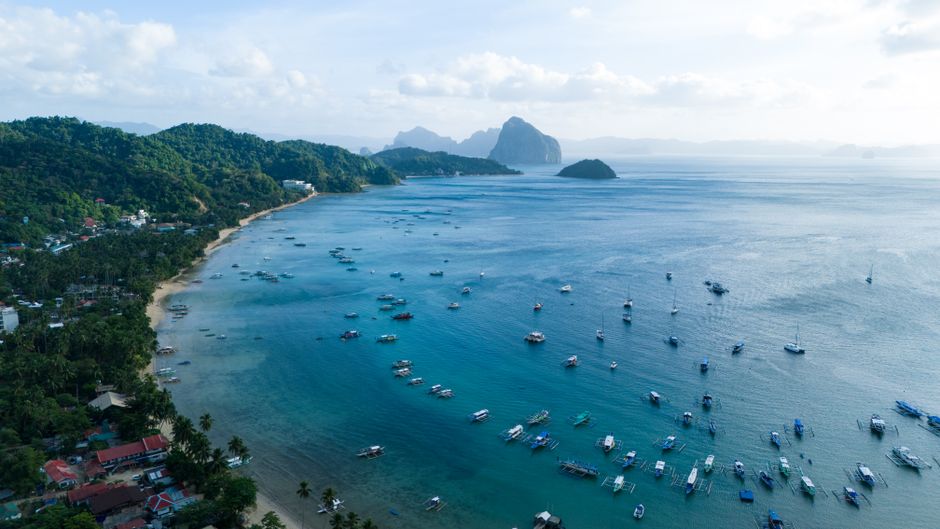
El Nido is a small town at the northern tip of Palawan, and the gateway to Bacuit Bay, a scatter of dozens of limestone islands rising sheer from clear green water, with hidden lagoons, white-sand coves and coral reefs between them. The town itself sits on a narrow beach below the black cliffs of Taraw, a busy grid of guesthouses, dive shops, cafés and tour agencies, but the reason to come is out on the water: every morning, a fleet of outrigger boats (bancas) leaves the beach on the municipality’s numbered island-hopping tours, A, B, C and D, to kayak into the Big and Small Lagoons, snorkel over reefs and picnic on empty beaches. Back on the mainland, long sweeps of sand such as Nacpan Beach, sunsets at Las Cabanas and waterfalls in the hills fill the remaining days. El Nido is a protected area, and every visitor pays an ecotourism development fee before joining a tour. The best time to visit is from about December to May, when the seas are calm; from June to October, the southwest monsoon brings rain and canceled boat trips.
Right now in El Nido
- Wed25–30°C77–85°F15 mm rain
- Thu26–30°C78–86°F11 mm rain
- Fri25–27°C77–81°F8 mm rain
Top tours in El Nido
See all tours for El Nido →
From local operators, with prices and reviews; you check availability and book on Viator, our partner. We may earn a commission at no extra cost to you. How we earn money
El Nido at a glance
- Best for: island-hopping and kayaking in Bacuit Bay, snorkeling and diving, beaches, sunsets and a relaxed backpacker scene.
- How long: 3 to 4 days for two or three island-hopping tours and a beach day; 5 or more to do all four tours.
- Best time: December to May, with February to April the calmest and driest; highs are about 31–33 °C (88–91 °F).
- Getting there: fly from Manila to El Nido’s small Lio Airport, travel 5 to 6 hours by road from Puerto Princesa, or take a boat from Coron.
- Getting around: on foot in town, by tricycle and rented scooter on the mainland, and by banca to the islands.
- Fees to know: the municipal ecotourism development fee (ETDF), paid once per visit, plus extra fees at some lagoons.
- Before you go: eTravel registration, visa-free stays, money and general safety are in our Philippines travel guide.
El Nido’s areas and where to stay
Most visitors stay in or near El Nido town, where the tours start, but quieter beaches stretch north and south along the coast.
El Nido town
The town proper (Poblacion) is a cramped few streets between the beach and the cliffs, with Calle Hama, Serena Street and Rizal Street lined with guesthouses, restaurants, bars and tour desks. It is convenient but noisy, and the town beach is a boat parking lot rather than a swimming beach.
Corong-Corong and Caalan
A short tricycle ride south, Corong-Corong is a strip of hotels and restaurants facing the bay and the sunset, with boats to the islands leaving from its own beach. It is calmer than town but still close.
Marimegmeg and Las Cabanas
Farther south, the beaches of Marimegmeg (Las Cabanas) have resorts, beach bars, a zip line to Depeldet Island and some of the best sunsets in El Nido.
Nacpan and the north
About 20 km (12 miles) north of town, the 4 km (2.5-mile) sweep of Nacpan Beach and its twin, Calitang, have a handful of rustic resorts, glamping sites and beach bars; it is peaceful but far from the tours. Near the airport, the Lio Estate is a planned beachfront development with hotels, restaurants and shops.
Island resorts
On private islands in Bacuit Bay, a few high-end resorts, such as those on Miniloc, Lagen and Pangulasian, offer all-inclusive stays with their own boats and activities.
Top things to see in El Nido
Bacuit Bay and the island-hopping tours
The town’s tour operators sell four standard island-hopping circuits, set by the local tourism office and sold at similar prices around town. Each runs from about 9 a.m. to 4 or 5 p.m., includes a buffet lunch on a beach, snorkel gear and stops at five or so sites, and the route can change with the weather and the tides. The ecotourism development fee and some site fees are paid separately. Book a day ahead, or ask about private boats to avoid the crowds.
A few habits make the tours better for everyone. Boats leave from the town beach or Corong-Corong at high or mid tide, so you may wade out to the banca in knee-deep water; keep phones and cameras in a dry bag. El Nido has long discouraged single-use plastics, and many tour operators provide refillable water, so bring your own bottle. Crews set the order of stops to avoid the crowds, but the lagoons on Tour A are busiest between 10 a.m. and 2 p.m., and private boats that leave early can reach them before the main fleet. In the shoulder months, ask the tour desk the evening before whether the Coast Guard has cleared boats to sail.
Tour A: the Big and Small Lagoons
The most popular tour visits the Big Lagoon and Small Lagoon on Miniloc Island, where you paddle a kayak or swim through a narrow gap between cliffs into emerald water, plus the Secret Lagoon, Shimizu Island and Seven Commando Beach. The lagoons have separate entrance fees and limits on visitor numbers, and kayaks are rented on site.
Tour B: caves and sandbars
Tour B heads south to Snake Island, with its winding sandbar, the Cudugnon and Cathedral caves, Pinagbuyutan Island and Entalula Beach. It is less crowded than Tour A.
Tour C: hidden beaches and the shrine
Tour C explores Matinloc and Tapiutan islands to the west: the Hidden Beach and Secret Beach, tucked behind rock walls, the Matinloc Shrine, Helicopter Island and Star Beach. It has some of the best snorkeling, but it is often canceled in rough weather, as it faces the open sea.
Tour D: beaches near town
The shortest and gentlest tour visits Cadlao Lagoon and beaches on and near Cadlao Island, such as Paradise Beach, Pasandigan, Nat Nat and Bukal, closer to town. It suits families and rainy-season days.
Nacpan Beach
According to the Department of Tourism, Nacpan is a 4 km (2.5-mile) stretch of sand about 20 km (12 miles) from the town, easily reached by tricycle, van or scooter. Climb the small hill at its southern end for a view of the twin beaches.
More classic sights
- Las Cabanas Beach: sunset drinks and the zip line to Depeldet Island.
- Taraw Cliff: the limestone wall behind town, with guided climbs to a viewpoint for the fit and sure-footed.
- Nagkalit-kalit Falls: a jungle walk with river crossings to a waterfall north of town.
- Duli Beach: a wild beach with surfable waves in the northeast-monsoon months.
Other things to do in El Nido
Food and drink
El Nido’s restaurants serve everything from Filipino grills and fresh seafood to wood-fired pizza, Italian, Mexican and vegan cafés, reflecting its international crowd. Try grilled fish and squid, kinilaw (raw fish in vinegar), adobo and halo-halo, and look for local cashews, a Palawan specialty. In the evening, the bars on the beach at Corong-Corong and Las Cabanas and around Calle Hama in town have happy hours and live music.
Diving and snorkeling
Several dive centers in town run trips to Bacuit Bay’s reefs and walls, such as South Miniloc and Dilumacad, with turtles, rays and reef fish, and offer courses. Snorkeling on the tours is good, especially on Tour C. See our diving and snorkeling guides.
Kayaking and expedition cruises
Rent a kayak to paddle to Cadlao or Ipil, or join a multi-day expedition boat trip between El Nido and Coron, camping on islands along the way, a popular adventure from about November to May. See our boat trips guide.
Festivals
The town’s fiesta and Holy Week are busy times; most of the year, the rhythm is set by the weather and the boat schedule.
Day trips from El Nido
- Nacpan and Calitang: a beach day in the north, by tricycle or scooter.
- Sibaltan: a quiet fishing village on the east coast, with traditional houses and calm beaches.
- Port Barton: a laid-back beach village about 3 hours south, better as an overnight stop on the way to or from Puerto Princesa.
- Coron: about 4 hours by fast boat, better as the next stop on your trip. See our Coron guide.
Nearby destinations
- Coron127 km
- Puerto Princesa175 km
- Boracay290 km
Getting there and getting around
By air
El Nido’s small Lio Airport (ENI), about 7 km (4.3 miles) north of town, has flights from Manila and some other cities on small turboprops operated by AirSWIFT; seats are limited and fares higher than on trunk routes, and baggage allowances are tight. Most travelers fly instead to Puerto Princesa, which has frequent Philippine Airlines and Cebu Pacific flights from Manila, Cebu and elsewhere.
From Puerto Princesa
Air-conditioned vans and buses run from Puerto Princesa’s airport and terminal to El Nido in about 5 to 6 hours, with a stop on the way; book a van that collects you at the airport or your hotel. Private cars are faster and more comfortable. See our Puerto Princesa guide.
By boat from Coron
Fast boats between El Nido and Coron take about 4 hours across open water and run mainly in the dry season; they are canceled in rough seas, and the crossing can be uncomfortable. Multi-day expedition boats are a slower, scenic alternative. Boats stop when the Coast Guard suspends sea travel.
Around El Nido
The town is walkable. Tricycles wait everywhere for short rides to Corong-Corong and Las Cabanas; agree on the fare first. Scooters are easy to rent for trips to Nacpan, but roads can be steep and slippery after rain, and you need a license and a helmet. Grab does not operate in El Nido.
When to go and how long to stay
Northern Palawan has a clear dry season and wet season. According to PAGASA, the national weather agency, the rainy season runs from June to November and the dry season from December to May, and in 2026 PAGASA declared the start of the rainy season in western areas on June 4. El Nido has no PAGASA station of its own, so the table uses PAGASA’s 1991–2020 normals for its Coron station, about 125 km (78 miles) to the northeast in the same climate zone, as submitted to the World Meteorological Organization (WMO). Coron’s normals have no published maximum temperatures, so the highs are from PAGASA’s station at Cuyo, also in Palawan.
| Month | Average high / low | Rain (days with 1 mm or more) | What to expect |
|---|---|---|---|
| January | 31 °C (87 °F) / 24 °C (74 °F) | 20 mm (0.8 in), 2 days | Dry season; occasional breezy days |
| February | 31 °C (88 °F) / 24 °C (74 °F) | 25 mm (1.0 in), 2 days | Dry and calm; excellent tours |
| March | 32 °C (89 °F) / 24 °C (76 °F) | 18 mm (0.7 in), 2 days | The driest month; peak season |
| April | 33 °C (92 °F) / 25 °C (77 °F) | 40 mm (1.6 in), 3 days | Hot; very busy at Holy Week |
| May | 33 °C (91 °F) / 25 °C (77 °F) | 198 mm (7.8 in), 11 days | Hot and still mostly calm; first storms |
| June | 32 °C (89 °F) / 25 °C (76 °F) | 324 mm (12.8 in), 18 days | Southwest monsoon arrives; some tours canceled |
| July | 31 °C (89 °F) / 24 °C (75 °F) | 540 mm (21.3 in), 21 days | The wettest month; frequent cancellations |
| August | 31 °C (89 °F) / 24 °C (76 °F) | 480 mm (18.9 in), 20 days | Very wet; low season |
| September | 32 °C (89 °F) / 24 °C (75 °F) | 480 mm (18.9 in), 20 days | Very wet; typhoons possible |
| October | 32 °C (89 °F) / 24 °C (76 °F) | 239 mm (9.4 in), 14 days | Rain easing |
| November | 32 °C (89 °F) / 24 °C (76 °F) | 98 mm (3.9 in), 7 days | Drying out; season starts |
| December | 31 °C (88 °F) / 24 °C (75 °F) | 87 mm (3.4 in), 6 days | Dry and busy; Christmas peak |
Coron gets about 2,550 mm (100 in) of rain a year, almost all from May to October. Even in the wet season there are sunny spells, but island tours, especially Tour C, are often canceled. PAGASA said in September 2026 that a strong El Niño was expected to bring below-normal rainfall to most of the country into early 2027.
3 days in El Nido
Day one, Tour A and the lagoons, with sunset at Las Cabanas. Day two, Tour C for hidden beaches and snorkeling, or Tour B for Snake Island. Day three, a day at Nacpan Beach.
5 days
Do all four tours, or swap one for a dive trip, and add Nagkalit-kalit Falls or a kayak to Cadlao.
What a trip to El Nido costs
Prices are approximate, for October 2026, converted at about ₱62.6 to the US dollar.
| Item | Typical cost |
|---|---|
| Ecotourism development fee (ETDF), per visit | about ₱400 (about US$6.40) |
| Shared island-hopping tour A, B, C or D, with lunch | ₱1,400–2,200 (about US$22–35), plus site fees |
| Big Lagoon or Small Lagoon entrance and kayak | ₱200–500 (about US$3.20–8) |
| Private boat for a day | ₱7,000–12,000 (about US$112–192) |
| Van from Puerto Princesa | ₱600–900 (about US$10–14) |
| Tricycle to Corong-Corong | ₱50–100 (about US$0.80–1.60) |
| Scooter rental, per day | ₱500–700 (about US$8–11) |
| Meal at a local restaurant | ₱250–500 (about US$4–8) |
| Mid-range hotel double, per night | ₱3,500–7,000 (about US$56–112) |
Practical tips for El Nido
- Pay the ETDF once: keep the receipt or wristband, as boat crews check it on every tour during your stay.
- Bring cash: ATMs in town are few and can run out; many tours and guesthouses prefer cash.
- Book Tour A early in the day: lagoon slots are limited, and early boats beat the crowds.
- Protect the reefs: don’t stand on coral, feed fish or take shells, and use reef-safe sunscreen.
- Allow a buffer day: boats from Coron and flights from Lio can be canceled by weather.
Safety
El Nido is relaxed and friendly. The main risks are at sea and on the roads: choose established tour operators, wear a life jacket on boats and kayaks, and don’t swim out to the lagoons alone. Tours stop when the Coast Guard suspends sea travel, especially when PAGASA raises Tropical Cyclone Wind Signals for northern Palawan, so keep your plans flexible from June to November. The roads to Nacpan and Puerto Princesa are winding and poorly lit at night; scooter accidents are common, so ride slowly and wear a helmet. Jellyfish appear at times; ask locally and wear a rash guard. Sun and dehydration catch out many visitors on long boat days. Petty theft from rooms and beaches occasionally happens. Medical facilities are basic, and serious cases go to Puerto Princesa. In an emergency, call 911.
What to pack for El Nido
Swimwear, a rash guard, reef-safe sunscreen and a hat, water shoes for rocky beaches and coral, a dry bag for boat days, a light rain jacket in the wet season, and a headlamp for power cuts. The Philippines uses 220 V and mostly flat two-pin US-style plugs. See our water shoes and travel adapters guides.
El Nido travel FAQ
What are El Nido tours A, B, C and D?
The four standard island-hopping circuits of Bacuit Bay. Tour A visits the Big and Small Lagoons, Tour B goes to Snake Island and caves, Tour C covers hidden beaches and the Matinloc Shrine, and Tour D visits Cadlao Lagoon and nearby beaches.
Which El Nido tour is best?
Tour A for the famous lagoons and Tour C for the best snorkeling and hidden beaches; if you have time for only one, most people choose A.
What is the El Nido ecotourism development fee?
A municipal environmental fee that every visitor pays once per visit, about ₱400 in recent years, before joining island tours; keep the receipt, as crews check it.
How do I get from Puerto Princesa to El Nido?
By van or bus in about 5 to 6 hours from the airport or the city terminal, or by private car.
Can I fly directly to El Nido?
Yes. AirSWIFT flies small planes to Lio Airport, about 7 km (4.3 miles) north of town, mostly from Manila; seats are limited, so book early.
How do I get from El Nido to Coron?
By fast boat in about 4 hours, mainly in the dry season, or on a multi-day expedition boat trip; there are no direct flights between the two.
What is the best time to visit El Nido?
December to May, when the seas are calm and tours rarely canceled; March is the driest month. June to October is wet, with frequent cancellations.
How many days do I need in El Nido?
Three to four days for two or three tours and a beach day; five to do all four tours or add diving.
Is there Grab in El Nido?
No. Use tricycles, rented scooters and vans.
Is El Nido expensive?
Mid-range by Philippine standards: tours and fees add up, but guesthouses and local restaurants are reasonably priced, and private island resorts are very expensive.
Plan your trip
Partner links: TravelerCenter may earn a commission if you book, at no extra cost to you.
🇵🇭 Useful Filipino phrases for El Nido
All 38 Filipino phrases: restaurant, hotel, emergencies, romance (printable) →
Sources · last reviewed 4 October 2026
Researched and last reviewed on 4 October 2026. Nacpan Beach and Bacuit Bay descriptions: the Department of Tourism; seasons, the 2026 rainy-season onset, typhoon statistics and the El Niño outlook: PAGASA, with climate normals for Coron and Cuyo via the World Meteorological Organization; Grab coverage: Grab Philippines; exchange rate: the European Central Bank. The ETDF amount, tour routes, lagoon fees and limits, flights to Lio, van and boat times, dive sites and typical prices are general references or estimates, flagged for checking, because the Municipality of El Nido’s website could not be read. Fees and routes change, so check the official sites before you go. For entry rules, money and general safety, see our Philippines travel guide.
Data: Weather: MET Norway (CC BY 4.0) · Sea temperature: NOAA CoastWatch · Rates: ECB · Costs: World Bank ICP and price levels · Wikidata (CC0)