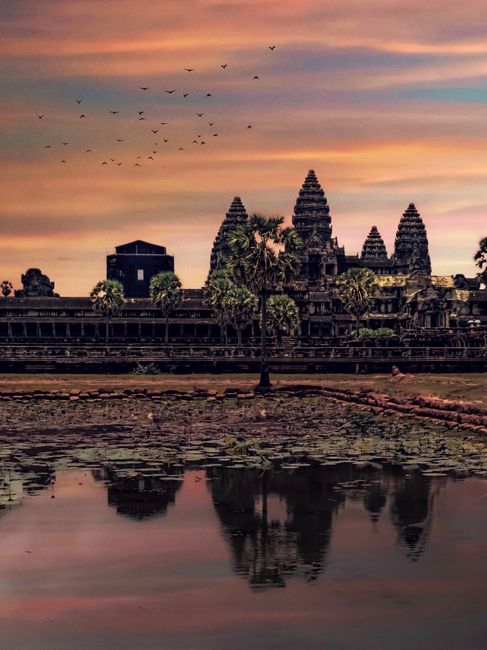
Siem Reap is the town at the gates of Angkor, the vast archaeological park that holds the remains of the capitals of the Khmer Empire, which ruled much of mainland Southeast Asia from the 9th to the 15th centuries. Within a short tuk-tuk ride of its hotels stand Angkor Wat, the largest religious monument in the world, the enigmatic stone faces of the Bayon, the jungle-wrapped ruins of Ta Prohm and dozens of other temples, spread over about 400 km² (155 sq miles) of forest, rice fields and ancient reservoirs. UNESCO inscribed Angkor as a World Heritage Site in 1992. Siem Reap itself has grown from a sleepy provincial town into a relaxed, green city of riverside paths, markets, restaurants, bars, galleries and boutique hotels, with the floating villages of the Tonle Sap lake to the south. The best time to visit is from November to February, when it is dry and relatively cool; March to May is very hot, and the wet season from May to October turns the temples lush and green. Since October 2023, flights have used the new Siem Reap Angkor International Airport, about 40 km (25 miles) east of town.
Right now in Siem Reap (Angkor)
- Wed24–31°C75–88°F8 mm rain
- Thu24–31°C75–88°F5 mm rain
- Fri25–30°C77–86°F11 mm rain
- Sat 10 Oct Pchum Ben (ពិធីបុណ្យភ្ផុំបិណ្ឌ)
- Sun 11 Oct Pchum Ben (ពិធីបុណ្យភ្ផុំបិណ្ឌ)
- Mon 12 Oct Pchum Ben (ពិធីបុណ្យភ្ផុំបិណ្ឌ)
Top tours in Siem Reap (Angkor)
See all tours for Siem Reap (Angkor) →
From local operators, with prices and reviews; you check availability and book on Viator, our partner. We may earn a commission at no extra cost to you. How we earn money
Siem Reap at a glance
- Best for: the temples of Angkor, sunrise and sunset at the ruins, cycling, floating villages, Khmer food and crafts, and a lively evening scene.
- How long: 3 days for the main temples; 4–5 with Banteay Srei, Beng Mealea, Koh Ker or the Tonle Sap.
- Best time: November to February, when it is dry and cooler; the green season from June to October is quieter, with afternoon downpours.
- Getting there: Siem Reap Angkor International Airport (SAI) is about 40 km (25 miles) east; buses from Phnom Penh take about 5–6 hours.
- Getting around: tuk-tuk with driver, bicycle or e-bike, car with driver, and ride-hailing apps in town.
- Fees to know: the Angkor Pass costs US$37 for one day, US$62 for three days and US$72 for seven days, according to Angkor Enterprise.
- Before you go: the e-visa, the e-Arrival card, money and general safety are in our Cambodia travel guide.
Siem Reap’s areas and where to stay
Siem Reap stretches along the Siem Reap River, with the old market district in the south and the road to the temples, Charles de Gaulle Boulevard, running north toward Angkor Wat, about 6 km (4 miles) away.
The Old Market and Pub Street
Around Psar Chas, the Old Market, the lanes of Pub Street and the alleys around it are packed with restaurants, bars, massage shops, night markets and budget hotels. It is lively and convenient, but loud until late.
The riverside and Wat Bo
Across the river from the Old Market, the area around Wat Bo, one of the town’s oldest pagodas, has quieter guesthouses, boutique hotels and cafés, within a 5- to 10-minute walk of the center.
Sivatha, Wat Damnak and the south
Along Sivatha Boulevard and in the leafy lanes around Wat Damnak, mid-range hotels and some of the best restaurants mix with local life.
The road to the temples
North of the center, toward the Angkor Pass ticket office and the park, large resort hotels with gardens and pools line the roads; they are calm but need a tuk-tuk to reach town.
Where to stay in Siem Reap
- Old Market and Pub Street: budget and mid-range hotels in the heart of the action.
- Wat Bo and the riverside: boutique hotels and guesthouses, quieter but central.
- Wat Damnak: villas, pool hotels and good restaurants.
- North of town: resorts closer to the temples.
Siem Reap has a huge choice of good-value hotels with pools; prices peak from December to February and around Khmer New Year in April.
The temples of Angkor
Angkor Wat
Built in the early 12th century by King Suryavarman II as a temple to Vishnu and later used as a Buddhist sanctuary, Angkor Wat is the largest religious monument in the world and Cambodia’s national symbol, on its flag. A broad moat and a causeway lead to a temple-mountain of three galleried tiers rising to five lotus-shaped towers; the outer gallery holds some of the finest bas-reliefs in Asia, including the Churning of the Ocean of Milk and scenes from the Mahabharata and Ramayana. Come at sunrise, when the towers are silhouetted against the dawn and reflected in the pools in front, and stay to explore before the crowds and heat build. The steep stairs to the uppermost level, the Bakan, have limited daily hours, close on Buddhist holy days and require shoulders and knees to be covered.
Angkor Thom and the Bayon
Angkor Thom, the walled royal city built by Jayavarman VII in the late 12th century, is entered through monumental gates topped by giant faces, such as the South Gate, approached along a causeway lined with gods and demons pulling a serpent. At its center, the Bayon is a forest of towers carved with more than 200 serene, smiling faces, and its galleries show scenes of daily life and battles with the Cham. Nearby are the Baphuon temple-mountain, the royal enclosure and Phimeanakas, and the Terrace of the Elephants and the Terrace of the Leper King, carved with processions and mythical figures.
Ta Prohm
Left largely as it was found, with silk-cotton and strangler fig trees growing out of its towers and galleries, Ta Prohm is the most atmospheric of the temples and famous from the film Lara Croft: Tomb Raider. Wooden walkways guide visitors through the ruins; go early or late to avoid the crowds.
Angkor Pass prices and rules
Tickets are sold by Angkor Enterprise, the state body that manages ticketing for the park, at the official ticket office on Road 60, about 4 km (2.5 miles) from the center, through its website and through its official Angkor Pass app; tickets bought anywhere else are not valid. According to Angkor Enterprise, in October 2026:
- 1-day pass: US$37, valid for one day.
- 3-day pass: US$62, valid on any three days within seven days.
- 7-day pass: US$72, valid on any seven days within 30 days.
- Hours: entry to the park from 5 a.m., with closing at 6:30 p.m.; individual temples keep shorter hours, and only Angkor Wat, Srah Srang and a few other sunrise spots open before about 7:30 a.m.
- Sunset bonus: a ticket bought after 4:45 p.m. lets you enter the park that evening for sunset and still use it the next day.
- Photos and children: 1-day tickets need no photo, while 3- and 7-day tickets carry your photo, taken at the office; children under 12 enter free but may need to show a passport.
Carry your pass at all times; it is checked at the main temples. Separate tickets are needed for Koh Ker (US$15), Beng Mealea (US$10) and Kbal Spean (US$5).
More temples in the park
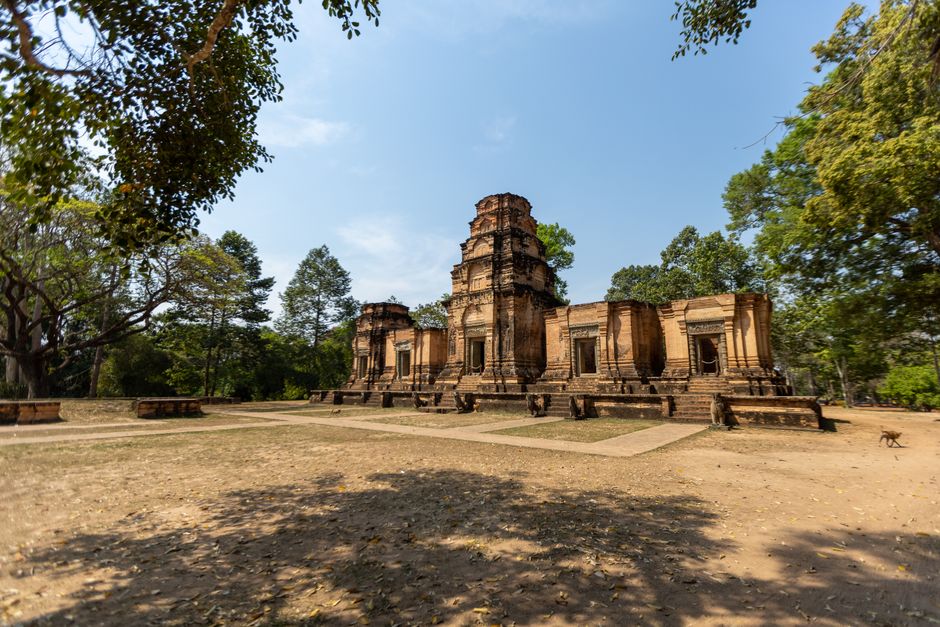
- Banteay Srei: a small 10th-century temple of pink sandstone with the finest carvings at Angkor, about 37 km (23 miles) north.
- Preah Khan: a sprawling monastic complex of corridors, carvings and trees on the Grand Circuit.
- Neak Pean: a shrine on an island in the middle of a square pool.
- Pre Rup and East Mebon: temple-mountains popular for sunset.
- Phnom Bakheng: a hilltop temple with views of Angkor Wat at sunset; the number of visitors at the top is limited.
- Srah Srang and Banteay Kdei: a royal bathing pond, lovely at sunrise, opposite a peaceful temple.
- The Roluos Group: Preah Ko, Bakong and Lolei, the oldest temples, from the 9th century, about 13 km (8 miles) east of town.
Other things to do in Siem Reap
Food and drink
Siem Reap is a great place to discover Khmer cooking. Try fish amok steamed in banana leaves, lok lak beef, num banh chok rice noodles with green curry for breakfast, and the red curries and grilled fish of local restaurants; Siem Reap’s own specialty is a sweet, slightly fermented Siem Reap sausage. Several training restaurants run by social enterprises serve excellent food while teaching young Cambodians, and cooking classes are popular. Pub Street and its alleys have cheap draft beer and cocktails, and rooftop and riverside bars offer quieter evenings.
Museums, shows and crafts
- Angkor National Museum: galleries of sculpture and multimedia displays explaining Angkor’s history, a good primer before the temples.
- Phare, the Cambodian Circus: a nightly show of acrobatics, theater and music by graduates of a Battambang arts school.
- Artisans d’Angkor: a workshop training young Cambodians in stone carving, wood carving and lacquerware, with free tours.
- APOPO Visitor Center: shows how trained rats detect landmines.
- Cambodia Landmine Museum: founded by a former child soldier who became a deminer, near Banteay Srei.
Cycling, quad bikes and countryside tours
The temples and the villages around them are flat, shaded and ideal for cycling, and many hotels rent bicycles and e-bikes; guided cycling tours follow back roads through rice fields. See our cycling and city sightseeing guides.
Day trips from Siem Reap
- The Tonle Sap and floating villages: boats visit stilt and floating villages such as Kampong Phluk, Kampong Khleang and Chong Kneas, where Angkor Enterprise sells boat tickets, and the Prek Toal bird sanctuary; water levels are highest from about August to November. See our boat trips guide.
- Beng Mealea: a vast, collapsed temple overgrown by jungle, about 1–1.5 hours east (US$10).
- Kbal Spean and Phnom Kulen: carvings in a riverbed reached by a forest walk (US$5), and the sacred mountain of Phnom Kulen with waterfalls and a reclining Buddha, which has a separate entry fee.
- Koh Ker: the 10th-century capital with a seven-tiered pyramid, a UNESCO World Heritage Site since 2023, about 2–2.5 hours northeast (US$15).
- Battambang: colonial architecture and countryside, about 3 hours by road; better with a night.
Nearby destinations
- Ko Chang215 km
- Phnom Penh230 km
- Ko Samet275 km
- Khao Yai National Park283 km
Getting there and getting around
By air
Siem Reap Angkor International Airport (SAI) opened in October 2023 about 40 km (25 miles) east of the city, replacing the old airport near the temples. Shuttle buses, taxis and tuk-tuks booked through hotels or ride-hailing apps make the trip into town in about an hour. There are direct flights from Phnom Penh, Bangkok, Kuala Lumpur, Singapore, Ho Chi Minh City, Hanoi and several Chinese and Korean cities; see our Thailand, Malaysia and Singapore guides. Before flying, complete the free e-Arrival card at arrival.gov.kh.
By bus and road
Buses and minivans link Siem Reap with Phnom Penh (about 5–6 hours), Battambang (about 3 hours) and other towns; several companies run comfortable express and night buses. The land border with Thailand at Poipet, about 2.5–3 hours west, has been closed since June 2025, according to the Thai authorities, so travelers from Bangkok should fly.
Around Siem Reap and the temples
The classic way to see the temples is by tuk-tuk (remork) with a driver for the day, who waits at each temple; agree on the route and price the night before. Cars with air conditioning suit hot days and small families. Bicycles and e-bikes are ideal for the Small Circuit if you are fit and start early. In town, PassApp and Grab offer tuk-tuks and cars at fixed prices.
When to go and how long to stay
Siem Reap is hot all year. The cool, dry season from November to February brings sunny days around 31–32 °C (88–90 °F), cooler nights and the biggest crowds. March to May is the hot season, with highs of about 35 °C (95 °F). The wet season, from May to October, brings short, heavy afternoon storms and green landscapes; September and October are the wettest months, when parts of town can flood. The table uses long-term averages for Siem Reap from Cambodia’s Ministry of Water Resources and Meteorology, as published by the World Meteorological Organization’s World Weather Information Service, covering 1982 to 2024 rather than the standard 1991–2020 period: average daily highs and lows and total rain.
| Month | Average high / low | Rain | What to expect |
|---|---|---|---|
| January | 31 °C (88 °F) / 20 °C (68 °F) | 4 mm (0.2 in) | Dry and pleasant; peak season |
| February | 32 °C (90 °F) / 21 °C (70 °F) | 4 mm (0.1 in) | Dry; clear sunrises |
| March | 35 °C (94 °F) / 23 °C (73 °F) | 41 mm (1.6 in) | Hot; quieter temples |
| April | 35 °C (95 °F) / 24 °C (75 °F) | 48 mm (1.9 in) | Very hot; Khmer New Year |
| May | 35 °C (96 °F) / 25 °C (76 °F) | 143 mm (5.6 in) | The hottest month; first storms |
| June | 33 °C (91 °F) / 25 °C (77 °F) | 195 mm (7.7 in) | Green season; afternoon rain |
| July | 33 °C (91 °F) / 24 °C (75 °F) | 170 mm (6.7 in) | Lush temples; fewer visitors |
| August | 32 °C (89 °F) / 25 °C (77 °F) | 170 mm (6.7 in) | Wet; Tonle Sap rising |
| September | 32 °C (89 °F) / 25 °C (76 °F) | 305 mm (12.0 in) | The wettest month; flooding possible |
| October | 31 °C (88 °F) / 22 °C (72 °F) | 227 mm (8.9 in) | Very wet; Tonle Sap at its fullest |
| November | 32 °C (89 °F) / 22 °C (72 °F) | 62 mm (2.4 in) | Drying out; Water Festival |
| December | 31 °C (87 °F) / 20 °C (69 °F) | 7 mm (0.3 in) | Cool and dry; busy |
Siem Reap receives about 1,380 mm (54 in) of rain a year, almost all from May to October.
Three days at Angkor
Day one, sunrise at Angkor Wat, then Angkor Thom, the Bayon and Ta Prohm (the Small Circuit), and sunset at Pre Rup or Phnom Bakheng. Day two, the Grand Circuit, with Preah Khan, Neak Pean, Ta Som and East Mebon, and Banteay Srei. Day three, the Roluos Group or Beng Mealea, and a sunset boat trip on the Tonle Sap.
Four to five days
Add Kbal Spean and Phnom Kulen, or Koh Ker, a cooking class, the Angkor National Museum and an evening at the Phare circus.
What a trip to Siem Reap costs
Prices are approximate, for October 2026, converted at about 4,050 riel to the US dollar. Most tourist prices are quoted in dollars.
| Item | Typical cost |
|---|---|
| Angkor Pass, 1 / 3 / 7 days | US$37 / US$62 / US$72 (about 150,000 / 251,000 / 292,000 KHR) |
| Tuk-tuk with driver for the Small Circuit | 60,000–80,000 KHR (about US$15–20) |
| Tuk-tuk to Banteay Srei or the Grand Circuit | 80,000–120,000 KHR (about US$20–30) |
| Bicycle or e-bike rental, per day | 8,000–40,000 KHR (about US$2–10) |
| Fish amok at a local restaurant | 16,000–32,000 KHR (about US$4–8) |
| Draft beer on Pub Street | 2,000–6,000 KHR (about US$0.50–1.50) |
| Phare circus ticket | 81,000–162,000 KHR (about US$20–40) |
| Mid-range pool hotel double, per night | 120,000–280,000 KHR (about US$30–70) |
Practical tips for Siem Reap
- Buy your pass only from Angkor Enterprise: at the Road 60 office, the website or the official app.
- Dress for the temples: cover shoulders and knees, or you may be turned away from Angkor Wat’s upper level and other sanctuaries.
- Start early and rest at midday: sunrise to late morning is the coolest and quietest time.
- Carry water and small dollar notes: drinks and snacks are sold at most temples.
- Don’t climb on fragile ruins: stay on paths and walkways, and don’t touch carvings.
- Complete the e-Arrival card: before you fly in.
Safety
Siem Reap is relaxed and safe, but take some care. At the temples, stairs are steep and uneven, and the heat is intense, especially from March to May; wear shoes with grip and drink plenty of water. Around remote temples and in the countryside, landmines and unexploded ordnance may remain away from cleared areas; stay on paths and roads. Bag snatching by thieves on motorbikes occurs around Pub Street and on quiet roads at night; carry bags on the side away from traffic and use tuk-tuks with side guards. Traffic is chaotic, and motorbike accidents are common; wear a helmet. Heavy rain in September and October can flood streets and rural roads. Methanol-contaminated spirits have caused deaths in Cambodia, so stick to sealed, branded drinks. Some areas near the Thai border, north and west of Siem Reap province, have been affected by the border conflict since 2025; follow local information if traveling there. In an emergency, call 117 for police and 119 for an ambulance.
What to pack for Siem Reap
Light, breathable clothes that cover shoulders and knees, comfortable shoes with grip for temple stairs, a hat, sunscreen and a refillable water bottle, a flashlight or headlamp for sunrise, insect repellent, and a rain jacket from May to October. Cambodia uses 230 V, with sockets for flat (type A) and round (type C) two-pin plugs. See our rain jackets, hiking shoes and travel adapters guides.
Siem Reap travel FAQ
How much is the Angkor Pass?
US$37 for one day, US$62 for three days within a week and US$72 for seven days within a month, according to Angkor Enterprise. Children under 12 enter free.
Where can I buy the Angkor Pass?
Only from Angkor Enterprise: at the official ticket office on Road 60, on its website or through its official app. Tickets from anyone else are not valid.
What time does Angkor Wat open for sunrise?
The park opens at 5 a.m. for sunrise at Angkor Wat and a few other spots; most temples open around 7:30 a.m., and the park closes at 6:30 p.m.
How many days do I need at Angkor?
Three days covers the main temples comfortably; one day is enough for the highlights, and four or five allow outlying sites such as Banteay Srei, Beng Mealea and Koh Ker.
How far is the airport from Siem Reap?
Siem Reap Angkor International Airport is about 40 km (25 miles) east of town, about an hour by shuttle bus or taxi.
What is the best time to visit Angkor?
November to February, when it is dry and cooler. The green season, from June to October, is quieter, with afternoon rain.
What should I wear to Angkor Wat?
Clothes covering shoulders and knees, and comfortable shoes with grip for the steep stairs.
Can I cycle around Angkor?
Yes. The Small Circuit is flat and shaded, and bicycles and e-bikes are widely available; start early to avoid the heat.
How do I get from Phnom Penh to Siem Reap?
By bus or minivan in about 5–6 hours, or by domestic flight in under an hour.
Can I travel from Bangkok to Siem Reap by land?
Not at present: Thailand closed its land crossings with Cambodia, including Poipet, in June 2025, and they remained closed in mid-2026. Direct flights link Bangkok and Siem Reap.
Plan your trip
Partner links: TravelerCenter may earn a commission if you book, at no extra cost to you.
🇰🇭 Useful Khmer phrases for Siem Reap (Angkor)
All 38 Khmer phrases: restaurant, hotel, emergencies, romance (printable) →
Sources · last reviewed 4 October 2026
Researched and last reviewed on 4 October 2026. Angkor Pass prices, validity, entry and closing hours, the sunset rule, photo and child rules, the ticket office and the Chong Kneas boat tickets and the Small Circuit temples: Angkor Enterprise; the e-Arrival card: Cambodia’s General Department of Immigration; exchange rate: the National Bank of Cambodia; climate averages (1982–2024): Cambodia’s Ministry of Water Resources and Meteorology via the World Meteorological Organization’s World Weather Information Service. Landmines, bag snatching, methanol and temple dress are from the UK government’s factual safety pages; the Thai border status is from Thai media reporting government statements. Temple history and dates, the park area, the UNESCO years, the airport opening and distance, Phnom Kulen’s separate fee, bus times and typical prices are general references or estimates, flagged for checking. Prices and hours change, so check the official sites before you go. For entry rules, money and general safety, see our Cambodia travel guide.
Data: Weather: MET Norway (CC BY 4.0) · Air quality: OpenAQ · Rates: ECB · Holidays: Nager.Date · Costs: World Bank ICP and price levels · Wikidata (CC0)