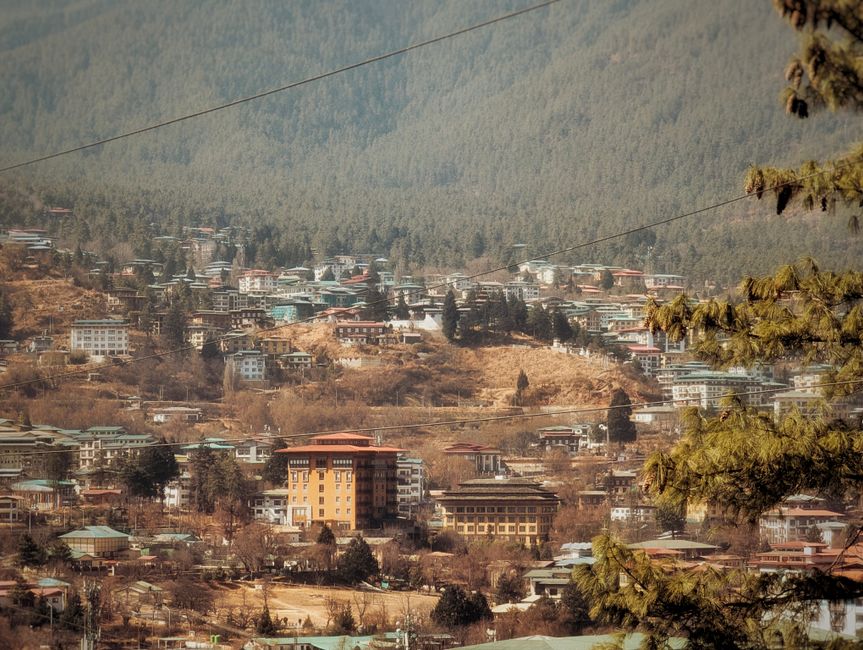
Thimphu, the capital of Bhutan, climbs the western slopes of the Wang Chhu valley at about 2,300 m (7,600 ft), a small city of about 100,000 people where traditional architecture is required by law, office workers wear the national dress, and a police officer in white gloves directs traffic at the main crossroads instead of traffic lights. It is the seat of the King, the government and the central monastic body, which share the vast Tashichho Dzong by the river, and the best place in the country to learn about Bhutanese crafts, textiles, medicine and daily life, in museums, art schools and weekend markets. Above the city, a 51 m (169 ft) golden statue of the Buddha, the Buddha Dordenma, looks down the valley, and forested hills hold monasteries and hiking trails. Thimphu is about an hour from Paro airport, and most visitors spend one or two nights here between Paro and Punakha, ideally timing their visit for the autumn Thimphu Tshechu. Like the rest of Bhutan, it is visited with a certified guide. The best months are October and November and March to May.
Right now in Thimphu
- Wed 9–17°C 49–63°F 3 mm Showers
- Thu 8–18°C 46–64°F 1 mm Light showers
- Fri 9–13°C 48–55°F 9 mm Heavy rain
Weather: MET Norway (CC BY 4.0)
Top tours in Thimphu
See all tours for Thimphu →
From local operators, with prices and reviews; you check availability and book on Viator, our partner. We may earn a commission at no extra cost to you. How we earn money
Thimphu at a glance
- Best for: dzongs and temples, museums of crafts and textiles, markets, festivals and Bhutanese city life.
- How long: 1–2 nights; 3 with a hike to Tango and Cheri monasteries or a day at Dochula.
- Best time: October and November, for clear skies and the Thimphu Tshechu; March to May, for spring flowers.
- Getting there: about 50 km (31 miles), an hour’s drive, from Paro International Airport.
- Getting around: on foot in the center with your guide; by car with your driver to the outlying sights.
- Good to know: foreign visitors can tour Tashichho Dzong in the evening after office hours on weekdays and during the day on public holidays, according to the Department of Tourism’s list.
- Before you go: the SDF, visa, guide rules, money and general safety are in our Bhutan travel guide.
Thimphu’s areas and where to stay
Thimphu stretches for several kilometers along the west bank of the Wang Chhu, with the center around Norzin Lam, the main street, and Tashichho Dzong to the north.
Norzin Lam and the town center
The main street and the streets around the clock tower square have most of the hotels, restaurants, cafés, handicraft shops and banks, with the traffic police box at the main crossing. It is the most convenient base, within walking distance of the markets and the Memorial Chorten.
Motithang and the upper town
On the slopes above the center, the quieter residential district of Motithang has hotels with valley views, near the Takin Preserve and the telecom tower viewpoint.
Babesa and the south
On the road from Paro, the southern suburbs have newer hotels and the Simtokha Dzong, a short drive from the center.
Outlying lodges
Luxury lodges in the forested hills north and south of the city offer seclusion and views, 10 to 20 minutes from town.
Top things to see in Thimphu
Tashichho Dzong
The “fortress of the glorious religion,” rebuilt in its present form in the 1960s, houses the throne room and offices of the King, government ministries and the summer quarters of the Je Khenpo, Bhutan’s chief abbot, and his monks. Its whitewashed walls, golden roofs and courtyards stand among lawns beside the river. According to the Department of Tourism’s list, foreigners pay Nu 500 and can visit on weekdays from 5 to 6 p.m., after office hours, and from 9 a.m. to 5 p.m. on public holidays; the flag-lowering ceremony takes place in the late afternoon. The Thimphu Tshechu is held in its courtyard.
Buddha Dordenma
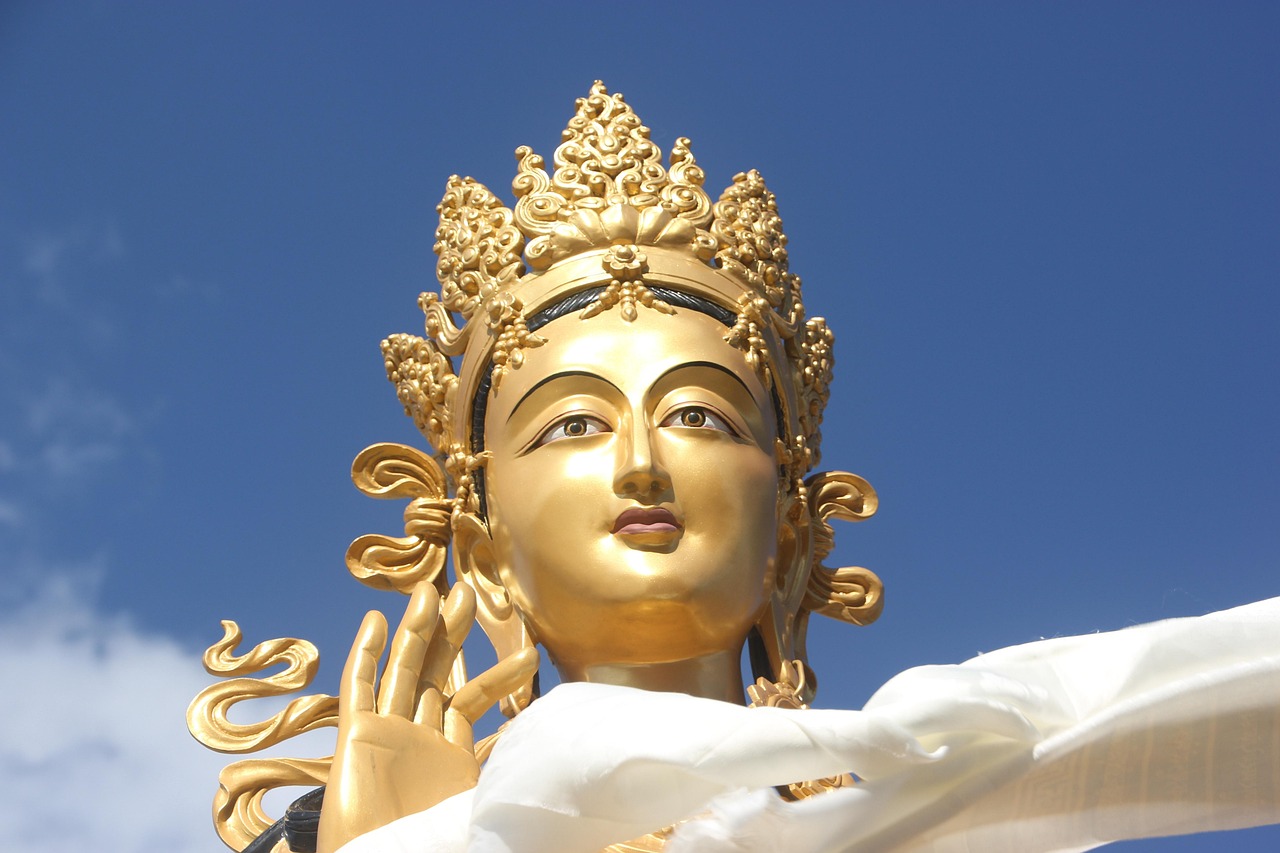
A giant bronze and gilded statue of the seated Buddha Shakyamuni, about 51 m (169 ft) tall, on a hilltop at Kuenselphodrang overlooking the southern end of the valley; inside, its hall holds 125,000 smaller Buddha statues. The surrounding nature park has walking trails and views over the city. Entry is free.
The National Memorial Chorten
A large white chorten built in 1974 in memory of the third king, Jigme Dorji Wangchuck, and the most visible center of daily worship in Thimphu: from dawn to dusk, elderly residents walk around it, spinning prayer wheels and counting prayer beads. Entry is Nu 500.
Changangkha Lhakhang
A 12th-century temple on a ridge above the city, where parents bring newborn children to be named and blessed, with views over the valley. Entry is Nu 500.
The Motithang Takin Preserve
A forested enclosure where you can see Bhutan’s national animal, the takin, a strange-looking relative of goats and sheep. Entry is Nu 300.
Simtokha Dzong
Built in 1629 by Zhabdrung Ngawang Namgyal, this is one of the oldest dzongs in Bhutan, guarding the southern entrance to the valley; it houses a school of Buddhist studies. Entry is free.
Museums and craft schools
- National Institute for Zorig Chusum: the school of Bhutan’s 13 traditional arts, where students learn painting, woodcarving, embroidery and sculpture; visitors can watch classes (Nu 200).
- Royal Textile Academy and National Textile Museum: Bhutanese weaving traditions, royal costumes and live weaving (Nu 250).
- Folk Heritage Museum: a restored 19th-century farmhouse showing rural life (Nu 250).
- Simply Bhutan: a living museum of village life with demonstrations and archery (Nu 1,000).
- National Institute of Traditional Medicine: exhibits on Bhutan’s traditional medicine (Nu 500).
- Bhutan Post Office Museum: the story of Bhutan’s famous postage stamps (Nu 250).
- National Library: old Buddhist texts and one of the world’s largest published books (Nu 100).
- Jungshi Handmade Paper Factory: paper made from the bark of the daphne shrub (Nu 100).
Other things to do in Thimphu
The Thimphu Tshechu
Thimphu’s biggest festival, usually held over three days in September or October in the courtyard of Tashichho Dzong, draws people from across the country in their finest clothes for masked dances, clown performances by the atsaras and blessings. The dates follow the lunar calendar; hotels fill months ahead.
Markets and shopping
The Centenary Farmers’ Market by the river, busiest from Friday to Sunday, sells red rice, chilies, cheese, dried yak meat, betel nut and incense; across the cantilever bridge, a handicraft market sells masks, prayer wheels and textiles. The Cottage and Small Industries (CSI) Market and the shops of the Textile Museum, Tarayana and Craft Gallery sell handwoven textiles, bamboo work and other local crafts. Buy only from reputable shops, which can arrange export permits where needed.
Food and drink
Thimphu has Bhutan’s widest range of restaurants, from local eateries serving ema datshi, red rice, momos and phaksha paa (pork with chilies) to Indian, Thai, Japanese and Western cafés and a growing café scene. Try the local craft beers and whisky, and suja, salty butter tea. Under Bhutan’s long-standing practice, Tuesday is a “dry day,” when bars do not serve alcohol.
The Dochula pass
On the road to Punakha, about 45 minutes east of the city, the Dochula pass at about 3,100 m (10,170 ft) is marked by 108 white memorial chortens (the Druk Wangyal Khangzang chortens), built in 2004, and the Druk Wangyal Lhakhang, a temple honoring the fourth king. On clear days from October to February, the view stretches along the eastern Himalaya, including Gangkhar Puensum, Bhutan’s highest peak; a café serves tea with the view. The Royal Botanical Park at Lamperi, just beyond, has rhododendron forests that flower in spring.
Weekends and nightlife
Thimphu is livelier at weekends, when families shop at the market, play archery and picnic along the river, and young Bhutanese fill the cafés, karaoke bars and a few small nightclubs in the center. Traditional song and dance performances are staged for visitors at some hotels and at the Royal Academy of Performing Arts, which preserves the masked dances performed at tshechus; ask your guide whether a rehearsal or show is on during your stay.
Archery
Watch Bhutan’s national sport at the Changlimithang archery ground, near the national stadium, especially at weekends, when teams compete over a distance of 145 m (476 ft) with singing, dancing and taunting of opponents.
Hikes around the city
Trails from the city lead to the Tango and Cheri monasteries at the head of the valley, each a 1- to 2-hour climb through forest; to the Wangditse and Thujidrag temples; and along the ridges of the Buddha Dordenma nature park. See our hiking guide.
Day trips from Thimphu
- Dochula pass: at about 3,100 m (10,170 ft), 30 km (19 miles) east on the road to Punakha, with 108 memorial chortens, the Druk Wangyal Lhakhang and, on clear days from October to February, a panorama of the eastern Himalaya; the Royal Botanical Park at Lamperi is nearby (Nu 300).
- Punakha: about 2.5 to 3 hours over the Dochula pass, with Punakha Dzong and Chimi Lhakhang; best with a night.
- Paro: about an hour west. See our Paro guide.
- Tango and Cheri monasteries: at the head of the valley, 30 minutes’ drive and a hike through forest.
- Dagala Thousand Lakes trek: a 5- to 6-day trek south of the city past high mountain lakes.
Nearby destinations
- Paro22 km
- Darjeeling144 km
- Lhasa283 km
- Sagarmatha National Park (Everest Region)293 km
Getting there and getting around
By air and road
There is no airport in Thimphu; visitors fly into Paro International Airport and drive about an hour along the Paro Chhu and Wang Chhu rivers, past the confluence at Chuzom. Thimphu is about 5 to 6 hours by road from the Indian border at Phuentsholing. Your guide and driver arrange transport.
Around the city
The center is compact and walkable, and your guide accompanies you. Taxis are plentiful, and the city has a small public bus network, though tourists usually travel with their driver. The Druk Ride app books local transport.
When to go and how long to stay
Thimphu has warm summers and cold, dry winters. October and November are the best months, with clear skies, crisp air and the Thimphu Tshechu. December to February is sunny and dry by day but freezing at night, with occasional snow. March to May is mild and pleasant, with flowers, and June to September is the wet season, with afternoon and night rain and occasional landslides on the roads. The table shows averages published by Bhutan’s National Center for Hydrology and Meteorology (NCHM) for the Thimphu station on the World Meteorological Organization’s (WMO) World Weather Information Service, based on 1996–2018; NCHM has not published 1991–2020 normals there.
| Month | Average high / low | Rain (rainy days) | What to expect |
|---|---|---|---|
| January | 15 °C (59 °F) / −2 °C (28 °F) | 6 mm (0.2 in), 1 day | Sunny and dry; freezing nights |
| February | 17 °C (62 °F) / 0 °C (33 °F) | 9 mm (0.4 in), 1 day | Cold; Losar; occasional snow |
| March | 19 °C (67 °F) / 4 °C (39 °F) | 20 mm (0.8 in), 4 days | Mild; spring flowers |
| April | 22 °C (72 °F) / 8 °C (46 °F) | 29 mm (1.1 in), 6 days | Pleasant; rhododendrons at Dochula |
| May | 25 °C (76 °F) / 12 °C (53 °F) | 48 mm (1.9 in), 9 days | Warm; showers begin |
| June | 27 °C (80 °F) / 15 °C (59 °F) | 92 mm (3.6 in), 14 days | Monsoon arrives |
| July | 27 °C (81 °F) / 16 °C (61 °F) | 147 mm (5.8 in), 19 days | Wettest month |
| August | 27 °C (81 °F) / 16 °C (61 °F) | 121 mm (4.8 in), 17 days | Wet and green |
| September | 26 °C (79 °F) / 15 °C (58 °F) | 72 mm (2.8 in), 12 days | Rains easing; Thimphu Tshechu in some years |
| October | 23 °C (74 °F) / 9 °C (48 °F) | 42 mm (1.6 in), 5 days | Clear and mild; Thimphu Tshechu in some years |
| November | 20 °C (67 °F) / 3 °C (38 °F) | 1 mm (under 0.1 in), under 1 day | Dry, sunny and crisp |
| December | 16 °C (62 °F) / −1 °C (31 °F) | 4 mm (0.2 in), 1 day | Cold and sunny; Dochula festival on December 13 |
1 day in Thimphu
Morning, the Buddha Dordenma, the Memorial Chorten and the Takin Preserve; afternoon, the Zorig Chusum school, the Textile Museum and the Folk Heritage Museum; evening, Tashichho Dzong after office hours.
2 days in Thimphu
Add a morning hike to Cheri or Tango monastery, the weekend market and craft shops, and an archery match.
Where to stay in Thimphu
- Town center (Norzin Lam): mid-range hotels close to restaurants, shops and the markets.
- Motithang: quieter hotels with views, near the Takin Preserve.
- Babesa and the south: newer hotels on the road from Paro.
- Outlying luxury lodges: in the forested hills, with spa and mountain views.
All tourist accommodation must be certified by the Department of Tourism. Rooms fill during the Thimphu Tshechu; book months ahead.
What a trip to Thimphu costs
Prices are approximate, for October 2026, converted at about Nu 96 to the US dollar. Entry fees are those published by the Department of Tourism.
| Item | Typical cost |
|---|---|
| Sustainable Development Fee, adult, per night | US$100 |
| Tashichho Dzong | Nu 500 (about US$5.20) |
| National Memorial Chorten / Changangkha Lhakhang | Nu 500 each (about US$5.20) |
| Buddha Dordenma / Simtokha Dzong | Free |
| Takin Preserve | Nu 300 (about US$3.10) |
| National Textile Museum / Folk Heritage Museum | Nu 250 each (about US$2.60) |
| Lunch of ema datshi and red rice | Nu 250–600 (about US$2.60–6.25) |
| Dinner in a mid-range restaurant | Nu 800–1,800 (about US$8–19) per person |
| Three-star hotel double, per night | Nu 5,000–12,000 (about US$52–125) |
Practical tips for Thimphu
- Time Tashichho Dzong for the evening: on weekdays, foreigners visit after office hours, around the flag-lowering ceremony.
- Visit the markets at the weekend: the Centenary Farmers’ Market is busiest from Friday to Sunday.
- Dress for the dzong and temples: long sleeves and long trousers or skirts, no hats inside.
- Carry some cash: cards and digital wallets work in many shops, but small vendors prefer cash.
- Check festival dates early: if you want to see the Thimphu Tshechu, hotels and flights fill months ahead.
Safety
Thimphu is a very safe city, with little crime. Watch your step on uneven pavements and in steep lanes, and keep away from the stray dogs that roam the streets, especially at night. At about 2,300 m (7,600 ft), the altitude can cause breathlessness for the first day or two. During the monsoon, from June to September, landslides can close the roads to Paro, Punakha and the south, and the Dochula road is sometimes affected by snow in winter. The national referral hospital in Thimphu is the best equipped in the country. For emergencies, call 113 for police, 112 for an ambulance and 110 for fire; the Department of Tourism’s hotline is +975 17661974 (or 2300 within Bhutan).
What to pack for Thimphu
Warm layers and a down jacket from November to March, a fleece for evenings all year, comfortable walking shoes, a rain jacket from June to September, sunscreen for the strong mountain sun, and smart, modest clothing with long sleeves for the dzong and festivals. Bhutan uses 230 V, with British (type G), European (type C) and Indian (type D) sockets. See our hiking shoes, rain jackets and travel adapters guides.
Thimphu travel FAQ
How many days do I need in Thimphu?
One or two nights for the dzong, the Buddha Dordenma, the museums and the markets; three with a monastery hike or a day at Dochula.
Is it true Thimphu has no traffic lights?
Yes. A police officer directs traffic by hand from a decorated pavilion at the main crossing on Norzin Lam, one of the city’s best-known sights.
When can tourists visit Tashichho Dzong?
According to the Department of Tourism’s list, from 5 to 6 p.m. on weekdays, after office hours, and from 9 a.m. to 5 p.m. on public holidays; entry is Nu 500.
When is the Thimphu Tshechu?
In September or October, over three days, on dates set by the lunar calendar. The Department of Tourism publishes the festival calendar.
How far is Thimphu from Paro airport?
About 50 km (31 miles), around an hour by car.
Can I walk around Thimphu on my own?
Bhutan’s rules require visitors to be accompanied by a certified guide at all times, so plan sightseeing with your guide.
What should I buy in Thimphu?
Handwoven textiles, Bhutanese paper, incense, masks, bamboo work and local foods such as red rice and dried chilies, from reputable shops and the weekend market.
How tall is the Buddha Dordenma?
About 51 m (169 ft), one of the largest seated Buddha statues in the world.
Can I see Himalayan peaks from Thimphu?
Not from the city itself. The Dochula pass, 30 km (19 miles) east, has views of the eastern Himalaya on clear days, best from October to February.
What is the best time to visit Thimphu?
October and November, for clear skies and the Thimphu Tshechu, and March to May, for spring weather.
Sources and last review
Researched and last reviewed on 4 October 2026. The Sustainable Development Fee, guide rules, Paro flights, Druk Ride, markets and craft shops, monument and museum fees and visiting hours (Tashichho Dzong, Memorial Chorten, Changangkha, Takin Preserve, Simtokha Dzong, Buddha Dordenma, Zorig Chusum, Textile Museum, Folk Heritage Museum, Simply Bhutan, Traditional Medicine, Post Office Museum, National Library, Jungshi paper factory, Lamperi Botanical Park) and emergency numbers: Bhutan’s Department of Tourism (bhutan.travel and its monument and museum fee list); exchange rate: the Royal Monetary Authority of Bhutan; climate data for Thimphu: Bhutan’s National Center for Hydrology and Meteorology (1996–2018), via the World Meteorological Organization’s World Weather Information Service. Population, history, the statue’s height, the Tuesday dry day, festival timing, hiking times, travel times, food and hotel prices are general references or estimates, flagged for checking. Fees and hours change, so check with your guide or the official sites before you go. For the SDF, visa, guide rules, money and general safety, see our Bhutan travel guide.
Plan your trip
Partner links: TravelerCenter may earn a commission if you book, at no extra cost to you.