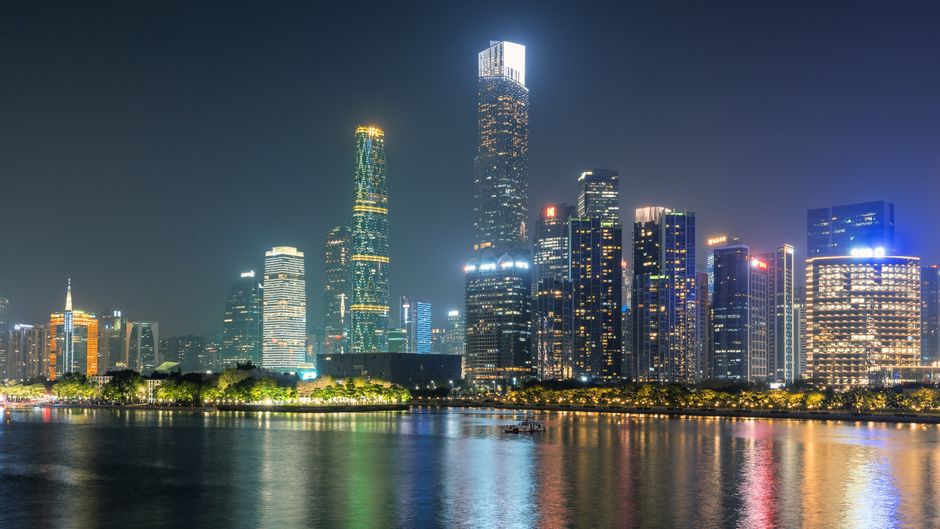
Guangzhou, the old Canton, is the capital of Guangdong province and the great trading city of southern China, on the Pearl River about 120 km (75 miles) northwest of Hong Kong. For more than 2,000 years, it has been a port for the maritime Silk Road, and in the 18th and 19th centuries it was the only Chinese city where Western merchants could trade, through the waterfront “Thirteen Factories.” Today it is one of China’s biggest cities, a hub of manufacturing and trade that hosts the Canton Fair twice a year, and, above all, the capital of Cantonese food: few places in the world eat as well, from dim sum breakfasts in teahouses to roast goose and wonton noodles. Come for the Canton Tower and the night cruise on the Pearl River, the colonial villas of Shamian Island, the carved Chen Clan Ancestral Hall, the old arcaded streets of Liwan, Yuexiu Park and the city’s temples, and easy trips to Foshan, the Kaiping watchtowers and Shenzhen. High-speed trains reach Shenzhen in about half an hour, Hong Kong’s West Kowloon in under an hour, and Guilin in about 2.5–3 hours. The best time is October to December; summers are hot, wet and humid, with typhoons possible.
Right now in Guangzhou
- Wed 19–28°C 65–82°F Clear
- Thu 20–29°C 69–84°F Partly cloudy
- Fri 22–30°C 72–86°F Clear
Weather: MET Norway (CC BY 4.0)
Top tours in Guangzhou
See all tours for Guangzhou →
From local operators, with prices and reviews; you check availability and book on Viator, our partner. We may earn a commission at no extra cost to you. How we earn money
Guangzhou at a glance
- Best for: Cantonese food and dim sum, river views, colonial and Lingnan architecture, markets, trade fairs and shopping.
- How long: 2–3 days, plus a day trip to Foshan or Kaiping.
- Best time: October to December, when it is dry, sunny and warm; March to April can be humid and misty, and May to September hot and rainy.
- Getting there: by air to Guangzhou Baiyun (CAN), or by high-speed train from Hong Kong, Shenzhen, Guilin, Beijing and Shanghai.
- Getting around: by metro, which covers the city and the airport, and by taxi or DiDi.
- Good to know: hotel prices and traffic jump during the Canton Fair in April–May and October–November.
- Before you go: visa-free entry, the 240-hour transit, the arrival card, payments and general safety are in our China travel guide.
Guangzhou’s areas and where to stay
Guangzhou stretches along both banks of the Pearl River. The old city lies on the north bank in Liwan and Yuexiu; the modern city center has moved east to Tianhe, with the new skyline of Zhujiang New Town facing the Canton Tower across the river.
Tianhe and Zhujiang New Town
The modern heart of the city, with skyscrapers, international hotels, malls, the Guangdong Museum and the Guangzhou Opera House, and the best views of the Canton Tower; convenient for metro Line 3 to the airport and for Guangzhou East station.
Yuexiu and Beijing Road
The historic center, around Beijing Road, a pedestrian shopping street where glass panels show the road surfaces of earlier dynasties, and Yuexiu Park; mid-range hotels close to temples, museums and old restaurants.
Liwan and Shamian Island
The old western district, with the arcaded qilou shophouse streets of Shangxiajiu, Enning Road and the Xiguan mansions, markets and some of the city’s most traditional teahouses. On the river, Shamian Island, the former British and French concession, is a quiet enclave of colonial villas, banyan trees and a few hotels.
Haizhu and Pazhou
South of the river, Haizhu is residential and green; Pazhou is home to the Canton Fair complex, with large business hotels that fill during fairs.
Where to stay in Guangzhou
- Tianhe and Zhujiang New Town: international hotels, malls and skyline views.
- Yuexiu and Beijing Road: mid-range hotels in the historic center.
- Shamian Island and Liwan: heritage atmosphere, teahouses and riverside walks.
- Pazhou: business hotels for the Canton Fair.
Hotel prices can double during the Canton Fair, held in three phases in spring (April–May) and autumn (October–November); book early or avoid those weeks.
Top things to see in Guangzhou
The Canton Tower and the Pearl River
The 600-meter (1,970-foot) Canton Tower, a slim, twisting lattice completed in 2010, is the city’s symbol; its outdoor observation decks near the top give views over the whole city, with a slow “bubble tram” ride around the summit and a sky drop for thrill-seekers. At night, the tower and the skylines on both banks glow with light shows. The best way to see them is a Pearl River night cruise, which runs for about 1–1.5 hours from piers such as Tianzi Wharf near Beijing Road and the Canton Tower; walking the riverside promenades of Zhujiang New Town and Haixinsha Island is free.
Shamian Island
A sandbank island of about 900 by 300 m (3,000 by 1,000 ft), Shamian was leased to Britain and France after the Opium Wars, and its avenues of banyan trees are lined with more than 150 European-style buildings: former consulates, banks, churches and villas, now cafés, shops and the historic White Swan Hotel. It is car-free and lovely for a stroll, especially in the early morning or evening light.
Chen Clan Ancestral Hall
The Chen Clan Ancestral Hall, built in the 1890s as an academy and ancestral temple for the Chen families of Guangdong, is a masterpiece of Lingnan decoration: its roofs and walls are covered with intricate carvings in wood, stone and brick, ceramic figures and ironwork. It now houses the Guangdong Folk Arts Museum.
Yuexiu Park and the Five Rams
Yuexiu Park, the city’s largest park, contains the Zhenhai Tower of 1380, now the Guangzhou Museum, a stretch of Ming city wall and the Five Rams statue, symbol of the legend of the city’s founding. Nearby, the Mausoleum of the Nanyue King, the tomb of a 2nd-century-BC ruler, holds a jade burial suit made of thousands of jade pieces sewn with silk.
Temples and old streets
The Temple of the Six Banyan Trees has a nine-story pagoda from the 11th century; Guangxiao Temple is one of the oldest Buddhist temples in southern China; and the Huaisheng Mosque, founded in the Tang dynasty, is one of the oldest in China. In Liwan, walk the arcaded qilou streets of Shangxiajiu and Enning Road, with the Cantonese opera museum and the copper-smithing lane of Xiguan.
More classic sights
- Guangdong Museum and the Guangzhou Opera House: landmark modern buildings in Zhujiang New Town; the museum has superb Cantonese carving and lacquer.
- Sun Yat-sen Memorial Hall: an octagonal hall honoring the founder of the Republic of China.
- Baiyun Mountain: forested hills on the northern edge of the city, with cable cars and city views.
- Huacheng Square: the central plaza of the new city, between the Canton Tower and the IFC tower.
- Chimelong Tourist Resort: a safari park, theme park and circus in Panyu, in the south of the city.
Other things to do in Guangzhou
Food and drink
Guangzhou’s motto could be “eat in Guangzhou.” The ritual of yum cha (“drinking tea”) means dim sum: shrimp dumplings (har gow), pork siu mai, char siu buns, rice noodle rolls (cheung fun), egg tarts and chicken feet, ordered from a menu or a passing trolley in big teahouses from early morning. Old establishments such as Panxi Restaurant, Taotaoju and Guangzhou Restaurant are institutions. Try roast goose and char siu barbecued pork, wonton noodles, congee, clay-pot rice in winter, steamed fish and seafood, and sweet soups and double-skin milk pudding for dessert. Food streets around Beijing Road, Shangxiajiu and Baohua Road are open late.
Canton Fair and shopping
The China Import and Export Fair (Canton Fair), the country’s largest trade fair, fills the Pazhou complex for three phases each spring and autumn; business visitors register online in advance. For shopping, try Beijing Road, Tianhe’s malls, the jade and antiques market around Hualin Temple, and the wholesale markets for clothing, tea and electronics, where bargaining is normal.
Culture
Catch Cantonese opera at a theater in Liwan, see lion dance and kung fu at temples during festivals, or visit the Guangzhou Opera House, designed by Zaha Hadid. See our city sightseeing and boat trips guides.
Day trips from Guangzhou
- Foshan: a neighboring city, about 30 minutes by metro, with the Ancestral Temple (Zumiao), the Wong Fei-hung memorial hall with lion-dance and kung fu shows, Lingnan Tiandi’s restored streets and the Nanfeng Kiln, and food in the Shunde district, famous for its cooking.
- Kaiping Diaolou: fortified watchtowers built by returning overseas Chinese in the early 20th century, a UNESCO site, about 2 hours by road.
- Shenzhen: China’s tech city, about 30–40 minutes by high-speed train.
- Zhuhai and Macau: about 1–1.5 hours by intercity train to Zhuhai, then across the border to Macau.
- Hong Kong: under an hour by high-speed train to West Kowloon, a separate jurisdiction with its own entry rules.
Nearby destinations
- Shenzhen104 km
Getting there and getting around
By air
Guangzhou Baiyun International Airport (CAN), about 28 km (17 miles) north of the center, is one of China’s busiest airports, with flights across Asia, Europe, Africa and Australia, and is a designated port for the 240-hour visa-free transit. Metro Line 3 runs to Tianhe in about 45 minutes, and taxis take 40–60 minutes.
By train
Guangzhou has several big stations. Guangzhou South, in Panyu, is the main high-speed hub, for Shenzhen and Hong Kong West Kowloon via the Guangzhou–Shenzhen–Hong Kong Express Rail Link (under an hour), Guilin (about 2.5–3 hours), Changsha, Wuhan and Beijing (about 8–10 hours). Guangzhou East, in Tianhe, has fast trains to Shenzhen. Guangzhou Station and Guangzhou North, near the airport, handle other routes. Buy tickets on the 12306 website or app with your passport; trains to Hong Kong require the same passport you will use at the border, and you clear Chinese and Hong Kong immigration at West Kowloon.
By boat and road
Ferries run from Nansha and the Pazhou ferry terminal to Hong Kong, and buses and the Hong Kong–Zhuhai–Macao Bridge link the Pearl River Delta cities.
Around town
The metro is extensive and cheap, with English signs; pay with Alipay or WeChat Pay QR codes or a Lingnan Pass card. Taxis and DiDi are easy, and riverside paths are good for walking and cycling.
When to go and how long to stay
Guangzhou has a humid subtropical climate, almost tropical, with long, hot summers and short, mild winters. October to December is the best time: dry, sunny and warm, with highs of 21–29 °C (69–85 °F). January and February are mild, with cool, damp spells. March and April bring rising humidity, drizzle and fog. The rainy season runs from April to September, peaking in May and June, with heavy downpours and thunderstorms; July and August are hot and humid, with highs around 33 °C (92 °F), and typhoons can strike between July and October. The table uses the 1991–2020 climate normals for the Guangzhou station of the China Meteorological Administration (CMA), as submitted to the World Meteorological Organization (WMO): average daily highs and lows, total precipitation, and days with at least 1 mm of rain.
| Month | Average high / low | Rain (days with 1 mm or more) | What to expect |
|---|---|---|---|
| January | 19 °C (66 °F) / 11 °C (51 °F) | 51 mm (2.0 in), 5 days | Mild; cool spells; dry |
| February | 20 °C (68 °F) / 13 °C (54 °F) | 56 mm (2.2 in), 6 days | Mild; Chinese New Year flower fairs |
| March | 22 °C (72 °F) / 16 °C (60 °F) | 101 mm (4.0 in), 9 days | Warmer; humid and foggy |
| April | 26 °C (80 °F) / 20 °C (67 °F) | 194 mm (7.6 in), 11 days | Warm and humid; rains begin; Canton Fair |
| May | 30 °C (86 °F) / 23 °C (74 °F) | 329 mm (13.0 in), 14 days | Hot; heavy rain |
| June | 32 °C (90 °F) / 25 °C (77 °F) | 365 mm (14.4 in), 16 days | The wettest month; hot |
| July | 33 °C (92 °F) / 26 °C (78 °F) | 243 mm (9.6 in), 14 days | Hot and humid; storms |
| August | 33 °C (92 °F) / 26 °C (78 °F) | 270 mm (10.6 in), 14 days | Hot and humid; typhoon risk |
| September | 32 °C (90 °F) / 24 °C (76 °F) | 203 mm (8.0 in), 10 days | Hot; showers easing; typhoon risk |
| October | 29 °C (85 °F) / 21 °C (70 °F) | 67 mm (2.6 in), 4 days | Warm and dry; excellent; Canton Fair |
| November | 25 °C (78 °F) / 17 °C (62 °F) | 37 mm (1.5 in), 3 days | Sunny and pleasant; ideal |
| December | 21 °C (69 °F) / 12 °C (53 °F) | 33 mm (1.3 in), 4 days | Mild and dry; very good |
Guangzhou receives about 1,950 mm (77 in) of rain a year, most of it from April to September.
Two days in Guangzhou
Day one, dim sum breakfast in Liwan, Shangxiajiu and Enning Road, the Chen Clan Ancestral Hall and Shamian Island at sunset, and a Pearl River night cruise. Day two, Yuexiu Park and the Nanyue King’s tomb, Beijing Road and the temples, then Zhujiang New Town, the Guangdong Museum and the Canton Tower at night.
Three to four days
Add a day in Foshan and Shunde for food and kung fu culture, the Kaiping watchtowers, Baiyun Mountain or Chimelong, then continue to Shenzhen, Hong Kong or Guilin.
What a trip to Guangzhou costs
Prices are approximate, for October 2026, converted at about 6.74 yuan to the US dollar.
| Item | Typical cost |
|---|---|
| Dim sum breakfast in a traditional teahouse | 60–150 CNY (about US$8.90–22) per person |
| Bowl of wonton noodles | 20–35 CNY (about US$3–5.20) |
| Canton Tower observation deck | about 150–300 CNY (about US$22–45) |
| Pearl River night cruise | about 80–200 CNY (about US$12–30) |
| Metro ride | 2–10 CNY (about US$0.30–1.50) |
| High-speed train to Shenzhen | about 75–100 CNY (about US$11–15) |
| High-speed train to Hong Kong West Kowloon | about 200–250 CNY (about US$30–37) |
| Mid-range hotel double, per night | 400–900 CNY (about US$59–134), more during the Canton Fair |
Practical tips for Guangzhou
- Go early for dim sum: traditional teahouses are busiest at weekend mornings; arrive before 9:00 or queue.
- Check Canton Fair dates: hotel prices soar during the fair phases in spring and autumn.
- Use your passport for trains: the same passport is needed to book, board and cross to Hong Kong.
- Carry an umbrella: rain is frequent from April to September.
- Learn a little Cantonese: m̀h’gōi means thank you for a service, and Mandarin is understood everywhere.
- Plan for the heat: sightsee early and late in summer.
Safety
Guangzhou is generally safe, though as a big trading city it has more petty crime than most Chinese cities. Watch for pickpockets and phone snatchers on crowded streets, at railway stations and on the metro, and keep bags closed. Use official taxis or DiDi, especially at the airport and stations, and refuse touts offering hotels or cheap rides. Avoid unofficial money changers and street sellers of “cheap” electronics or tea. Traffic is heavy, and electric scooters are everywhere, including on sidewalks; look carefully before you cross. In summer, the heat and humidity are intense, and heavy rain can flood streets and underpasses; typhoons, mainly from July to October, can stop flights, trains and ferries, so follow official alerts. Carry your passport, as police may ask to see it. In an emergency, call 110 for police, 120 for an ambulance and 119 for fire.
What to pack for Guangzhou
Light, breathable clothes for most of the year, an umbrella and a light rain jacket from April to September, sandals or quick-drying shoes for downpours, a light sweater or jacket for air-conditioning and for December to February, sunscreen and a hat, and a power bank. China uses 220 V, with flat two-pin, round two-pin and angled three-pin sockets. See our rain jackets and travel adapters guides.
Guangzhou travel FAQ
What is Guangzhou famous for?
Cantonese food, especially dim sum, the Canton Fair, the Canton Tower and its long history as China’s southern trading port.
How do I get from Hong Kong to Guangzhou?
By high-speed train from Hong Kong West Kowloon to Guangzhou South in under an hour, clearing both immigration controls at West Kowloon, or by intercity bus or ferry.
How do I get from Guangzhou to Shenzhen?
By high-speed train from Guangzhou South or Guangzhou East in about 30–40 minutes, or by intercity bus.
When is the Canton Fair?
Twice a year, in three phases each in spring (April–May) and autumn (October–November), at the Pazhou complex. Check the official dates and book hotels early.
What is the best time to visit Guangzhou?
October to December, when the weather is dry, sunny and warm. Summers are hot, humid and wet, with typhoons possible.
Where is the best dim sum in Guangzhou?
In traditional teahouses in Liwan and Yuexiu, such as Panxi Restaurant, Taotaoju and Guangzhou Restaurant, as well as in modern restaurants across Tianhe.
Can I use the 240-hour visa-free transit in Guangzhou?
Yes. Guangzhou Baiyun airport, Nansha port and the Pazhou ferry terminal are designated ports, and you can travel throughout Guangdong province during your stay.
How many days do I need in Guangzhou?
Two or three days for the city, plus a day trip to Foshan or Kaiping.
Is Guangzhou safe for tourists?
Yes, generally. Watch for pickpockets and phone snatchers in crowds and at stations, and take care with traffic.
Where should I stay in Guangzhou?
In Tianhe or Zhujiang New Town for modern hotels and views, Yuexiu for the old center, or Shamian Island for heritage charm.
Sources and last review
Researched and last reviewed on 4 October 2026. Visa-free transit ports and the permitted area: the National Immigration Administration; Hong Kong control points: the Hong Kong Immigration Department; train booking with a passport: China Railway’s official 12306 site; climate normals: the China Meteorological Administration via the World Meteorological Organization’s 1991–2020 normals; the exchange rate: the CFETS central parity rate. Canton Fair timing, the Canton Tower and Shamian facts, airport and train times, the Kaiping inscription, restaurant names, opening hours and typical prices are general references or estimates, flagged for checking. Prices and rules change, so check locally before you go. For entry rules, money and general safety, see our China travel guide.
Plan your trip
Partner links: TravelerCenter may earn a commission if you book, at no extra cost to you.
🇨🇳 Useful Mandarin Chinese phrases for Guangzhou
All 38 Mandarin Chinese phrases: restaurant, hotel, emergencies, romance (printable) →