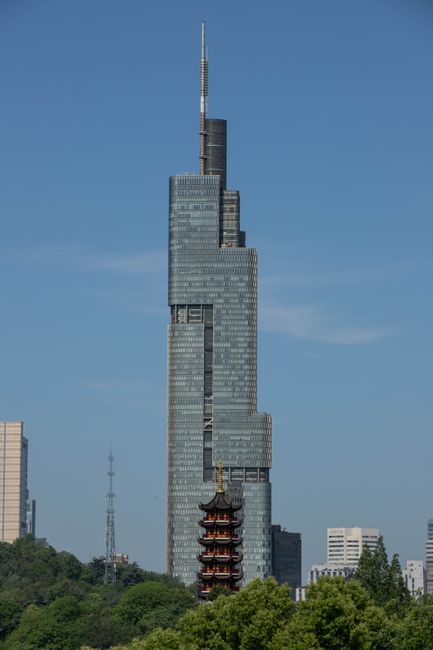
Nanjing, the “Southern Capital,” on the Yangtze River in Jiangsu province in eastern China, has been the capital of China several times: of six early dynasties, of the first Ming emperors in the 14th century and of the Republic of China in the 20th. That history is everywhere. The Ming city wall, among the longest and best-preserved city walls in the world, still loops around the old city, and the Zhonghua Gate is a fortress in itself. On the forested slopes of Zhongshan Mountain (Purple Mountain), east of the center, lie the white-granite Sun Yat-sen Mausoleum, the resting place of the founder of modern China, free to visit with an advance reservation, and the Ming Xiaoling Mausoleum of the first Ming emperor, part of a UNESCO World Heritage Site, with its avenue of stone animals. Downtown, explore the Nanjing Museum, one of the finest in China; the Presidential Palace; the lanes and lantern-lit canal of the Confucius Temple and the Qinhuai River; and the lakes and parks of Xuanwu Lake. The Memorial Hall of the Victims in the Nanjing Massacre commemorates the 1937 atrocity. Nanjing is a green, plane-tree-lined city of about 9.3 million, famous for salted duck, and just over an hour by high-speed train from Shanghai. The best seasons are spring and autumn.
Right now in Nanjing
- Wed 14–25°C 58–77°F Clear
- Thu 14–24°C 57–75°F Clear
- Fri 16–25°C 60–76°F Partly cloudy
Weather: MET Norway (CC BY 4.0)
Top tours in Nanjing
See all tours for Nanjing →
From local operators, with prices and reviews; you check availability and book on Viator, our partner. We may earn a commission at no extra cost to you. How we earn money
Nanjing at a glance
- Best for: Chinese history, the Ming city wall, the Sun Yat-sen and Ming mausoleums, museums, Republican-era architecture, the Qinhuai River and duck dishes.
- How long: 2–3 days.
- Best time: March to May and September to November; June and July bring the plum rains, July and August are very hot, and winters are cold and damp.
- Getting there: by high-speed train to Nanjing South from Shanghai (about 1–1.5 hours) and Beijing (about 3.5–4 hours), or by air to Nanjing Lukou (NKG).
- Getting around: by metro, bus, taxi and DiDi; shared bikes are handy in the center.
- Good to know: reserve the Sun Yat-sen Mausoleum and the main museums in advance with your passport; several sights close on Mondays.
- Before you go: visa-free entry, the 240-hour transit, the arrival card, payments and general safety are in our China travel guide.
Nanjing’s areas and where to stay
The historic city lies on the south bank of the Yangtze inside the Ming walls, with Zhongshan Mountain to the east.
Xinjiekou
Xinjiekou, the commercial heart of the city, is a hub of shopping malls, department stores, hotels of every level and metro lines 1 and 2. It is central for everything, if not charming.
Confucius Temple and the Qinhuai River
In the south of the old city, the area around the Confucius Temple (Fuzimiao) and the Qinhuai River is lively with restaurants, snack streets, lanterns and evening boat rides, with the Zhonghua Gate and the old quarter of Laomendong nearby. It is atmospheric, but very busy on weekends and holidays.
The Republican quarter and Gulou
North of Xinjiekou, the tree-lined streets around Yihe Road, Nanjing University and Gulou have Republican-era villas, embassies of the 1930s, cafés and quieter hotels.
Xuanwu Lake and the Presidential Palace
Around Xuanwu Lake, the Presidential Palace and the 1912 bar district, hotels look over the lake and the city wall, close to Jiming Temple and Nanjing Station.
Hexi
West of the old city, Hexi is the modern district of high-rise hotels, the Olympic Sports Center and Yangtze riverside parks, with fast metro links.
Where to stay in Nanjing
- Xinjiekou: central, with the best transport and shopping.
- Confucius Temple: old-town atmosphere and evening river life.
- Gulou and Yihe Road: leafy streets and Republican villas.
- Xuanwu Lake: lake and wall views, near Nanjing Station.
- Hexi: modern towers and riverside parks.
Rooms fill and prices rise during Chinese New Year, May Day and Golden Week.
Top things to see in Nanjing
Sun Yat-sen Mausoleum
The Sun Yat-sen Mausoleum, built from 1926 to 1929 on the southern slope of Zhongshan Mountain, is the tomb of Dr. Sun Yat-sen, the revolutionary leader honored as the founder of modern China. Designed by the architect Lü Yanzhi in a plan shaped like a bell, it climbs about 70 m (230 ft) along a central axis about 700 m (2,300 ft) long, from the Memorial Archway along the sacred way to the gate, the stele pavilion and the Sacrificial Hall, up 392 stone steps, all of white granite with blue glazed tiles. Entry is free with a real-name reservation: book a time slot in the scenic area’s official WeChat account, “Nanjing Zhongshan Fengjingqu” (南京钟山风景区), its ticket center service account or mini program, or at the self-service machines on site, with your passport, and enter at your booked time. The area above the gate inscribed “Tianxia Wei Gong” (The World Belongs to All) is open from 8:30 to 17:00; the burial chamber itself is closed. The mausoleum is a place of quiet; amplified speakers and loud noise are banned. It is usually closed on Mondays, except on public holidays.
Ming Xiaoling Mausoleum
At the southern foot of Zhongshan Mountain, the Ming Xiaoling Mausoleum is the tomb of Zhu Yuanzhang, the founding Hongwu emperor of the Ming dynasty, and Empress Ma. Begun in 1376 and completed in 1413, it stretches about 3 km (2 miles) from the entrance arch along the Sacred Way, lined with stone elephants, camels, horses and lions and stone officials, to the great walled burial mound. It set the model for later Ming and Qing imperial tombs and is part of the Imperial Tombs of the Ming and Qing Dynasties UNESCO World Heritage Site. The ticket is 70 yuan. The Sacred Way is lovely with plum blossoms in spring and golden leaves in autumn.
The Ming city wall and Zhonghua Gate
Built from 1366 to 1393, the Ming city wall enclosed the capital with brick ramparts, many bricks stamped with the names of their makers. About 25 km (16 miles) of the original wall survives. Walk the sections at Zhonghua Gate, a vast fortress gate with three inner courtyards and tunnels for soldiers, and along Xuanwu Lake and Taicheng near Jiming Temple.
Nanjing Museum
The Nanjing Museum, one of China’s three great national-level museums, displays treasures from prehistoric jade to Ming porcelain, a jade burial suit and a recreated Republican-era street. Entry is free with a real-name booking; it is closed on Mondays.
Confucius Temple and the Qinhuai River
The Confucius Temple (Fuzimiao) area, around a temple founded in the 11th century and the Jiangnan Examination Hall, where imperial civil service exams were held, is Nanjing’s busiest old quarter. In the evening, take a painted boat along the lantern-lit Qinhuai River.
Presidential Palace
The Presidential Palace has served as a Ming prince’s mansion, the Taiping Heavenly Kingdom’s palace and the seat of Sun Yat-sen’s provisional government and the Republic of China, with gardens, offices and exhibitions spanning six centuries.
More classic sights
- Memorial Hall of the Victims in the Nanjing Massacre: a solemn memorial and museum of the 1937 massacre; free with booking, closed Mondays.
- Linggu Scenic Area: a forested area of Zhongshan Mountain with the Beamless Hall and Linggu Pagoda; 35 yuan.
- Meiling Palace: the 1930s villa of Soong Mei-ling and Chiang Kai-shek, on Zhongshan Mountain; 30 yuan.
- Xuanwu Lake and Jiming Temple: islands and walls by the lake, and a temple famous for cherry blossoms.
- Porcelain Tower (Dabaoen Temple): the site of a famous glazed pagoda, rebuilt as a modern museum.
Other things to do in Nanjing
Zhongshan Mountain National Park
The Zhongshan Mountain scenic area covers about 31 km² (12 sq miles) of forest east of the city, with more than 200 historic sites. Beyond the mausoleums, walk the plane-tree avenues, visit the Purple Mountain Observatory, China’s first modern astronomical observatory, founded in 1934, the Music Stage (10 yuan) and the Sun Yat-sen Memorial Museum, or ride the cable car to the top. A combined ticket for Ming Xiaoling, Linggu, the Music Stage and Meiling Palace costs 100 yuan. Shuttle buses and sightseeing carts connect metro stations such as Xiamafang and Muxuyuan with the sights. See our hiking and city sightseeing guides.
Food and drink
Nanjing is China’s duck city. Try salted duck (yanshui ya), poached and pale, tender and lightly salty, sold at shops all over town; duck blood and vermicelli soup; and duck oil pancakes. Nanjing’s soup dumplings (tangbao) and the Qinhuai snacks around the Confucius Temple, such as sweet osmanthus rice cakes, plum-blossom cakes and tofu pudding, are classics. The cooking here is Jiangsu (Huaiyang) style: refined, mild and slightly sweet. Drink green Yuhua tea, grown on Nanjing’s hills.
Day trips from Nanjing
- Yangzhou: the Slender West Lake, gardens and famous breakfast dumplings, about 1 hour by train or bus.
- Suzhou: classical gardens and canals, about 1 hour by high-speed train.
- Zhenjiang: the Jinshan Temple and Xijin Ferry old street on the Yangtze, about 20 minutes by high-speed train.
- Niushou Mountain: a Buddhist park with the Usnisa Palace, a vast modern temple hall, on the southern edge of the city.
- Qixia Mountain: a temple, grottoes and some of the best red maples in eastern China in November, northeast of the city.
- Huangshan: the Yellow Mountain, about 3 hours by high-speed train; best over 2–3 days.
Nearby destinations
- Suzhou194 km
- Huangshan (Yellow Mountain)223 km
- Hangzhou241 km
- Shanghai271 km
Getting there and getting around
By air
Nanjing Lukou International Airport (NKG), about 35 km (22 miles) south of the center, has flights across China and international routes in Asia and beyond. It is a designated port for the 240-hour visa-free transit, with all of Jiangsu province as the permitted area. Metro line S1 links the airport with Nanjing South station in about 35 minutes.
By train
Nanjing South is the main high-speed station, on the Beijing–Shanghai line, with trains to Shanghai (about 1–1.5 hours), Beijing South (about 3.5–4 hours), Suzhou (about 1 hour), Hangzhou (about 1.5 hours), Hefei, Wuhan and beyond. Nanjing Station, north of Xuanwu Lake, also has high-speed and conventional trains. Book on the 12306 website or app with your passport.
Around town
Nanjing’s metro network covers the center, the stations, Zhongshan Mountain (Xiamafang and Muxuyuan stations) and the airport. Buses, taxis, DiDi and shared bikes fill the gaps; the center is pleasant to walk under the plane trees.
When to go and how long to stay
Nanjing has a humid subtropical climate with four distinct seasons. Spring (March–May) is mild and the best time to visit, with plum blossoms on Zhongshan Mountain in February and March and cherry blossoms at Jiming Temple in late March. The plum rains (meiyu) usually arrive in mid-June and last into July. Summer (July–August) is hot and humid, with highs around 32 °C (90 °F); Nanjing is traditionally counted among China’s “furnace” cities. Autumn (September–November) is clear and comfortable, with osmanthus scent in the air and red maples at Qixia in November. Winter (December–February) is cold and damp, with occasional snow. The table uses the 1991–2020 climate normals for the Nanjing station of the China Meteorological Administration (CMA), as submitted to the World Meteorological Organization (WMO): average daily highs and lows, total precipitation, and days with at least 1 mm of rain.
| Month | Average high / low | Rain (days with 1 mm or more) | What to expect |
|---|---|---|---|
| January | 7 °C (45 °F) / 0 °C (32 °F) | 50 mm (2.0 in), 7 days | Cold and damp; occasional snow |
| February | 10 °C (50 °F) / 2 °C (36 °F) | 54 mm (2.1 in), 7 days | Cold; plum blossoms begin; Chinese New Year |
| March | 15 °C (59 °F) / 6 °C (43 °F) | 80 mm (3.1 in), 8 days | Cool; plum and cherry blossoms |
| April | 21 °C (71 °F) / 12 °C (53 °F) | 82 mm (3.2 in), 7 days | Mild and pleasant; ideal |
| May | 27 °C (80 °F) / 17 °C (63 °F) | 84 mm (3.3 in), 7 days | Warm; May Day crowds |
| June | 29 °C (85 °F) / 21 °C (71 °F) | 193 mm (7.6 in), 8 days | Hot; plum rains begin |
| July | 32 °C (90 °F) / 25 °C (77 °F) | 227 mm (8.9 in), 9 days | Hot and humid; the wettest month |
| August | 32 °C (89 °F) / 25 °C (77 °F) | 159 mm (6.2 in), 9 days | Hot; storms |
| September | 28 °C (82 °F) / 20 °C (69 °F) | 73 mm (2.9 in), 6 days | Warm and drier; osmanthus |
| October | 23 °C (73 °F) / 14 °C (58 °F) | 56 mm (2.2 in), 5 days | Mild and clear; Golden Week crowds |
| November | 17 °C (62 °F) / 8 °C (46 °F) | 52 mm (2.1 in), 6 days | Cool; red maples at Qixia |
| December | 10 °C (50 °F) / 2 °C (35 °F) | 35 mm (1.4 in), 5 days | Cold and quiet |
Nanjing receives about 1,140 mm (45 in) of rain a year, most of it from June to August.
Two days in Nanjing
Day one, Zhongshan Mountain: the Sun Yat-sen Mausoleum (book ahead), the Ming Xiaoling Sacred Way and Meiling Palace, then the Confucius Temple and a Qinhuai River boat at night. Day two, the Nanjing Museum, the Presidential Palace, Xuanwu Lake and the city wall, and salted duck for dinner.
Three to four days
Add Zhonghua Gate and Laomendong, the Memorial Hall, Niushou Mountain or Qixia, and a day trip to Yangzhou; continue to Suzhou, Shanghai, Hangzhou or Huangshan.
What a trip to Nanjing costs
Prices are approximate, for October 2026, converted at about 6.74 yuan to the US dollar.
| Item | Typical cost |
|---|---|
| Sun Yat-sen Mausoleum | free, with reservation |
| Ming Xiaoling Mausoleum | 70 CNY (about US$10.40) |
| Combined ticket: Ming Xiaoling, Linggu, Music Stage, Meiling Palace | 100 CNY (about US$15) |
| Nanjing Museum | free, with reservation |
| Qinhuai River boat ride | about 80–100 CNY (about US$12–15) |
| Salted duck, half | 30–50 CNY (about US$4.50–7.40) |
| Metro ride | 2–10 CNY (about US$0.30–1.50) |
| High-speed train, Shanghai–Nanjing South | about 135–145 CNY (about US$20–22) second class |
| Mid-range hotel double, per night | 300–700 CNY (about US$45–104) |
Practical tips for Nanjing
- Reserve ahead: the Sun Yat-sen Mausoleum, Nanjing Museum and Memorial Hall need real-name bookings with your passport, and slots go fast at weekends.
- Avoid Mondays: several major museums and memorials close.
- Use the metro to Zhongshan Mountain: parking is limited and private cars need advance permits in busy periods.
- Go early: the mausoleum stairs and the Confucius Temple are crowded by late morning.
- Pack for the plum rains: an umbrella is essential in June and July.
- Carry your passport: for bookings, trains, hotels and checks.
Safety
Nanjing is a safe and orderly city. The main challenges are weather and crowds. Summer heat and humidity are intense in July and August, with highs above 32 °C (90 °F) on many days; drink water and rest in the shade. The plum rain season brings days of heavy rain and occasional local flooding, and summer thunderstorms are common. The Confucius Temple, the Qinhuai River and the mausoleums are extremely busy during Golden Week (1–7 October), the May Day holiday and Chinese New Year, when reservations fill and some sights limit numbers; follow staff instructions in crowds. At the Memorial Hall and the Sun Yat-sen Mausoleum, visitors are expected to be quiet and respectful. Watch your belongings in crowded areas and stations, and use official taxis or DiDi. Carry your passport for bookings and checks. In an emergency, call 110 for police, 120 for an ambulance and 119 for fire.
What to pack for Nanjing
Comfortable walking shoes for walls, stairs and parks, an umbrella and light rain jacket for spring and the plum rains, light clothes, a hat and sunscreen for summer, and a warm coat for the damp winters. China uses 220 V, with flat two-pin, round two-pin and angled three-pin sockets. See our rain jackets and travel adapters guides.
Nanjing travel FAQ
Do I need to book the Sun Yat-sen Mausoleum?
Yes. Entry is free, but you must book a real-name time slot in advance through the scenic area’s official WeChat channels or at the self-service machines on site, with your passport.
Is the Sun Yat-sen Mausoleum open on Mondays?
It is usually closed on Mondays, except on public holidays; check when you book.
How much is the Ming Xiaoling Mausoleum?
70 yuan, or 100 yuan for a combined ticket with Linggu, the Music Stage and Meiling Palace.
How do I get from Shanghai to Nanjing?
By high-speed train from Shanghai or Shanghai Hongqiao to Nanjing South or Nanjing Station in about 1–1.5 hours.
How many days do I need in Nanjing?
Two to three days for Zhongshan Mountain, the museums, the city wall and the Qinhuai River.
What is Nanjing famous for?
Its history as a former capital, the Ming city wall, the Sun Yat-sen and Ming Xiaoling mausoleums, the Qinhuai River and salted duck.
What is the best time to visit Nanjing?
March to May and September to November; June and July bring the plum rains and summer is very hot.
Can I use the 240-hour visa-free transit in Nanjing?
Yes. Nanjing Lukou airport is a designated port, and all of Jiangsu province is in the permitted area.
Is the Nanjing Museum free?
Yes, with a real-name booking; it is closed on Mondays.
Can I walk on the Nanjing city wall?
Yes. Several sections are open, including Zhonghua Gate and the stretch along Xuanwu Lake, each with a small fee.
Sources and last review
Researched and last reviewed on 4 October 2026. The Sun Yat-sen Mausoleum’s free real-name reservation, booking channels, opening hours of the area above the gate, closed burial chamber and noise rules; the Ming Xiaoling, Linggu, Music Stage, Meiling Palace and combined ticket prices; and the history and dimensions of the mausoleums and Zhongshan Mountain: the Nanjing Zhongshan Mausoleum Administration’s official site, including its English pages dated September 2026; visa-free transit and Nanjing Lukou airport as a designated port: the National Immigration Administration; train booking with a passport: China Railway’s official 12306 site; climate normals: the China Meteorological Administration via the World Meteorological Organization’s 1991–2020 normals; the exchange rate: the CFETS central parity rate; the Ming Xiaoling inscription: the UNESCO World Heritage List. Monday closures, museum booking rules, wall details, boat and food prices, train times, distances, population and typical prices are general references or estimates, flagged for checking. Prices and rules change, so check locally before you go. For entry rules, money and general safety, see our China travel guide.
Plan your trip
Partner links: TravelerCenter may earn a commission if you book, at no extra cost to you.
🇨🇳 Useful Mandarin Chinese phrases for Nanjing
All 38 Mandarin Chinese phrases: restaurant, hotel, emergencies, romance (printable) →