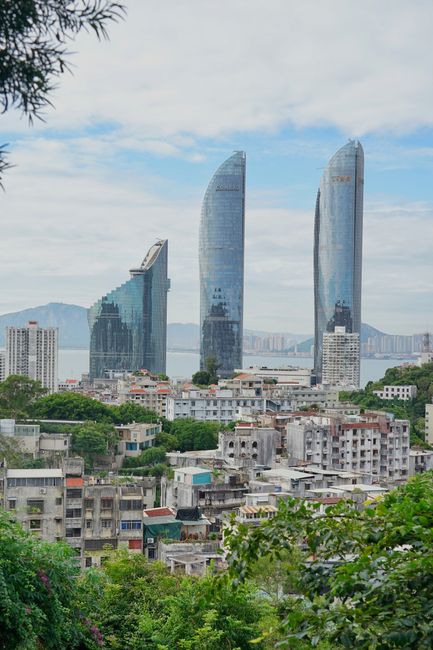
Xiamen, on the coast of Fujian province in southeast China, is one of the country’s most attractive and relaxed cities: an island of hills, beaches, banyan trees and seafood restaurants, linked to the mainland by bridges and causeways, with a warm climate and a long seafront promenade. Its star is Gulangyu (Kulangsu), a small, car-free island a short ferry ride away, where 19th- and early 20th-century villas built by foreign consulates, merchants and returning overseas Chinese stand among gardens and narrow lanes. Gulangyu, “Kulangsu, a Historic International Settlement,” is a UNESCO World Heritage Site, and its ferries are booked in advance under your real name. On Xiamen Island itself, visit the Buddhist Nanputuo Temple, the lakeside campus of Xiamen University, the old arcaded streets around Zhongshan Road, the lanes of Zengcuo’an, and cycle the coastal Huandao Road past beaches and parks. Feast on Minnan cooking, from oyster omelets to shacha noodles, and drink Fujian’s oolong teas. A few hours away, the earthen round houses of the Fujian Tulou are another World Heritage Site. Xiamen’s airport and port are both designated for the 240-hour visa-free transit. The city has about 5 million people. The best months are October to December and March to May.
Right now in Xiamen
- Wed21–28°C70–83°FClear
- Thu21–29°C71–84°FPartly cloudy
- Fri22–31°C72–87°FPartly cloudy
Top tours in Xiamen
See all tours for Xiamen →
From local operators, with prices and reviews; you check availability and book on Viator, our partner. We may earn a commission at no extra cost to you. How we earn money
Xiamen at a glance
- Best for: Gulangyu’s villas and lanes, seaside walks and cycling, temples, Minnan food and tea, beaches and the Fujian Tulou.
- How long: 3–4 days, including a day on Gulangyu and a day trip to the tulou.
- Best time: October to December and March to May; June to September is hot, humid and the typhoon season; January and February are mild but gray.
- Getting there: by air to Xiamen Gaoqi (XMN), or by high-speed train to Xiamen North from Fuzhou, Shenzhen, Shanghai and beyond.
- Getting around: by metro, BRT, bus, taxi, DiDi and shared bikes; ferries to Gulangyu.
- Good to know: Gulangyu ferry tickets are real-name and sold up to 15 days ahead; foreign visitors book with a passport.
- Before you go: visa-free entry, the 240-hour transit, the arrival card, payments and general safety are in our China travel guide.
Xiamen’s areas and where to stay
Most of the city’s sights are on Xiamen Island and Gulangyu; newer districts spread across the mainland.
Gulangyu
Staying on Gulangyu means boutique hotels and guesthouses in historic villas, with the island to yourself after the day visitors leave in the evening. There are no cars: you walk, and porters with carts move luggage from the pier. Rooms are limited and pricier, and the ferry is your only link to town.
Zhongshan Road and the old town
Across the water from Gulangyu, the old city around Zhongshan Road, a pedestrian street of arcaded buildings, and the Xiamen Ferry Terminal has hotels of every level, snack streets and the evening ferry to the island. It is central and lively, close to the old harbor and Shapowei.
Siming south: Nanputuo and Xiamen University
Around Nanputuo Temple and Xiamen University, on the island’s south coast, are guesthouses, cafés and student streets, with the beaches of the Huandao Road and the lanes of Zengcuo’an a short ride away.
Huandao Road and the east coast
Seafront hotels along the Huandao Road on the east coast face the sea, beaches and the coastal bike path, a quieter base for a beach stay.
Where to stay in Xiamen
- Gulangyu: heritage villas and quiet evenings on the island.
- Zhongshan Road: central, lively, near the ferries.
- Nanputuo and Xiamen University: cafés, temples and the south coast.
- Huandao Road: sea views and the coastal bike path.
Rooms fill and prices rise during Chinese New Year, May Day, the summer holidays and Golden Week.
Gulangyu ferries: routes, tickets and booking
All visitor ferries to Gulangyu are run by the Xiamen Ferry Company, and tickets are real-name, round-trip and tied to a sailing time.
- Dongdu Passenger Terminal to Sanqiutian or Neicuo’ao piers: the main visitor route, about 20 minutes, sailings about every 10 minutes from 7:10 to 17:30 (to 18:30 from June to September); 35 yuan, with an 80-yuan fare on some sailings.
- First Pier (near Zhongshan Road) to Neicuo’ao: about 15 minutes, hourly sailings from 8:45 to 16:45; 80 yuan.
- Songyu Passenger Terminal (Haicang) to Neicuo’ao: from the mainland side.
- Night route, Xiamen Ferry Terminal (Hall 2) to Sanqiutian: about 7 minutes, from 17:50 (October to May) or 18:50 (June to September) until 23:45; 35 yuan.
Book at the terminal ticket windows or through the official “Yujian Xiamen” (屿见厦门) mini program in WeChat or Alipay, up to 15 days ahead, including the same day. Each passenger needs a valid ID, and foreign visitors use their passport; each ID can hold only one valid ticket per travel date, and the ticket and passport must match at the gate. Children aged 6–14 or 1.2–1.5 m (3 ft 11 in to 4 ft 11 in) tall travel at half price, and an adult can bring up to two younger children free, with a free child ticket claimed in the app or at the window at least an hour before sailing. From 1 September 2026, you can cancel or change a ticket free within 30 minutes of paying, if the sailing is more than 4 hours away, once a day per account; after your sailing time, you can change to another sailing until midnight for a 20 percent fee (same day) or 30 percent (another day). Tickets sell out on weekends and holidays, and a waiting-list option is available in the app. The Xiamen Ferry Terminal to Piano Pier route is for residents only. All ferries stop when typhoons or strong winds approach; tickets for canceled sailings are refunded.
Top things to see in Xiamen
Gulangyu
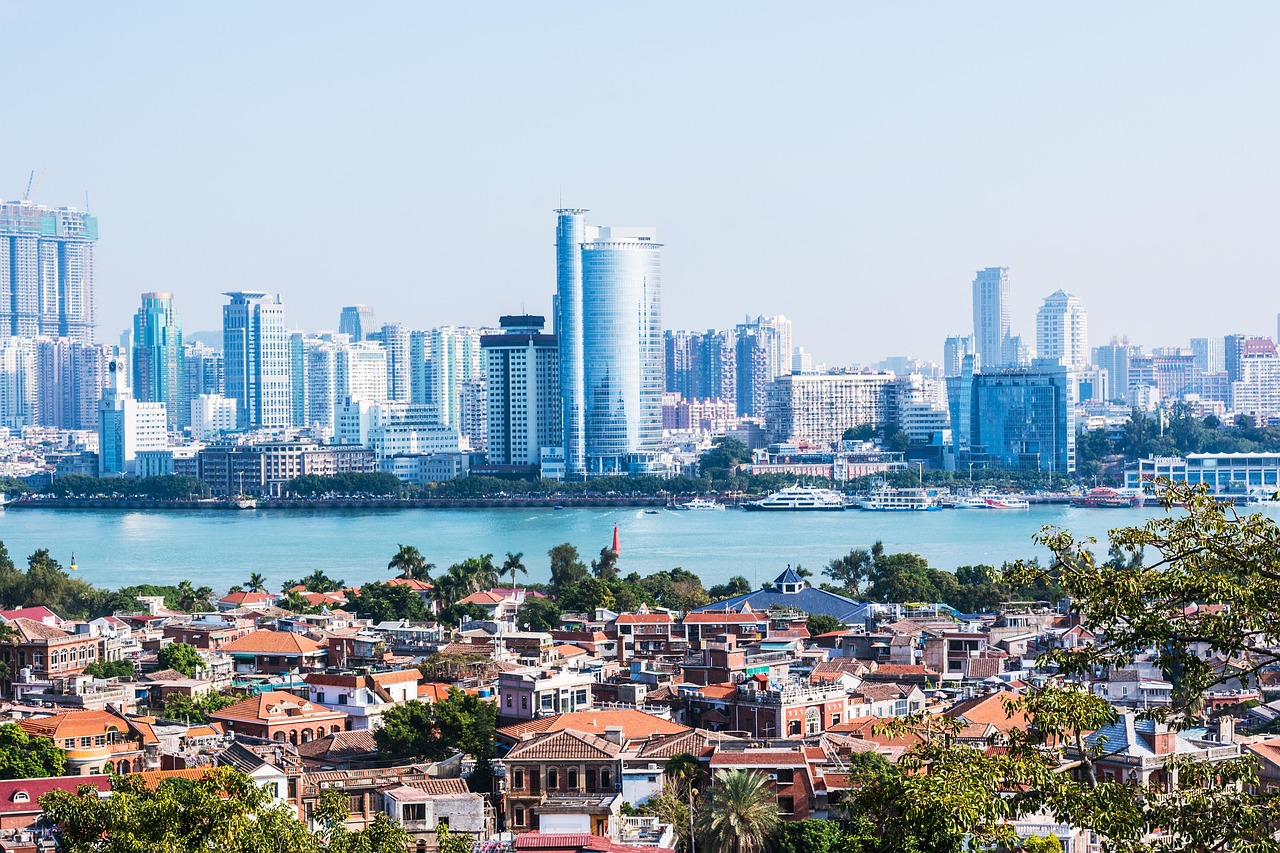
Gulangyu is about 2 km² (0.8 sq miles) of lanes, gardens and more than a thousand historic buildings: Western-style villas with verandas, consulates, churches, and mansions mixing Minnan, colonial and Southeast Asian styles built by Chinese returning from overseas. Climb Sunlight Rock, the island’s highest point, for views over the island and Xiamen; stroll through Shuzhuang Garden by the sea, with its zigzag bridges; and visit the Piano Museum, a reminder that Gulangyu was called the “island of music” for its many pianos. Wander without a plan: the back lanes are the best part. Some sights charge separate tickets or a combined pass.
Nanputuo Temple
At the foot of Wulao Peak, Nanputuo Temple is one of Fujian’s most important Buddhist temples, with halls climbing the hillside, a lotus pond and rock carvings. Paths lead up behind the temple through boulders to viewpoints over the city and Xiamen University.
Xiamen University
Founded in 1921 by the overseas Chinese businessman Tan Kah Kee, Xiamen University is often called one of China’s most beautiful campuses, with lakes, palm trees and buildings in the “Jiageng” style of tiled roofs on Western walls. Public visits are limited and require advance booking.
Huandao Road and the beaches
The Huandao Road runs along the south and east coasts of the island, with a cycling and walking path, beaches such as Baicheng and Zengcuo’an, sculpture parks and views of the islands offshore. Rent a bike for an afternoon. See our cycling and beaches guides.
Zengcuo’an
Zengcuo’an, a former fishing village near the south coast, is now a maze of narrow lanes packed with snack stalls, cafés, guesthouses and street art, busy in the evenings.
Zhongshan Road and Shapowei
Zhongshan Road, a pedestrian street of 1920s arcaded buildings, is lit up at night and lined with snack shops; nearby, Shapowei is an old harbor of fishing boats turned into an arts district of studios, bars and cafés.
More classic sights
- Hulishan Fortress: a 19th-century coastal fort with a giant Krupp cannon, on the south coast.
- Jimei School Village: schools, a seaside garden and the tomb of Tan Kah Kee on the mainland.
- Wanshi Botanical Garden: rainforest, cacti and rock gardens in the hills behind the city.
- Bailuzhou Park and Yundang Lake: evening walks and fountains in the city center.
- Teahouses: gongfu tea with Tieguanyin and Wuyi rock teas in the old town.
Other things to do in Xiamen
The Fujian Tulou
The Fujian Tulou, part of a UNESCO World Heritage Site, are huge round and square earthen houses built by the Hakka and Minnan peoples from the 12th to the 20th centuries, each home to a whole clan around an inner courtyard. The most visited clusters, such as Tianluokeng in Nanjing county and the Yongding tulou near Hongkeng, are about 2.5–3.5 hours west of Xiamen by road; join a tour, hire a car, or take the train toward Longyan, and consider staying a night in a tulou guesthouse.
Food and drink
Xiamen’s Minnan cooking is all about seafood. Try the oyster omelet (haili jian), with sweet chili sauce; shacha noodles, in a rich satay-style broth with seafood and pork; tusundong, a cold jelly made from sea worms; peanut soup; fried fish balls; and popiah, fresh spring rolls. The seafood restaurants on the Huandao Road and the snack streets of Zengcuo’an and Zhongshan Road are the places to graze. Drink Tieguanyin, the famous oolong from nearby Anxi, prepared gongfu-style in tiny cups.
Day trips from Xiamen
- Fujian Tulou: Tianluokeng, Yongding and other earthen roundhouses, about 2.5–3.5 hours west; best overnight.
- Quanzhou: a UNESCO World Heritage city of the medieval Maritime Silk Road, with temples, mosques and old lanes, about 30–45 minutes by high-speed train.
- Jimei: the school village, dragon boat pond and seaside promenade on the mainland side of the bay.
- Gulangyu evening: stay into the evening and return on the night ferry from Sanqiutian.
- Wuyishan: the tea-growing mountains and bamboo rafts of northern Fujian, about 3–4 hours by high-speed train; best over 2 days.
Nearby destinations
- Tainan271 km
- Sun Moon Lake296 km
- Alishan296 km
Getting there and getting around
By air
Xiamen Gaoqi International Airport (XMN), on the north of Xiamen Island about 10 km (6 miles) from the center, has flights across China and to Southeast Asia, Japan, Korea and beyond. It is a designated port for the 240-hour visa-free transit, as is Xiamen Port for passenger ships, with all of Fujian province as the permitted area. Metro, buses and taxis link the airport with the center in about 30 minutes.
By train
Xiamen North, on the mainland, is the main high-speed station, with trains to Fuzhou (about 1 hour), Quanzhou (about 30 minutes), Shenzhen North (about 3–3.5 hours), Shanghai (about 5–7 hours) and Beijing; Xiamen Station, on the island, has some high-speed and conventional trains. Book on the 12306 website or app with your passport. Metro line 1 and the BRT link Xiamen North with the island.
Around town
Xiamen has a growing metro, an elevated BRT bus network, buses, taxis, DiDi and shared bikes. Gulangyu is car-free and walkable. See our boat trips guide for harbor cruises.
When to go and how long to stay
Xiamen has a mild, humid subtropical climate, warm most of the year. Autumn and early winter (October–December) are the best time, with sunny, dry days and highs of 20–28 °C (68–82 °F); October is, on average, the driest month. Spring (March–May) is warm, with increasing rain and spring fog over the sea. Summer (June–September) is hot and humid, with highs around 32 °C (90 °F), heavy showers and typhoons, most often from July to September, which stop ferries and flights. January and February are mild, around 18 °C (64 °F) by day, often cloudy. The table uses the 1991–2020 climate normals for the Xiamen station of the China Meteorological Administration (CMA), as submitted to the World Meteorological Organization (WMO): average daily highs and lows, total precipitation, and days with at least 1 mm of rain.
| Month | Average high / low | Rain (days with 1 mm or more) | What to expect |
|---|---|---|---|
| January | 18 °C (64 °F) / 11 °C (51 °F) | 42 mm (1.7 in), 4 days | Mild; often cloudy |
| February | 18 °C (64 °F) / 11 °C (51 °F) | 70 mm (2.8 in), 7 days | Mild; showery; Chinese New Year crowds |
| March | 20 °C (68 °F) / 13 °C (55 °F) | 99 mm (3.9 in), 9 days | Mild; fog over the sea |
| April | 24 °C (76 °F) / 17 °C (62 °F) | 120 mm (4.7 in), 9 days | Warm; spring rains |
| May | 28 °C (82 °F) / 21 °C (69 °F) | 171 mm (6.7 in), 11 days | Warm and wet; May Day crowds |
| June | 30 °C (86 °F) / 24 °C (75 °F) | 203 mm (8.0 in), 12 days | Hot; heavy rain |
| July | 33 °C (91 °F) / 26 °C (78 °F) | 131 mm (5.1 in), 7 days | Hot; typhoons possible |
| August | 32 °C (90 °F) / 25 °C (78 °F) | 216 mm (8.5 in), 9 days | Hot; the wettest month; typhoons possible |
| September | 31 °C (87 °F) / 24 °C (75 °F) | 122 mm (4.8 in), 6 days | Hot; typhoons still possible |
| October | 28 °C (82 °F) / 21 °C (70 °F) | 49 mm (1.9 in), 2 days | Warm, sunny and dry; Golden Week crowds |
| November | 24 °C (75 °F) / 17 °C (63 °F) | 37 mm (1.4 in), 3 days | Warm and dry; ideal |
| December | 20 °C (67 °F) / 13 °C (55 °F) | 43 mm (1.7 in), 4 days | Mild and sunny; very good |
Xiamen receives about 1,300 mm (51 in) of rain a year, most of it from March to September.
Three days in Xiamen
Day one, Gulangyu: Sunlight Rock, Shuzhuang Garden, the Piano Museum and the villa lanes; return on the night ferry. Day two, Nanputuo Temple, Xiamen University (if your visit is booked), the Huandao Road by bike and Zengcuo’an in the evening. Day three, Zhongshan Road, Shapowei and a seafood dinner.
Four to five days
Add a night in a tulou in Yongding or Nanjing county, and a day in Quanzhou; continue to Shenzhen, Hong Kong, Hangzhou or Shanghai by high-speed train.
What a trip to Xiamen costs
Prices are approximate, for October 2026, converted at about 6.74 yuan to the US dollar.
| Item | Typical cost |
|---|---|
| Gulangyu ferry, Dongdu–Sanqiutian, round trip | 35 CNY (about US$5.20); 80 CNY (about US$11.90) on some sailings |
| Gulangyu night ferry from Xiamen Ferry Terminal | 35 CNY (about US$5.20) |
| Gulangyu sight tickets or combined pass | about 50–100 CNY (about US$7.40–15) |
| Fujian Tulou entrance, per cluster | about 90–130 CNY (about US$13–19) |
| Bike rental on the Huandao Road, per hour | 15–30 CNY (about US$2.20–4.50) |
| Bowl of shacha noodles | 15–35 CNY (about US$2.20–5.20) |
| Seafood dinner, per person | 100–250 CNY (about US$15–37) |
| Mid-range hotel double, per night | 300–700 CNY (about US$45–104) |
| Gulangyu boutique villa hotel double | 600–1,500 CNY (about US$89–223) |
Practical tips for Xiamen
- Book Gulangyu ferries early: weekend and holiday sailings sell out; tickets go on sale 15 days ahead.
- Carry your passport: ferry tickets, hotels and trains are real-name, and the name must match at the gate.
- Leave the big bags: if you stay on Gulangyu, pack light; there are no cars, and the lanes are hilly.
- Book Xiamen University: public visits need advance booking and may be suspended during term events.
- Watch the weather: from July to September, typhoons can suspend ferries and flights for a day or more.
- Try the night ferry: it is quieter, and the island’s lanes are lovely after dark.
Safety
Xiamen is safe and relaxed. The main natural risk is typhoons, which can affect Fujian from about May to November, most often from July to September, with destructive winds, heavy rain and flooding; when warnings are issued, all Gulangyu ferries stop (the whole network was suspended on 3 September 2026, for example), flights and trains may be canceled, and beaches close; follow your hotel’s and local authorities’ instructions. Summer thunderstorms with strong gusts also halt the ferries. Swim only at beaches with lifeguards, as currents can be strong. Crowds are huge on Gulangyu, at Zengcuo’an and on Zhongshan Road during Golden Week (1–7 October), the May Day holiday and Chinese New Year; hold children’s hands in the lanes and at the piers. Buy ferry tickets only through the official channels, and agree prices before ordering seafood by weight. Carry your passport for tickets and checks. In an emergency, call 110 for police, 120 for an ambulance and 119 for fire.
What to pack for Xiamen
Light, breathable clothes, comfortable walking shoes for Gulangyu’s hills and lanes, a hat, sunglasses and sunscreen, an umbrella or light rain jacket, swimwear, and a light sweater for winter evenings and air-conditioning. China uses 220 V, with flat two-pin, round two-pin and angled three-pin sockets. See our rain jackets and travel adapters guides.
Xiamen travel FAQ
How do I book the Gulangyu ferry?
At the terminal ticket windows or through the official “Yujian Xiamen” mini program in WeChat or Alipay, up to 15 days ahead, with your passport; tickets are real-name and tied to a sailing.
How much is the ferry to Gulangyu?
35 yuan round trip on the main route from Dongdu Passenger Terminal (80 yuan on some sailings), 80 yuan from the First Pier, and 35 yuan on the night route.
Which pier do visitors use for Gulangyu?
Dongdu Passenger Terminal, with boats to Sanqiutian or Neicuo’ao, is the main daytime terminal for visitors; the Xiamen Ferry Terminal has the evening route to Sanqiutian.
Can I stay overnight on Gulangyu?
Yes. Many villas and guesthouses take guests, and the island is quiet in the evening; the night ferry runs until about 23:45.
Do the Gulangyu ferries run in typhoons?
No. All routes are suspended when typhoons or strong winds approach, and tickets for canceled sailings are refunded.
What is the best time to visit Xiamen?
October to December and March to May. Summer is hot and humid, with typhoons possible from July to September.
How many days do I need in Xiamen?
Three to four days, including a full day on Gulangyu and a day trip or night at the Fujian Tulou.
How do I get to the Fujian Tulou from Xiamen?
By tour, hired car or bus, about 2.5–3.5 hours each way; staying overnight in a tulou is the best way to see them.
Can I use the 240-hour visa-free transit in Xiamen?
Yes. Xiamen Gaoqi airport and Xiamen Port are designated ports, and all of Fujian province is in the permitted area.
What food is Xiamen famous for?
Oyster omelets, shacha noodles, tusundong sea worm jelly, peanut soup, fish balls and fresh seafood, with Tieguanyin oolong tea.
Plan your trip
Partner links: TravelerCenter may earn a commission if you book, at no extra cost to you.
🇨🇳 Useful Mandarin Chinese phrases for Xiamen
All 38 Mandarin Chinese phrases: restaurant, hotel, emergencies, romance (printable) →
Sources · last reviewed 4 October 2026
Researched and last reviewed on 4 October 2026. Gulangyu ferry routes, sailing times, fares, real-name booking in the “Yujian Xiamen” mini program, the 15-day booking window, child fares, the refund and change rules from 1 September 2026, the residents-only route and the typhoon suspension of 3 September 2026: the Xiamen Ferry Company’s official site; visa-free transit and Xiamen Gaoqi airport and Xiamen Port as designated ports: the National Immigration Administration; train booking with a passport: China Railway’s official 12306 site; climate normals: the China Meteorological Administration via the World Meteorological Organization’s 1991–2020 normals; the exchange rate: the CFETS central parity rate; the Kulangsu, Fujian Tulou and Quanzhou inscriptions: the UNESCO World Heritage List. Sight tickets, Xiamen University visits, tulou access and prices, train times, distances, population and typical prices are general references or estimates, flagged for checking; the Xiamen government sites could not be read from here. Prices and rules change, so check locally before you go. For entry rules, money and general safety, see our China travel guide.
Data: Weather: MET Norway (CC BY 4.0) · Sea temperature: NOAA CoastWatch · Rates: ECB · Costs: World Bank ICP and price levels · Wikidata (CC0)