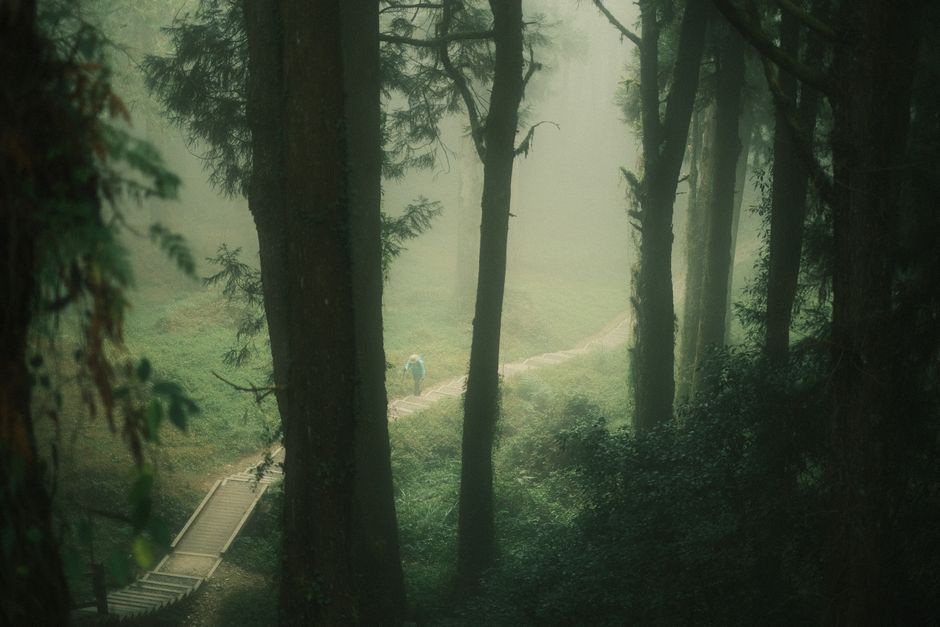
Alishan, in the mountains of Chiayi County in south-central Taiwan, is one of the island’s classic journeys: a narrow-gauge forest railway climbs from the tropical plain at Chiayi through bamboo, tea plantations and cloud forest to a mountain resort at about 2,200 m (7,200 ft), surrounded by giant red cypress trees, some of them thousands of years old. Visitors come for the train itself, for sunrise over a “sea of clouds” from Zhushan, for forest walks among the sacred trees and mossy ponds, for the cherry blossoms of spring and for the high-mountain oolong teas grown on the slopes below. The Alishan National Scenic Area also includes the old railway village of Fenqihu, tea towns such as Shizhuo and the villages of the Tsou people, Alishan’s Indigenous inhabitants. After years of repairs to typhoon damage, the Alishan Forest Railway’s main line has run all the way from Chiayi to Alishan again since 2024, and it was in normal operation in October 2026. It is cool all year, cold on winter nights and very wet in summer.
Right now in Alishan
- Wed 8–16°C 46–61°F 17 mm Heavy rain
- Thu 8–16°C 47–60°F 12 mm Heavy rain
- Fri 9–14°C 49–57°F 9 mm Rain
Weather: MET Norway (CC BY 4.0)
Top tours in Alishan
See all tours for Alishan →
From local operators, with prices and reviews; you check availability and book on Viator, our partner. We may earn a commission at no extra cost to you. How we earn money
Alishan at a glance
- Best for: the forest railway, sunrise and cloud seas, giant trees, tea and mountain walks.
- How long: one night at Alishan is the minimum; two with Fenqihu or the tea villages.
- Best time: October to April for clear skies; March and April for cherry blossoms.
- Getting there: the high-speed rail or railway to Chiayi, then the Alishan Forest Railway (about 5 hours) or a bus (about 2.5 hours).
- Getting around: on foot inside the forest area, plus the short Zhushan, Shenmu and Zhaoping railway lines.
- Good to know: book train tickets as soon as they go on sale, up to about two weeks ahead, especially for weekends.
- Before you go: visa-free entry, the online arrival card, money and general safety are in our Taiwan travel guide.
Rail status, tickets and rules (as of October 2026)
The main line
According to the Alishan Forest Railway and Cultural Heritage Office, the main line from Chiayi to Alishan and the branch lines at the top were in normal operation in early October 2026. Under the timetable in force since January 10, 2025, one through train a day, the Alishan Express No. 5, leaves Chiayi at 10:00 a.m., stops for about an hour at Fenqihu and reaches Alishan at 2:56 p.m.; another, No. 1, leaves Chiayi at 9:00 a.m. and runs as far as Shizilu. Downhill, No. 8 leaves Alishan at 11:50 a.m. and reaches Chiayi at 3:45 p.m., and No. 2 runs from Shizilu, via Fenqihu, to Chiayi by 4:51 p.m. A full-fare ticket from Chiayi to Alishan costs NT$600; children and seniors pay half.
Booking
Reserved tickets go on sale on the railway’s official booking website up to about 15 days before travel (12 days at station counters), and each person can book up to six seats, or 12 for a return trip. Pay online within the deadline or at stations and 7-Eleven stores. Weekend and holiday trains sell out quickly, and the railway publishes a separate schedule for holiday booking dates. If the train is full, take the bus up and the train down, or the reverse.
The branch lines at the top
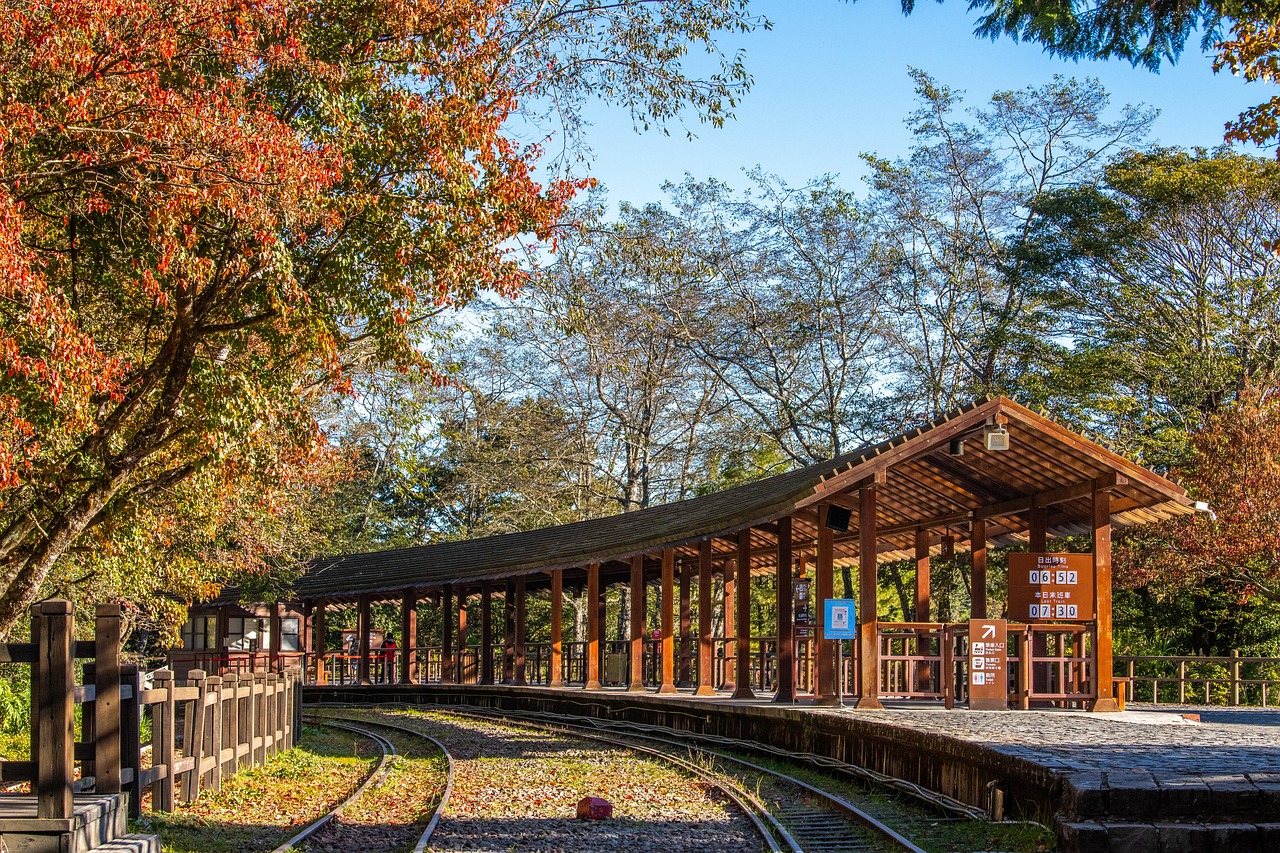
Three short lines run from Alishan station. The Zhushan line carries visitors to the sunrise viewpoint before dawn; its departure time changes daily with the sunrise (on October 5, 2026, it left at 5 a.m., with the last return at 6:50 a.m.), and a full fare is NT$150. The Shenmu (Sacred Tree) line and the Zhaoping line cost NT$100 each.
The forest recreation area
The resort at the top is the Alishan National Forest Recreation Area, run by Taiwan’s Forestry and Nature Conservation Agency, which charges an entry fee at the gate for visitors arriving by road. Stay on marked trails, don’t pick plants, and take your rubbish with you.
Top things to see at Alishan
The Alishan Forest Railway
Built by the Japanese from 1906 to bring cypress timber down from the mountains, the 762 mm (2.5 ft) gauge railway climbs from 30 m (100 ft) at Chiayi to 2,216 m (7,270 ft) at Alishan station over about 72 km (45 miles), through tropical, subtropical and temperate forest zones. It uses switchbacks, a spiral around Dulishan and many tunnels and bridges to gain height. The views of bamboo forests, tea terraces and plunging valleys are the reason to ride it; sit on either side, and expect clouds to roll in by early afternoon.
Sunrise at Zhushan
The classic Alishan experience is to rise before dawn, take the Zhushan train or walk up, and watch the sun rise over the Yushan range above a sea of clouds. Clear mornings are most likely from October to April. It is cold at that hour, often near freezing in winter, so bring warm layers.
The Giant Trees Trail and the Sacred Trees
Boardwalks wind through a forest of huge red cypress and Taiwan cedar, some more than 2,000 years old, with signs giving their ages. The old Alishan Sacred Tree, a 3,000-year-old cypress, was damaged by lightning and heavy rain and laid down in 1997; new “sacred trees” have since been named. The Xianglin Sacred Tree is a popular stop.
The Sister Ponds and Shouzhen Temple
Two small ponds, linked by legend to two Tsou sisters, surrounded by cypress groves and wooden pavilions, a short walk from the hotels. Nearby, Shouzhen Temple and the Ciyun Temple, with a statue from Thailand, add color to the forest.
Zhaoping and the cherry blossoms
Zhaoping station and park, with a Japanese-style rest house, are the center of the cherry blossom season, usually from March to April, when the forest area fills with visitors.
More classic sights
- Fenqihu: an old railway village at 1,403 m (4,603 ft), famous for its railway lunch boxes (bento), old street and bamboo forests.
- The Alishan Museum and the Zhaoping area: exhibitions on logging, forests and railway history.
- The Tashan trail: a cliff-top walk to views over the Tashan peaks.
- Duigaoyue: an alternative sunrise viewpoint reached by a trail.
- Chiayi’s Hinoki Village and Beimen station: restored Japanese-era wooden houses at the foot of the railway.
Other things to do in the Alishan area
Tea
The slopes between about 1,000 and 1,600 m (3,300–5,200 ft) produce Alishan high-mountain oolong, one of Taiwan’s most prized teas, light and floral. Tea farms around Shizhuo, Longtou and Fenqihu offer tastings, and the Shizhuo trails wind through the plantations.
Tsou culture
The Tsou are Alishan’s Indigenous people, living in villages such as Dabang, Tefuye, Leye and Laiji. Their men’s meeting houses (kuba), coffee farms, crafts and festivals, such as the Mayasvi ceremony held in some years, are an important part of the area; visit with respect, and ask before photographing people.
Hiking
Beyond the forest area, trails lead to the Tashan cliffs, Duigaoyue, the Zhushan viewpoint and, for experienced hikers with permits, toward Yushan, Taiwan’s highest peak, which is reached from Tataka on the Alishan Highway. See our hiking guide.
Seasons in the forest
Each season has its own draw. From late February to April, cherry, plum and other blossoms bloom in the forest recreation area, with the biggest crowds in late March and early April. From April to June, fireflies glow at night in the mid-altitude forests around Fenqihu and the tea villages. Summer is cool, green and misty, a relief from the lowland heat but also the rainiest time. From October to December, clear, dry days bring the best chance of cloud seas and sunrise views, and in winter frost, and very occasionally snow, dusts the higher peaks.
Food
Fenqihu’s railway bento, with pork chop, egg and vegetables in a wooden box, is a tradition. At the top, restaurants serve mountain vegetables, wild boar and trout; Chiayi, below, is famous for turkey rice (huoji fan).
Day trips and side trips
- Fenqihu: stop on the way up or down for its old street and bento.
- Shizhuo and Longtou: tea plantations, misty trails and homestays on the road between Chiayi and Alishan.
- Tataka and Yushan National Park: trails and viewpoints on the road toward Yushan, about an hour beyond Alishan.
- Chiayi city: the Hinoki Village, Lantan lake, the National Palace Museum’s Southern Branch and turkey rice.
- Sun Moon Lake: another classic central Taiwan stop, best reached via Taichung. See our Sun Moon Lake guide.
- Tainan: about 20 minutes south of Chiayi by high-speed rail. See our Tainan guide.
Nearby destinations
- Sun Moon Lake41 km
- Tainan86 km
- Taroko National Park90 km
- Kaohsiung113 km
- Kenting National Park171 km
- Taipei186 km
- Xiamen296 km
Getting there and getting around
To Chiayi
Chiayi is the gateway. The high-speed rail station is at Taibao, west of the city; according to Taiwan High Speed Rail, a standard reserved seat costs NT$1,080 from Taipei and NT$410 from Zuoying in Kaohsiung, and the fastest trains from Taipei take about 1 hour 20 minutes. Buses and the BRT link the high-speed station with Chiayi’s railway station, about 30 minutes away, where conventional Taiwan Railway trains stop and the Alishan Forest Railway begins.
The forest railway or the bus
The Alishan Forest Railway leaves from the forest-railway platform at Chiayi station (see the timetable above). Alternatively, the Taiwan Tourist Shuttle buses run from Chiayi’s high-speed station and railway station to Alishan in about 2.5 hours, with several departures a day, and buses also link Alishan with Sun Moon Lake and Taichung on some days. The Alishan Highway (Provincial Highway 18) is paved but long and winding; drive with care and allow for fog.
Getting around at the top
The forest recreation area is compact and walkable, with signposted trails between the hotels, the station, the ponds and the giant trees, plus the short Zhaoping and Shenmu railway lines.
When to go and how long to stay
Weather for your datesSunrise and sunset
Alishan has a cool, wet mountain climate. October to April is the dry season, with the best chance of clear sunrises and cloud seas, though winter nights can be near freezing; May to September is the wet season, with afternoon thunderstorms, the plum rains and typhoons, which can close the highway and railway. The table shows the Central Weather Administration’s 1991–2020 normals for its Alishan station, at about 2,400 m (7,900 ft) in the forest recreation area. Rain days count days with at least 0.1 mm of rain.
| Month | Average high / low | Rain (rain days) | What to expect |
|---|---|---|---|
| January | 11 °C (52 °F) / 3 °C (38 °F) | 87 mm (3.4 in), 8 days | Coldest month; frost possible; clear sunrises |
| February | 12 °C (53 °F) / 4 °C (39 °F) | 110 mm (4.3 in), 8 days | Plum blossoms; Lunar New Year crowds |
| March | 14 °C (57 °F) / 6 °C (43 °F) | 147 mm (5.8 in), 10 days | Cherry blossom season begins |
| April | 16 °C (60 °F) / 8 °C (47 °F) | 224 mm (8.8 in), 12 days | Cherry blossoms; very busy |
| May | 17 °C (63 °F) / 10 °C (50 °F) | 510 mm (20.1 in), 19 days | Plum rains; fireflies at lower levels |
| June | 18 °C (65 °F) / 12 °C (53 °F) | 675 mm (26.6 in), 20 days | Very wet; afternoon fog |
| July | 19 °C (67 °F) / 12 °C (53 °F) | 695 mm (27.4 in), 21 days | Cool escape from the heat; typhoons |
| August | 19 °C (66 °F) / 12 °C (53 °F) | 813 mm (32.0 in), 23 days | Wettest month; typhoon risk |
| September | 18 °C (65 °F) / 11 °C (52 °F) | 403 mm (15.9 in), 17 days | Rain easing |
| October | 17 °C (63 °F) / 9 °C (48 °F) | 141 mm (5.6 in), 9 days | Clearer skies; cloud seas |
| November | 16 °C (60 °F) / 7 °C (45 °F) | 67 mm (2.6 in), 7 days | Dry and crisp; great sunrises |
| December | 13 °C (55 °F) / 5 °C (40 °F) | 70 mm (2.7 in), 7 days | Cold nights; clear mornings |
The figures add up to about 3,940 mm (155 in) of rain a year, nearly 80% of it from May to September, making Alishan one of the wettest places on the main tourist routes.
One night at Alishan
Take the morning train from Chiayi, with a stop at Fenqihu, arrive mid-afternoon and walk the Giant Trees Trail and the Sister Ponds before dusk. Rise early for the Zhushan sunrise, walk the Zhaoping area and the Tashan trail, then take the bus or train back down.
Two nights
Add a night in a tea homestay at Shizhuo or Fenqihu, with plantation walks and tastings, or continue to Tataka for views toward Yushan.
Where to stay
- Inside the forest recreation area: a handful of hotels near the station, best for sunrise trips; book early.
- Alishan village area: simpler inns and homestays near the bus stops.
- Fenqihu, Shizhuo and Longtou: tea farm homestays and guesthouses with mountain views.
- Chiayi city: hotels near the station if you want to start the train early.
What a trip to Alishan costs
Money exchange (TWD)Tip calculator
Prices are approximate, for October 2026, converted at about NT$31.8 to the US dollar.
| Item | Typical cost |
|---|---|
| High-speed rail, Taipei to Chiayi, standard reserved seat | NT$1,080 (about US$34) |
| Alishan Forest Railway, Chiayi to Alishan, full fare | NT$600 (about US$19) |
| Zhushan sunrise train, full fare | NT$150 (about US$4.70) |
| Shenmu or Zhaoping line, full fare | NT$100 (about US$3.10) |
| Bus, Chiayi to Alishan, one way | about NT$240–280 (about US$7.50–8.80) |
| Alishan forest area entry by road | about NT$150–300 (about US$4.70–9.40) |
| Fenqihu railway bento | NT$100–150 (about US$3.10–4.70) |
| Tea tasting or 150 g of high-mountain oolong | NT$300–1,000 (about US$9.40–31) |
| Homestay double in the tea villages, per night | NT$2,500–4,000 (about US$79–125) |
| Hotel double inside the forest area, per night | NT$4,000–8,000 (about US$125–250) |
Practical tips for Alishan
- Book the train early: tickets go on sale about 15 days ahead and sell out for weekends and blossom season.
- Check the sunrise train time: it changes daily; ask your hotel or check the railway’s website the day before.
- Cash: carry cash for buses, food stalls and homestays in the mountains.
- Altitude: at around 2,200–2,400 m (7,200–7,900 ft), walk slowly on stairs and drink water.
- Clouds: views are best early in the day; clouds usually build by early afternoon.
Safety
Cold: sunrise viewpoints are cold year-round and near freezing in winter; dress in layers. Weather and landslides: heavy rain and typhoons, mainly from May to September, can trigger landslides that close the Alishan Highway and the railway; follow the Central Weather Administration’s warnings and check the railway’s operating status. Roads: the highway is winding, often foggy and busy with tour buses; drive slowly and avoid driving at night. Trails: boardwalks and stone steps are slippery when wet; wear proper shoes. Altitude: mild altitude symptoms are possible, especially if you continue toward Yushan; descend if you feel unwell. Earthquakes: in a strong tremor, move away from slopes and steep drops. In an emergency, call 110 for the police or 119 for fire and ambulance.
What to pack for Alishan
A warm jacket, hat and gloves for sunrise, layers for changing weather, a rain jacket and umbrella, sturdy walking shoes, a headlamp for the pre-dawn walk, sunscreen, snacks and water, and cash. Taiwan uses 110 V and flat two-pin plugs.
Alishan travel FAQ
Is the Alishan Forest Railway running in 2026?
Yes. The railway office listed the main line and the branch lines in normal operation in early October 2026, with one through train a day each way between Chiayi and Alishan.
How long does the Alishan train take?
The through train No. 5 leaves Chiayi at 10 a.m. and reaches Alishan at 2:56 p.m., including a stop of about an hour at Fenqihu; the downhill train takes about four hours.
How much does the Alishan Forest Railway cost?
A full fare from Chiayi to Alishan is NT$600; children and seniors pay half. The Zhushan sunrise train costs NT$150 and the Shenmu and Zhaoping lines NT$100.
How do I book Alishan train tickets?
On the railway office’s official booking website, up to about 15 days before travel, or at stations up to 12 days ahead. Pay by the deadline online, at stations or at 7-Eleven.
How do I get to Alishan without the train?
Take the Taiwan Tourist Shuttle bus from Chiayi’s high-speed rail station or railway station, about 2.5 hours, or drive the Alishan Highway.
What time is the Alishan sunrise train?
It changes every day with the sunrise; in early October 2026, it left around 5 a.m. Check the timetable the day before.
When is the best time to visit Alishan?
October to April for clear sunrises and cloud seas, and March to April for cherry blossoms. Summer is very wet.
How many days do I need at Alishan?
At least one night to see the sunrise; two nights with a tea village or Fenqihu.
How cold is Alishan?
Average lows range from about 3 °C (38 °F) in January to 12 °C (53 °F) in summer, and it is colder at sunrise; bring warm clothes year-round.
Can I visit Alishan as a day trip?
It is possible by bus from Chiayi, but long and rushed; you would miss the sunrise and the quiet evening forest. An overnight stay is much better.
Plan your trip
Partner links: TravelerCenter may earn a commission if you book, at no extra cost to you.
🇨🇳 Useful Mandarin Chinese phrases for Alishan
All 38 Mandarin Chinese phrases: restaurant, hotel, emergencies, romance (printable) →
Sources · last reviewed 4 October 2026
Researched and last reviewed on 4 October 2026. Railway status, timetable, fares, booking rules and the Zhushan train time: the Alishan Forest Railway and Cultural Heritage Office; climate normals (1991–2020): the Central Weather Administration; high-speed rail fares: Taiwan High Speed Rail; visa-free entry and the arrival card: the Bureau of Consular Affairs and the National Immigration Agency; exchange rate: the Central Bank. The 2024 full reopening, tree ages, the forest area’s entry fee, bus times and fares, cherry blossom dates and typical prices are general references or estimates, flagged for checking. Rules change, so check the official sites before you go. For entry rules, money and general safety, see our Taiwan travel guide.
Place data: Wikidata (CC0)