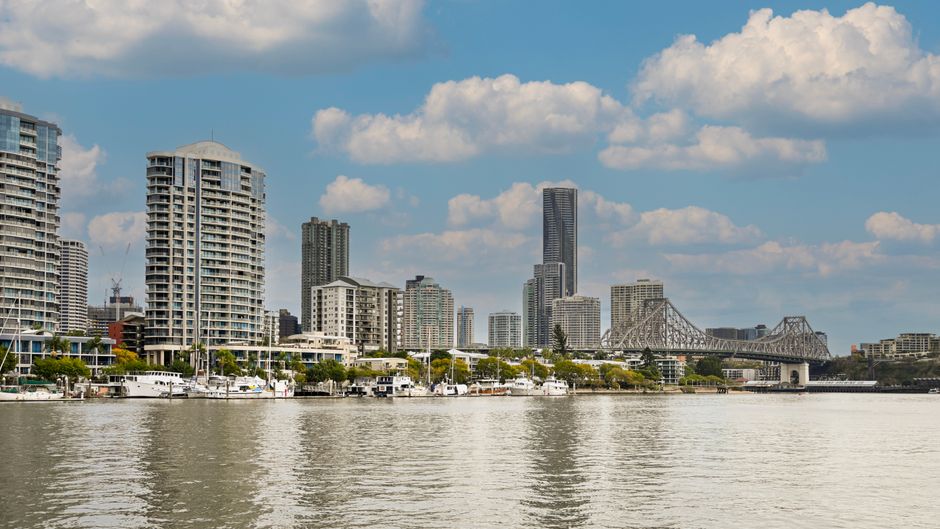
Brisbane, the capital of Queensland, is a sunny, outdoor river city that has grown up fast. The broad, winding Brisbane River loops through its center, crossed by bridges and fast CityCat ferries; on its south bank, a man-made swimming beach, gardens and the state’s art galleries and museums fill the old Expo 88 site, and in the hills around the city, you can cuddle up to koalas in the world’s first koala sanctuary. Greater Brisbane, home to more than two million people on the lands of the Turrbal and Yuggera (Jagera) peoples, is also the gateway to the sand islands of Moreton Bay, the Sunshine Coast and the Gold Coast, each about an hour away, and it is preparing to host the 2032 Olympic and Paralympic Games. The climate is subtropical, with mild, dry, sunny winters and hot, humid, stormy summers; remember that in the southern hemisphere summer runs from December to February and winter from June to August. Queensland does not use daylight saving, so from October to April Brisbane is one hour behind Sydney and Melbourne.
Right now in Brisbane
- Wed17–27°C63–81°F4 mm rain
- Thu15–22°C59–71°FCloudy
- Fri14–23°C57–74°FCloudy
Top tours in Brisbane
See all tours for Brisbane →
From local operators, with prices and reviews; you check availability and book on Viator, our partner. We may earn a commission at no extra cost to you. How we earn money
Brisbane at a glance
- Best months: April to October, when days are sunny and warm, around 22–27 °C (72–81 °F), and humidity is low. November to March is hot and humid, with afternoon thunderstorms.
- Time needed: two or three days for South Bank, the river, the galleries and a koala sanctuary; five to seven days with Moreton Bay’s islands, the Sunshine Coast or the Gold Coast.
- Getting there: Brisbane Airport (BNE) is about 15 km (9 miles) northeast of the city center, linked by the Airtrain in about 20 minutes.
- Costs (as of October 2026): all Translink buses, trains, ferries and trams cost a flat 50 cents (about US$0.35) per journey; the Airtrain is separate, from $23.30 to city stations.
- Before you go: entry rules (ETA, eVisitor or visa), biosecurity and money are covered in our Australia travel guide.
Brisbane neighborhoods and who each one suits
The CBD
The central business district sits in a bend of the river, with the Queen Street Mall, heritage sandstone buildings such as City Hall and the old Treasury, the City Botanic Gardens and riverside walks. It’s the most convenient base for transport and has the most hotels, but it can be quiet at night.
South Bank and West End
Across the Victoria Bridge, South Bank combines the Parklands, Streets Beach and the Cultural Centre with restaurants, hotels and the Wheel of Brisbane. West End, just beyond, is a bohemian neighborhood of cafes, bars, live-music venues and the Saturday Davies Park Market. Ideal for families and anyone who wants to walk to the galleries.
Fortitude Valley, Newstead and Teneriffe
“The Valley,” northeast of the CBD, is Brisbane’s nightlife district, with clubs, live music, rooftop bars and Chinatown. Newstead and Teneriffe, by the river, are converted wool stores and warehouses with breweries, restaurants and the Howard Smith Wharves precinct under the Story Bridge. Good for nightlife and food lovers.
Kangaroo Point and Paddington
Kangaroo Point, on a peninsula opposite the CBD, has cliffs for rock climbing, parkland and views of the skyline. Paddington and Red Hill, west of the center, are hilly suburbs of old timber “Queenslander” houses on stilts, with boutiques, cafes and antique shops along Given Terrace.
Top things to see in Brisbane
South Bank Parklands and Streets Beach
The 17-hectare (42-acre) Parklands are Brisbane’s living room: lawns, rainforest walks, a bougainvillea-covered arbor walk, barbecues and Streets Beach, a free, lifeguard-patrolled man-made lagoon with sand, right in the middle of the city. On weekends, the Collective Markets sell crafts and food.
Queensland Art Gallery and Gallery of Modern Art (QAGOMA)
The two buildings of QAGOMA, in the Cultural Centre at South Bank, hold one of Australia’s leading collections of Aboriginal and Torres Strait Islander art and contemporary art from Asia and the Pacific, including the Asia Pacific Triennial. General admission is free. The Queensland Museum next door covers natural history, dinosaurs and Queensland’s First Nations cultures, and the State Library has free exhibitions.
Lone Pine Koala Sanctuary
Opened in 1927, Lone Pine is the world’s first and largest koala sanctuary, about 12 km (7 miles) southwest of the city at Fig Tree Pocket. Besides more than 100 koalas, it has kangaroos to hand-feed, platypuses, wombats and birds of prey. Reach it by bus or by a scenic boat cruise from the city.
The Brisbane River and the CityCats
The best way to see Brisbane is from the water. The CityCat catamarans run up and down the river from the University of Queensland at St Lucia to Northshore Hamilton, stopping at South Bank, the CBD, New Farm and the Story Bridge, at the standard 50-cent fare. Free CityHopper ferries also run in the inner city. At night, the river walks of New Farm and Kangaroo Point and the lit-up Story Bridge are worth a stroll.
Story Bridge and Kangaroo Point Cliffs
The 1940 steel cantilever Story Bridge is Brisbane’s icon. Walk across for views, or book the Story Bridge Adventure Climb to the top. Below it, the Kangaroo Point Cliffs are floodlit at night for climbers and abseilers, and the lookout at the top of the cliffs is free.
Mount Coot-tha and the Botanic Gardens
About 7 km west of the CBD, the Mount Coot-tha Summit Lookout gives a panorama of the city, Moreton Bay and, on clear days, the Glass House Mountains. Walking trails wind through the surrounding forest, and the Brisbane Botanic Gardens at the foot of the mountain, with a planetarium, are free.
New Farm Park and the Powerhouse
The riverside New Farm Park has jacaranda trees that turn purple in late October and November, a rose garden and playgrounds. The Brisbane Powerhouse, a former power station beside it, is an arts venue with a Saturday farmers’ market.
Other things to do in Brisbane
- Cycling and walking: the riverside paths and the Bicentennial Bikeway link the CBD, South Bank and the university; e-scooters and e-bikes are available to hire in the inner city.
- Live music and sport: the Valley’s venues host live music most nights; the Gabba holds cricket and Australian rules football, and Suncorp Stadium hosts rugby league, including State of Origin matches.
- XXXX Brewery: tours and tastings at the historic Milton brewery, home of Queensland’s best-known beer.
- Markets: Eat Street Northshore, a night market in shipping containers, on Friday to Sunday evenings.
Food and drink
Brisbane’s dining has boomed in recent years. Try Moreton Bay bugs (a local slipper lobster), mud crab, prawns and reef fish, Queensland mangoes and tropical fruit in summer, and the breweries of Newstead and West End. Howard Smith Wharves, James Street and Fortitude Valley have the most restaurants. Tipping is optional, and many places add a surcharge on Sundays and public holidays.
Day trips from Brisbane
Moreton Island and North Stradbroke Island
Moreton Island (Mulgumpin), across Moreton Bay, is one of the world’s largest sand islands, with towering dunes for sandboarding, shipwrecks to snorkel at Tangalooma, and, in season, humpback whales offshore. Passenger and vehicle ferries leave from the Port of Brisbane; much of the island is national park, and you need a four-wheel drive (or a tour) to explore beyond the resort. North Stradbroke Island (Minjerribah), reached by ferry and water taxi from Cleveland, has the surf beaches and headland walk of Point Lookout, where dolphins, turtles and migrating whales are often seen.
The Sunshine Coast and Australia Zoo
About 1.5 to 2 hours north, the Sunshine Coast stretches from Caloundra to Noosa, with surf beaches, Noosa National Park’s coastal walk and the river town of Noosa Heads. On the way, the volcanic peaks of the Glass House Mountains rise beside the highway, and Australia Zoo at Beerwah, founded by the Irwin family, is one of the country’s best-known wildlife parks.
The Gold Coast and the hinterland
The Gold Coast’s beaches and theme parks are about an hour south by car or train, at the 50-cent fare; see our Gold Coast guide. The rainforests of Lamington and Springbrook national parks lie inland.
Nearby destinations
- Gold Coast71 km
- Sunshine Coast91 km
- Byron Bay143 km
- K'gari (Fraser Island)248 km
Getting there and getting around
Brisbane Airport (BNE) and the Airtrain
Brisbane Airport has separate domestic and international terminals about 2 km apart, linked by the Airtrain and a free terminal-transfer bus to Skygate. Flights connect to every Australian capital and to Asia, the Pacific, New Zealand and North America. The Airtrain, a private (non-Translink) line, runs from both terminals to Brisbane City stations, including Central, Roma Street and Fortitude Valley, in about 20 minutes, and continues on Queensland Rail lines to the Gold Coast. Trains run between about 4:30 a.m. and 10 p.m., every 15 minutes at peak times. Fares start from $23.30 to Brisbane City stations (from 27 April 2026); children 14 and under travel free with an adult ticket. You can tap on with a contactless Visa or Mastercard or a go card, but Airtrain fares apply and transfers to other services count as a new journey. Taxis and rideshares to the CBD take 20 to 30 minutes, and the Airport Link and Gateway tunnels and bridges charge electronic tolls.
50-cent fares and contactless payment
All Translink public transport in Queensland costs a flat 50 cents per journey, regardless of distance or how you pay, including buses, Queensland Rail trains (except the Airtrain), CityCat and other ferries, and the Brisbane Metro. Transfers within one journey are free if you tap on and off correctly. Contactless payment works on all trains, buses, ferries and trams in South East Queensland: tap on and off with a Visa or Mastercard credit or debit card, phone or smartwatch, using the same card or device each time, or you may be charged a $2.50 default fare. You can also use a go card or buy a paper ticket at station machines. Cash is not accepted on board in South East Queensland.
Brisbane Metro, buses, trains and driving
The Brisbane Metro, high-capacity bi-articulated buses on the busway network, links the CBD, South Bank, the hospitals and the University of Queensland. Suburban trains run to the airport (via the Airtrain), the Gold Coast, the Sunshine Coast and Ipswich. You won’t need a car in the city; rent one for the Sunshine Coast hinterland or the national parks. Drive on the left.
When to go and how long to stay
Brisbane enjoys about 280 sunny days a year. Winter (June to August) is dry and sunny, with highs around 22 °C (72 °F) and cool nights around 10–12 °C (50–54 °F), ideal for sightseeing. Spring (September to November) is warm and mostly dry, with jacarandas blooming in late October and November. Summer (December to February) is hot and humid, with highs around 30 °C (86 °F), warm nights and late-afternoon thunderstorms that can bring hail and flash flooding. Autumn (March to May) cools and dries gradually. The river has flooded parts of the city in the past, most recently in 2022, during prolonged heavy rain.
| Month | Average high | Average low | Rain | Rain days (≥1 mm) |
|---|---|---|---|---|
| Jan | 30 °C (87 °F) | 22 °C (71 °F) | 140 mm (5.5 in) | 8 |
| Feb | 30 °C (86 °F) | 21 °C (71 °F) | 150 mm (5.9 in) | 10 |
| Mar | 29 °C (84 °F) | 20 °C (68 °F) | 115 mm (4.5 in) | 10 |
| Apr | 27 °C (81 °F) | 17 °C (63 °F) | 59 mm (2.3 in) | 7 |
| May | 24 °C (76 °F) | 14 °C (57 °F) | 60 mm (2.4 in) | 6 |
| Jun | 22 °C (72 °F) | 12 °C (53 °F) | 66 mm (2.6 in) | 7 |
| Jul | 22 °C (72 °F) | 10 °C (51 °F) | 26 mm (1.0 in) | 4 |
| Aug | 23 °C (74 °F) | 11 °C (51 °F) | 35 mm (1.4 in) | 4 |
| Sep | 26 °C (78 °F) | 14 °C (57 °F) | 27 mm (1.1 in) | 4 |
| Oct | 27 °C (81 °F) | 16 °C (62 °F) | 83 mm (3.3 in) | 7 |
| Nov | 28 °C (83 °F) | 19 °C (66 °F) | 88 mm (3.5 in) | 8 |
| Dec | 30 °C (85 °F) | 20 °C (69 °F) | 129 mm (5.1 in) | 9 |
| Year | 27 °C (80 °F) | 16 °C (62 °F) | 973 mm (38 in) | 81 |
Figures are the Bureau of Meteorology’s 1991–2020 statistics for the Brisbane city station, which has records from 1999 within that period. The airport is slightly cooler.
Events worth planning around
- Brisbane Festival (September): three weeks of arts, ending with the Riverfire fireworks over the river.
- Ekka (August): the Royal Queensland Show at the Brisbane Showgrounds, with a public holiday in Brisbane.
- State of Origin (June and July): rugby league matches between Queensland and New South Wales at Suncorp Stadium.
- Jacaranda season (late October to November): purple blossoms in New Farm Park and across the suburbs.
- Whale season (about June to November): humpbacks in Moreton Bay and off the Sunshine Coast and North Stradbroke Island.
Dates vary; check the organizers’ sites.
How long to stay: 2, 4 and 7 days
- Two days: South Bank, QAGOMA, a CityCat ride, the Story Bridge and the Valley at night; Lone Pine and Mount Coot-tha.
- Four days: add a day on Moreton Island or North Stradbroke Island.
- Seven days: add two or three nights on the Sunshine Coast (Noosa) or the Gold Coast.
Where to stay in Brisbane
- CBD: the most hotels, close to the train stations and the Airtrain.
- South Bank: walk to the Parklands, galleries and Streets Beach.
- Fortitude Valley and Newstead: nightlife, boutique hotels and riverside dining.
- Kangaroo Point: skyline views and serviced apartments, a ferry ride from the center.
Queensland has no hotel tax, and the 10% GST is included in prices. Rates rise during big concerts, State of Origin and the Brisbane Festival.
Typical costs in Brisbane
| Item (as of October 2026) | Australian dollars | About US dollars |
|---|---|---|
| Bus, train, CityCat or Metro journey (Translink) | $0.50 | $0.35 |
| Default fare if you don’t tap on or off correctly | $2.50 | $1.70 |
| Airtrain, airport to Brisbane City stations | from $23.30 | from $16 |
| QAGOMA and Queensland Museum general entry | Free | Free |
| Flat white coffee | about $5–6 | about $3.50–4 |
| Casual restaurant main | about $25–40 | about $17–28 |
| Mid-range hotel room, per night | about $200–320 | about $140–220 |
Transport fares are official Translink prices; meals and hotels are typical ranges. Conversions use about US$0.69 to A$1.
Safety in Brisbane
Brisbane is a safe, relaxed city; take normal care in Fortitude Valley late at night, where crowds and alcohol can lead to trouble.
- Sun and UV: UV is very high most of the year; use SPF 50+ sunscreen, a hat and shade, and drink water.
- Storms and floods: summer storms bring lightning, hail and flash flooding. Never drive or walk through floodwater, and follow warnings from the Bureau of Meteorology and local authorities.
- Swimming: don’t swim in the Brisbane River, which has strong currents, poor visibility and bull sharks; swim at Streets Beach or patrolled ocean beaches, between the red and yellow flags. Ocean beaches on the islands and coasts have rip currents.
- Bushfires: the hinterland and islands can have high fire danger in spring and early summer; check fire danger ratings before bushwalking.
- Wildlife: snakes live in bushland, and magpies may swoop on walkers and cyclists during their spring nesting season; keep your distance.
- Emergencies: call 000 (112 also works from mobile phones).
Practical tips for Brisbane
- Time zone: Australian Eastern Standard Time (UTC+10) all year; no daylight saving.
- Plugs and money: type I plugs at 230 V; cards accepted almost everywhere, with small surcharges common.
- Shopping refunds: claim GST back on purchases of $300 or more from one business through the Tourist Refund Scheme when you leave.
What to pack for Brisbane
Pack light summer clothes, swimwear, a wide-brimmed hat, sunglasses and SPF 50+ sunscreen year-round, plus a light rain jacket or umbrella for summer storms. In winter, add a sweater or light jacket for the evenings. Comfortable walking shoes are useful for the riverside paths and Mount Coot-tha trails.
Brisbane travel FAQ
How much is public transport in Brisbane?
A flat 50 cents per journey on all Translink buses, trains, ferries, Brisbane Metro and trams, however far you go. The Airtrain to the airport is the exception, with its own fares.
How do I get from Brisbane Airport to the city?
Take the Airtrain to Central, Roma Street or Fortitude Valley in about 20 minutes. Fares start from $23.30; children 14 and under ride free with an adult. Taxis take 20 to 30 minutes.
Can I use my credit card on Brisbane public transport?
Yes. Tap on and off with a contactless Visa or Mastercard, phone or smartwatch on all South East Queensland trains, buses, ferries and trams, using the same card or device each time.
Can you hold a koala in Brisbane?
Lone Pine Koala Sanctuary, the world’s first and largest, lets visitors get close to koalas; check its website for current encounter options and prices.
Is there a beach in Brisbane?
Yes, Streets Beach at South Bank, a free man-made lagoon with sand and lifeguards. The nearest ocean surf beaches are on North Stradbroke Island, the Gold Coast and the Sunshine Coast.
What is the best time to visit Brisbane?
April to October, when it is sunny, warm and dry. Summer is hot and humid, with storms.
Is Brisbane on the same time as Sydney?
From April to early October, yes. Queensland has no daylight saving, so from 4 October 2026 to 4 April 2027 Brisbane is one hour behind Sydney and Melbourne.
How do I get to Moreton Island from Brisbane?
Ferries leave from the Port of Brisbane for Tangalooma and other landing points. Book ahead, and take a tour or a four-wheel drive to go beyond the resort area.
Can you swim in the Brisbane River?
No. The river has strong currents, murky water and bull sharks. Swim at Streets Beach or a public pool instead.
How far is the Gold Coast from Brisbane?
About an hour by car or train. The train costs the 50-cent Translink fare from Brisbane; connect to the G:link tram at Helensvale.
Plan your trip
Partner links: TravelerCenter may earn a commission if you book, at no extra cost to you.
Sources · last reviewed 5 October 2026
Researched and last reviewed on 5 October 2026. The 50-cent fare, contactless payment, the default fare, cash rules and Airtrain details (fares from $23.30 effective 27 April 2026, hours, frequency, journey time and free child travel) come from Translink (Queensland Government); daylight saving dates from the NSW Government; the Tourist Refund Scheme from the Australian Border Force; climate from the Bureau of Meteorology’s 1991–2020 statistics for Brisbane (station 040913, data from 1999); population from Wikidata. Attraction details, Lone Pine history, ferry operations, the free CityHopper, events, flood history, sunny-day count, typical prices and drive times are general references and flagged for checking. For entry rules, biosecurity and money, see our Australia travel guide.
Data: Weather: MET Norway (CC BY 4.0) · Sea temperature: NOAA CoastWatch · Air quality: OpenAQ · Rates: ECB · Costs: World Bank ICP and price levels · Wikidata (CC0)