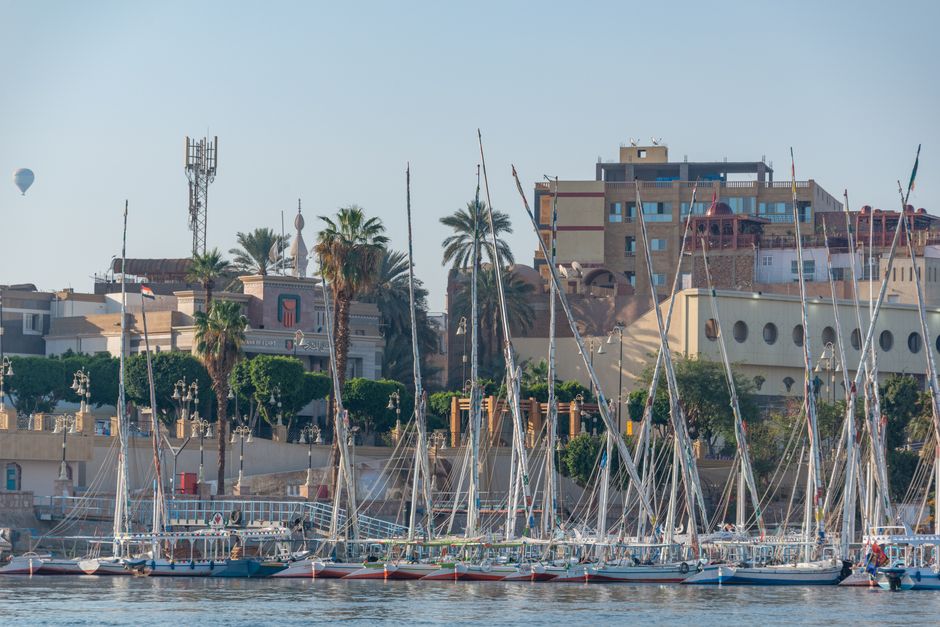
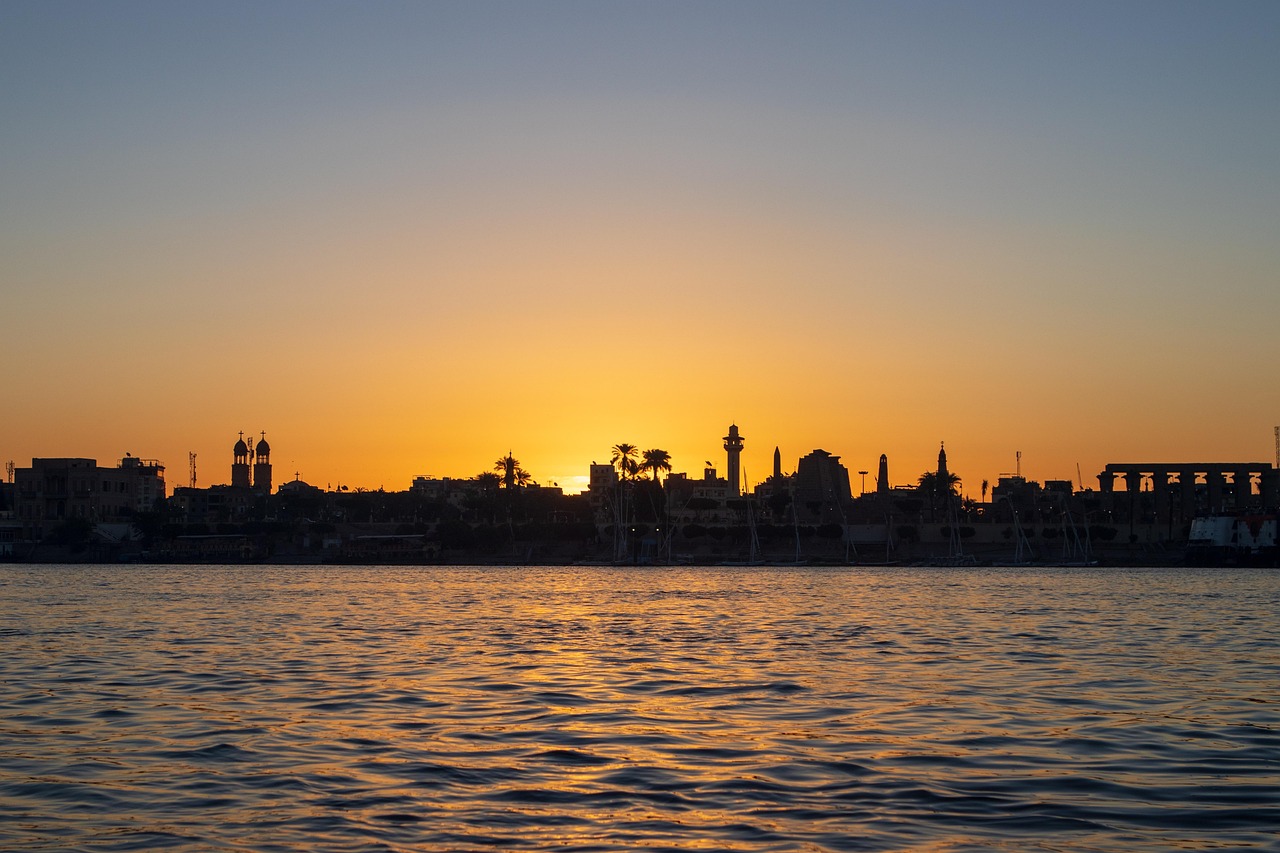
Luxor, on the Nile about 650 km (400 miles) south of Cairo, stands on the site of Thebes, the religious capital of Egypt’s New Kingdom, and is often called the world’s greatest open-air museum. On the East Bank, where the sun rises and the living city grows, are the vast temple complex of Karnak, with its forest of giant columns, and the elegant Luxor Temple on the riverfront, linked by the restored Avenue of Sphinxes. Across the river, on the West Bank, where the sun sets and the pharaohs were buried, lie the Valley of the Kings with the tomb of Tutankhamun, the terraced temple of Queen Hatshepsut, the colossal Colossi of Memnon, the temple of Ramesses III at Medinet Habu, the Valley of the Queens and hundreds of painted tombs of nobles and workmen. Luxor is the start or end of most Nile cruises to Aswan, the arrival point of the overnight sleeper trains from Cairo, and a classic day trip from the Red Sea resorts. Dawn hot-air balloon flights over the West Bank, feluccas at sunset and the evening light on Luxor Temple make it worth staying at least two or three nights. The Ancient Thebes site is a UNESCO World Heritage Site. The best months are October to April; summer is extremely hot.
Right now in Luxor
- Wed22–34°C71–94°FMostly clear
- Thu20–36°C69–97°FClear
- Fri25–37°C77–98°FClear
- Today Armed Forces Day (عيد القوات المسلحة)
Top tours in Luxor
See all tours for Luxor →
From local operators, with prices and reviews; you check availability and book on Viator, our partner. We may earn a commission at no extra cost to you. How we earn money
Luxor at a glance
- Best for: temples, royal tombs, Egyptology, Nile cruises, balloon flights and feluccas.
- How long: 2 full days for the highlights; 3–4 days with Dendera, Abydos or Esna and Edfu.
- Best time: October to April; June to September averages above 40 °C (104 °F).
- Getting there: fly into Luxor (LXR), take the sleeper train from Cairo or Giza, or a cruise from Aswan.
- Getting around: on foot and by taxi or Uber on the East Bank; ferry, taxi or hired driver on the West Bank.
- Good to know: start the West Bank at 6 a.m., carry a card for tickets, and agree prices for carriages and boats.
- Before you go: visas, money and general safety are in our Egypt travel guide.
Luxor’s areas and where to stay
The modern city lies on the East Bank, along the Corniche between Luxor Temple and Karnak about 3 km (2 miles) to the north. The West Bank, reached by bridge or ferry, is farmland and villages backed by the Theban hills, with the tombs and temples scattered along the edge of the desert.
East Bank: the Corniche and the center
The riverfront Corniche has the big hotels, including the historic Winter Palace, cruise boat moorings, restaurants and the Luxor Museum, all within walking distance of Luxor Temple. The streets behind it, around the souk and the station, have budget hotels.
East Bank: Karnak and the south
Resort-style hotels with gardens and pools line the river south of the center and near Karnak; they are quieter but need a taxi into town.
West Bank
The villages around Al-Bairat and Gezira, near the ferry landing, have family-run guesthouses and small hotels with views of the Theban hills, rooftop dinners and donkeys in the lanes. Staying here puts you closest to the tombs at opening time and under the balloons at dawn.
Where to stay in Luxor
- East Bank Corniche: central, with river views and restaurants.
- East Bank south: resort hotels with pools.
- West Bank: peaceful guesthouses close to the tombs.
- On a Nile cruise boat: most cruises spend one or two nights moored in Luxor.
Top things to see in Luxor
Karnak Temple
Karnak, the “most select of places”, was the greatest religious complex of ancient Egypt, built, rebuilt and enlarged by about 30 pharaohs over 2,000 years for the god Amun-Ra. Pass the avenue of ram-headed sphinxes and the unfinished first pylon into the Great Hypostyle Hall, with 134 colossal papyrus columns, the tallest about 21 m (69 ft) high, many still with their paint. Beyond are the obelisks of Thutmose I and Hatshepsut, the sacred lake and the giant scarab that visitors walk around for luck. According to the Ministry of Tourism and Antiquities, Karnak opens daily at 6 a.m., and the ticket costs EGP 600 (about US$11.50) for foreign adults and EGP 300 for students; the Open Air Museum and the Temple of Mut have separate tickets. Allow at least two to three hours, and go early or late in the afternoon.
Luxor Temple and the Avenue of Sphinxes
On the riverfront in the heart of town, Luxor Temple was built mainly by Amenhotep III and Ramesses II for the annual Opet festival. Its pylon is guarded by seated colossi of Ramesses and a single obelisk (its twin stands in the Place de la Concorde in Paris), and a mosque, the Mosque of Abu al-Haggag, still perches on the columns of the courtyard. The temple is magical in the evening, when it is floodlit. The ministry lists the ticket at EGP 500 for foreign adults, with the temple open from 6 a.m. into the evening. From its entrance, the Avenue of Sphinxes, about 2.7 km (1.7 miles) long and reopened in 2021, runs north to Karnak.
The Valley of the Kings
The pharaohs of the New Kingdom (about 1550–1070 BC), from Thutmose I to Ramesses XI, were buried in more than 60 rock-cut tombs in this barren desert valley under a pyramid-shaped peak. Long corridors decorated with brightly painted texts and gods lead to the burial chambers. According to the ministry, the valley opens at 6 a.m., and the general ticket costs EGP 750 (about US$14) for foreign adults, giving access to a selection of the open tombs, usually three; the opened tombs rotate to protect them. Three tombs need extra tickets: the tomb of Tutankhamun (KV62), small but with his mummy still in place (EGP 700); the long, superbly painted tomb of Seti I (KV17), the finest in the valley (EGP 2,000); and the tomb of Ramesses V and VI (KV9), with its astronomical ceiling (EGP 220). Photography with a phone is allowed, but flash is not. An electric shuttle runs from the visitor center to the tombs for a small fee. Allow two to three hours.
Hatshepsut’s temple at Deir el-Bahari
The mortuary temple of Hatshepsut, the woman who ruled as pharaoh around 1470 BC, rises in three colonnaded terraces against the cliffs of Deir el-Bahari. Its reliefs show the expedition to the land of Punt and the queen’s divine birth. The ministry lists the ticket at EGP 440 for foreign adults. It is hot and shadeless by late morning, so combine it with the Valley of the Kings at dawn.
Medinet Habu and the Ramesseum
The mortuary temple of Ramesses III at Medinet Habu (EGP 220) is one of the best preserved in Egypt, with deep-cut reliefs of battles against the Sea Peoples and colored ceilings, and it is usually much quieter than Karnak. The Ramesseum (EGP 220), the temple of Ramesses II, has the broken colossus that inspired Shelley’s poem “Ozymandias”.
The Colossi of Memnon
Two 18 m (59 ft) statues of Amenhotep III sit beside the road to the West Bank sites, the only remains of his vast mortuary temple. They are free to see from the roadside.
More of the West Bank
- Valley of the Queens: tombs of queens and princes (EGP 220); the tomb of Nefertari, the most beautiful in Egypt, opens on a separate, expensive ticket.
- Tombs of the Nobles: small, vivid tombs of officials showing daily life, harvests, banquets and hunting, on several separate tickets.
- Deir el-Medina: the village and tombs of the craftsmen who built the royal tombs.
- Howard Carter’s House: the archaeologist’s restored house, with a replica of Tutankhamun’s tomb nearby (EGP 220).
The Luxor and Mummification museums
The small, beautifully lit Luxor Museum on the Corniche (EGP 400) has masterpieces from Theban temples, including statues found in a cache under Luxor Temple in 1989. The Mummification Museum (EGP 220), also on the Corniche, explains how the Egyptians preserved humans and animals. Both open in the morning and again in the evening.
Luxor Pass
The ministry sells a Luxor Pass for visitors who will see many sites in a few days. The standard pass covers most East and West Bank sites, and the premium pass adds the tombs of Seti I and Nefertari; both are valid for five consecutive days. Recent visitors report prices of about US$130 for the standard pass and about US$250 for the premium pass, with half price for students under 30, paid in US dollars or euros at the Karnak or West Bank ticket offices, with a passport copy and a photo. Check the current price at the ticket office before planning around it.
Other things to do in Luxor
Hot-air balloons
At sunrise, dozens of balloons float over the West Bank, giving views of the temples, the green fields and the Nile. Flights last about 45 minutes and leave from the West Bank after a pre-dawn pickup. They are cancelled in strong winds, and passengers must follow the crew’s landing instructions.
Feluccas and the Nile
A sunset felucca sail from the Corniche, or a motorboat to Banana Island, is a relaxing end to a day of temples. The public ferry between the East Bank Corniche and the West Bank costs a few pounds and runs all day. See our boat trips guide.
Food and drink
Eat on rooftop terraces facing Luxor Temple or the Theban hills: grilled meats and fish, tagines of okra or molokhia, stuffed pigeon, mezze and fresh juices. West Bank guesthouses cook home-style Egyptian dinners. The souk near Luxor Temple sells spices, scarves and alabaster, but haggle hard.
Cycling the West Bank
Renting a bicycle on the West Bank to ride between the Colossi, Medinet Habu and the villages is a pleasant way to explore in the cooler months; the Valley of the Kings road is a steep climb in the heat. See our cycling guide.
Day trips from Luxor
- Dendera: the Temple of Hathor, about 60 km (37 miles) north, is one of the best preserved in Egypt, with a blue astronomical ceiling and rooftop chapels (EGP 300).
- Abydos: the Temple of Seti I, about 170 km (105 miles) north, has some of the finest reliefs in Egypt and the “King List” of pharaohs (EGP 260); often combined with Dendera in a long day.
- Esna and Edfu: the Temple of Khnum at Esna (EGP 200), recently cleaned to reveal its original colors, and the Temple of Horus at Edfu, the best-preserved temple in Egypt (EGP 550), on the way south to Aswan.
- Aswan: about 3 hours by train or road, or 3–4 nights by Nile cruise; see our Aswan guide.
Nearby destinations
- Aswan181 km
- Hurghada209 km
- El Gouna214 km
- Marsa Alam237 km
- Sharm El Sheikh291 km
Getting there and getting around
By air
Luxor International Airport (LXR), about 7 km (4 miles) east of the center, has flights to Cairo in about an hour and seasonal charter flights from Europe. Taxis and hotel transfers reach the Corniche in 15–20 minutes.
By train
The station is in the center of the East Bank. According to the Abela sleeper train timetable for October 2026, the evening sleepers from Cairo and Giza arrive between about 05:15 and 09:00, and northbound sleepers leave Luxor between about 19:45 and 23:30. Day trains run to Aswan in about 3 hours and to Cairo in about 10 hours.
By road and cruise
Buses and private transfers connect Luxor with Hurghada on the Red Sea in about 3.5–4 hours. Nile cruise boats moor along the East Bank Corniche.
Getting around
The East Bank center is walkable, and horse-drawn caleches are a classic way along the Corniche (agree the price first). Uber operates in Luxor. On the West Bank, the sites are spread out over about 10 km (6 miles): most visitors hire a taxi or a driver for the day, or join a tour; cycling is possible in winter. The road bridge is about 7 km (4 miles) south of the center.
When to go and how long to stay
Luxor has one of the hottest and driest climates in the world. Winter (November to February) is ideal for sightseeing: warm, sunny days around 23–29 °C (73–84 °F), but nights can drop to about 7 °C (45 °F), so bring a jacket for dawn balloon flights. Spring heats up quickly, and from May to September highs average about 39–41 °C (102–107 °F); visit sites from 6 a.m. to about 11 a.m. and rest in the afternoon. Rain is almost unknown. The table uses the 1991–2020 climate normals for the Luxor station of the Egyptian Meteorological Authority (EMA), as published by the World Meteorological Organization (WMO): average daily highs and lows, total precipitation, and days with at least 1 mm of rain.
| Month | Average high / low | Rain (days with 1 mm or more) | What to expect |
|---|---|---|---|
| January | 23 °C (73 °F) / 7 °C (45 °F) | 3 mm (0.1 in), 0 days | Ideal days, cold nights; peak season |
| February | 25 °C (78 °F) / 9 °C (48 °F) | under 1 mm, 0 days | Warm and sunny; very good |
| March | 30 °C (85 °F) / 13 °C (55 °F) | 2 mm (under 0.1 in), 0 days | Warming; still pleasant |
| April | 35 °C (95 °F) / 18 °C (64 °F) | under 1 mm, 0 days | Hot afternoons |
| May | 39 °C (102 °F) / 22 °C (72 °F) | 1 mm (under 0.1 in), 0 days | Very hot; go at dawn |
| June | 41 °C (106 °F) / 25 °C (76 °F) | under 1 mm, 0 days | Extreme heat; low season |
| July | 41 °C (107 °F) / 26 °C (78 °F) | under 1 mm, 0 days | Extreme heat; cheap cruises |
| August | 41 °C (106 °F) / 26 °C (78 °F) | under 1 mm, 0 days | Extreme heat |
| September | 39 °C (103 °F) / 23 °C (74 °F) | under 1 mm, 0 days | Very hot; quieter |
| October | 35 °C (96 °F) / 20 °C (67 °F) | 1 mm (under 0.1 in), 0 days | Hot early in the month; season starts |
| November | 29 °C (84 °F) / 13 °C (56 °F) | 1 mm (under 0.1 in), 0 days | Warm and sunny; excellent |
| December | 24 °C (76 °F) / 9 °C (47 °F) | under 1 mm, 0 days | Mild days, chilly nights; busy |
Luxor receives less than 10 mm (0.4 in) of rain a year; most years see no rain at all.
Two days in Luxor
Day one, the West Bank from 6 a.m.: the Valley of the Kings with Tutankhamun’s or Seti I’s tomb, Hatshepsut’s temple, the Colossi of Memnon and Medinet Habu; rest at midday; Luxor Temple at sunset. Day two, a balloon flight at dawn, Karnak in the morning, the Luxor Museum, and a felucca at sunset.
Three to four days
Add the Valley of the Queens, the Tombs of the Nobles and the Ramesseum, a long day trip to Dendera and Abydos, or Esna and Edfu on the way to Aswan.
What a trip to Luxor costs
Prices are approximate, for October 2026, converted at about EGP 52.3 to the US dollar. Site tickets are the ministry’s foreign adult prices.
| Item | Typical cost |
|---|---|
| Valley of the Kings (general ticket) | EGP 750 (about US$14) |
| Tomb of Tutankhamun (extra) | EGP 700 (about US$13) |
| Tomb of Seti I (extra) | EGP 2,000 (about US$38) |
| Karnak Temple | EGP 600 (about US$11.50) |
| Luxor Temple | EGP 500 (about US$9.50) |
| Hot-air balloon flight | about US$60–150, depending on the operator and season |
| Taxi or driver for the West Bank, half day | EGP 800–1,500 (about US$15–29) |
| Mid-range hotel double, per night | EGP 2,500–6,000 (about US$48–115) |
Practical tips for Luxor
- Start at 6 a.m.: the West Bank sites open early, and the light and temperatures are best before 10 a.m.
- Carry a card: ticket offices accept Visa and Mastercard; keep small notes for tips and the ferry.
- Choose your tombs: the general Valley of the Kings ticket covers a selection; decide in advance whether Tutankhamun or Seti I is worth the extra.
- Hire a licensed guide: an Egyptologist guide brings the reliefs to life; look for the official badge.
- Agree prices first: for caleches, feluccas, taxis and balloons, agree the full price before you start.
- Bring a flashlight: some tombs and temple corners are dim.
Safety
Luxor is calm and friendly, with a strong police presence at the sites, but it is also known for persistent touts. Caleche drivers, felucca captains, “guides” and shop owners will approach you repeatedly along the Corniche and at the temple gates; agree prices clearly, in Egyptian pounds and for the whole group, before any ride or service, and say no firmly if you are not interested. At the sites, guards may offer to show you a “closed” area or hold your phone for a photo in exchange for a tip; it is your choice, but photography rules apply. Heat is the main health risk: from May to September, temperatures above 40 °C (104 °F) are normal, so drink plenty of water, wear a hat and avoid the midday sun. Balloon flights operate under the supervision of the civil aviation authorities, and a 2013 accident killed 19 people; choose an established operator, follow the pilot’s safety briefing and landing position, and accept cancellations for wind. On the road, traffic is lighter than in Cairo, but drive or ride with care at night. In an emergency, call 122 for the police, 123 for an ambulance and 126 for the tourist police.
What to pack for Luxor
A sun hat, sunglasses and high-factor sunscreen, light long-sleeved clothes, a scarf against dust, comfortable shoes with grip for tomb ramps and temple floors, a warm layer for winter nights and balloon flights, a refillable water bottle, a small flashlight and a card for tickets. See our hiking shoes and travel adapters guides.
Luxor travel FAQ
How much is the Valley of the Kings ticket?
According to the Ministry of Tourism and Antiquities, EGP 750 (about US$14) for foreign adults and EGP 375 for students, with extra tickets for the tombs of Tutankhamun, Seti I and Ramesses V and VI.
Is Tutankhamun’s tomb worth the extra ticket?
It is small and less decorated than other royal tombs, but it still holds the king’s mummy and his outer sarcophagus. If you want one special tomb, Seti I’s is the most spectacular, but it costs EGP 2,000.
What time does the Valley of the Kings open?
At 6 a.m. every day; last entry is about 5 p.m. in summer and 4 p.m. in winter.
Can I pay cash at Luxor’s temples?
Bring a card: the ministry’s ticket offices and kiosks accept Visa and Mastercard, and many no longer take cash.
How many days do I need in Luxor?
Two full days for Karnak, Luxor Temple and the main West Bank sites; three or four with Dendera, Abydos or Edfu.
Is the Luxor Pass worth it?
Only if you will visit many sites in five days, including the expensive tombs of Seti I or Nefertari; check the current price at the Karnak or West Bank ticket office.
What is the best time to visit Luxor?
October to April. From May to September, highs average around 40 °C (104 °F) or more.
Are hot-air balloon rides in Luxor safe?
Flights are regulated and very popular. Choose an established operator, listen to the safety briefing and accept cancellations in strong wind.
How do I get from Cairo to Luxor?
Fly in about an hour, or take the overnight sleeper train from Cairo or Giza, arriving early in the morning after about 10 hours.
Can I visit Luxor as a day trip from Hurghada?
Yes, but it means about 3.5–4 hours each way by road; an overnight stay is much better.
Plan your trip
Partner links: TravelerCenter may earn a commission if you book, at no extra cost to you.
🇪🇬 Useful Arabic phrases for Luxor
All 38 Arabic phrases: restaurant, hotel, emergencies, romance (printable) →
Sources · last reviewed 5 October 2026
Researched and last reviewed on 5 October 2026. Ticket prices and hours for Karnak, Luxor Temple, the Valley of the Kings, the tombs of Tutankhamun, Seti I and Ramesses V and VI, Hatshepsut’s temple, Medinet Habu, the Ramesseum, the Valley of the Queens, Howard Carter’s House, the Luxor and Mummification museums, Dendera, Abydos, Esna and Edfu, and card payment: the Ministry of Tourism and Antiquities (egymonuments.com and egymonuments.gov.eg); the West Bank electric shuttles: ministry news; sleeper train times: Abela Trains; climate normals: the Egyptian Meteorological Authority via the World Meteorological Organization’s 1991–2020 normals (Luxor station); the exchange rate: the Central Bank of Egypt. Luxor Pass prices, the number of tombs on the general ticket, Nefertari’s tomb, the Avenue of Sphinxes, balloon prices and history, transport times and typical prices are general references or estimates, flagged for checking. Prices and rules change, so check locally before you go. For visas, money and general safety, see our Egypt travel guide.
Data: Weather: MET Norway (CC BY 4.0) · Rates: ECB · Holidays: Nager.Date · Costs: World Bank ICP and price levels · Wikidata (CC0)