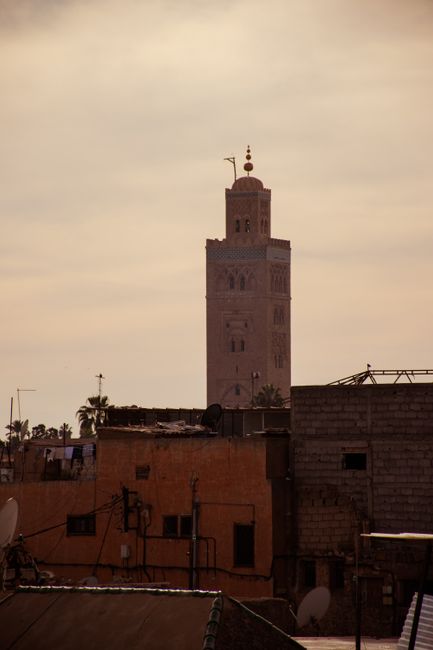
Marrakech, the “Red City” at the foot of the High Atlas, is Morocco’s most visited destination and the place most travelers picture when they think of the country. Its walled medina, a UNESCO World Heritage Site since 1985, is a maze of souks, mosques, palaces and hidden courtyard houses called riads, and at its heart lies Jemaa el-Fna, the great square where storytellers, musicians, henna artists and dozens of open-air food stalls take over every evening. Beyond the walls are the cobalt-blue Majorelle Garden, the Palmeraie palm grove and, on clear winter days, the snowy Atlas on the horizon. Marrakech is also the gateway to the mountain valleys of Ourika and Imlil, the coast at Essaouira and the long road over the Tizi n’Tichka pass to Aït Ben Haddou and the Sahara. The best months are March to May and October to November; July and August are very hot.
Right now in Marrakech
- Wed 19–28°C 66–83°F 1 mm Light showers
- Thu 18–27°C 64–80°F 3 mm Showers
- Fri 16–23°C 60–73°F 3 mm Showers
Weather: MET Norway (CC BY 4.0) · Air quality: OpenAQ
Top tours in Marrakech
See all tours for Marrakech →
From local operators, with prices and reviews; you check availability and book on Viator, our partner. We may earn a commission at no extra cost to you. How we earn money
Marrakech at a glance
- Best for: medina life, riads, souks, palaces and gardens, food, hammams and trips into the Atlas and the desert.
- How long: 3 full days for the city; 4–5 days with day trips to the Atlas, Agafay or Essaouira.
- Best time: March to May and October to November; July and August average about 38 °C (100 °F) in the afternoon.
- Getting there: fly into Marrakech Menara (RAK), or take the train from Casablanca, Rabat, Tangier or Fez.
- Getting around: on foot in the medina; petit taxis, ride-hailing apps and buses for Gueliz and the gardens.
- Good to know: buy Majorelle Garden tickets online in advance, carry small notes, and ignore anyone who says the road ahead is “closed.”
- Before you go: visas, money and general safety are in our Morocco travel guide.
Marrakech’s areas and where to stay
The old city, the medina, is enclosed by about 19 km (12 miles) of ocher walls with gates such as Bab Agnaou and Bab Doukkala. Outside them, the French-built new town spreads west and north, and the resort areas of the Palmeraie and the Ourika road lie further out.
The medina around Jemaa el-Fna and the souks
The streets around Jemaa el-Fna, Riad Zitoun and the northern souks (Mouassine, Bab Doukkala and Ben Youssef) are full of riads, from simple guesthouses to restored palaces with plunge pools. Many riads can’t be reached by car, so arrange for a porter to meet your taxi. The southern medina, around the palaces and the old Jewish quarter of the Mellah, is slightly calmer.
Gueliz and Hivernage
Gueliz, the new town built under the French protectorate, has cafés, galleries, shops and the train station, near the Majorelle Garden. Hivernage, next to the medina walls, has the big international hotels and nightlife.
The Palmeraie and the outskirts
The Palmeraie, a palm grove about 10 km (6 miles) northeast of the medina, has resort hotels, golf courses and villas with big pools. Agafay, 40 km (25 miles) south, has desert camps.
Where to stay in Marrakech
- Medina riad near Jemaa el-Fna or Mouassine: the classic Marrakech experience, with breakfast in a courtyard and a rooftop terrace.
- Kasbah and the Mellah: quieter riads close to the palaces.
- Gueliz: modern hotels and apartments, near the station and the Majorelle Garden.
- Hivernage: large hotels with pools, between the new town and the medina.
- Palmeraie or Agafay: resorts, villas and desert lodges for a slower stay.
Top things to see in Marrakech
Jemaa el-Fna
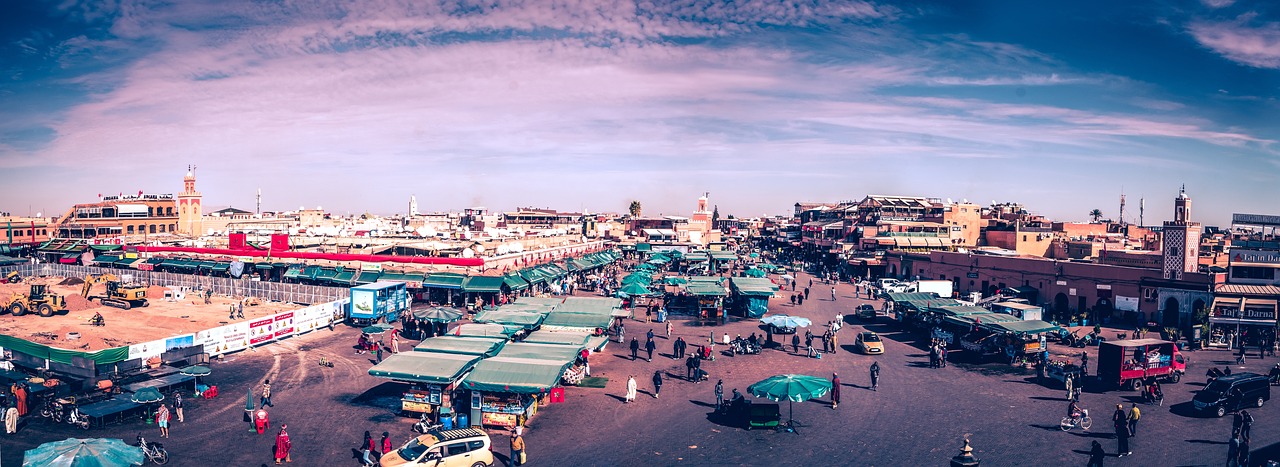
The great square of Jemaa el-Fna is the stage of Marrakech. By day it holds juice sellers, snake charmers and henna artists; at dusk dozens of food stalls set up benches and grills, and musicians and storytellers gather crowds until late. UNESCO lists the “cultural space” of the square on its list of the Intangible Cultural Heritage of Humanity. Entry is free, but performers expect a tip if you watch or take photos, and stall touts will steer you to their benches. Café terraces give the best sunset view. The small Museum of Intangible Heritage on the square, run by the National Museums Foundation, opens Tuesday to Sunday from 10 a.m. to 6 p.m.
The souks
North of the square, the covered lanes of Souk Semmarine lead into a warren of specialist markets: leather slippers (babouches), lanterns and metalwork, carpets, wood, spices and the dyers’ souk, where skeins of wool hang to dry. Rahba Kedima, the old spice square, has herbalists selling argan oil and ras el hanout. Prices are rarely marked, so bargain politely and walk away if you’re not happy.
The Koutoubia Mosque
The 12th-century minaret of the Koutoubia, the great Almohad mosque, rises about 77 m (253 ft) over the square and is the landmark that guides you home. Like most Moroccan mosques, it is closed to non-Muslims, but its gardens are open to all.
The Bahia Palace
The Bahia Palace, built in the late 19th century for the grand viziers Si Moussa and his son Ba Ahmed, is a sequence of courtyards, gardens and salons with painted cedar ceilings, zellige tilework and carved stucco, spread over about 8 hectares (20 acres). According to the Ministry of Youth, Culture and Communication’s official ticket site, entry costs MAD 100 (about US$10) for foreign adults and MAD 50 for children aged 7 to 13; tickets can be bought online or at the gate. The palace is very popular, so go at opening time or late in the afternoon.
The Badi Palace and the Saadian Tombs
The ruined Badi Palace, built by the Saadian sultan Ahmad al-Mansur in the late 16th century, is now a vast courtyard of sunken gardens and high walls where storks nest; climb the terraces for views over the Kasbah. Nearby, the Saadian Tombs, rediscovered in 1917, hold the richly decorated burial chambers of the Saadian dynasty, including the Hall of the Twelve Columns. The ministry lists both at MAD 100 for foreign adults. After the 2023 earthquake, the government launched a restoration program for the Badi and Bahia palaces, the Saadian Tombs and the city walls; some areas may be closed while work continues, so check the ministry’s ticket site before you go.
The Majorelle Garden and the Yves Saint Laurent Museum
The painter Jacques Majorelle created this garden of cactuses, bamboo, palms and lily ponds from the 1920s, and painted his studio a now-famous electric blue; Yves Saint Laurent and Pierre Bergé later bought and restored it. Tickets are sold only online, on the garden’s official ticket site, for a timed entry. In October 2026 the site lists MAD 170 (about US$17) for the garden, MAD 230 for the garden and the Pierre Bergé Museum of Berber Arts, MAD 140 for the Musée Yves Saint Laurent Marrakech next door, and MAD 330 for all three; children under 10 enter free. The garden opens daily from 8 a.m. to 6:30 p.m. (last entry 6 p.m.), and the Yves Saint Laurent Museum is closed on Wednesdays. Book a morning slot, and beware of unofficial resellers.
Ben Youssef Madrasa and the northern medina
The 16th-century Ben Youssef Madrasa, once one of the largest Koranic schools in North Africa, has a courtyard of carved cedar, stucco and tiles around a long pool, and tiny student cells upstairs; it reopened after restoration and charges a small fee. Next to it, the Almoravid Koubba, built around 1117, is one of the last Almoravid buildings in Morocco (MAD 100 for foreign adults, according to the ministry).
Museums and hidden courtyards
- Dar Si Said: the National Museum of Weaving and Carpets, in a 19th-century mansion (MAD 30; Tuesday to Sunday, 10 a.m. to 6 p.m.).
- Dar el Bacha, Museum of Confluences: the former pasha’s palace, with temporary exhibitions and a famous coffee house (MAD 60; Tuesday to Sunday, 10 a.m. to 6 p.m.).
- The Mellah: the old Jewish quarter, with the Lazama Synagogue, the spice market and the Miaara cemetery.
Other things to do in Marrakech
Hammams and spas
A visit to a hammam, the steam bath at the center of Moroccan life, is the best cure for the dust of the souks. Public hammams are cheap and separated by gender, with a black-soap scrub; spa hammams in riads and hotels offer the ritual in private, for more.
Food and drink
Eat at the Jemaa el-Fna stalls for harira soup, grilled kefta, snails and fried fish; try tanjia, the slow-cooked beef jar that is the city’s own dish, around the Mechouar; and book a rooftop or riad restaurant for tagines, couscous and pastilla. Mint tea is poured everywhere, and freshly squeezed orange juice costs a few dirhams on the square. Alcohol is served in licensed hotels, bars and some restaurants, not at the stalls. Many riads run cooking classes that start with a trip to the market.
Gardens, balloons and the Agafay desert
Besides Majorelle, the Menara Gardens, an olive grove around a large pool with a green-roofed pavilion (MAD 60 for the pavilion, according to the ministry), and the Agdal Gardens behind the royal palace are quiet places to walk. At dawn, hot-air balloons take off near the Palmeraie for views of the Atlas; book only with licensed operators. About 40 km (25 miles) south, the stony Agafay desert has camel rides, quad bikes and camps with dinner under the stars, an easy taste of the desert if you can’t go as far as the Sahara.
Day trips from Marrakech
- Ourika Valley: about 35 km (22 miles) south, with riverside restaurants, Berber villages and the Setti Fatma waterfalls; busy at weekends.
- Imlil and Toubkal National Park: about 65 km (40 miles) south, the base for walks in the High Atlas and for climbing Toubkal, North Africa’s highest peak at 4,167 m (13,671 ft), usually over two days with a guide. See our hiking guide.
- Ouzoud Waterfalls: a 110 m (360 ft) cascade with olive groves and Barbary macaques, about 150 km (93 miles) northeast; a long day.
- Essaouira: the windy, whitewashed port on the Atlantic, about 2.5–3 hours by road; see our Essaouira guide.
- Aït Ben Haddou and Ouarzazate: over the Tizi n’Tichka pass, about 4 hours each way; better as an overnight trip; see our Ouarzazate guide.
- Merzouga and the Sahara: at least 3 days round trip from Marrakech by road; see our Merzouga guide.
Nearby destinations
- Ouarzazate129 km
- Essaouira170 km
- Agadir203 km
- Casablanca222 km
- Rabat286 km
Getting there and getting around
By air
Marrakech Menara Airport (RAK), about 6 km (4 miles) southwest of the medina, has flights from across Europe and the Middle East and domestic links with Casablanca and other cities. Taxis to the medina take about 20 minutes; agree the fare first or ask your riad to send a driver, which is easier if your riad is down a pedestrian lane. An airport bus runs to Jemaa el-Fna and Gueliz.
By train
The station is in Gueliz. ONCF’s conventional Al Atlas trains link Marrakech with Casablanca in about 2 hours 40 minutes and continue to Rabat, Fez and Tangier; for Tangier you can change in Casablanca or Kenitra onto the Al Boraq high-speed train. ONCF is building a new high-speed line from Kenitra to Marrakech, launched in April 2025, which will cut Tangier to Marrakech to about 2 hours 40 minutes; it was not open in October 2026, and its opening is planned before the 2030 World Cup.
By bus and road
Supratours (ONCF’s coach company) and CTM run comfortable buses to Essaouira, Agadir, Ouarzazate, Fez and other cities. The N9 over the Tizi n’Tichka pass to Ouarzazate is spectacular but slow, with hairpins and trucks.
Getting around
The medina is best explored on foot, with a map app downloaded offline; lanes are poorly signed. Petit taxis carry up to three passengers inside the city; insist on the meter or agree the price before you get in. Ride-hailing drivers may not be licensed.
When to go and how long to stay
Marrakech has a hot, semi-arid climate with plenty of sunshine. Spring (March to May) and autumn (October and November) are ideal, with warm days around 24–29 °C (75–85 °F). Summer is very hot: in July and August, afternoon highs average about 38 °C (100 °F) and can pass 45 °C (113 °F) in heat waves, so plan sightseeing for early morning and evening. Winter days are sunny and mild, around 19–20 °C (66–68 °F), but nights drop to about 6 °C (43 °F) and riads can feel cold, so bring a sweater. Rain falls mainly from November to April. The table uses the 1991–2020 climate normals for the Marrakech station of Morocco’s General Directorate of Meteorology (DGM), as published by the World Meteorological Organization (WMO): average daily highs and lows, total precipitation, and days with at least 1 mm of rain.
| Month | Average high / low | Rain (days with 1 mm or more) | What to expect |
|---|---|---|---|
| January | 19 °C (66 °F) / 6 °C (43 °F) | 25 mm (1.0 in), 3 days | Sunny days, cold nights; snow on the Atlas |
| February | 21 °C (69 °F) / 8 °C (46 °F) | 26 mm (1.0 in), 4 days | Mild and bright; almond blossom in the valleys |
| March | 24 °C (74 °F) / 10 °C (51 °F) | 35 mm (1.4 in), 5 days | Warm days; one of the wetter months |
| April | 26 °C (78 °F) / 12 °C (54 °F) | 26 mm (1.0 in), 3 days | Very pleasant; gardens in bloom |
| May | 29 °C (85 °F) / 15 °C (59 °F) | 10 mm (0.4 in), 2 days | Warm to hot; good for the mountains |
| June | 34 °C (92 °F) / 18 °C (64 °F) | 3 mm (0.1 in), 1 day | Hot afternoons; quieter riads |
| July | 38 °C (100 °F) / 21 °C (69 °F) | 2 mm (0.1 in), 0 days | Very hot; sightsee early, rest at midday |
| August | 37 °C (99 °F) / 21 °C (70 °F) | 5 mm (0.2 in), 1 day | Very hot; busy with summer holidays |
| September | 32 °C (90 °F) / 19 °C (65 °F) | 15 mm (0.6 in), 1 day | Still hot; prices start to rise |
| October | 28 °C (83 °F) / 16 °C (60 °F) | 19 mm (0.8 in), 2 days | Warm and pleasant; peak season returns |
| November | 23 °C (74 °F) / 11 °C (51 °F) | 30 mm (1.2 in), 4 days | Mild days, cool evenings; excellent |
| December | 20 °C (68 °F) / 7 °C (45 °F) | 24 mm (1.0 in), 4 days | Cool nights; festive and busy at New Year |
Marrakech receives about 220 mm (8.7 in) of rain a year, falling on about 29 days.
Events worth planning around
The Marrakech International Film Festival, created in 2001, takes place in late autumn. During Ramadan, expected to begin in early February 2027, sights keep shorter hours and many restaurants open only after sunset.
Three days in Marrakech
Day one, the medina: Jemaa el-Fna in the morning, the souks, the Ben Youssef Madrasa and a rooftop lunch, then back to the square at dusk for dinner at the stalls. Day two, the Kasbah and gardens: the Bahia Palace at opening time, the Badi Palace and Saadian Tombs, lunch in the Mellah, then the Majorelle Garden and Gueliz, with a hammam in the evening. Day three, a day trip to the Ourika Valley or Imlil, or a sunset camel ride and dinner in the Agafay desert.
What a trip to Marrakech costs
Prices are approximate, for October 2026, converted at about MAD 9.85 to the US dollar (Bank Al-Maghrib reference rate). Site tickets are the official foreign adult prices.
| Item | Typical cost |
|---|---|
| Majorelle Garden (online ticket) | MAD 170 (about US$17) |
| Majorelle Garden, Berber Museum and YSL Museum | MAD 330 (about US$33.50) |
| Bahia Palace or Saadian Tombs | MAD 100 (about US$10) |
| Dinner at a Jemaa el-Fna stall | MAD 60–120 (about US$6–12) |
| Rooftop or riad restaurant dinner | MAD 200–450 (about US$20–46) |
| Public hammam with scrub | MAD 50–150 (about US$5–15) |
| Petit taxi across town | MAD 20–50 (about US$2–5) |
| Mid-range riad double, per night | MAD 900–2,000 (about US$90–205) |
Practical tips for Marrakech
- Book Majorelle online: tickets are sold only on the official site, with timed slots.
- Carry small notes: for taxis, tips, juice stalls and porters; ATMs are common in Gueliz and around the medina gates.
- Use your riad: ask it to arrange airport pickups, guides and porters, and pin its location on your phone before you go out.
- Hire a licensed guide: official guides carry a badge; a half day helps you navigate the souks without hassle.
- Dress modestly: light clothes covering shoulders and knees are comfortable and respectful in the medina.
- Expect Friday closures: many shops shut around midday prayers on Fridays.
Safety in Marrakech
Marrakech is generally safe, with a visible tourist police presence in the medina, but it is famous for touts and small scams. Young men may tell you a road is “closed” or offer to lead you to your riad, then ask for money or take you to a shop; politely decline, use a map app, and ask a shopkeeper if you’re lost. Agree prices before henna, photos with animals, taxi rides and food-stall meals, and check your bill. Pickpocketing and bag snatching by motorbike happen in crowds and on the square, so carry valuables in a zipped bag in front of you. Heat is a real risk from June to September: carry water, wear a hat and rest in the afternoon. On 8 September 2023, a strong earthquake centered in Al Haouz province in the High Atlas, about 70 km (43 miles) southwest of the city, killed nearly 3,000 people and damaged mountain villages and parts of the old medina. The government reports that most damaged homes in Marrakech and Al Haouz have since been rebuilt, and restoration of the palaces and walls continues; the city and its sights are open. The mountain roads south of Marrakech, especially the Tizi n’Tichka and Tizi n’Test passes, can be closed by snow or rockfalls in winter, so check conditions before driving and avoid driving at night. In an emergency, call 190 for the police and 150 for an ambulance or fire.
What to pack for Marrakech
Light, loose clothes that cover shoulders and knees, a scarf or shawl, a sun hat, sunglasses and high-factor sunscreen, comfortable shoes with grip for uneven lanes, a sweater or fleece for winter nights and the mountains, a reusable water bottle, hand sanitizer, a small daypack with a zip, and some cash in small notes. Morocco uses 220 V with two-pin European sockets. See our hiking shoes and travel adapters guides.
Marrakech travel FAQ
How much is the Majorelle Garden ticket?
According to the garden’s official ticket site, MAD 170 (about US$17) for the garden, MAD 230 with the Berber Museum, and MAD 330 with the Yves Saint Laurent Museum as well. Tickets are sold only online, and children under 10 enter free.
How much does the Bahia Palace cost?
MAD 100 (about US$10) for foreign adults and MAD 50 for children aged 7 to 13, according to the Ministry of Youth, Culture and Communication’s ticket site, where you can also book online.
How many days do I need in Marrakech?
Three full days for the medina, palaces and gardens; four or five with day trips to the Atlas, Agafay or Essaouira.
Should I stay in a riad or a hotel?
Stay in a riad in the medina for atmosphere and walkability, or in a hotel in Hivernage, Gueliz or the Palmeraie for pools, space and car access. Many visitors split their stay.
Is Marrakech safe for tourists?
Yes, for most visitors. The main problems are persistent touts, small scams and pickpocketing in crowds; agree prices first, keep valuables close and decline unwanted help firmly but politely.
What is the best time to visit Marrakech?
March to May and October to November, when days are warm but not too hot. July and August average about 38 °C (100 °F) in the afternoon.
Was Marrakech affected by the 2023 earthquake?
Parts of the medina were damaged by the September 2023 Al Haouz earthquake, and the worst destruction was in mountain villages to the south. Most damaged homes have been rebuilt, the city is open, and restoration of historic monuments is ongoing.
How do I get from Marrakech airport to the medina?
Take a taxi (about 20 minutes, agree the fare first), the airport bus to Jemaa el-Fna, or a transfer arranged by your riad, which is easiest at night.
Can I take the high-speed train to Marrakech?
Not yet. In October 2026 Al Boraq runs between Tangier, Kenitra, Rabat and Casablanca; from Casablanca, conventional trains reach Marrakech in about 2 hours 40 minutes. A new high-speed line from Kenitra to Marrakech is under construction.
Can I visit the Sahara from Marrakech?
Yes, but Merzouga is about 9–10 hours away by road, so allow at least three days. For a shorter taste of the desert, spend an evening in the Agafay desert, about an hour from the city.
Sources and last review
Researched and last reviewed on 5 October 2026. Ticket prices for the Bahia and Badi palaces, the Saadian Tombs, the Almoravid Koubba and the Menara pavilion: the Ministry of Youth, Culture and Communication’s official ticket site; Majorelle Garden, Berber Museum and Yves Saint Laurent Museum prices, hours and online-only sales: the garden’s official sites; Dar Si Said, Dar el Bacha and the Museum of Intangible Heritage: the National Museums Foundation; the UNESCO listing: the UNESCO World Heritage Center; high-speed rail: ONCF and the Moroccan government portal; earthquake reconstruction: the Moroccan government portal; emergency numbers: the UK government’s factual safety pages, used for practical facts only; the exchange rate: Bank Al-Maghrib; climate normals: Morocco’s General Directorate of Meteorology via the World Meteorological Organization’s 1991–2020 normals (Marrakech station). Train times, distances, the Ben Youssef Madrasa, festival timing, Ramadan dates and typical prices are general references or estimates, flagged for checking. Prices and rules change, so check locally before you go. For visas, money and general safety, see our Morocco travel guide.
Plan your trip
Partner links: TravelerCenter may earn a commission if you book, at no extra cost to you.
🇪🇬 Useful Arabic phrases for Marrakech
All 38 Arabic phrases: restaurant, hotel, emergencies, romance (printable) →